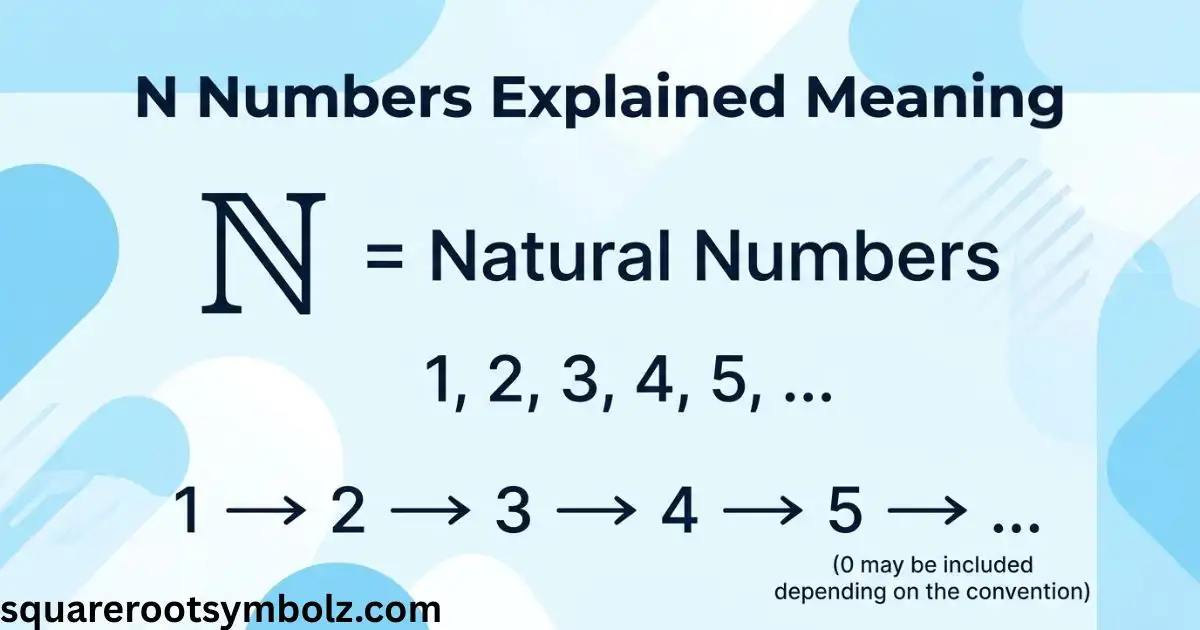
N numbers means a collection containing n values, where n tells you how many numbers are being considered. In mathematics, n is commonly used as a count, index, or variable. For example, if a problem gives n numbers as x₁, x₂, x₃, …, xₙ, then n tells you the total number of values.
At first, notation such as n numbers, xₙ, and Σ can feel unnecessarily complicated. In practice, the idea is simple: identify what n represents, count the values, and then use the appropriate formula. In averages, n usually means the number of observations; in sequences, it can identify a term; in algebra, it may represent an integer or unknown quantity.
What Is the Average of N Numbers?
The average of n numbers is found by adding all the values and dividing their total by n. If the numbers are x₁, x₂, …, xₙ, their arithmetic mean is the total sum divided by the number of values.
For example, consider four numbers: 10, 20, 30, and 40. Their sum is 100, and there are four values. Therefore, the average is 100 ÷ 4 = 25. Here, n = 4 because four numbers are included in the data set.
| Values | Number of values | Sum | Average |
| 2, 4, 6 | 3 | 12 | 4 |
| 10, 20, 30, 40 | 4 | 100 | 25 |
| 5 | 1 | 5 | 5 |
| 1, 2 | 2 | 3 | 1.5 |
Calculate the Mean of a Set of Numbers
The mean is another name for the arithmetic average. For n numbers, first find their total sum and then divide by the number of values. This makes n a count rather than a particular number that always has one fixed value.
Suppose the values are 8, 12, 15, 9, and 6. There are five numbers, so n = 5. Their sum is 50. Dividing 50 by 5 gives a mean of 10. The result provides a single value representing the center of this group.
How To
To calculate the mean, write the sum of all values in the numerator and put n in the denominator. Then substitute the actual number of observations. Finally, simplify the result and check that the answer is reasonable compared with the smallest and largest values.
The Mean
For n numbers, the arithmetic mean can be written using individual terms such as x₁, x₂, x₃, and xₙ. The notation simply provides a compact way to describe a collection without listing every value separately. The letter n identifies how many terms belong to the collection.
For example, if a data set contains 100 observations, n = 100. If it contains 7 observations, n = 7. The actual values can be different, but the denominator in the mean formula always reflects the number of values being averaged.
| Mathematical idea | Meaning |
| n | Number of values |
| x₁ | First value |
| x₂ | Second value |
| x₃ | Third value |
| xₙ | nth value |
| Sum | Total of all values |
| Mean | Sum divided by n |
Average Definition
Average describes a central or typical value of a group of numbers. In elementary mathematics, “average” usually refers to the arithmetic mean. To find it, add every observation and divide the total by the number of observations.
The same idea appears in everyday situations. A teacher may calculate the average test score, a family may calculate average monthly spending, or a sports statistician may calculate an average score. In each case, the basic relationship is total divided by count.
| Situation | What is averaged? |
| Test results | Scores |
| Weekly temperatures | Temperature readings |
| Monthly expenses | Dollar amounts |
| Game scores | Points |
| Daily steps | Step counts |
Average Formula in Maths
For n numbers written as x₁, x₂, x₃, …, xₙ, the arithmetic mean is the sum of all those values divided by n. In plain language, the formula says: add the numbers, count how many there are, and divide the total by that count.
For example, take 12, 18, 20, 25, and 30. There are five values, so n = 5. Their sum is 105. Therefore, the mean is 105 ÷ 5 = 21. The formula works for whole numbers, decimals, and negative values.
| Formula element | Meaning |
| x₁ | First value |
| x₂ | Second value |
| … | Remaining values |
| xₙ | Last or nth value |
| n | Number of values |
| Sum | Total of all values |
| Mean | Sum ÷ n |
How to Calculate Average?
Finding an average becomes straightforward when the process is broken into three steps. First, add all the numbers. Second, count how many numbers are present. Third, divide the total by that count. This approach works whether the data contains three values or thousands.
Imagine five quiz scores: 72, 81, 76, 91, and 80. Their sum is 400. Because there are five scores, n = 5. Dividing 400 by 5 gives an average of 80. The calculation is short, but labeling n correctly prevents common mistakes.
Step 1: Add the Numbers
Start by adding every value in the data set. For 72, 81, 76, 91, and 80, the total is 400. This total becomes the numerator of the average calculation. Accurate addition matters because one arithmetic error changes the final mean.
Step 2: Count the Numbers
Next, count the observations rather than counting the numerical digits. The example contains five scores, so n = 5. This is an important distinction: n represents the number of values in the collection, not the sum or size of the values themselves.
Step 3: Divide to Find the Average
Finally, divide the total by the number of observations. With a sum of 400 and n = 5, calculate 400 ÷ 5 = 80. Therefore, the arithmetic mean is 80. Always check that the result falls between the smallest and largest value.
Let’s See an Example
Consider the numbers 20, 21, 23, 22, 21, 20, and 23. There are seven values, so n = 7. Their sum is 150, giving an average of 150 ÷ 7, or approximately 21.43. The decimal result is perfectly valid even though every original value is a whole number.
Edge Cases & Pitfalls
One important edge case occurs when n = 0. The ordinary arithmetic mean requires division by the number of observations, so an empty collection does not provide a standard mean because division by zero is undefined. Always establish that at least one value is present.
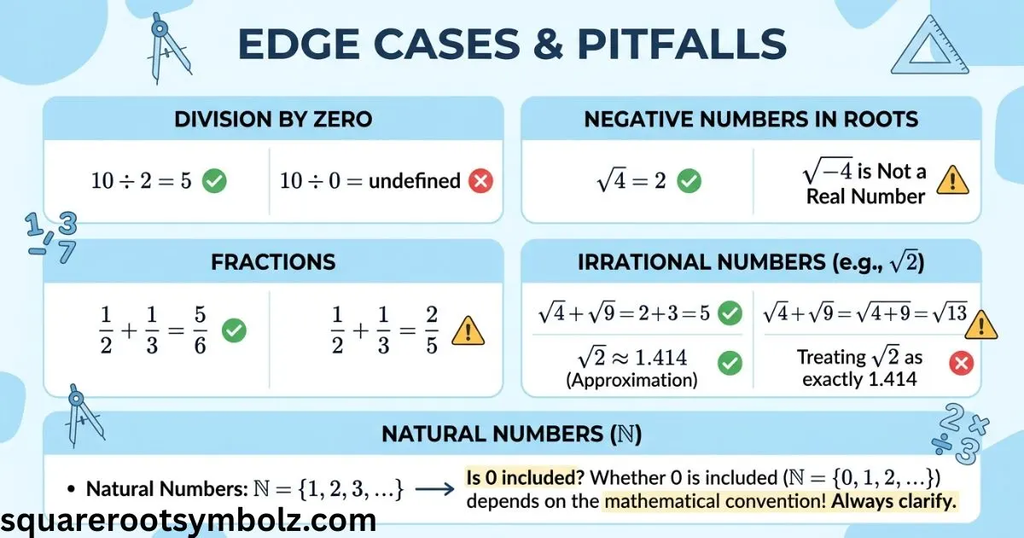
Another common mistake is confusing average with median. The mean uses the sum and count, whereas the median depends on the middle position after ordering the data. Negative values are also allowed in an arithmetic mean; they simply contribute their signed values to the total.
| Situation | What happens? |
| n = 1 | Average equals the single value |
| n > 1 | Calculate sum ÷ n |
| n = 0 | Ordinary mean is undefined |
| Negative values | Included normally |
| Decimal values | Included normally |
| Mean vs median | Different statistical measures |
How It Works
The underlying logic is always the same: identify the number of observations, calculate their total, and divide the total by the count. If there are n observations, the denominator is n. The notation changes between problems, but this relationship remains constant.
Conclusion
N numbers generally means a collection containing n values, with n indicating how many values are present. In an arithmetic mean, n is the number of observations, so the average is the sum of those values divided by n.
The same letter can take other roles. In a sequence, n can identify the term position; in a summation, it can act as an index; in an expression such as 2ⁿ, it can be an exponent. Therefore, the safest rule is simple: never assign n a meaning without checking the surrounding notation and the definition given in the problem.
FAQs
What does n mean in mathematics?
The letter n does not have one universal meaning. Depending on context, it can represent a number, count, integer, sequence index, exponent, or number of observations. The surrounding notation and definitions determine its specific meaning.
What does n numbers mean?
N numbers means a collection containing n values. For example, if a problem says there are n numbers and n = 5, then five numerical values are included. In statistics, n commonly represents the number of observations.
What is the average of n numbers?
The average of n numbers is their total sum divided by n. If the values are x₁, x₂, …, xₙ, add them together and divide by the number of values.
What is n in an average formula?
In an arithmetic mean formula, n normally represents the number of values or observations. For example, if there are 8 test scores, then n = 8.
What is the sum of the first n natural numbers?
The sum of the first n natural numbers, starting with 1, is n(n + 1) ÷ 2. For example, when n = 5, the calculation is 5 × 6 ÷ 2 = 15.
Does n always mean a natural number?
No. Although n is often used for natural numbers or integers, its meaning depends on context. It may represent a count, sequence index, sample size, exponent, or another quantity defined by the problem.
What does n mean in a sequence?
In sequence notation, n commonly identifies the position of a term. For example, aₙ means the nth term. If n = 5, a₅ represents the fifth term.
What does n mean in statistics?
In statistics, lowercase n commonly represents the sample size, meaning the number of observations in a sample. Capital N may be used for a population size in some statistical conventions, but notation varies by source.

I’m the creator of SquareRootSymbolz.com, where I publish easy-to-understand guides on symbols, Unicode characters, Alt codes, keyboard shortcuts, and copy-and-paste text symbols. My goal is to provide accurate, well-researched, and user-friendly content that helps readers quickly find the information they need.