
6 square root 2 = 6√2 ≈ 8.485281374.
If you see 6√2 in an algebra problem, the expression is already in simplified radical form. The 6 is the coefficient, while √2 is the radical part. You can keep it exactly as 6√2, or use the decimal approximation 8.485281374 when a numerical answer is needed.
The useful connection is √72 = 6√2 because 72 can be written as 36 × 2. Since √36 = 6, the perfect-square factor moves outside the radical. This simple pattern appears in algebra, geometry, factoring, and square-root problems, so understanding it makes later calculations much less intimidating.

Key Formula
The key relationship behind 6 square root 2 is that a square root asks which nonnegative number, multiplied by itself, produces the radicand. For the expression 6√2, the coefficient remains outside while √2 remains under the radical. The expression is already simplified.
A useful equivalent form is √72 = 6√2. Since 72 = 36 × 2, the product rule gives √72 = √36 × √2. Because √36 = 6, the result becomes 6√2. Mathwords uses this same relationship when demonstrating the simplification of √72.
| Form | Value |
| Exact radical form | 6√2 |
| Decimal form | 8.485281374… |
| Rounded to nearest tenth | 8.5 |
| Rounded to nearest hundredth | 8.49 |
| Equivalent square root | √72 |
The radical form is exact, while the decimal form is an approximation. This distinction matters in algebra because keeping a radical such as 6√2 avoids introducing rounding error too early.
Worked Example
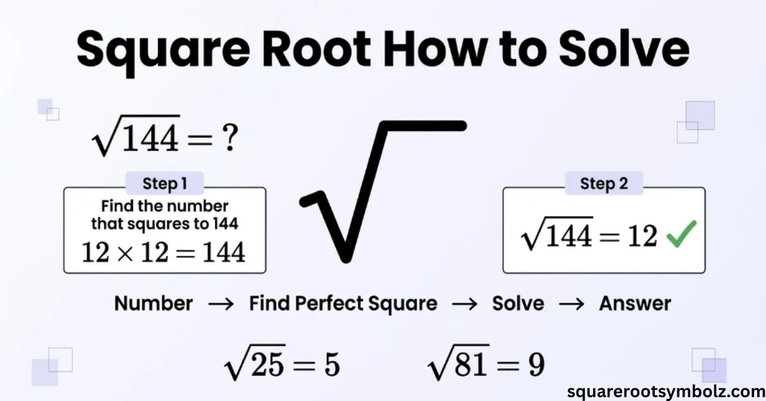
Suppose the problem asks you to simplify √72. Start by looking for the largest perfect-square factor of 72. That factor is 36 because 36 × 2 = 72. Now separate the radical into √36 × √2. This reveals exactly where the coefficient 6 comes from.
Next, evaluate √36. Because 6 × 6 = 36, √36 = 6. Therefore √72 becomes 6√2. You can check the result by squaring it: (6√2)² = 36 × 2 = 72. The answer returns to the original radicand, confirming the simplification.
From √72 to 6√2
Write 72 as 36 × 2:
√72 = √(36 × 2)
Separate the square factors:
√36 × √2
Evaluate the perfect square:
6√2
This is why 6 appears outside the radical. It is not an extra number added during the calculation; it comes directly from the square root of 36.
The same idea works whenever a radicand contains a perfect-square factor. Find the square, take its root, and leave the factor that cannot be simplified under the radical.
Another Example
You can also understand 6 square root 2 from its decimal value. The square root of 2 is approximately 1.414213562. Multiplying that approximation by 6 gives approximately 8.485281374. The result is useful when a question asks for a decimal rather than an exact radical.
For a quick mental check, notice that 8² = 64 and 9² = 81. Since 72 lies between 64 and 81, √72 must lie between 8 and 9. Therefore 8.485… has the correct size, while a result such as 84.85 would immediately be impossible.
| Calculation | Result |
| √2 | 1.414213562… |
| 6 × √2 | 8.485281374… |
| 6√2 to nearest tenth | 8.5 |
| 6√2 to nearest hundredth | 8.49 |
How to Pass the GED gives the same decimal result for 6√2 and shows that rounding 8.485281374 to the nearest hundredth gives 8.49.
Square Root vs. Cube Root
A square root and cube root use different powers. A square root asks what number multiplied by itself gives the original number, while a cube root asks what number multiplied by itself three times gives it. For example, √64 = 8, whereas ∛64 = 4.
For 6√2, the radical is specifically a square root because the index 2 is understood and normally omitted. The expression therefore represents 6 multiplied by the principal square root of 2. Mathwords distinguishes square roots from cube roots using this same power-based relationship.
| Type | Question | Example |
| Square root | What number squared gives the radicand? | √36 = 6 |
| Cube root | What number cubed gives the radicand? | ∛27 = 3 |
| 6√2 | 6 multiplied by √2 | ≈ 8.4853 |
The distinction becomes important when solving equations. A square-root expression involves powers of 2, while a cube-root expression involves powers of 3. The notation may look similar, but the underlying operation is different.
Why It Matters
Understanding 6 square root 2 is useful because simplified radicals appear throughout algebra and geometry. Square roots occur in the Pythagorean theorem, distance formulas, diagonal calculations, and quadratic equations. Keeping an answer in exact radical form also makes later algebraic operations easier.
Consider a right triangle with equal legs of length 6. Its hypotenuse is √(6² + 6²) = √72 = 6√2. The radical is not merely a symbolic answer; it represents an exact geometric length. This is one reason radicals remain important beyond basic arithmetic.
The expression also provides a clean example of exact versus approximate mathematics. 6√2 tells you the precise value, while 8.485281374… gives a decimal representation. When precision matters, keeping the radical until the final step prevents unnecessary rounding.
Common Mistakes
One common mistake is treating 6√2 as though it means √12. The 6 is a coefficient outside the radical, so the expression means 6 × √2. It is not the same as √(6 × 2). The position of a number relative to the radical sign changes the meaning.
Another error is rounding √2 too early. If you replace √2 with 1.41, then multiply by 6, you get 8.46 instead of the more accurate 8.485281374…. Early rounding can affect later calculations, so retain the exact radical until the problem specifically requests a decimal.
A third mistake is assuming √72 = √36 + √2. Square roots do not distribute over addition. The valid relationship here comes from multiplication: √(36 × 2) = √36 × √2. Recognizing the difference between multiplication and addition is essential when simplifying radicals.

Quick error check
If your answer is 6√2, square it. You should get 72:
(6√2)² = 36 × 2 = 72
If the original problem involved √72, the check works perfectly. This simple habit can catch coefficient errors, incorrect factors, and misplaced radicals before you submit an answer.
Related Terms
Several mathematical terms connect naturally with 6 square root 2. The radical is the root expression, the radicand is the number under the radical, and the coefficient is the number outside it. In 6√2, the coefficient is 6 and the radicand is 2.
Other useful terms include simplified radical, perfect square, irrational number, principal square root, and decimal approximation. Understanding these relationships makes it easier to move between equivalent forms such as √72, 6√2, and 8.485281374….
The broader concept is the square-root operation itself. A principal square root is nonnegative, so √2 refers to the positive value approximately equal to 1.414213562. When an equation such as x² = 72 is solved, however, both +6√2 and −6√2 can appear as solutions.
Conclusion
The important result is simple: 6 square root 2 = 6√2 ≈ 8.485281374. It is already in simplified radical form and is exactly equal to √72. The connection comes from 72 = 36 × 2 and √36 = 6.
For an exact answer, keep 6√2. For a decimal answer, use approximately 8.485281374. If rounding to the nearest hundredth, write 8.49. When in doubt, square 6√2 and check that you return to 72.
FAQs
What is 6 square root 2?
6 square root 2, written 6√2, is an exact radical expression. Its decimal value is approximately 8.485281374. It is also equal to √72, because √72 = √(36 × 2) = 6√2.
What is 6√2 squared?
Square both parts: (6√2)² = 6² × (√2)² = 36 × 2 = 72. This is one of the fastest ways to verify that 6√2 and √72 represent the same number.
Is 6√2 irrational?
Yes. √2 is irrational, meaning it cannot be written as a ratio of two integers. Multiplying √2 by the nonzero integer 6 keeps the result irrational. Therefore 6√2 is irrational. Wolfram MathWorld identifies √2 as an irrational number.
What is 6√2 as a decimal?
6√2 is approximately 8.485281374. For common rounding, it is 8.5 to the nearest tenth and 8.49 to the nearest hundredth. The radical form 6√2 remains the exact value.
Is 6√2 the same as √72?
Yes. Since 72 = 36 × 2, √72 = √36 × √2 = 6√2. Both expressions represent exactly the same number.
Can 6√2 be simplified further?
No. The number inside the radical is 2, and 2 has no perfect-square factor greater than 1. Therefore 6√2 is already in simplest radical form.

I’m the creator of SquareRootSymbolz.com, where I publish easy-to-understand guides on symbols, Unicode characters, Alt codes, keyboard shortcuts, and copy-and-paste text symbols. My goal is to provide accurate, well-researched, and user-friendly content that helps readers quickly find the information they need.