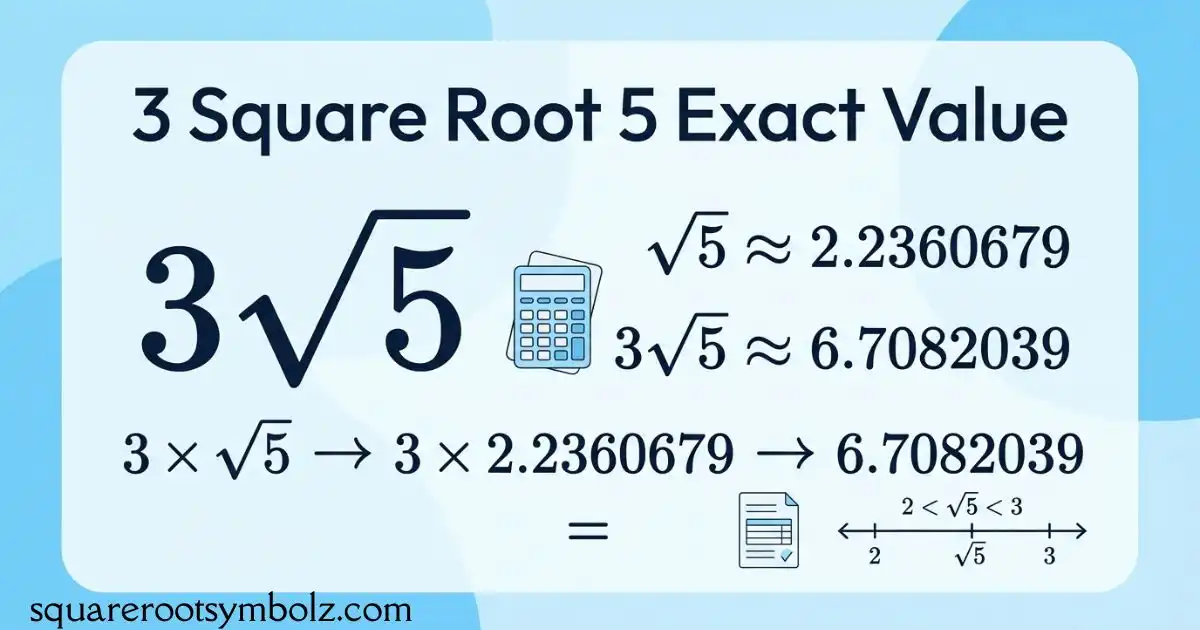
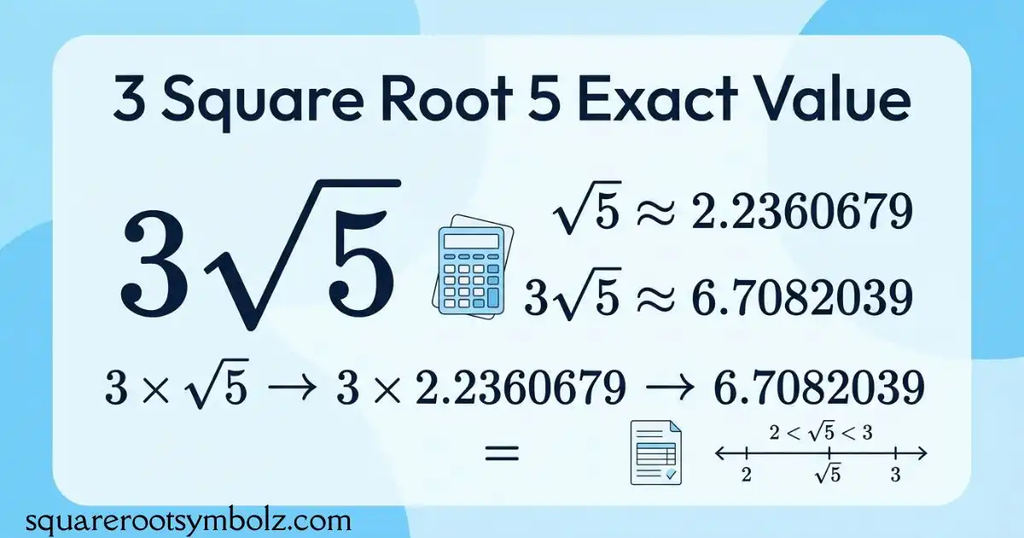
The value of 3 square root 5 is approximately 6.7082. In mathematical notation, the expression is written as 3√5, which means 3 multiplied by the square root of 5. Its exact form is 3√5 because the square root of 5 cannot be simplified into a whole number or a simpler radical.
To calculate its decimal value, first use √5 ≈ 2.2360679775. Then multiply that approximation by 3: 3 × 2.2360679775 ≈ 6.7082039325. The result can be rounded to 6.7082 to four decimal places.
Quick answer
3√5 ≈ 6.7082
Exact form: 3√5
Approximate form: 6.7082
How to Find the Square Root of 5?
To evaluate 3√5, calculate the square root of 5 and multiply it by the coefficient 3. Since 5 is not a perfect square, its square root is irrational and has a non-terminating, non-repeating decimal expansion. Keeping the radical form preserves the exact value.
The calculation is straightforward: √5 ≈ 2.2360679775, and 3 × 2.2360679775 ≈ 6.7082039325. You can use a calculator for the decimal approximation, but the exact expression remains 3√5. The following methods help explain why the result has this form.
Square Root of 5 Using Prime Factorization
Prime factorization breaks a number into its prime factors. The number 5 is already prime, so it has no repeated pair of prime factors that can be taken outside the square root. Therefore, √5 is already in simplest radical form, and multiplying it by 3 gives the exact expression 3√5.
Square Root of 5 By Long Division
The long-division method can estimate √5 digit by digit. First, recognize that 2² = 4 and 3² = 9, so √5 lies between 2 and 3. Continuing the method produces digits that approach 2.2360679 and beyond. Multiplying the approximation by 3 gives approximately 6.7082.
Is the Square Root of 5 Rational or Irrational?
The square root of 5 is irrational because it cannot be written as a fraction of two integers. Its decimal digits continue without ending or repeating in a fixed pattern. Since 3 is a nonzero rational number, multiplying 3 by √5 also produces an irrational number.
This means 3√5 has an exact radical representation but no exact terminating or repeating decimal representation. A calculator displays only a rounded approximation, such as 6.7082. For algebraic work, keeping 3√5 in exact form avoids introducing rounding error.
Square Root of 5 Solved Examples
Worked examples make it easier to distinguish the square root from the coefficient outside the radical. In 3√5, the number 5 is the radicand, while 3 is the coefficient. You multiply the coefficient by the value of the radical; you do not place 3 inside the root unless you transform the expression correctly.
| Expression | Calculation | Result |
| 3√5 | 3 × √5 | Approximately 6.7082 |
| 2√5 | 2 × √5 | Approximately 4.4721 |
| 5√5 | 5 × √5 | Approximately 11.1803 |
| √45 | √(9 × 5) | 3√5 |
| (3√5)² | 3² × 5 | 45 |
Example: Simplify √45.
Since 45 = 9 × 5, √45 = √9 × √5 = 3√5. This shows that √45 and 3√5 are equivalent expressions.
How to Square A Number
Squaring a number means multiplying it by itself. This is different from multiplying it by 2. For example, 5 squared is 5 × 5 = 25, while doubling 5 gives 5 × 2 = 10. This distinction is useful when working with square roots and expressions such as 3√5.
For the target expression, squaring the entire quantity gives a useful result:
(3√5)² = 3² × (√5)² = 9 × 5 = 45
The parentheses matter. The expression (3√5)² means the entire product is squared. It is not the same as 3√(5²), which evaluates to 15.
Perfect Squares
A perfect square is a number obtained by multiplying an integer by itself. Examples include 1, 4, 9, 16, and 25. Because 5 is not a perfect square, √5 is not an integer. This is why 3√5 cannot be reduced to a whole-number answer.
| Integer | Perfect square |
| 1 | 1 |
| 2 | 4 |
| 3 | 9 |
| 4 | 16 |
| 5 | 25 |
| 6 | 36 |
The perfect squares around 5 are 4 and 9. Therefore, √5 must lie between 2 and 3. This gives a quick way to estimate the expression: 3√5 must lie between 6 and 9, and its more precise value is about 6.7082.
Calculating Square Roots
You can estimate a square root by comparing the number under the radical with nearby perfect squares. For √5, the nearby squares are 4 and 9, so the answer is between 2 and 3. Testing decimal values narrows the estimate until it is accurate enough for the problem.
For example, 2.2 × 2.2 = 4.84, while 2.3 × 2.3 = 5.29. This shows that √5 is between 2.2 and 2.3. A calculator gives a more precise approximation of 2.2360679775. Multiplying by 3 gives 6.7082039325.
The Easiest Way to Calculate a Square Root
For most classroom calculations, a calculator is the quickest way to find √5. Enter 5 and use the square-root key. Then multiply the displayed result by 3. If you need an exact answer rather than a decimal, leave the expression as 3√5.
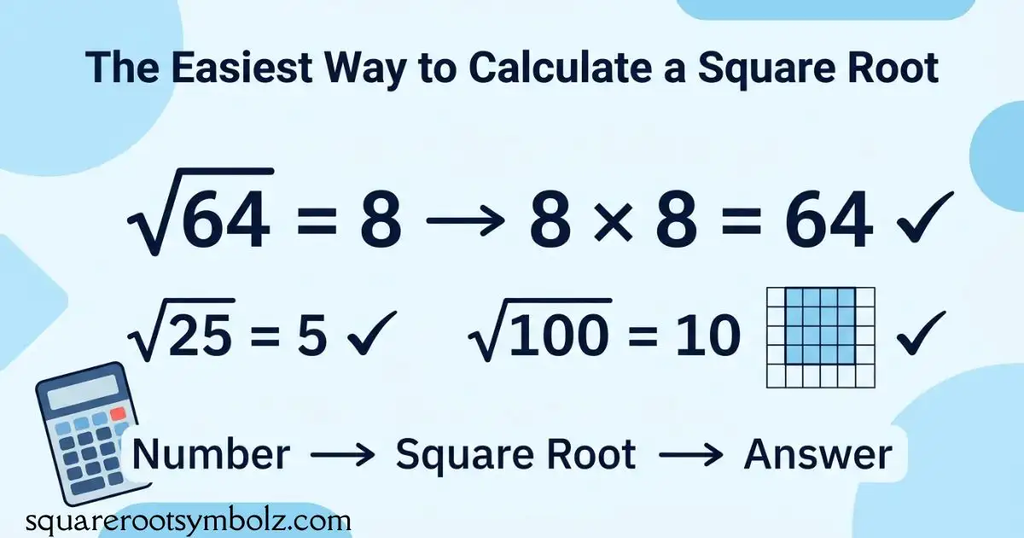
A useful check is to square the result. Since (3√5)² = 45, the decimal answer should satisfy 6.7082 × 6.7082 ≈ 45. The small difference, if any, comes from rounding the decimal value rather than an error in the exact expression.
Conclusion
The expression 3 square root 5 means 3 multiplied by the square root of 5. Its exact value is 3√5, and its decimal approximation is 6.7082. Since 5 is not a perfect square, the radical cannot be simplified further, and the result is irrational.
Understanding the coefficient, radicand, exact form, and decimal approximation makes radical expressions easier to solve. The same approach works for related expressions such as 2√5, 5√5, and √45, helping build a stronger foundation in algebra.
FAQs
What is 3 square root 5 equal to?
3 square root 5 equals approximately 6.7082. Its exact form is 3√5, calculated by multiplying 3 by √5.
How do you simplify 3√5?
The expression 3√5 is already in simplest radical form. Since 5 has no perfect-square factor other than 1, the square root cannot be simplified further.
Is 3√5 rational or irrational?
3√5 is irrational. The square root of 5 is irrational, and multiplying it by the nonzero rational number 3 keeps the result irrational.
What is 3√5 squared?
The square of 3√5 is 45.
(3√5)² = 3² × 5 = 9 × 5 = 45
Is 3√5 the same as √45?
Yes. Both expressions have the same value.
√45 = √(9 × 5) = 3√5
What is √5 as a decimal?
The square root of 5 is approximately 2.2360679775. Its decimal expansion continues without terminating or repeating.
How do you calculate 3√5 without a calculator?
Estimate √5 between 2 and 3 using 2² = 4 and 3² = 9. Refine the estimate to approximately 2.2361, then multiply by 3 to get approximately 6.7083. For a more accurate result, use additional decimal places.

I’m the creator of SquareRootSymbolz.com, where I publish easy-to-understand guides on symbols, Unicode characters, Alt codes, keyboard shortcuts, and copy-and-paste text symbols. My goal is to provide accurate, well-researched, and user-friendly content that helps readers quickly find the information they need.