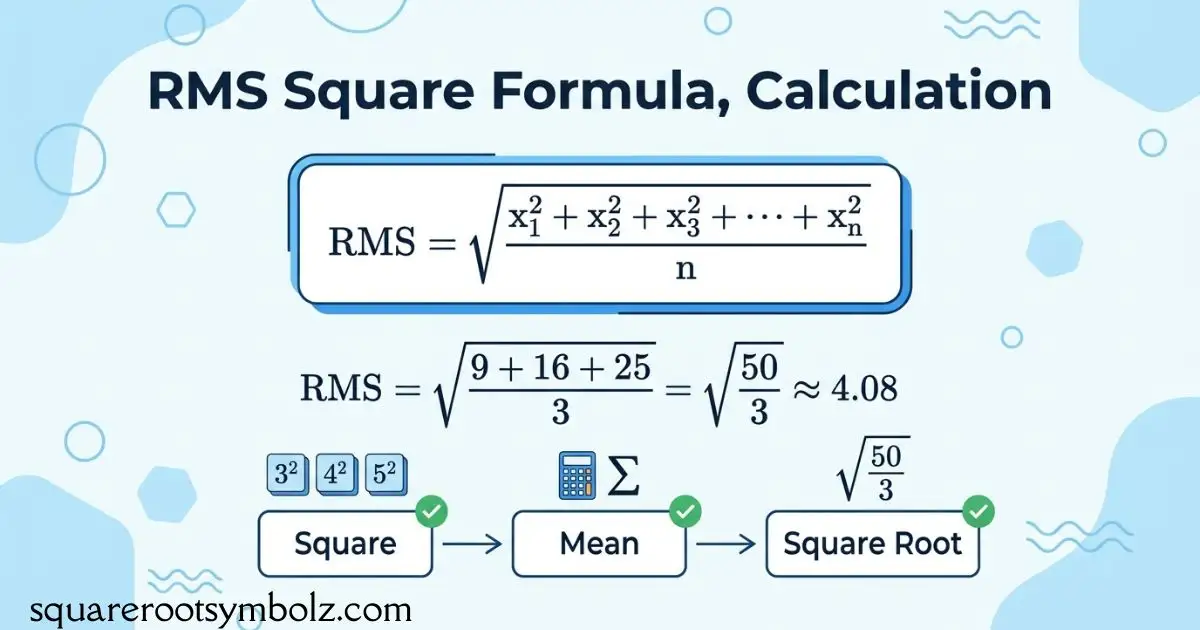
RMS stands for root mean square. It is calculated by squaring each value, finding the mean of those squares, and taking the square root. In electrical engineering, RMS voltage and RMS current describe the effective magnitude of alternating electrical quantities.
The key reason for using RMS is that AC voltage and current change continuously. Their ordinary average over a complete, symmetrical cycle may be zero, even though they deliver energy. RMS provides a useful equivalent value for comparing AC quantities with steady DC in a resistive circuit.
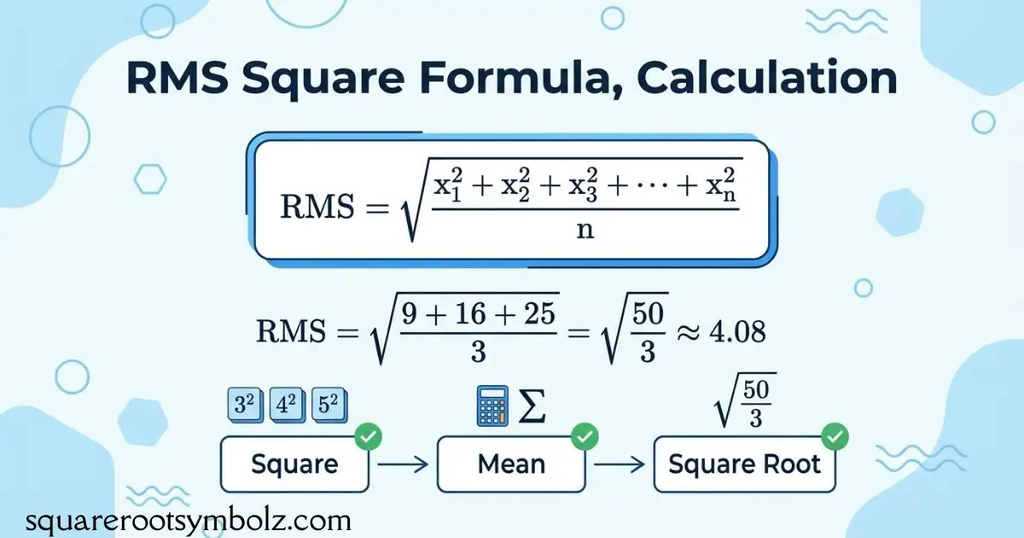
RMS formula for a set of values
RMS = square root of [(x₁² + x₂² + … + xₙ²) ÷ n]
Square the values, calculate their average, then take the square root.
For example, consider the values 3 and 4.
- Square each value: 3² = 9 and 4² = 16.
- Find the mean: (9 + 16) ÷ 2 = 12.5.
- Take the square root: √12.5 ≈ 3.536.
The RMS of 3 and 4 is approximately 3.536.
RMS Current and Voltage
RMS current and voltage are especially important in alternating-current circuits. They represent the constant DC current or voltage that would produce the same average power in a resistor. This makes RMS useful for electrical ratings, circuit calculations, and understanding the energy delivered by AC systems.
For a pure sinusoidal waveform, the RMS value is the peak value divided by the square root of 2. This gives the familiar relationship:
- RMS voltage = peak voltage ÷ 1.414
- RMS current = peak current ÷ 1.414
For example, if an AC voltage has a peak value of 170 V, its RMS voltage is approximately 170 ÷ 1.414 = 120.2 V. This relationship applies to a sine wave, not automatically to every waveform.
Variables
The RMS formula uses a few important mathematical variables. In a list of measurements, each value represents one observation, while n represents the total number of observations. Understanding these terms makes the calculation easier and helps prevent confusion between the mean, mean square, and final RMS value.
| Symbol | Meaning |
| x₁, x₂, … | Individual values |
| n | Number of values |
| x² | The square of a value |
| Mean square | Average of the squared values |
| RMS | Square root of the mean square |
| Vᵣₘₛ | RMS voltage |
| Iᵣₘₛ | RMS current |
| Vpeak | Peak voltage |
| Ipeak | Peak current |
The phrase “RMS square” often refers to the squaring step within this process. It is important to distinguish the mean square from the RMS value: the mean square is the average of the squared values, while RMS is the square root of that average.
Derivation
The RMS formula follows directly from its three operations: square, average, and take the square root. For a list of values, first calculate x₁² + x₂² and continue for every observation. Divide the total by n to obtain the mean square, then take its square root.
For a sinusoidal waveform, the average of the squared sine function over a full cycle is 0.5. This is why the RMS value of a sine wave is its peak value divided by √2, or approximately 1.414. The same relationship is used for both sinusoidal current and voltage.
For example, suppose a sine-wave current has a peak value of 10 A.
- Peak current = 10 A
- RMS current = 10 ÷ 1.414
- RMS current ≈ 7.071 A
The RMS current is approximately 7.07 A.
Calculator
An RMS calculator can quickly evaluate a set of measurements. Enter the values, square each one, calculate the average of the squares and take the square root. This is useful when working with multiple readings or checking manual calculations.
RMS calculator
Enter numbers separated by commas
RMS result
3.535534
Mean square: 12.500000
Number of values: 2
Reset example
For the example values 3 and 4, the mean square is 12.5 and the RMS is approximately 3.535534. The calculator uses the same formula as the manual method, so the result can be checked step by step.
Common questions
RMS questions often focus on the difference between squaring and taking the square root, or on why RMS is used instead of a regular average. The distinction matters because positive and negative waveform values can cancel in an ordinary average, while squaring makes their contributions nonnegative.
Another common source of confusion is applying the peak-to-RMS formula to a non-sinusoidal waveform. Dividing peak value by 1.414 is valid for a pure sine wave. Other waveform shapes may have different RMS-to-peak relationships, so their RMS values should be calculated from the actual waveform or measured with an appropriate instrument.
Conclusion
The RMS square process is the essential middle step in calculating root mean square. You square each value, find the mean of those squares, and then take the square root. This gives a useful measure of magnitude for numerical data, electrical current, voltage, and other varying signals.
For a set of values, the formula is straightforward. For sinusoidal AC, the RMS value is approximately 0.707 times the peak value. Understanding the difference between mean square, RMS, peak value, and ordinary average makes RMS calculations easier and more accurate.
FAQs
What is RMS square?
RMS square usually refers to the squaring step in the root mean square calculation. Each value is multiplied by itself before the average is calculated. The square root of that average gives the final RMS value.
What is the formula for RMS?
For a set of n values:
RMS = √[(x₁² + x₂² + … + xₙ²) ÷ n]
Square every value, add the squares, divide by the number of values, and take the square root.
Why do you square values in RMS?
Squaring makes negative and positive values contribute positively to the calculation. It also connects RMS to power calculations, because power in a resistor depends on the square of current or voltage.
What is the difference between RMS and mean square?
Mean square is the average of the squared values. RMS is the square root of the mean square. For values 3 and 4, the mean square is 12.5, while the RMS is approximately 3.536.
What is the RMS value of a sine wave?
For a pure sine wave, RMS is the peak value divided by √2, approximately 1.414. A sine wave with a peak voltage of 120 V has an RMS voltage of approximately 84.85 V.
Is RMS the same as average?
No. RMS is the square root of the average of squared values. An ordinary average adds the original values and divides by their count. For a symmetrical AC sine wave, the ordinary average over a complete cycle is zero, but the RMS value is not zero.
How do you calculate RMS voltage?
For a sinusoidal AC voltage, divide the peak voltage by √2. For example, a peak voltage of 170 V gives an RMS voltage of approximately 120.2 V. For other waveform shapes, use the general RMS formula or a suitable measurement instrument.
What is the RMS value of constant DC?
For a constant DC value, the RMS value equals the constant itself. For example, a steady current of 5 A has an RMS value of 5 A because squaring, averaging, and taking the square root leaves the value unchanged.

I’m the creator of SquareRootSymbolz.com, where I publish easy-to-understand guides on symbols, Unicode characters, Alt codes, keyboard shortcuts, and copy-and-paste text symbols. My goal is to provide accurate, well-researched, and user-friendly content that helps readers quickly find the information they need.