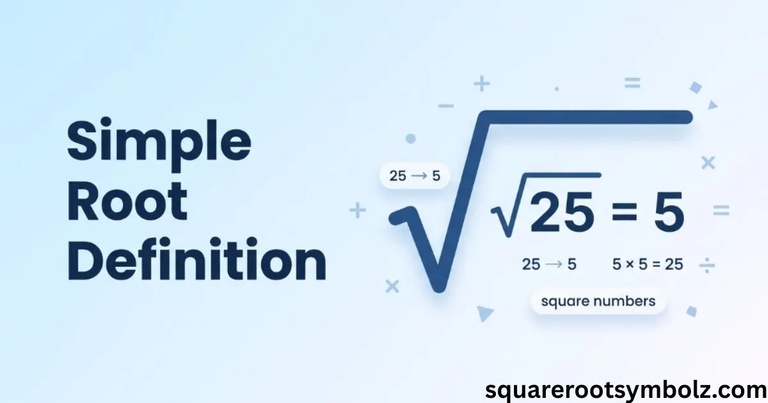

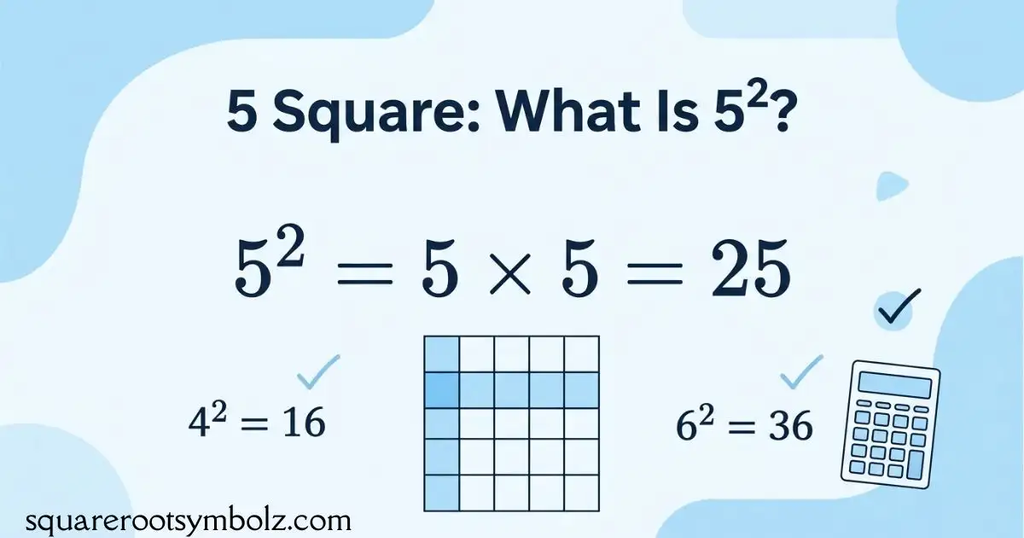
The square of 5 is 25. In exponent notation, it is written as 5². This means multiplying the base, 5, by itself: 5 × 5 = 25. The small 2 is called the exponent, and it tells you that the base appears twice as a factor.
The word “square” also has a geometric meaning. Imagine a square with each side measuring 5 inches. Its area is 5 × 5, or 25 square inches. That connection explains why mathematicians use the word squared for a number multiplied by itself.
Square of 5 at a glance
5² = 5 × 5 = 25
How to Calculate the Value of Square of 5
There are several ways to calculate the square of 5, but they all lead to the same result: 25. You can multiply directly, substitute the number into the square formula, or use a calculator. The multiplication method is usually enough for this small whole number.
Understanding more than one method is useful because math problems do not always ask for the answer in the same way. A worksheet may ask you to evaluate 5², show your work, or apply the square formula to a geometry problem. The calculation stays the same even when the wording changes.
By the Multiplication Method
To find 5 squared, write the number twice as a multiplication problem: 5 × 5. Multiply the two factors to get 25. This is the most direct way to calculate a square and is especially useful when practicing multiplication facts and basic exponent notation.
Using a Formula (a²)
The general formula for squaring a number is a² = a × a. Here, a represents the base. Substitute 5 for a to get 5² = 5 × 5 = 25. The formula works for any real number, including fractions, decimals, and negative values.
By Using a Calculator
To calculate 5² on a calculator, enter 5 and use the square or exponent key if available. You can also type 5 × 5 and press equals. Both approaches return 25. If your calculator has a dedicated x² button, make sure the display shows the intended base before pressing it.
Squares From 0² to 6²
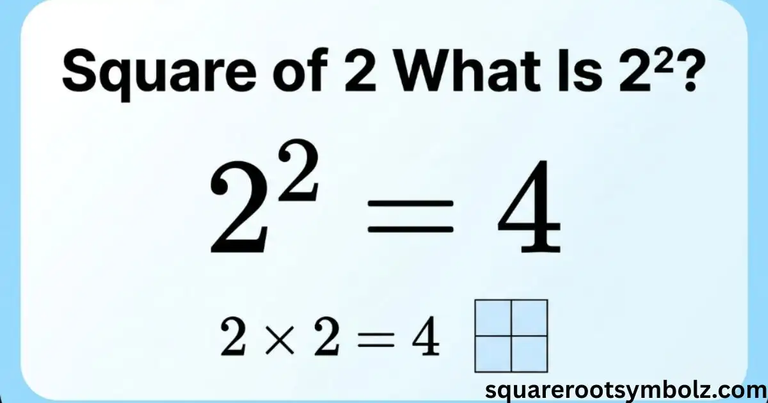
The first few square numbers form a useful pattern. Starting at zero, multiply each whole number by itself: 0² = 0, 1² = 1, 2² = 4, and so on. Seeing 5² within this sequence makes it easier to remember that its value is 25.
| Number | Squared form | Calculation | Result |
| 0 | 0² | 0 × 0 | 0 |
| 1 | 1² | 1 × 1 | 1 |
| 2 | 2² | 2 × 2 | 4 |
| 3 | 3² | 3 × 3 | 9 |
| 4 | 4² | 4 × 4 | 16 |
| 5 | 5² | 5 × 5 | 25 |
| 6 | 6² | 6 × 6 | 36 |
Notice that the difference between consecutive square numbers grows by consecutive odd numbers: 1, 3, 5, 7, 9, and 11. For example, 16 + 9 = 25. This pattern can help you calculate or check square numbers without starting each multiplication from scratch.
Perfect Squares
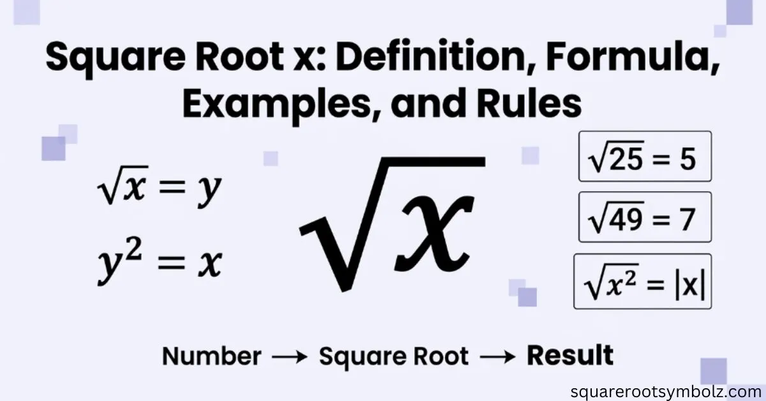
A perfect square is a number that can be written as an integer multiplied by itself. Since 5 × 5 = 25, the number 25 is a perfect square. Its principal square root is 5, because √25 = 5. This links squaring and square roots as inverse operations.
Not every number is a perfect square. For example, 20 is not the square of a whole number, while 16, 25, and 36 are. Recognizing perfect squares is useful when simplifying radicals, solving equations, and working with the area of squares in geometry.
| Perfect square | Whole-number root |
| 1 | 1 |
| 4 | 2 |
| 9 | 3 |
| 16 | 4 |
| 25 | 5 |
| 36 | 6 |
| 49 | 7 |
Tips and Tricks for the Square of 5
One easy way to remember the square of 5 is to picture a five-by-five grid. Five rows with five objects in each row give 25 objects in total. You can also connect the result to the multiplication table: the fifth row and fifth column meet at 25.
Another useful check is to reverse the operation. Since 5² = 25, taking the principal square root of 25 gives 5. You can use this check after calculating other squares too. Remember that squaring an odd integer produces an odd result, while squaring an even integer produces an even result.
Common Mistakes to Avoid When Calculating the Square of 5
The most common mistake is confusing squaring with doubling. The expression 5² does not mean 5 × 2. The exponent tells you to use 5 as a factor twice, so the correct calculation is 5 × 5 = 25.
Parentheses also matter when negative numbers are involved. The expression (−5)² equals 25 because a negative number multiplied by itself gives a positive result. But −5² without parentheses is interpreted as the negative of 5², which equals −25 under standard order of operations.
| Expression | Correct result | Why |
| 5² | 25 | 5 × 5 |
| 5 × 2 | 10 | This is doubling, not squaring |
| (−5)² | 25 | Negative times negative is positive |
| −5² | −25 | Exponent is evaluated before the leading negative |
| √25 | 5 | The radical symbol represents the principal square root |
Solved Examples on Square of 5
Problem 1: Find 5².
Multiply 5 by itself: 5 × 5 = 25.
Problem 2: Find the area of a square with side length 5 feet.
Use the area formula, A = side × side. Therefore, A = 5 × 5 = 25 square feet.
Problem 3: What is the square of −5?
Multiply the negative number by itself: (−5) × (−5) = 25.
Problem 4: A square has an area of 25 square centimeters. What is its side length?
Take the principal square root of the area: √25 = 5 centimeters.
Problem 5: How much greater is 5² than 4²?
Calculate both values: 5² = 25 and 4² = 16. Subtract 16 from 25 to get 9.
Why It Matters
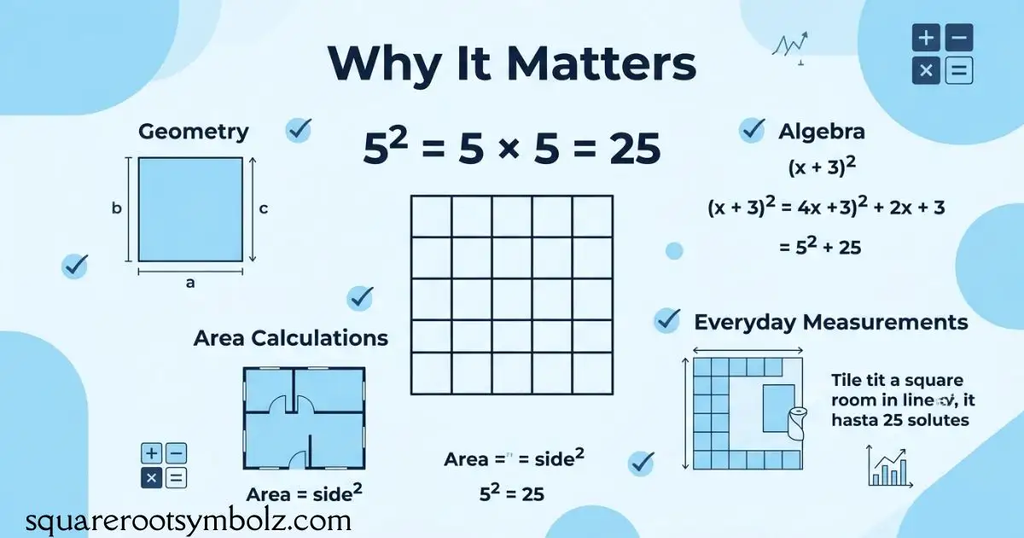
Squaring appears in geometry, algebra, and everyday measurements. The area of a square with side length 5 units is 25 square units. In the Pythagorean theorem, squared side lengths help calculate the hypotenuse of a right triangle. The same operation also appears in coordinate distance calculations.
Learning 5² is a small step toward understanding powers, quadratic expressions, and equations. Once you know that an exponent of 2 means multiplying a base by itself, you can apply the same idea to larger numbers, decimals, and variables such as x² or a².
Conclusion
The square of 5 is 25, written as 5² = 5 × 5 = 25. The exponent 2 means multiplying the base by itself, not multiplying it by 2. This result is also a perfect square and represents the area of a square with side lengths of 5 units.
When you see “5 square” in a math question, remember the simple rule: multiply 5 by itself. That one idea connects arithmetic, exponents, square numbers, and geometry and it provides a foundation for more advanced math.
FAQ Section
What is 5 square in math?
5 square, or 5 squared, is 25. It means 5 × 5 = 25 and is written as 5².
What is 5² equal to?
5² equals 25. The number 5 is the base, and 2 is the exponent.
Is 5 squared the same as 5 times 2?
No. 5 squared means 5 × 5 = 25, while 5 times 2 equals 10.
Why is 25 called a perfect square?
25 is a perfect square because it is the product of an integer multiplied by itself: 5 × 5 = 25.
What is the square root of 25?
The principal square root of 25 is 5 because 5 × 5 = 25. The equation x² = 25 has two solutions, 5 and −5.
What is the area of a square with sides of 5 units?
Its area is 25 square units. Multiply the side length by itself: 5 × 5 = 25.
What is negative 5 squared?
With parentheses, (−5)² = 25. Without parentheses, −5² = −25 because the exponent is evaluated before the negative sign.
What is the fifth square number?
Counting positive square numbers from 1², the fifth is 5² = 25.

I’m the creator of SquareRootSymbolz.com, where I publish easy-to-understand guides on symbols, Unicode characters, Alt codes, keyboard shortcuts, and copy-and-paste text symbols. My goal is to provide accurate, well-researched, and user-friendly content that helps readers quickly find the information they need.