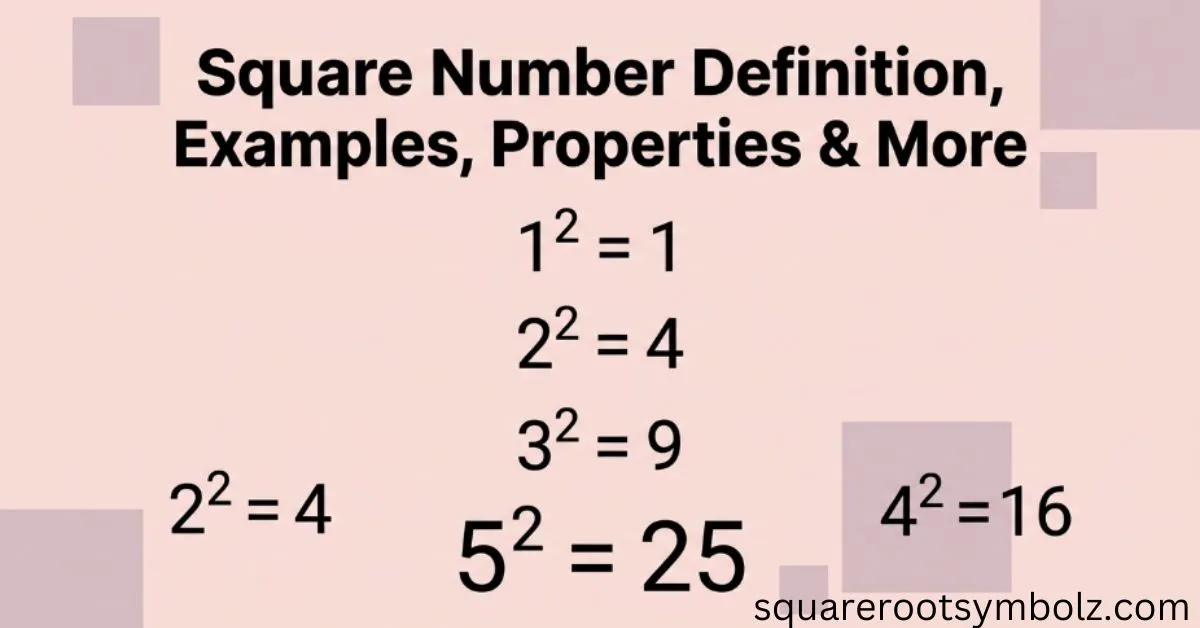
A square number is an integer that can be written as (n^2), meaning a number multiplied by itself. For example, (5^2=25), so 25 is a perfect square. The idea connects squaring, multiplication, square roots, factors, exponents, and number patterns, making it one of the most useful building blocks in elementary mathematics.
If square numbers have ever felt like a list you simply had to memorize, there is better news: they have a visual pattern. Square arrays, area, multiplication tables, triangular numbers, and consecutive odd numbers all reveal why these numbers behave the way they do. Once those connections become clear, remembering 1, 4, 9, 16, 25, 36 becomes much easier.
Square Number Mathematical Background
A square number is formed when an integer is multiplied by itself. In symbols, (n^2=n\times n). Thus, (3^2=9), (7^2=49), and (10^2=100). The terms square number and perfect square are commonly used for these results, although conventions around “whole number” and “integer” should be kept clear.
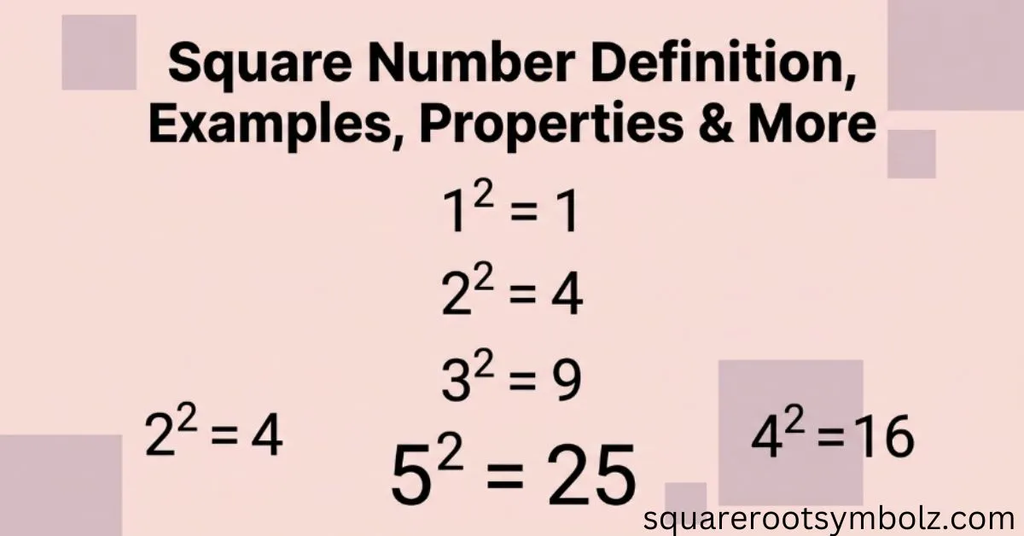
The sequence begins (0,1,4,9,16,25,36,49,64,81,100,\ldots). Zero is included when integers are allowed because (0^2=0). Negative integers also produce positive squares: ((-6)^2=36). The important idea is simple: the base is multiplied by itself, while the small exponent 2 tells you that the multiplication occurs twice.
| Number | Squared form | Result |
| 0 | (0^2) | 0 |
| 1 | (1^2) | 1 |
| 2 | (2^2) | 4 |
| 3 | (3^2) | 9 |
| 4 | (4^2) | 16 |
| 5 | (5^2) | 25 |
| 6 | (6^2) | 36 |
| 7 | (7^2) | 49 |
| 8 | (8^2) | 64 |
| 9 | (9^2) | 81 |
| 10 | (10^2) | 100 |
| 11 | (11^2) | 121 |
| 12 | (12^2) | 144 |
Objects Arranged in a Square Array
The name square number comes from geometry. If identical objects can be arranged into equal rows and columns forming a complete square, their total is a square number. For instance, 9 objects form a 3-by-3 array, while 16 form 4-by-4. This gives students a visual reason behind the arithmetic.
Imagine placing pennies on a table. Four pennies make a 2-by-2 square, nine make a 3-by-3 square, and sixteen make a 4-by-4 square. Seven or twelve cannot fill a complete square array. This is why multiplication, area, equal sides, rows, columns, and square roots naturally belong to the same concept.
Square Numbers in the Multiplication Table
Square numbers appear along the main diagonal of a standard multiplication table. Reading that diagonal gives (1\times1=1), (2\times2=4), (3\times3=9), (4\times4=16), and so forth. This makes a multiplication chart a useful visual tool for learning squares, products, factors, and repeated multiplication.
This pattern also explains why memorizing squares is easier when you connect them to multiplication facts. Instead of treating 49 as an isolated answer, recognize it as (7\times7). Likewise, 81 immediately connects with (9\times9). That mental relationship between base, exponent, product, and multiplication fact is more useful than memorization alone.
Connections With Square Number and Triangular Numbers
Square numbers have a surprising relationship with triangular numbers. A triangular number counts objects arranged in a triangle, while a square number counts objects arranged in a square. EDC demonstrates that combining two consecutive triangular-number structures can create a square, revealing a deeper relationship between these figurate numbers.
For example, (1+3=4), and (3+6=9), while (6+10=16). In general, the (n)th square number equals the sum of the ((n-1))th and (n)th triangular numbers. This is more than a clever pattern: it shows that different number sequences and geometric arrangements can describe the same mathematical quantity.
A Connection Between Square Number and Triangular Numbers, Seen Another Way
There is another visual way to see the same relationship. Two consecutive triangular arrangements can be joined to create a square. EDC uses Cuisenaire rods to demonstrate this construction, showing how a staircase-like triangular structure can become a complete square whose area equals a square number.
This perspective changes how the formula feels. Instead of seeing (16) only as (4^2), you can recognize it as a geometric total built from related triangular patterns. Such representations connect area, arrays, sequence growth, triangular numbers, square numbers, and visual reasoning, which can make abstract arithmetic much easier to remember.
Stair Steps From Square Numbers
Stair-step arrangements provide another visual model. When tiles rise and then fall in a balanced pattern, their total can equal a square number. EDC gives an example where 10 tiles of one color and 6 of another produce (10+6=16), connecting the arrangement with the square (4^2).
This pattern is useful because it shows that a square number does not always have to look like a traditional filled square at first glance. The same total can emerge from addition, patterns, tiles, triangular arrangements, and geometric construction. Seeing several representations helps students recognize the underlying number rather than relying on one memorized rule.
From One Square Number to the Next: Two Images With Cuisenaire Rods
Square numbers grow according to a predictable pattern. From one square to the next, the increase is (2n+1): (1) becomes (4) by adding 3, (4) becomes (9) by adding 5, and (9) becomes (16) by adding 7. MathWorld expresses this relationship as (S_{n+1}=S_n+2n+1).
This explains one of the most useful square-number patterns: consecutive odd numbers build consecutive squares. Starting with 1, add 3, then 5, then 7, then 9. The totals are (1,4,9,16,25). Once you understand this growth rule, square numbers become a sequence with structure rather than a collection of facts to memorize.
Quick Pattern Check
A useful mental shortcut is to examine the last digit. A perfect square in base 10 can end only in 0, 1, 4, 5, 6, or 9. Therefore, a number ending in 2, 3, 7, or 8 cannot be a square number. However, ending in 0, 1, 4, 5, 6, or 9 does not prove that a number is square.
For example, 49 passes the last-digit test and is actually (7^2). But 94 also ends in 4 and is not a perfect square. So the unit-digit rule is a quick elimination test, not a complete proof. For certainty, check whether the number has an integer square root.
Square Number vs Squaring a Number
These terms are closely related but describe different things. Squaring a number is the operation of multiplying it by itself, such as (8^2=64). A square number is the resulting number, 64. The distinction becomes especially useful when explaining the relationship between an operation, its result, and its square root.
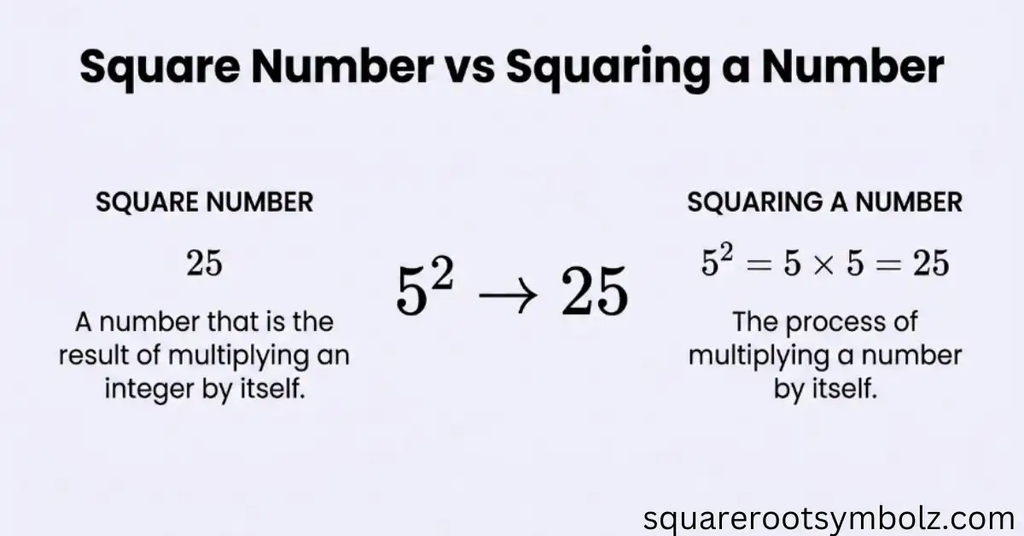
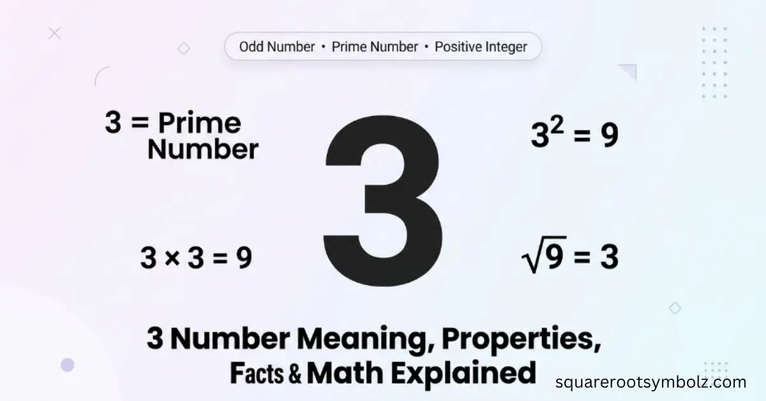
For example, when you calculate (12^2=144), you are squaring 12, while 144 is the square number. Reversing the process gives (\sqrt{144}=12). This simple three-part relationship—number → square → square root—is central to algebra and makes later work with equations much easier.
Square Number Conclusion
A square number is much more than a result to memorize. It is an integer formed by multiplying a number by itself, written as (n^2), and it connects naturally to perfect squares, square roots, multiplication tables, geometry, area, triangular numbers, and number patterns. The familiar sequence (1,4,9,16,25,\ldots) becomes easier to understand once you see how these relationships fit together.
Whether you’re learning basic arithmetic or moving toward algebra and number theory, understanding these patterns gives you a stronger mathematical foundation. Start with the simple idea of “a number multiplied by itself,” then use square arrays, odd-number growth, and square roots to recognize and verify perfect squares with confidence.
FAQ Section
What is a square number?
A square number is the product obtained by multiplying an integer by itself. In formula form, (n^2=n\times n). Examples include 1, 4, 9, 16, 25, and 36.
Is 0 a square number?
Yes. Under the integer definition, 0 is a square number because (0^2=0\times0=0). MathWorld’s square-number sequence begins with 0.
Is 1 a square number?
Yes. (1\times1=1), so 1 is a perfect square. It is the square of both 1 and −1.
What are the first 10 square numbers?
Starting with 1, the first ten positive square numbers are 1, 4, 9, 16, 25, 36, 49, 64, 81, and 100. If zero is included, it comes before these.
How do you know if a number is a perfect square?
Find its square root. If the principal square root is an integer, the number is a perfect square. For example, (\sqrt{49}=7), so 49 is square, while (\sqrt{50}) is not an integer.
Can a negative number be a square number?
A negative integer itself is not the result of squaring a real integer, but a negative integer can be the base being squared. For example, ((-5)^2=25). Thus, the square of a negative integer is positive.
What numbers can a square number end with?
In base 10, a square number can end only in 0, 1, 4, 5, 6, or 9. It cannot end in 2, 3, 7, or 8. This is a useful screening rule, not a complete test.
Why are they called square numbers?
They are called square numbers because (n^2) objects can be arranged in a complete square array with (n) rows and (n) columns. For example, 25 objects form a 5-by-5 square.
What is the difference between a square number and a cube number?
A square number has the form (n^2=n\times n), while a cube number has the form (n^3=n\times n\times n). For example, 25 is square because (5^2=25), while 27 is a cube because (3^3=27).

I’m the creator of SquareRootSymbolz.com, where I publish easy-to-understand guides on symbols, Unicode characters, Alt codes, keyboard shortcuts, and copy-and-paste text symbols. My goal is to provide accurate, well-researched, and user-friendly content that helps readers quickly find the information they need.