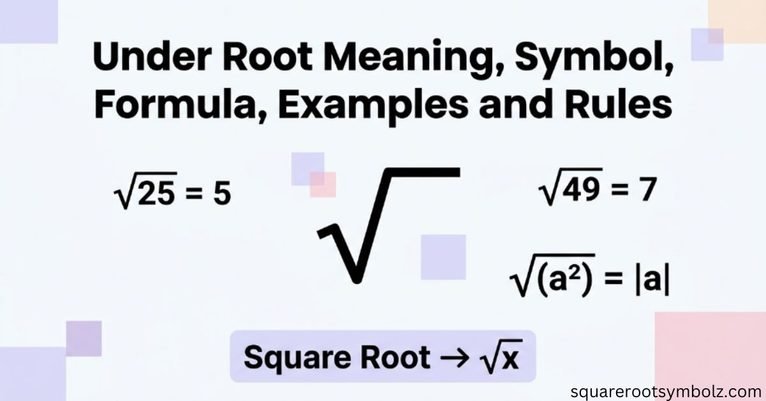
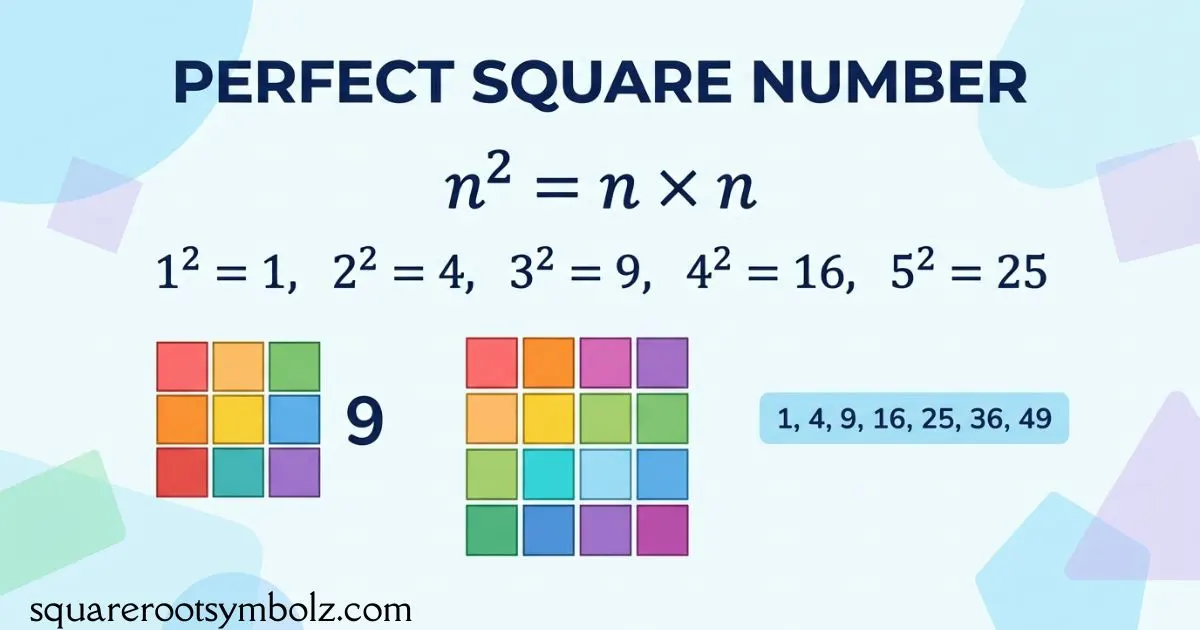
A perfect square number is the result of multiplying an integer by itself. For example, 25 is a perfect square because 5 × 5 = 25. These numbers are also called square numbers, and they are closely connected to multiplication, exponents, square roots, and geometry.
If you find it difficult to remember square numbers or determine whether a large number is a perfect square, a few simple methods can make the process much easier. In this guide, you will explore a perfect squares list, learn how to identify square numbers, and work through examples that connect classroom mathematics with everyday situations.
What are the perfect squares?
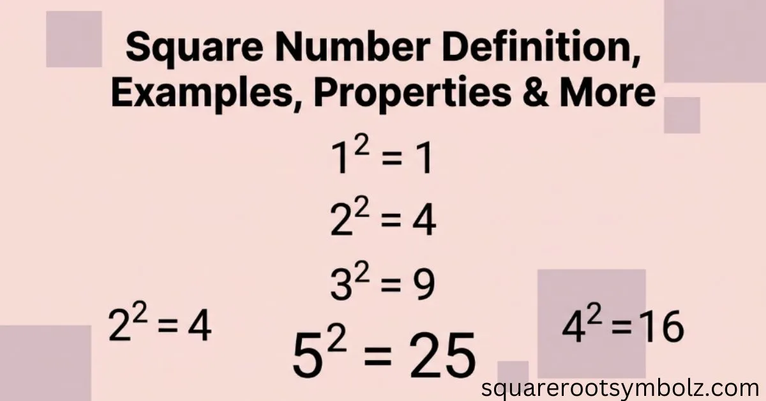
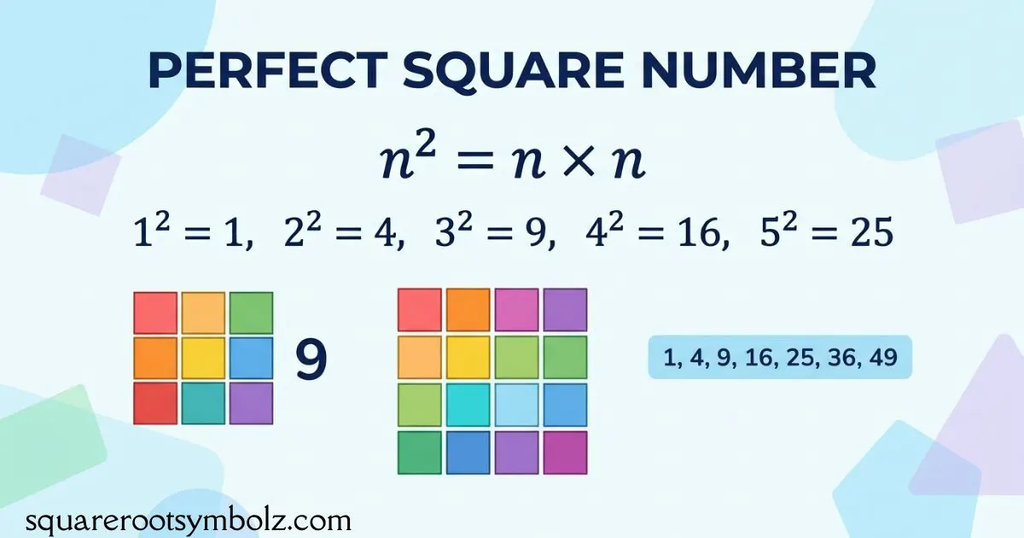
Perfect squares are numbers that result from multiplying an integer by itself. For example, 4, 9, 16, 25, and 36 are perfect squares because they can be written as 2², 3², 4², 5², and 6², respectively. The number being multiplied by itself is called the base.
Perfect squares also have a useful geometric interpretation. If you arrange 36 small tiles into six equal rows and six equal columns, you form a square. This relationship between multiplication and area explains why these values are called square numbers and helps students visualize an abstract mathematical idea.
Perfect square definition
A perfect square is an integer that can be expressed as the square of another integer. In other words, a number is a perfect square if its square root is an integer. For example, √144 = 12, so 144 is a perfect square.
The standard sequence of nonnegative integer squares starts with 0, 1, 4, 9, 16, and 25. Negative integers can also be squared to produce these values. For example, (−6) × (−6) = 36, so negative bases do not change which nonnegative integer values are perfect squares.
Visual examples of perfect squares
2² = 4
3² = 9
4² = 16
Each square has an equal number of rows and columns.
Perfect Squares List
A perfect squares list is useful for recognizing common square numbers without calculating each one from scratch. The values increase as the base number increases. For example, 7² = 49, 8² = 64, and 9² = 81.
Learning the first 20 or 30 square numbers can make arithmetic, algebra, and square-root problems easier. The table below shows the first 30 positive perfect squares, along with the whole number used to generate each result.
| Number | Square | Number | Square | Number | Square |
| 1 | 1 | 11 | 121 | 21 | 441 |
| 2 | 4 | 12 | 144 | 22 | 484 |
| 3 | 9 | 13 | 169 | 23 | 529 |
| 4 | 16 | 14 | 196 | 24 | 576 |
| 5 | 25 | 15 | 225 | 25 | 625 |
| 6 | 36 | 16 | 256 | 26 | 676 |
| 7 | 49 | 17 | 289 | 27 | 729 |
| 8 | 64 | 18 | 324 | 28 | 784 |
| 9 | 81 | 19 | 361 | 29 | 841 |
| 10 | 100 | 20 | 400 | 30 | 900 |
Zero is also a perfect square because 0 × 0 = 0. Therefore, if you include zero, the sequence begins with 0, followed by 1, 4, 9, and 16.
Examples of Perfect Squares
Examples help explain why some numbers qualify as perfect squares while others do not. Consider 81 and 80. Since 81 = 9 × 9, it is a perfect square. However, 80 falls between 8² = 64 and 9² = 81, so its square root is not an integer.
You can also connect square numbers with real-world measurements. Imagine a square patio with a side length of 10 feet. Its area is 10 × 10 = 100 square feet. The same multiplication principle applies to square gardens, floor tiles, and other geometric measurements.
| Number | Square root | Perfect square? |
| 36 | 6 | Yes |
| 49 | 7 | Yes |
| 72 | Approximately 8.485 | No |
| 100 | 10 | Yes |
| 121 | 11 | Yes |
| 150 | Approximately 12.247 | No |
| 196 | 14 | Yes |
| 225 | 15 | Yes |
How to Identify Perfect Squares
The easiest way to identify a perfect square number is to find its square root. If the result is a whole number, the original number is a perfect square. For instance, √169 = 13, confirming that 169 is a perfect square. If the square root is not an integer, the number is not an integer perfect square.
Another useful method is prime factorization. Break a positive integer into prime factors and group identical factors into pairs. If every prime factor can be paired, the number is a perfect square. For example, 196 = 2² × 7², so its prime factors have even exponents.
Useful number patterns
- A perfect square cannot end in 2, 3, 7, or 8.
- A perfect square must have an even number of trailing zeros.
- The difference between consecutive squares follows the odd-number sequence.
- Every odd perfect square leaves a remainder of 1 when divided by 8.
- Every even perfect square is divisible by 4.
These properties are useful for quickly eliminating possible answers, but they do not replace the square-root or prime-factorization test.
Perfect square number checker
Enter a nonnegative whole number
This is a perfect square.
225 = 15 × 15 = 15²
Solved Examples on Perfect Squares
Worked examples help turn the definition of a perfect square into a practical problem-solving skill. Instead of memorizing every value, you can use multiplication, square roots, or prime factorization to verify a result.
Let’s examine several common questions. Each example shows the calculation and the reasoning behind the answer, helping you recognize perfect squares even when the numbers become larger.
Example 1: Is 144 a perfect square?
√144 = 12.
Since 12 is an integer and 12 × 12 = 144, the answer is yes.
Example 2: Is 180 a perfect square?
13² = 169 and 14² = 196.
Because 169 is less than 180 and 196 is greater than 180, 180 is not a perfect square.
Example 3: Find the next perfect square after 625.
625 = 25².
The next integer is 26, and 26² = 676. Therefore, 676 is the next perfect square.
Example 4: Determine whether 324 is a perfect square using prime factorization.
324 = 2² × 3⁴.
All prime exponents are even, so 324 is a perfect square.
Practice Problems on Perfect Squares
Practice makes it easier to recognize perfect square numbers without relying on a calculator every time. Start with familiar values and then try larger numbers that fall between consecutive squares.
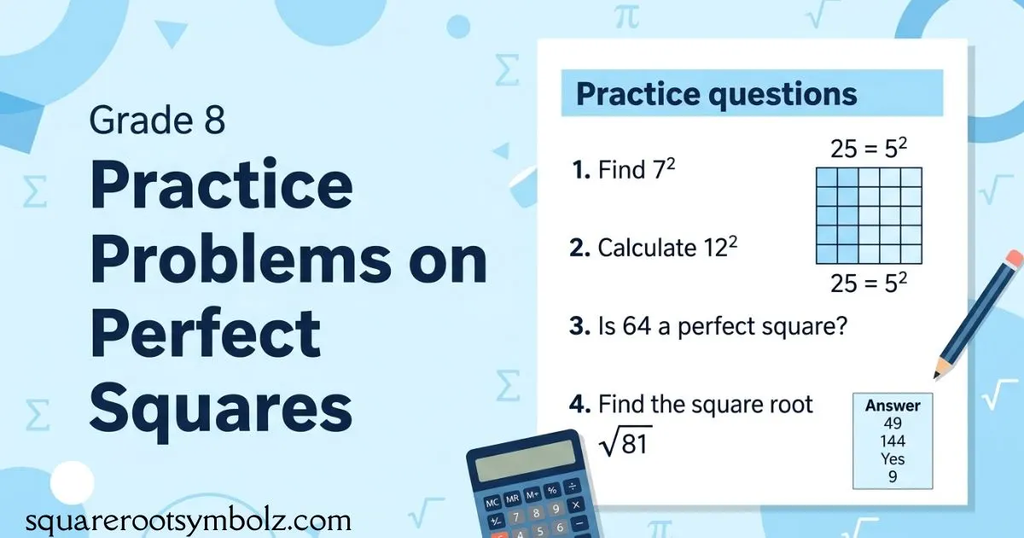
Use multiplication or square roots to solve these questions. Check your answers only after attempting each problem so you can identify which method works best for you.
Test your understanding
1. Is 196 a perfect square?
Yes
No
2. Which number is not a perfect square?
81
100
120
144
3. What is the square root of 529?
21
22
23
24
4. What is the next perfect square after 900?
920
961
1000
1024
0 of 4 correct
Try again
Conclusion
A perfect square number is the result of multiplying an integer by itself. Numbers such as 1, 4, 9, 16, 25, and 36 are simple examples of this mathematical pattern. By learning the square formula, recognizing number sequences, and checking square roots, you can identify perfect squares more confidently.
Whether you are studying for a math test, solving algebra problems, or exploring geometry, understanding square numbers gives you a strong foundation. Practice with number lists and worked examples, and gradually move toward larger numbers and more advanced calculations.
FAQs
What is a perfect square number?
A perfect square number is an integer that can be written as another integer multiplied by itself. For example, 49 is a perfect square because 7 × 7 = 49. Its square root is 7.
What are the first 10 perfect square numbers?
The first 10 positive perfect square numbers are 1, 4, 9, 16, 25, 36, 49, 64, 81, and 100. These are obtained by squaring the integers from 1 to 10.
Is zero a perfect square?
Yes. Zero is a perfect square because 0 × 0 = 0. It is the smallest nonnegative perfect square and is included in the sequence of squares of nonnegative integers.
How do you identify a perfect square number?
Calculate the square root of the number. If the result is an integer, the number is a perfect square. Prime factorization is another method: a positive integer is a perfect square when all prime exponents in its factorization are even.
Can a negative number be a perfect square?
A negative integer cannot be a perfect square in the real-number integer sense. Squaring a positive or negative integer always produces a nonnegative result. For example, (−8)² = 64.
Is 100 a perfect square?
Yes. One hundred is a perfect square because 10 × 10 = 100. Its principal square root is 10.
What is the difference between a square number and a perfect square?
In elementary mathematics, the terms square number and perfect square usually mean the same thing. Both describe a number that results from squaring an integer, such as 9, 16, or 25.

I’m the creator of SquareRootSymbolz.com, where I publish easy-to-understand guides on symbols, Unicode characters, Alt codes, keyboard shortcuts, and copy-and-paste text symbols. My goal is to provide accurate, well-researched, and user-friendly content that helps readers quickly find the information they need.