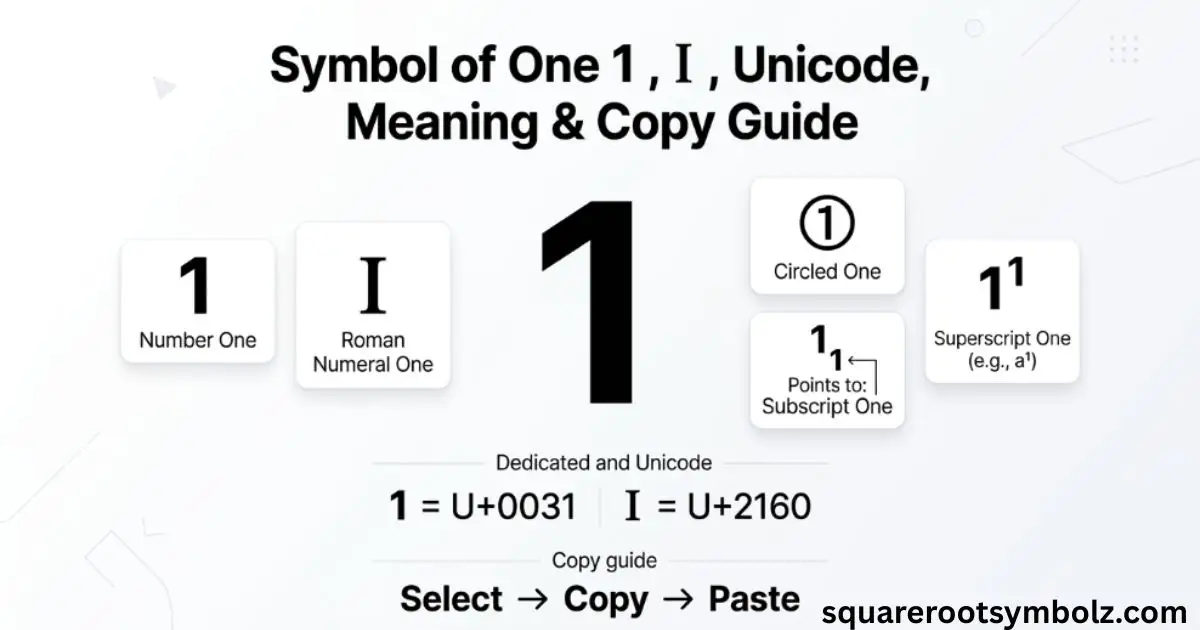
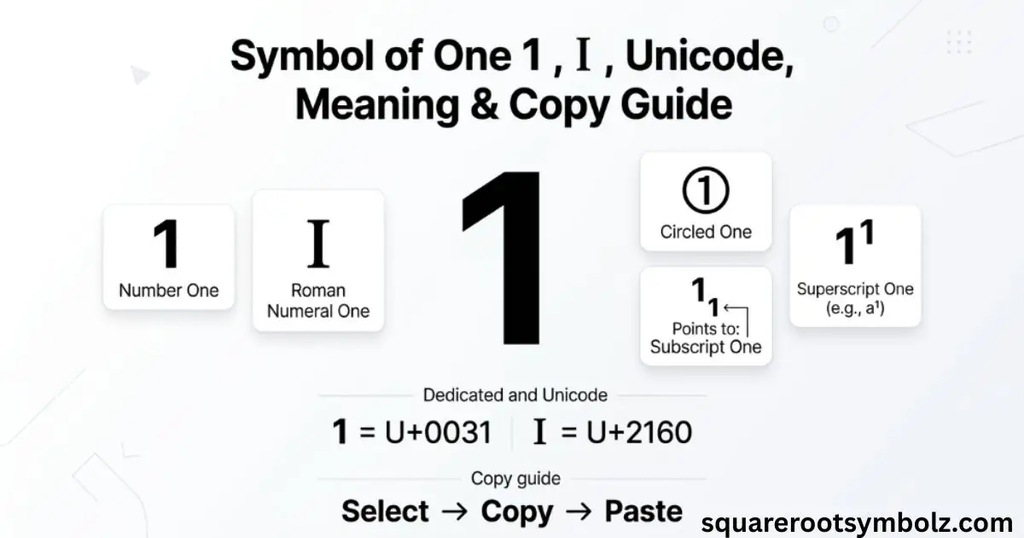
The most common symbol of one is 1, the decimal digit used to represent a single quantity. Depending on context, however, one can also appear as the Roman numeral I, superscript ¹, Eastern Arabic ١, Chinese 一, or another numeral-system representation. The ordinary digit 1 has Unicode code point U+0031.
If you searched for the symbol of one because you need to copy it, identify its name, understand its mathematical meaning, or find its Unicode and HTML code, this guide brings those uses together. The important distinction is simple: 1 is the familiar decimal digit, while forms such as I and ¹ are different characters or notation systems with their own purposes.
In mathematics
In mathematics, 1 is the first positive integer and serves as the multiplicative identity. That means multiplying any number by 1 leaves the number unchanged: 1 × n = n. This makes one much more than a simple counting mark; it is a fundamental object in arithmetic and algebra.
The number one has several unusual mathematical properties. It is neither prime nor composite under the modern convention, its square is 1, its square root is 1, and every positive integer raised to the first power remains itself. Also, 1! = 1, making it important in factorials and combinatorics.
The symbol 1 can represent one object, one unit, one measurement, or the value one in an equation. For example, 1 apple means a single apple, while x + 1 means one unit has been added to x.
The idea of one also appears in probability, normalization, vectors, and other mathematical settings. A probability of 1 represents certainty, while a unit vector has magnitude 1. These examples show how the same number can describe quantity, magnitude, or a normalized value depending on context.
As a word
The word one is the English name for the number represented by the digit 1. It is commonly used as a cardinal number to indicate a single item, person, event, or unit. For example, “one book” means a collection containing exactly one book.
English also uses one as a determiner and pronoun. In “one person,” it specifies a single person; in a sentence such as “one should be careful,” it can refer generally to a person without identifying anyone specifically.
The linguistic history of the word is older than the modern written digit. Wikipedia traces English one through Old English an and Germanic roots associated with the idea of one or unique. This gives the concept both a numerical and linguistic history.
Words built from the idea of one include alone, once, and numerical prefixes such as uni- and mono-. These forms carry the broader idea of being single, individual, or occurring once.
For search purposes, this distinction is useful: “one” is the word, “1” is the decimal digit, and “I” is the Roman numeral for one. They communicate the same numerical value in certain contexts, but they are not interchangeable characters.
Symbols and representation
The modern decimal 1 is the most familiar symbol of one in the United States and much of the Western world. It is a digit rather than a letter, and its exact visual shape can change slightly between fonts. Wumbo identifies it as Digit One with Unicode code point U+0031.
The number one can be represented differently across numeral systems. Examples include I in Roman numerals, ١ in Eastern Arabic numerals, १ in Devanagari, 一 in Chinese and Japanese contexts, and other historical or regional forms. Wikipedia provides a broad comparison of these representations.
| Representation | Meaning | Context |
| 1 | One | Modern decimal digit |
| I | One | Roman numeral |
| i | One | Lowercase Roman numeral |
| ¹ | One | Superscript character |
| ١ | One | Eastern Arabic digit |
| १ | One | Devanagari digit |
| 一 | One | Chinese/Japanese numeral |
| α′ | One | Greek numeral |
| .—- | One | Morse code |
It is important not to treat every visual variation as the same Unicode character. For example, ordinary 1 is U+0031, while superscript ¹ is a separate Unicode character. Roman numeral Ⅰ is also separately encoded from the ordinary digit 1.
This matters when copying symbols into websites, documents, code, or databases. A character that looks like a one may have a completely different code point and therefore behave differently during searching, sorting, formatting, or text processing.
History
The history of the symbol of one reaches back thousands of years. Ancient numeral systems used different marks for one, including Sumerian and Babylonian forms. The modern Western digit developed through the historical evolution of numeral systems associated with ancient India and later transmission through the Islamic world into Europe.
The Brahmic tradition provides an important link in the development of the modern numeral shape. Wikipedia notes an early Brahmi representation associated with Ashoka around the third century BCE, followed by later transformations before the familiar Western form emerged.
Roman civilization used I instead of the modern decimal 1. The Roman numeral system is non-positional and uses a limited group of letters as numerical symbols. In that system, I = 1, V = 5, and X = 10.
The development from ancient marks to modern digital characters shows why “the symbol of one” does not have only one historical shape. The value stayed conceptually stable while its written representation changed across cultures, writing systems, and technologies.
Modern typefaces
The appearance of 1 changes with typography. In modern fonts, it may have a simple vertical stroke, a top serif, or a small horizontal base. Some typefaces make it look quite different from the capital letter I or lowercase l to prevent reading errors.
Older-style numerals can also change the height and proportions of the digit. In text figures, numbers may be designed to blend with lowercase letters rather than align with capital-letter height.
This explains why the same symbol can look noticeably different in Arial, Times New Roman, Georgia, or decorative fonts while still representing exactly the same Unicode character U+0031.
Historically, some typewriters did not have a dedicated key for the numeral 1, so typists sometimes substituted other characters. Modern keyboards normally provide a dedicated 1 key, making the distinction much easier.
Typography therefore affects appearance, but not the numerical identity of the character. The underlying Unicode character remains DIGIT ONE, even when its glyph changes from one typeface to another.
In other fields
The symbol 1 extends far beyond ordinary counting. In computing, binary numbers use only 0 and 1, and 1 commonly represents an on, true, or active state. This makes the digit one a basic building block of digital information.
In physics and engineering, one can represent a unit value or appear in normalized quantities. Dimensionless quantities may have the value 1, and natural-unit systems sometimes assign selected physical constants a numerical value of 1 to simplify equations.
In chemistry, hydrogen has atomic number 1, placing it first in the periodic table. In probability, 1 represents a certain event. In mathematics, a unit vector has magnitude 1. The same tiny digit therefore appears in very different technical contexts.
The number one can also have symbolic meanings outside technical fields. It is often associated with unity, singularity, uniqueness, or completeness. Philosophical traditions have sometimes treated one as a representation of an ultimate unity or source.
The important point is context. The digit 1 has one numerical value, but its meaning can change according to the system in which it appears. In binary it can indicate an active state; in mathematics it can be an identity element; in a list it can indicate the first item.
Usage
The symbol 1 represents the quantity of one and can also function as a digit inside a larger number. For example, it is the first digit in 10, but it does not mean “one” alone when interpreted as part of that multi-digit number’s place-value structure.
If you need a simple symbol for one in ordinary writing, schoolwork, notes, forms, or digital communication, use:
1
If you need the Roman numeral version, use:
I
If you need a superscript version, use:
¹
These forms should not be confused. They can represent related numerical ideas, but they are distinct characters or notation conventions.
For a website or digital project, the ordinary digit 1 is Unicode U+0031. This is the standard character you should normally use when you want the decimal digit one rather than a special typographic variant.
One
The ordinary 1 is the most direct answer when someone asks for the symbol of one. It is the decimal digit used to represent one in the Hindu-Arabic numeral system and is recognized as the quantity of one in everyday numerical notation.
For quick reference:
| Item | Value |
| Symbol | 1 |
| Name | Digit One |
| Number | One |
| Unicode | U+0031 |
| Unicode block | Basic Latin |
| Decimal code point | 49 |
| Hexadecimal code point | 31 |
| HTML decimal | 1 |
| HTML hexadecimal | 1 |
HTMLSymbols.net provides the HTML and CSS representations for inserting the ordinary digit into web content. The HTML decimal form is 1, while the hexadecimal form is 1.
The distinction becomes particularly useful when a page asks for a “one symbol” but actually means a specialized character such as Roman numeral one, superscript one, or a circled number. Those are separate representations and should be selected according to the intended use.
HTMLSymbols.net Code Examples
For ordinary web development, the character 1 can simply be typed directly into HTML. Because it is a standard ASCII/Unicode character, there is usually no need for a special entity when the desired result is simply the digit one.
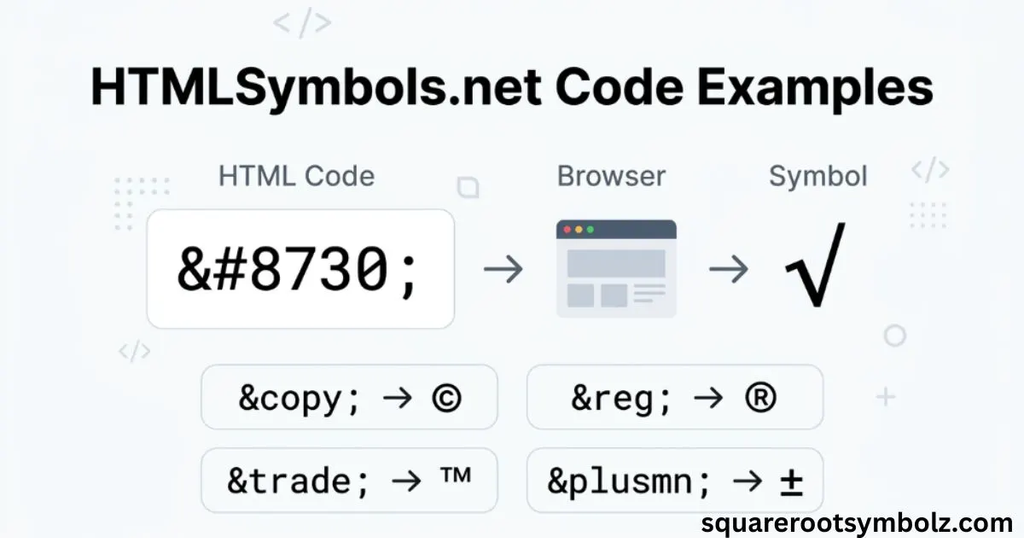
An HTML entity can nevertheless be useful when a project specifically requires encoded character data. HTMLSymbols.net lists 1 and 1 as representations of the digit.
Example:
<span>1</span>
This renders the digit:
1
For CSS, the site provides the escape sequence:
content: “\0031”;
That can be useful when generating content through CSS rather than placing the character directly in the HTML document.
For most normal pages, however, direct use of 1 is the simplest and clearest option. Special encoding becomes more useful when working with generated content, source code, databases, or systems where character escaping is required.
One Code Examples
The basic technical identifiers for the symbol can be summarized as follows:
| Format | Code |
| Symbol | 1 |
| Unicode | U+0031 |
| Hex | 31 |
| HTML decimal | 1 |
| HTML hexadecimal | 1 |
| CSS escape | \0031 |
| Decimal code point | 49 |
Wumbo independently identifies the character as Digit One and gives U+0031, while HTMLSymbols provides the HTML and CSS code forms. Using these identifiers is helpful when you need to reproduce the same character reliably across digital systems.
If you only need to copy the character, the fastest option is simply:
1
For Roman numeral one:
I
For superscript one:
¹
For Eastern Arabic one:
١
For Chinese one:
一
Each of these forms belongs to a different writing or notation system, so choosing the correct character is more important than finding the most visually similar shape.
Conclusion
The symbol of one is most commonly 1, the decimal digit used to represent a single quantity. But the same numerical idea can appear as I in Roman numerals, ¹ as superscript one, ١ in Eastern Arabic notation, १ in Devanagari, and 一 in Chinese and Japanese contexts.
For digital use, the ordinary 1 is DIGIT ONE, Unicode U+0031, with HTML representations such as 1 and 1.
The key distinction is simple: one is the number, 1 is the standard decimal digit, and other forms such as I or ¹ are context-specific representations. Understanding that difference makes it easier to choose the right symbol for mathematics, typography, websites, documents, and everyday writing.
FAQ Section
What is the symbol of one?
The most common symbol of one is 1. It is called Digit One and has Unicode code point U+0031.
What is the symbol for one in Roman numerals?
The Roman numeral for one is I. It is different from the ordinary decimal digit 1.
What is the Unicode for 1?
The Unicode code point for the ordinary digit one is U+0031.
What is the HTML code for the symbol 1?
You can use 1 or 1 in HTML to represent the digit 1.
Is I the same as 1?
They can represent the same numerical value in different notation systems, but I and 1 are different characters. I is the Roman numeral, while 1 is the decimal digit.
What is the superscript one symbol?
The superscript one is ¹. It is a separate character from the ordinary digit 1 and appears raised above the baseline.
What does 1 mean in mathematics?
In mathematics, 1 is the multiplicative identity, because multiplying any number by 1 leaves that number unchanged.
Is 1 a prime number?
No. Under the modern mathematical definition, 1 is neither prime nor composite.
What is one in binary?
In binary, 1 is one of the two possible digits. In many digital systems, 1 represents an on or true state.
What is the Arabic symbol for one?
The Eastern Arabic digit for one is ١. It represents the same numerical value as Western 1 but belongs to a different digit set.
What is the Chinese symbol for one?
The Chinese numeral for one is 一. It is also used in Japanese kanji-based numeral writing.
Can I copy and paste the symbol of one?
Yes. The standard symbol is:
1
You can copy it directly and paste it into documents, websites, messages, or other applications.

I’m the creator of SquareRootSymbolz.com, where I publish easy-to-understand guides on symbols, Unicode characters, Alt codes, keyboard shortcuts, and copy-and-paste text symbols. My goal is to provide accurate, well-researched, and user-friendly content that helps readers quickly find the information they need.