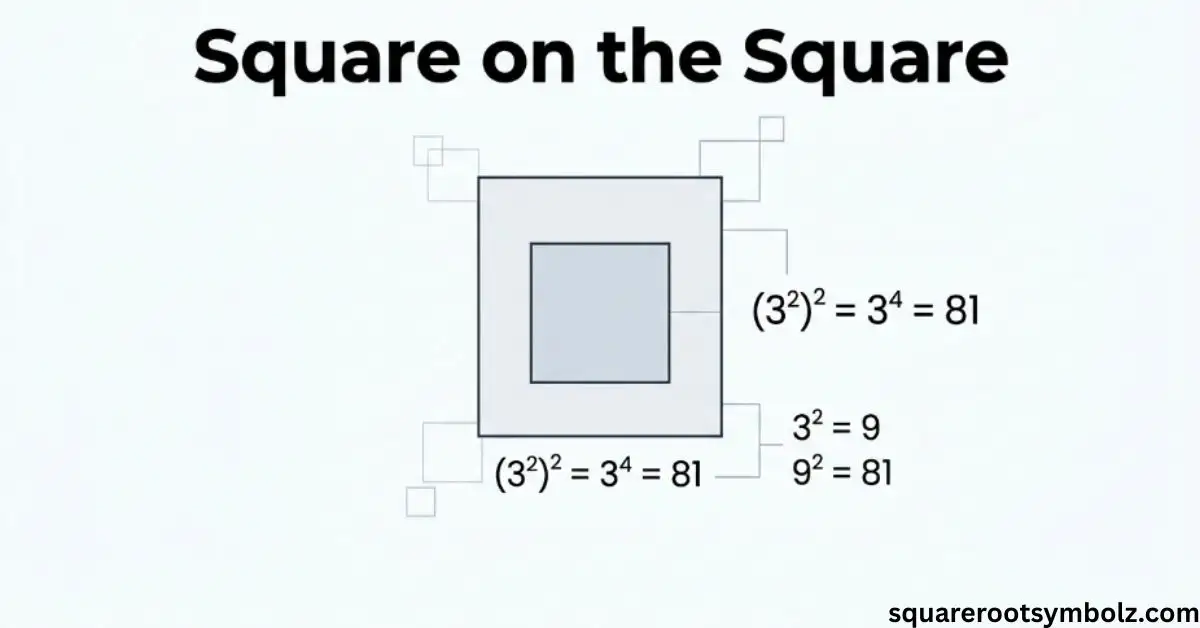
“Square on the square” is best understood through the geometric idea of constructing a square on a side of a triangle. In a right triangle, the areas of the squares built on the two legs add up to the area of the square built on the hypotenuse. This is the geometric meaning behind the Pythagorean theorem.
If the wording feels confusing, you are not alone. The phrase can sound like an exponent problem, but geometry gives it a different meaning. Once you picture a right triangle with three squares attached to its sides, the relationship becomes much easier to understand: the side length of each square matches the corresponding side of the triangle.
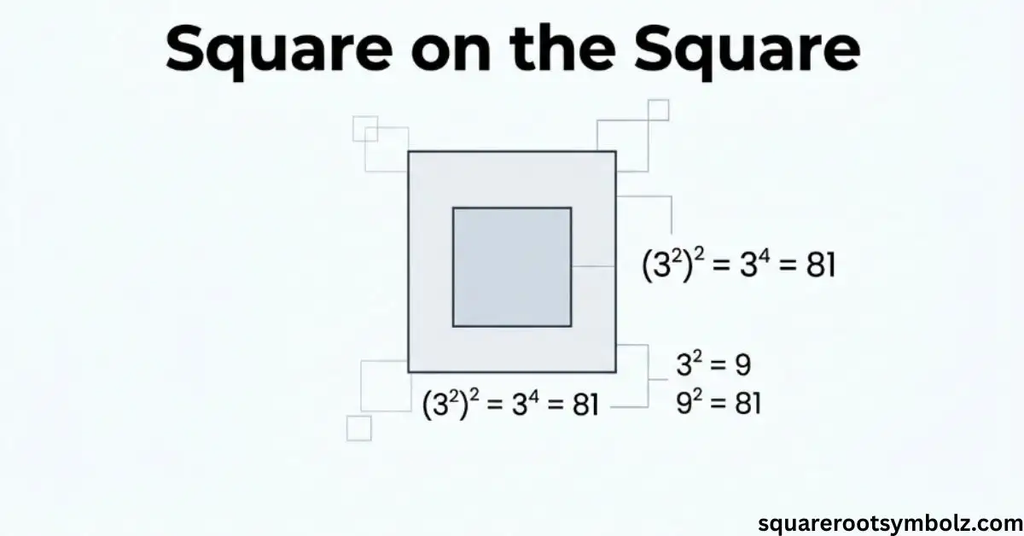
Squares on the Sides of Right Triangles
When mathematicians talk about a square on a side, they mean constructing a square so that the chosen side of the triangle becomes one side of the square. If a triangle has a side measuring 5 units, the square constructed on that side has a side length of 5 units and an area of (5^2=25) square units.
For a right triangle, three squares can be constructed: one on each leg and one on the hypotenuse. The largest square sits on the longest side. Its area is determined by squaring the hypotenuse length, while the other two areas come from squaring the leg lengths.
| Triangle side | Square constructed on it | Square area |
| Leg (a) | Square on (a) | (a^2) |
| Leg (b) | Square on (b) | (b^2) |
| Hypotenuse (c) | Square on (c) | (c^2) |
The important point is that “square on a side” refers to a geometric figure, while (a^2) describes the numerical area of that square. This distinction removes much of the confusion surrounding the phrase.
The Pythagorean Relationship
The Pythagorean relationship says that, for a right triangle, the area of the square on the hypotenuse equals the combined areas of the squares on the two legs. In symbols, if the side lengths are (a), (b), and (c), then (a^2+b^2=c^2).
Imagine a right triangle with legs of 3 and 4 units and a hypotenuse of 5 units. The first square has area (3^2=9), the second has area (4^2=16), and the largest has area (5^2=25). Since (9+16=25), the geometric relationship works perfectly.
The beautiful part is that this is more than a formula to memorize. The areas actually fit together. Geometric proofs can rearrange pieces from the two smaller squares so that they fill the square associated with the hypotenuse, demonstrating why the areas are equal.
The Pythagorean Theorem
The Pythagorean theorem gives the algebraic form of this geometric relationship:
[
\boxed{a^2+b^2=c^2}
]
Here, (a) and (b) are the lengths of the two legs of a right triangle, while (c) is the hypotenuse. Because the hypotenuse is opposite the 90-degree angle, it is always the longest side.
Suppose the legs measure 6 inches and 8 inches. The square on the first leg has area (36) square inches, and the square on the second leg has area (64) square inches. Therefore, the square on the hypotenuse has area:
[
36+64=100
]
The hypotenuse is therefore:
[
c=\sqrt{100}=10
]
So the familiar 6-8-10 triangle is another example of the same relationship.
The theorem applies specifically to right triangles. You cannot take any three sides of an arbitrary triangle, square them, and automatically expect the equation to work. Mathematics Monster emphasizes this limitation directly: the Pythagorean theorem is a right-triangle relationship.
Visualizing Pythagoras’ Theorem
Drawing squares on the three sides makes the theorem much easier to picture. The square attached to the hypotenuse represents (c^2), while the squares attached to the legs represent (a^2) and (b^2). Their areas provide a visual interpretation of the equation rather than leaving it as abstract algebra.
Consider a 3-4-5 triangle. A square built on the 3-unit side covers 9 square units. A square built on the 4-unit side covers 16 square units. Together, those areas total 25 square units, exactly matching the 5-unit square on the hypotenuse.
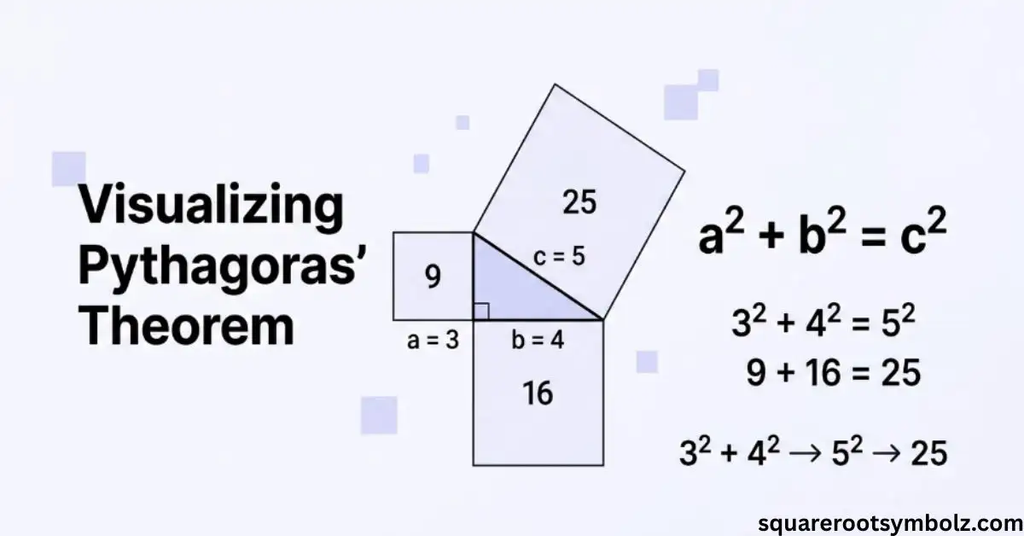
This visual approach is particularly helpful for students who struggle when a formula appears without context. Instead of thinking only about (3^2+4^2=5^2), they can see three actual geometric regions and understand that the equation compares their areas.
A Real Example of Pythagoras’ Theorem
Take a right triangle whose two legs are 3 feet and 4 feet. To find the missing hypotenuse, begin with the Pythagorean theorem:
[
a^2+b^2=c^2
]
Substitute the known lengths:
[
3^2+4^2=c^2
]
Then square the numbers:
[
9+16=c^2
]
So:
[
25=c^2
]
Taking the positive square root gives:
[
c=5
]
Therefore, the hypotenuse measures 5 feet. The corresponding square on the hypotenuse has an area of 25 square feet. This classic 3-4-5 example is also a Pythagorean triple.
The same idea works when the missing side is a leg. Suppose the hypotenuse is 13 units and one leg is 5 units. Then:
[
5^2+b^2=13^2
]
[
25+b^2=169
]
[
b^2=144
]
[
b=12
]
The triangle is therefore a 5-12-13 Pythagorean triple. Mathematics Monster identifies 5-12-13 alongside 3-4-5 as examples of Pythagorean triples.
A quick way to remember it
Think of the equation as an area statement rather than merely a side-length formula. The two smaller squares belong to the legs, and their combined area equals the square belonging to the hypotenuse. That visual interpretation is the heart of the theorem.
What “square on a side” does not mean
It does not mean that you draw a smaller square inside the triangle or simply multiply the triangle’s area by itself. It means a square is constructed using a triangle side as one complete side of the square. The square’s area is then the side length multiplied by itself.
Why the phrase matters
The wording “square on a side” explains why the Pythagorean theorem connects geometry and algebra so naturally. A geometric square has an area, and that area equals the side length squared. Therefore, the picture and equation are describing exactly the same relationship from two different viewpoints.
Conclusion
The phrase square on the square is easiest to understand through the standard geometric construction behind the Pythagorean theorem. A square can be built on each side of a right triangle, and the area of the square on the hypotenuse equals the combined areas of the two squares on the legs.
In algebraic form:
a2+b2=c2
FAQ Section
What does “square on a side” mean?
It means constructing a square using a side of a geometric figure as one side of the square. Its area equals the length of that side squared.
What is the square on the hypotenuse?
It is the square constructed on the hypotenuse of a right triangle. Its area is c2c^2, where cc is the hypotenuse length.
What is the formula for the squares on a right triangle?
The relationship is:
a2+b2=c2a^2+b^2=c^2
where aa and bb are the legs and cc is the hypotenuse.
Why are squares drawn on the sides of a right triangle?
They provide a visual representation of the Pythagorean theorem. Comparing their areas makes the relationship between the three side lengths easier to understand.
Does the Pythagorean theorem work for every triangle?
No. The standard equation a2+b2=c2a^2+b^2=c^2 applies to right triangles.
What is a 3-4-5 triangle?
A 3-4-5 triangle is a right triangle whose side lengths satisfy 32+42=523^2+4^2=5^2. It is the most familiar example of a Pythagorean triple.
What is the area of the square on a side of 7 units?
The area is:
72=497^2=49
So the square has an area of 49 square units.
Is “square on a side” the same as squaring a number?
They are closely connected but not identical. Constructing a square on a side is a geometric action; squaring the side length calculates the area of that square.
What is the difference between a square and a square number?
A square is a geometric figure with four equal sides and four right angles. A square number is a number produced by multiplying an integer by itself, such as 25=5225=5^2.
What does the Pythagorean theorem prove?
It establishes that the area of the square on the hypotenuse of a right triangle equals the sum of the areas of the squares on its two legs.

I’m the creator of SquareRootSymbolz.com, where I publish easy-to-understand guides on symbols, Unicode characters, Alt codes, keyboard shortcuts, and copy-and-paste text symbols. My goal is to provide accurate, well-researched, and user-friendly content that helps readers quickly find the information they need.