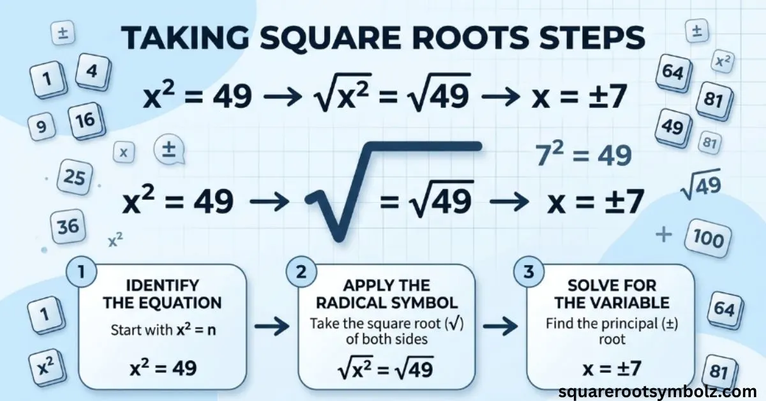
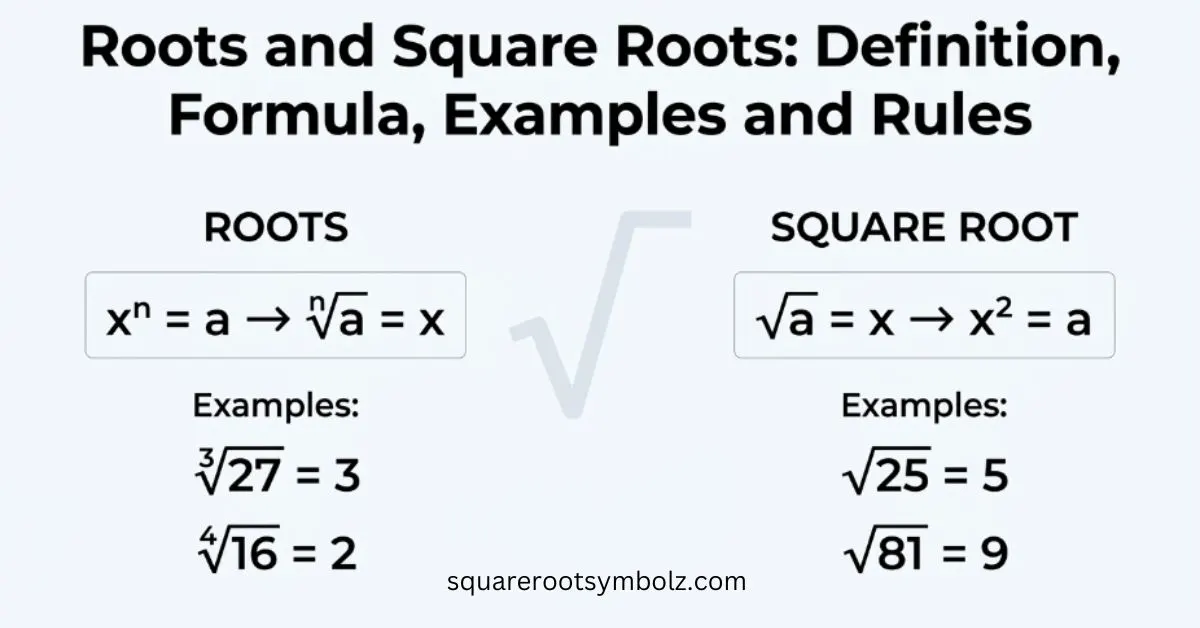
Roots and square roots are mathematical ideas that help us reverse powers and understand how numbers are connected. A square number, radical, perfect square, exponent, and factor all become easier once you see one simple relationship: squaring builds a value, while finding a root works backward.
I have found that students usually struggle not because the calculation is difficult, but because terms like principal square root, radical symbol, irrational number, prime factorization, and negative values appear before the basic idea feels clear. This guide explains the whole process with formulas, examples, and practical methods.
What Is Squares and Square Roots?
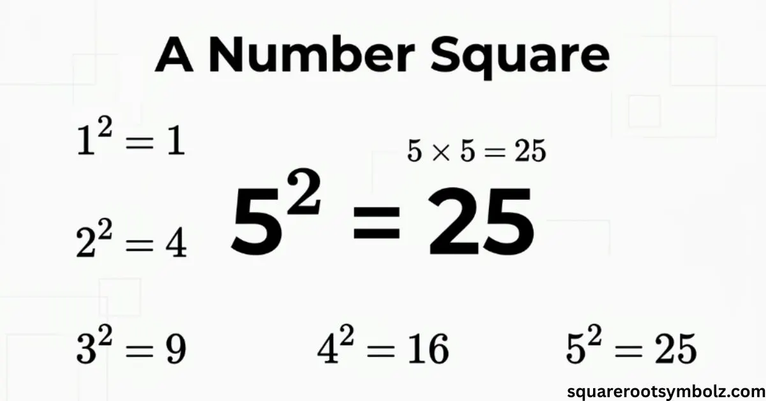
A square is created when a number is multiplied by itself. A square root works in the opposite direction by identifying the value that produced the square. For example, 5 × 5 = 25, so 25 is a square number and 5 is a square root.
This relationship is an example of inverse mathematical operations. If a number is squared first, finding its square root can reverse that operation. Understanding this connection helps with algebra, exponents, radicals, equations, and many later topics in mathematics.
How to Square A Number
To square a number, multiply it by itself once. The square of 6, for example, is written as 6² and calculated as 6 × 6 = 36. The small exponent 2 tells us that the same factor appears twice.
A number can be positive, negative, or zero before it is squared. Interestingly, both 5² and (−5)² equal 25 because multiplying two negative values produces a positive result. Parentheses are important because they show exactly which value is being squared.
Square Roots
A square root asks the reverse question: what number can be multiplied by itself to produce this value? Since 7 × 7 = 49, the principal square root of 49 is 7, written as √49 = 7.
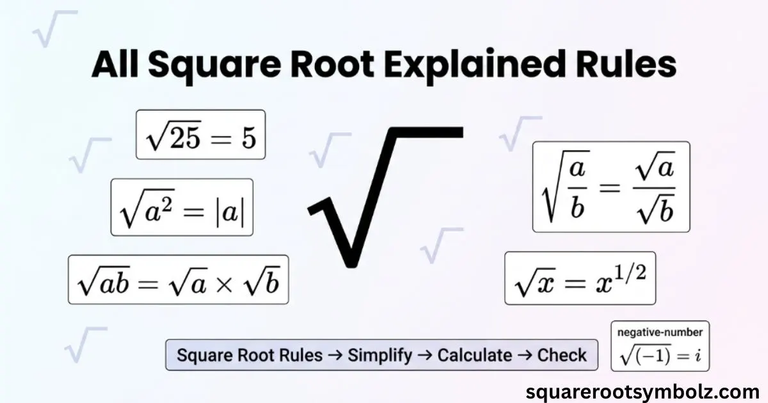
Positive numbers have two numbers that can produce the same square. Both 7 and −7 produce 49 when multiplied by themselves. However, the radical expression √49 represents the principal square root, which means the non-negative value, 7.
Key Formula for Squares and Square Roots
The basic square formula is:
n² = n × n
The basic square-root relationship can be written as:
√n = x, where x × x = n
These formulas show the direct relationship between powers and roots. If x² = n, then x is connected to the square root of n. This relationship becomes especially useful when solving algebraic equations and simplifying mathematical expressions.
Quick Example
If:
8² = 64
Then:
√64 = 8
The first equation squares the number, while the second equation reverses the operation. This pattern makes it easier to remember the difference between a square, a square root, and the value represented by a radical symbol.
The Square Root Symbol
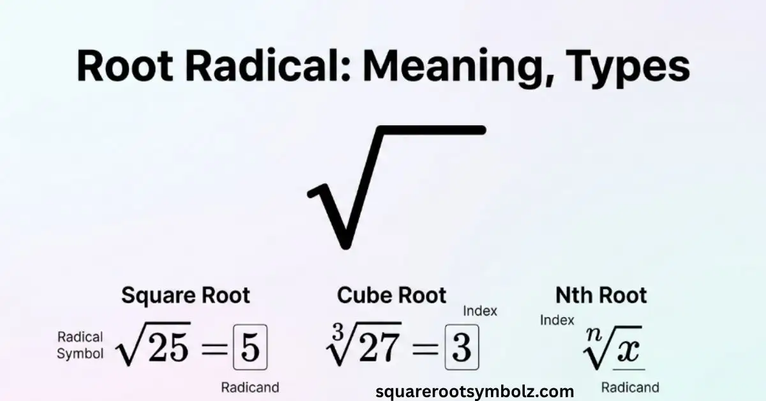
The symbol √ is called the square root symbol or radical symbol. It tells the reader to find the principal square root of the number or expression placed under the radical.
For example:
√81 = 9
The radical does not simply mean “find any number related to 81.” It specifically asks for the principal non-negative square root. That distinction becomes important when solving equations, because an equation may have both positive and negative solutions.
Perfect Squares
A perfect square is a number produced by multiplying an integer by itself. Common examples include 1, 4, 9, 16, 25, 36, 49, 64, 81, and 100.
Memorizing common perfect squares can make root calculations much faster. For example, recognizing that 121 equals 11 × 11 immediately tells you that √121 = 11 without needing a calculator, factor tree, or decimal approximation.
| Number | Square | Square Root of the Square |
| 1 | 1² = 1 | √1 = 1 |
| 2 | 2² = 4 | √4 = 2 |
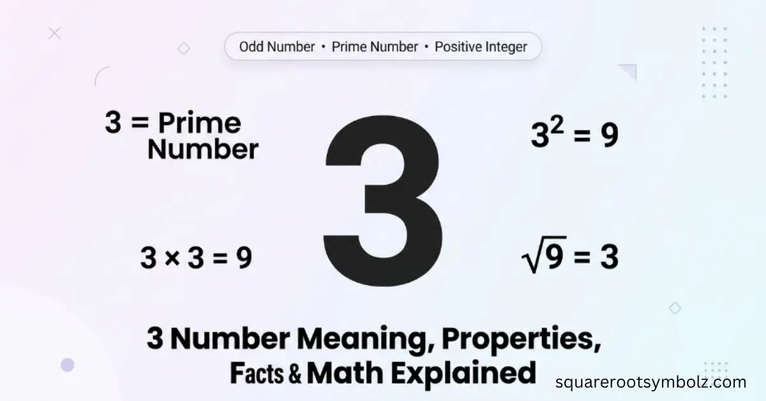
| 3 | 3² = 9 | √9 = 3 |
| 4 | 4² = 16 | √16 = 4 |
| 5 | 5² = 25 | √25 = 5 |
| 6 | 6² = 36 | √36 = 6 |
| 7 | 7² = 49 | √49 = 7 |
| 8 | 8² = 64 | √64 = 8 |
| 9 | 9² = 81 | √81 = 9 |
| 10 | 10² = 100 | √100 = 10 |
Calculating Square Roots
Finding the square root of a perfect square is usually straightforward because the answer is an integer. The challenge increases when the number is not a perfect square, such as √10 or √50.
For these values, first identify the nearest perfect squares. Since 9 < 10 < 16, we know that √10 lies between 3 and 4. A calculator gives an approximate decimal value, while algebra can sometimes simplify the radical further.
Example: Finding √10
We know:
3² = 9
4² = 16
Therefore:
3 < √10 < 4
The approximate value is 3.162. Because its decimal expansion does not terminate or repeat, √10 is an irrational number. This is why many non-perfect square roots are written either as radicals or rounded decimals.
Step-by-Step Illustration: Finding Square Root by Prime Factorization
Prime factorization is especially useful for finding the square root of a large perfect square. The main idea is to break the number into prime factors, group identical factors into pairs, and select one value from every pair.
For example, to find √144, begin by writing the prime factorization:
144 = 2 × 2 × 2 × 2 × 3 × 3
Now group matching factors:
(2 × 2)(2 × 2)(3 × 3)
Take one factor from each pair:
2 × 2 × 3 = 12
Therefore:
√144 = 12
Roots and Radicals
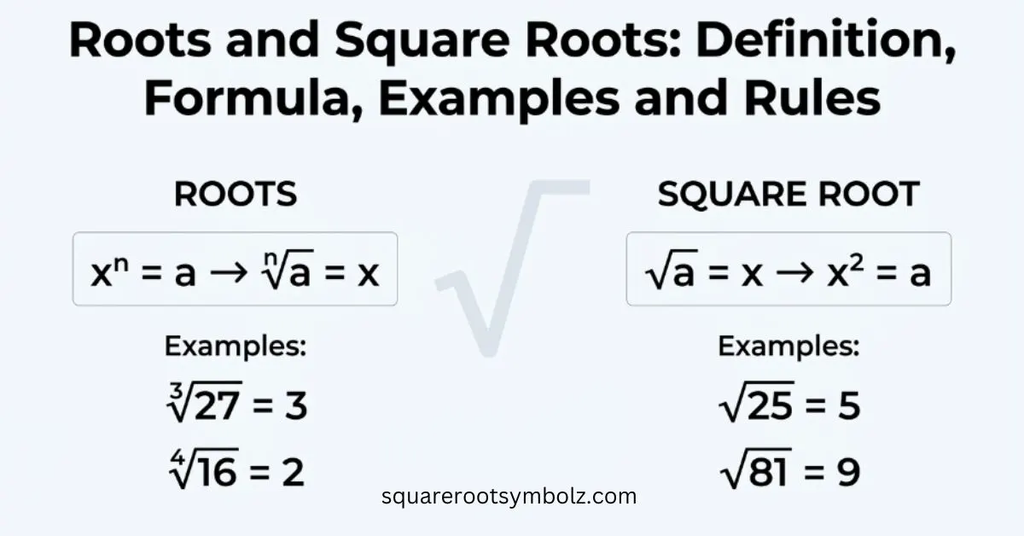
A root is a broader mathematical concept than a square root. If a number raised to a certain power produces another value, the corresponding root reverses that operation. Square roots are second roots, while cube roots reverse cubing.
For example, 3⁴ = 81, so the fourth root of 81 is 3. The radical symbol can represent different roots, while the square-root index 2 is usually omitted because square roots are the most common radical operation.
Square Roots and Other Roots
A square root answers:
What number multiplied by itself gives this result?
A cube root answers:
What number multiplied by itself three times gives this result?
For example:
√25 = 5
∛27 = 3
Both operations reverse powers, but the number of repeated factors is different. This is why understanding roots helps students move naturally from arithmetic into algebra and higher-level mathematics.
Numerical Values
Some roots produce exact whole numbers, while others produce decimal values. For example, √49 equals exactly 7, but √2 has a decimal expansion that continues without repeating.
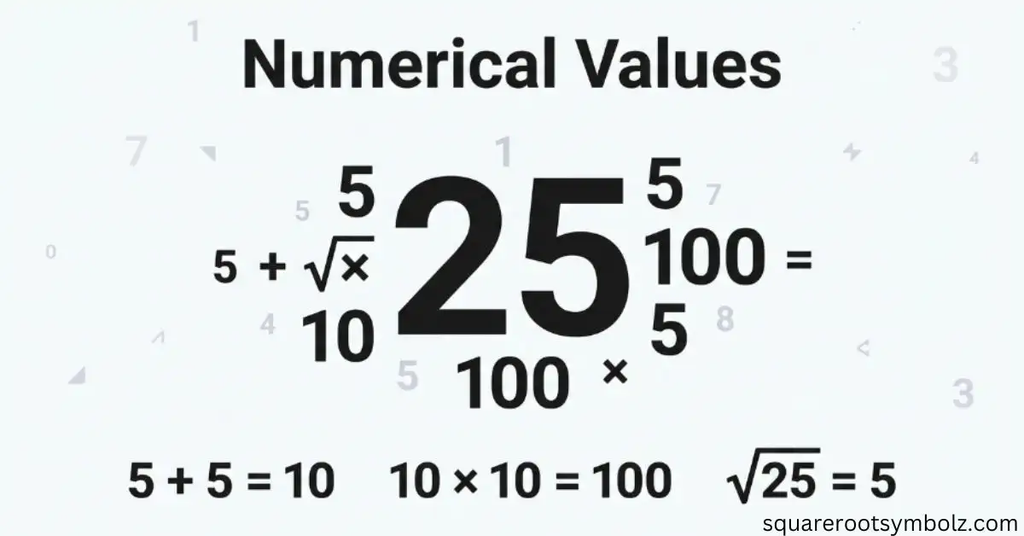
This difference helps distinguish perfect squares from values with irrational roots. Exact radicals are often preferred in algebra, while decimal approximations can be useful in measurement, engineering, science, and real-world calculations.
| Expression | Exact Form | Approximate Value |
| √4 | 2 | 2.000 |
| √9 | 3 | 3.000 |
| √16 | 4 | 4.000 |
| √2 | √2 | 1.414 |
| √3 | √3 | 1.732 |
| √5 | √5 | 2.236 |
| √10 | √10 | 3.162 |
Cross-Disciplinary Usage
Square roots are used far beyond classroom exercises. In geometry, they help calculate distances. In the Pythagorean theorem, square roots are used to determine a missing side of a right triangle after the squared values are combined.
They also appear in engineering, physics, computer science, statistics, and architecture. A distance formula, standard deviation calculation, or diagonal measurement may involve the same root relationship learned through simple examples like √25 = 5.
A Real-World Example
Imagine a square garden with an area of 144 square feet. To find the length of one side, you take the square root:
√144 = 12
So each side measures 12 feet. This is a simple example of how a square root converts an area measurement back into a one-dimensional length.
Conclusion
Roots and square roots become much easier when you remember their main relationship with powers. Squaring moves forward by multiplying a value by itself, while finding a root works backward to identify the original factor. Once you understand perfect squares, radicals, principal square roots, and prime factorization, more advanced algebra starts to feel far less intimidating.
FAQs
What are roots and square roots?
A root reverses a power operation. A square root specifically identifies the number that can be multiplied by itself to produce the original number.
What is the difference between a root and a square root?
A root can have different indices, such as a square root, cube root, or fourth root. A square root is specifically the second root of a number.
Why does √25 equal 5 and not −5?
The symbol √ represents the principal, non-negative square root. Although both 5 and −5 are square roots of 25, √25 specifically equals 5.
What is a perfect square?
A perfect square is a number formed by multiplying an integer by itself, such as 9, 16, 25, or 36.
How do you find a square root without a calculator?
You can use memorized perfect squares, prime factorization, estimation between known squares, or other mathematical methods depending on the number.
Is √2 a rational number?
No. √2 is an irrational number because its decimal expansion continues indefinitely without repeating.

I’m the creator of SquareRootSymbolz.com, where I publish easy-to-understand guides on symbols, Unicode characters, Alt codes, keyboard shortcuts, and copy-and-paste text symbols. My goal is to provide accurate, well-researched, and user-friendly content that helps readers quickly find the information they need.