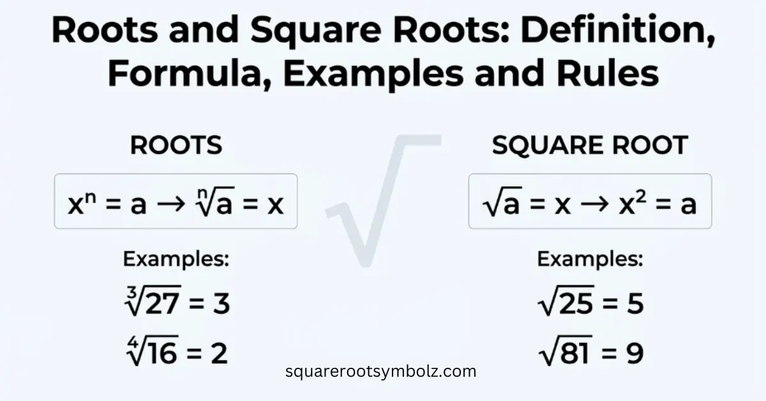
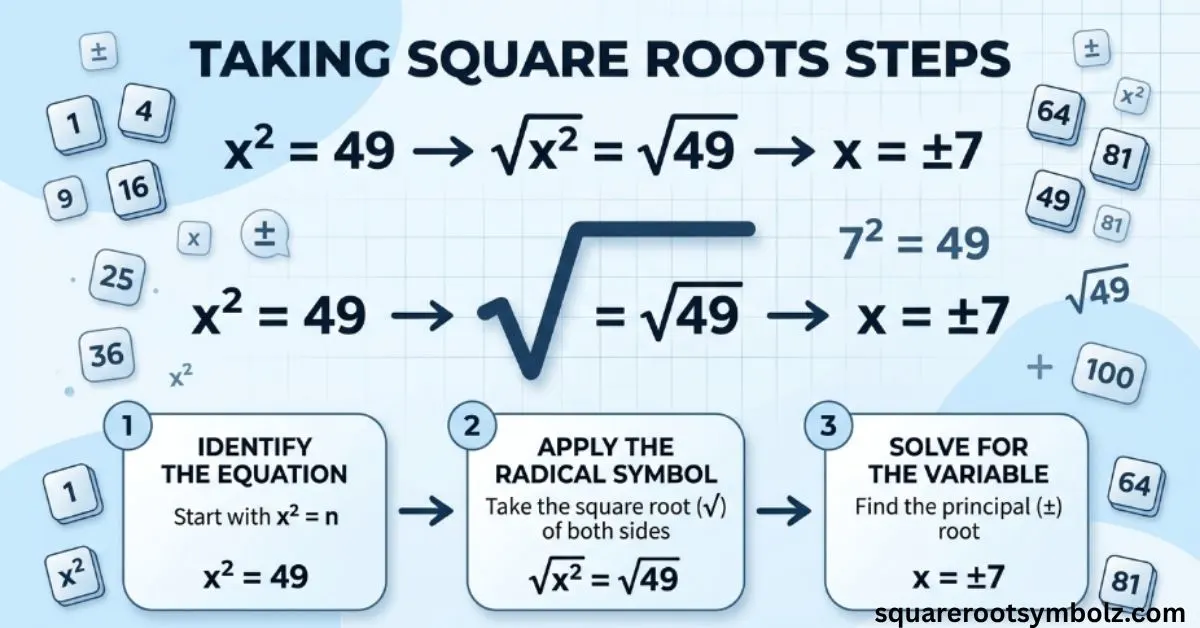
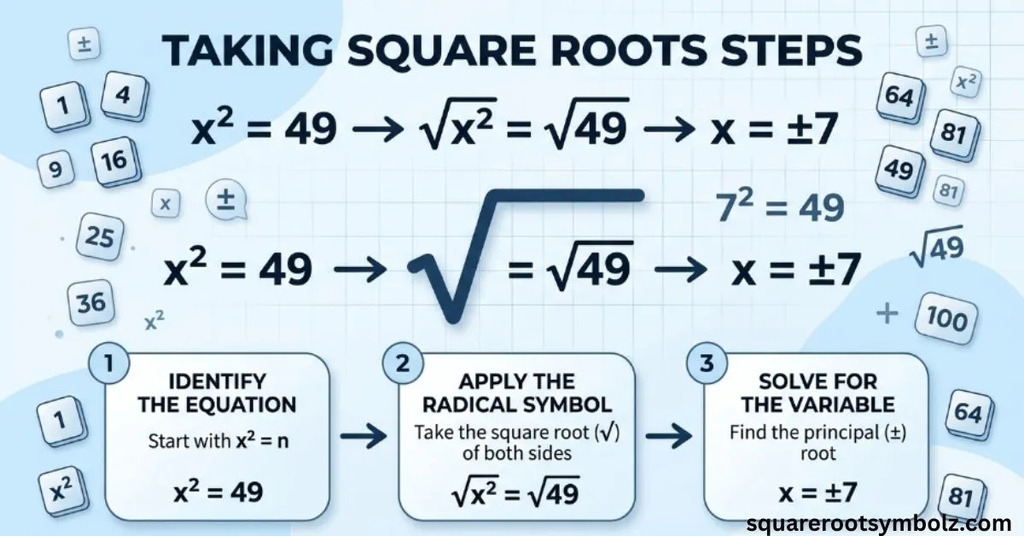
Taking square roots is a method used to solve equations when a variable or expression has been squared. The key idea is simple: isolate the squared term, take the square root of both sides, remember the positive and negative solutions, and then solve for the variable. In years of explaining algebra concepts, this is where many students first realize that one equation can produce two correct answers.
The confusion usually comes from the ± symbol, the difference between a square root and a squared variable, or knowing when the Square Root Property applies. Once you understand inverse operations, quadratic equations, perfect squares, and how to simplify a radical, taking square roots becomes a reliable method rather than a formula you have to memorize.
Solve Quadratic Equations of the Form ax² = k Using the Square Root Property
Taking square roots works especially well when a quadratic equation contains a squared variable but no separate linear term. An equation such as 3x² = 48 may look more complicated than x² = 16, but the solving process begins by isolating the quadratic term.
Before taking square roots, the coefficient of the squared variable should be removed. Divide both sides of the equation by the coefficient so that the squared term has a coefficient of one. Then apply the Square Root Property.
For example:
3x² = 48
Divide both sides by 3:
x² = 16
Now take the square root of both sides:
x = ±√16
Therefore:
x = ±4
This means the equation has two solutions:
x = 4 and x = −4
The plus-minus symbol matters because both values produce the same square. When 4 and −4 are multiplied by themselves, both give 16.
| Equation | Isolate Squared Term | Take Square Root | Solutions |
| x² = 25 | Already isolated | x = ±√25 | 5, −5 |
| 2x² = 50 | x² = 25 | x = ±5 | 5, −5 |
| 5x² = 45 | x² = 9 | x = ±3 | 3, −3 |
The main lesson is that taking square roots should happen after the squared term has been properly isolated. This makes the algebra cleaner and reduces the risk of forgetting an operation.
Solve Quadratic Equations of the Form a(x − h)² = k Using the Square Root Property
Taking square roots can also solve equations containing a squared expression in parentheses. These equations often look like:
a(x − h)² = k
The important difference is that the entire expression is squared. Therefore, after taking square roots, you must continue solving the equation to isolate x.
Consider:
(x − 3)² = 49
Take the square root of both sides:
x − 3 = ±7
Now solve both possibilities:
x − 3 = 7
x = 10
And:
x − 3 = −7
x = −4
Therefore, the solutions are:
x = 10 and x = −4
The two answers are expected because two different numbers can create the same positive square. This is one of the most important patterns to recognize when taking square roots of quadratic expressions.
Solve a Quadratic Equation Using the Square Root Property
The Square Root Property is used after the squared expression has been isolated. In its simplest form:
x² = k
becomes:
x = ±√k
The method follows a clear algebraic pattern. First, isolate the quadratic term. Next, make its coefficient one if necessary. Then take square roots, simplify the radical, and solve for the variable.
For example:
2x² + 8 = 40
Subtract 8:
2x² = 32
Divide by 2:
x² = 16
Take square roots:
x = ±4
The two solutions can be written as a solution set:
{−4, 4}
This method is efficient because it directly reverses the squaring operation. Instead of factoring or using the quadratic formula, you use the relationship between a square and its square root.
What the ± Sign Means
The symbol ± means “positive or negative.” When solving x² = 36, writing only x = 6 gives an incomplete answer because −6 also produces 36 when squared. The correct result is x = ±6.
However, do not confuse this with evaluating a radical by itself. √36 means the principal square root, which is 6. But solving the equation x² = 36 requires finding every value of x that makes the equation true.
A Note About Inverse Operations
Taking square roots is the inverse operation of squaring. Just as subtraction reverses addition and division reverses multiplication, a square root reverses a square. This relationship allows you to remove an exponent of two when solving an equation.
The difference is that squaring hides the sign. Both positive and negative values can produce the same positive square. That is why taking square roots while solving quadratic equations often requires ±, even though the principal radical symbol itself represents a non-negative value.
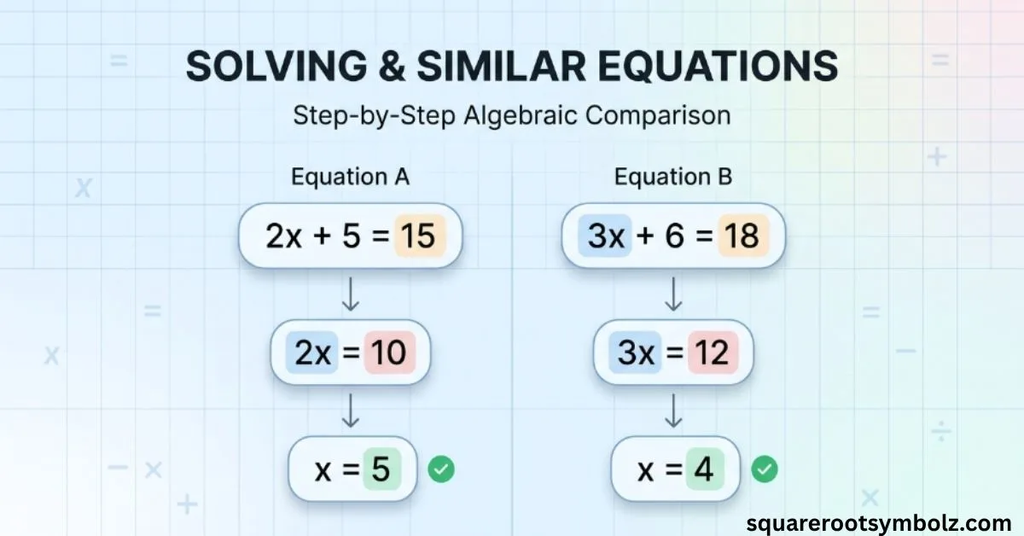
Solving and Similar Equations
Not every quadratic equation is ready for taking square roots immediately. Sometimes you must first rearrange the equation. The goal is to create a form where a squared variable or squared expression is isolated on one side.
For example:
2x² + 3 = 75
Subtract 3:
2x² = 72
Divide by 2:
x² = 36
Take square roots:
x = ±6
This shows an important solving habit: do not take the square root too early. First use ordinary algebra to isolate the quadratic expression. Then apply the square-root operation.
A similar example is:
(x + 2)² − 16 = 0
Add 16:
(x + 2)² = 16
Take square roots:
x + 2 = ±4
Solve both equations:
x = 2
or
x = −6
Both answers should satisfy the original equation. This final check confirms that the algebra and sign handling were correct.
Conclusion
Taking square roots is one of the simplest and most useful methods for solving certain quadratic equations. The process is straightforward: isolate the squared term, make its coefficient one when necessary, take the square root of both sides, include the ± symbol, and solve for the variable.
The biggest mistake is forgetting that an equation such as x² = 36 has two real solutions. Always remember that positive and negative values can produce the same square. Once you understand the connection between squaring and inverse operations, taking square roots becomes a fast, logical way to solve quadratic equations with confidence.
FAQs
What does taking square roots mean?
Taking square roots means applying the square-root operation to both sides of an equation to reverse a squared term and solve for the unknown variable.
Why do you use ± when taking square roots?
You use ± because both a positive and a negative number can have the same square. For example, both 5² and −5² equal 25.
What is the Square Root Property?
The Square Root Property states that if x² = k, then x = ±√k. It is commonly used to solve quadratic equations after the squared term has been isolated.
When should you take the square root of both sides?
Take the square root of both sides after isolating the squared variable or squared expression. If a coefficient remains, usually divide first to make the coefficient equal to one.
Does √25 equal ±5?
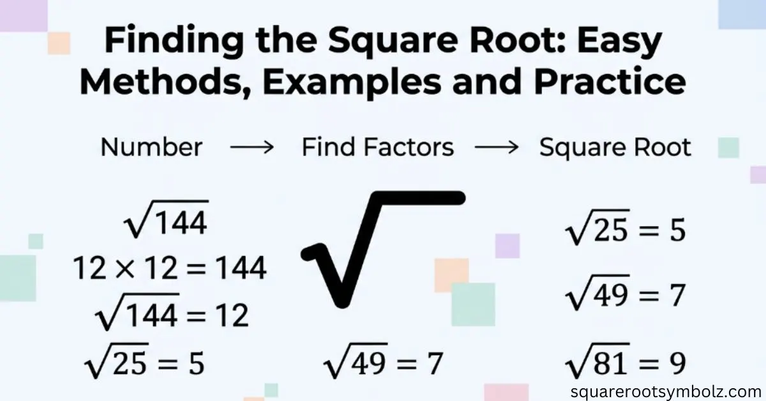
No. √25 = 5 because the radical symbol represents the principal square root. However, solving x² = 25 gives x = ±5.
Can taking square roots give two answers?
Yes. A quadratic equation can have two real solutions because a positive and negative number can produce the same square.
What is the first step before taking square roots?
The first step is usually to isolate the quadratic term. Use addition, subtraction, multiplication, or division to place the squared expression by itself.
What happens if the number under the square root is negative?
In the real number system, a negative number does not have a real square root. In more advanced mathematics, negative square roots are handled using imaginary numbers.

I’m the creator of SquareRootSymbolz.com, where I publish easy-to-understand guides on symbols, Unicode characters, Alt codes, keyboard shortcuts, and copy-and-paste text symbols. My goal is to provide accurate, well-researched, and user-friendly content that helps readers quickly find the information they need.