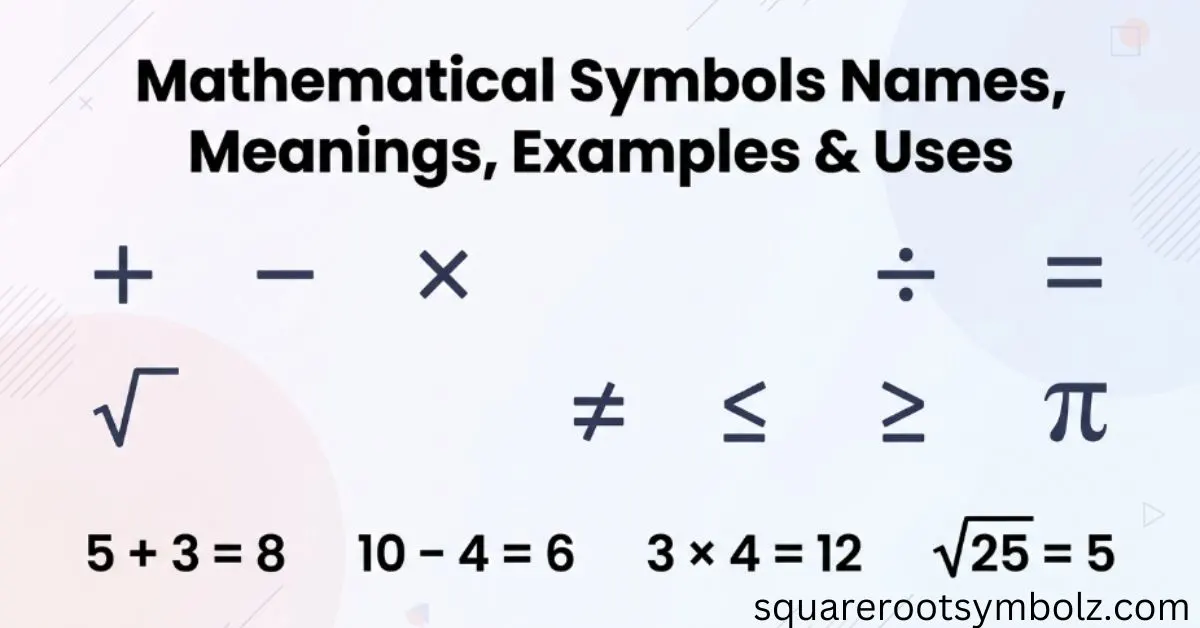
Mathematical symbols are shorthand signs that represent operations, relationships, quantities, sets, functions, and mathematical ideas. Symbols such as +, −, ×, ÷, =, <, √, π, ∞, ∑, and ∫ make equations shorter and far easier to read. Their exact meaning can change with context.
If you’ve ever looked at an equation and recognized the numbers but felt lost because of the symbols, you’re not alone. A strong reference should connect symbol names, meanings, examples, mathematical notation, Unicode, LaTeX, keyboard input, and subject area. This guide brings those pieces together so you can read and use notation with confidence.
Arithmetic and Comparison Mathematical Symbols
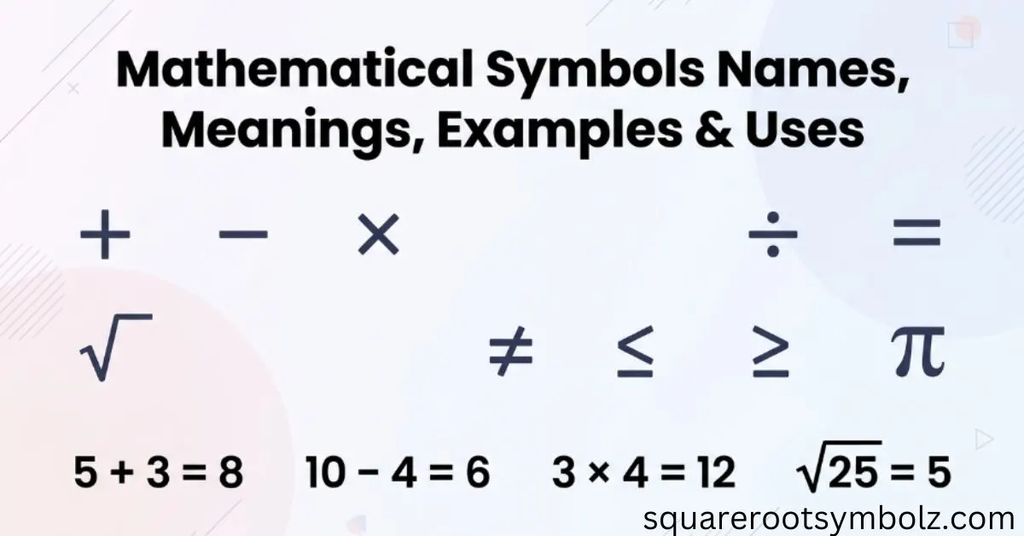
Arithmetic notation forms the foundation of everyday mathematics. The plus sign + means addition, minus sign − means subtraction, multiplication sign × means multiplication, and division sign ÷ indicates division. Comparison notation includes =, ≠, <, >, ≤, and ≥, allowing expressions to state relationships precisely.
| Symbol | Name | Meaning | Example |
| + | Plus | Addition | 5 + 3 = 8 |
| − | Minus | Subtraction | 9 − 4 = 5 |
| × | Multiplication | Multiply | 6 × 3 = 18 |
| ÷ | Division | Divide | 20 ÷ 4 = 5 |
| = | Equals | Equality | 4 + 2 = 6 |
| ≠ | Not equal | Inequality | 5 ≠ 7 |
| < | Less than | Smaller value | 3 < 8 |
| > | Greater than | Larger value | 9 > 4 |
| ≤ | Less than or equal | At most | x ≤ 10 |
| ≥ | Greater than or equal | At least | x ≥ 5 |
The surrounding expression matters. For example, < compares numbers, but similar symbols can have different roles in other areas of mathematics. Grouping symbols also affect calculation: 8−3×2=2, whereas (8−3)×2=10. Good notation is therefore not decoration; it tells the reader how an expression should be interpreted.
Read the whole statement, not a symbol in isolation
A symbol does not always have one fixed meaning. The vertical bar | can represent absolute value, set size, conditional probability, divisibility, determinant notation, or evaluation boundaries. The safest approach is to identify the mathematical field, inspect neighboring terms, and then interpret the notation in context.
Algebra, Functions, and Equation Mathematical Symbols
Algebraic notation describes relationships between known and unknown quantities. Variables such as x and y can represent numbers, while symbols such as =, ≡, →, ∝, ⇒, and ∴ communicate equality, identity, mapping, proportionality, implication, or logical consequence. The same compact language makes complicated relationships easier to read.
Consider 2x+3=11. The equals sign tells us that both sides have the same value, while x represents the unknown quantity. Functions add another layer: f:A→B indicates a mapping from one set to another, while x↦x2 tells us that the input is mapped to its square.
| Symbol | Common name | Example | Meaning |
| x | Variable | x + 4 | Unknown or changing quantity |
| = | Equals | x = 5 | Same value |
| ≡ | Identically equal | x+1)2≡x2+2x+1 | Identity |
| → | Arrow | A → B | Mapping/direction |
| ∝ | Proportional to | y ∝ x | Changes proportionally |
| ⇒ | Implies | P ⇒ Q | Logical implication |
| ∴ | Therefore | x = 4 ∴ 2x = 8 | Conclusion |
Set Theory and Logic Mathematical Symbols
Set theory uses mathematical symbols to describe collections and relationships between their elements. ∈ means “is an element of,” ∉ means “is not an element of,” ∪ represents union, ∩ represents intersection, and ⊆ expresses subset relationships. These symbols compress statements that would otherwise require several words.
Logic adds another layer of precision. ∀ means “for all,” while ∃ means “there exists.” Symbols such as ⇒ and ⇔ express implication and equivalence. These ideas appear in proofs, definitions, algorithms, discrete mathematics, and formal reasoning, making logical notation important far beyond classroom exercises.
| Symbol | Name | Meaning |
| ∈ | Element of | Belongs to a set |
| ∉ | Not element of | Does not belong |
| ∪ | Union | Combines sets |
| ∩ | Intersection | Common elements |
| ⊂ | Subset | Set contained in another |
| ⊆ | Subset or equal | Contained, possibly equal |
| ∀ | For all | Universal quantifier |
| ∃ | There exists | Existential quantifier |
| ⇒ | Implies | If one statement leads to another |
| ⇔ | If and only if | Two-way equivalence |
Geometry and Trigonometry Mathematical Symbols
Geometry uses symbols to communicate angles, lines, shapes, measurements, and spatial relationships. Common examples include ∠ for an angle, ⊥ for perpendicular lines, ∥ for parallel lines, and π for the mathematical constant used in circle calculations. These signs make diagrams and formulas much more compact.
Trigonometry frequently uses Greek letters such as θ, α, and φ to represent angles. For example, sinθ, cosθ, and tanθ describe relationships between an angle and the sides of a right triangle. The Pythagorean theorem, a2+b2=c2, combines geometry, exponents, variables, and equality in one familiar expression.
| Symbol | Name | Common use |
| ∠ | Angle | Identifies an angle |
| ⊥ | Perpendicular | Lines meeting at 90° |
| ∥ | Parallel | Lines that do not intersect |
| Δ | Triangle / Delta | Triangle or change |
| π | Pi | Circle calculations |
| θ | Theta | Angle variable |
| α | Alpha | Angle/parameter |
| φ | Phi | Angle/quantity |
Calculus and Analysis Mathematical Symbols
Calculus notation describes change, accumulation, limits, derivatives, and infinite processes. The derivative may appear as dy/dx, f′(x), or d/dx, while the integral sign ∫ represents accumulation. The infinity symbol ∞ expresses unboundedness or an unlimited process rather than an ordinary finite number.
For example, dxd(x2)=2x describes the derivative of x2. Meanwhile, ∫01x2dx=31 represents an integral over an interval. Advanced calculus also uses ∂ for partial derivatives and ∇ for gradient, divergence, and curl in vector calculus.
| Symbol | Name | Main meaning |
| ∫ | Integral | Accumulation |
| ∂ | Partial derivative | Derivative with multiple variables |
| d/dx | Derivative operator | Rate of change |
| lim | Limit | Approaching a value |
| ∞ | Infinity | Unboundedness |
| ∇ | Nabla | Gradient/divergence/curl |
| ′ | Prime | Derivative notation |
Probability and Statistics Mathematical Symbols
Probability and statistics rely heavily on mathematical notation to distinguish populations, samples, variables, events, means, standard deviations, and probabilities. The Greek letter μ commonly represents a population mean, while σ often denotes population standard deviation. A sample mean is commonly represented by xˉ.
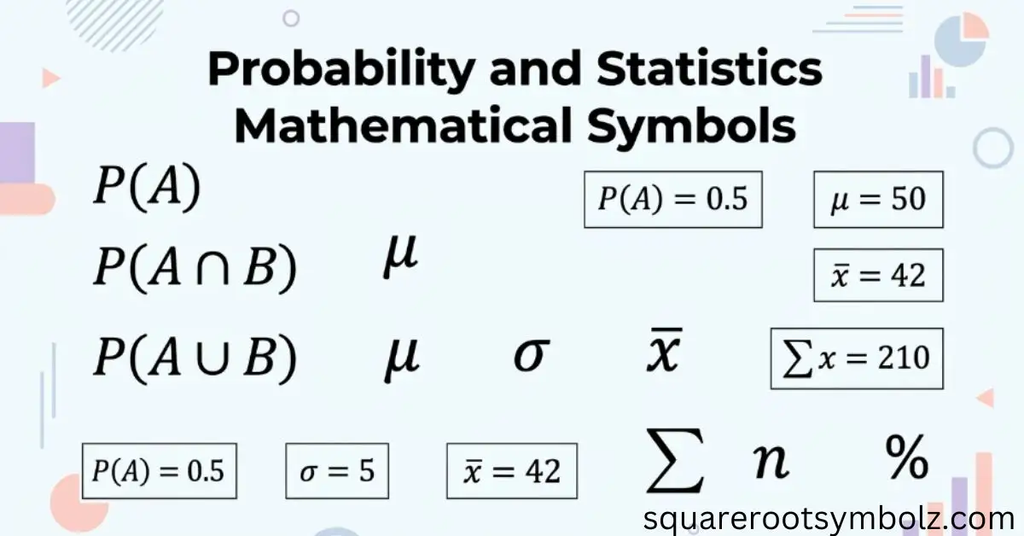
Probability notation includes P(A) for the probability of event A and P(A|B) for the probability of A given B. Set symbols such as ∪ and ∩ also appear because probability events can be combined through “or” and “and” relationships.
| Symbol | Meaning | Example |
| P(A) | Probability of A | P(A) = 0.5 |
| μ | Population mean | μ = 72 |
| σ | Population standard deviation | σ = 8 |
| x̄ | Sample mean | x̄ = 70 |
| s | Sample standard deviation | s = 6 |
| Σ | Summation | ∑xi |
| ∩ | Intersection | A ∩ B |
| ∪ | Union | A ∪ B |
| p | p-value/probability notation | p < 0.05 |
How to Type Mathematical Symbols in LaTeX, Documents, and Online Forms
There are three practical approaches to entering mathematical notation: copy the Unicode character, type a LaTeX command, or use an equation editor. The best choice depends on whether you are writing ordinary text, an academic formula, a webpage, or a structured document.
For example, the Unicode character π works well in normal text, while LaTeX \pi is better when constructing a larger mathematical expression. Similarly, \sqrt{x} creates a structured square-root expression, and \frac{a}{b} produces a properly formatted fraction.
Copying Unicode symbols
Unicode is convenient when you need a symbol directly inside ordinary text, worksheets, messages, headings, or documents. Characters such as π, θ, ≤, ≥, ≠, √, and ∞ can be copied and pasted without writing a markup command.
Using LaTeX commands
LaTeX is especially useful for structured mathematics containing fractions, roots, exponents, matrices, integrals, limits, and multi-line equations. Commands such as \sqrt{x}, \frac{a}{b}, and \sum preserve mathematical structure rather than treating an equation as ordinary text.
Using equation editors
Equation editors are useful in word processors, learning platforms, and presentations because they format mathematical notation visually. They can reduce problems caused by lost superscripts, fraction bars, or special characters during copy-and-paste, particularly when documents will be shared across devices.
Do not rely on font shape alone
Similar-looking characters can cause real errors. Examples include O and 0, l and 1, × and x, − and hyphen, ∈ and ε, and ⊂ and ⊆. When accuracy matters, check the actual mathematical meaning and use a suitable equation editor or Unicode character rather than relying only on appearance.
Mathematical Symbols Conclusion
Mathematical symbols are the compact language that allows equations, formulas, proofs, diagrams, and statistical statements to communicate complex ideas with very little text. From basic +, −, ×, ÷, and = signs to advanced symbols such as ∫, ∑, ∀, ∃, ∂, and ∇, each character carries meaning through its mathematical context.
The easiest way to master them is not to memorize a giant list blindly. Learn each symbol through its name, meaning, example, mathematical field, and surrounding notation. When you also understand Unicode and LaTeX, you can recognize, type, copy, and use mathematical notation accurately across schoolwork, documents, websites, and technical writing.
Frequently Asked Questions About Mathematical Symbols
Mathematical notation can look intimidating because one symbol may behave differently in different subjects. Common questions include how symbols are named, what they mean, and how to type them. Current reference material also emphasizes that context is essential when interpreting notation.
For example, = normally communicates equality, while ≡ may indicate an identity, congruence, or modular equivalence depending on the mathematical setting. Likewise, | can have several meanings. Reading the entire expression is more reliable than memorizing one definition for every symbol.
FAQ Section
What are mathematical symbols?
Mathematical symbols are characters or combinations of characters used to represent mathematical objects, operations, relationships, quantities, or the structure of expressions.
What are the most common mathematical symbols?
Common examples include +, −, ×, ÷, =, ≠, <, >, ≤, ≥, √, π, and ∞. Their exact interpretation depends on context.
What does ∈ mean in math?
The symbol ∈ means “is an element of” or “belongs to.” For example, 3∈N means that 3 belongs to the natural numbers.
What is the difference between = and ≡?
= expresses equality. ≡ can represent an identity, congruence, or logical equivalence depending on the mathematical field and surrounding expression.
How do you type mathematical symbols?
You can copy and paste Unicode characters, use keyboard or operating-system symbol tools, enter LaTeX commands, or use an equation editor. The best method depends on the application.
What does the upside-down A symbol ∀ mean?
∀ is the universal quantifier and means “for all” or “for every.” It is commonly used in mathematical definitions, proofs, and logic.
What does the backwards E symbol ∃ mean?
∃ means “there exists.” It states that at least one object satisfies a particular condition.
What does the vertical bar | mean in mathematics?
Its meaning depends on context. It can represent absolute value, set cardinality, conditional probability, divisibility, determinants, or evaluation boundaries.
What is the best way to read a mathematical symbol?
First identify the mathematical subject, then examine the symbols immediately around it. The same character can have different meanings in arithmetic, algebra, geometry, probability, or calculus.

I’m the creator of SquareRootSymbolz.com, where I publish easy-to-understand guides on symbols, Unicode characters, Alt codes, keyboard shortcuts, and copy-and-paste text symbols. My goal is to provide accurate, well-researched, and user-friendly content that helps readers quickly find the information they need.