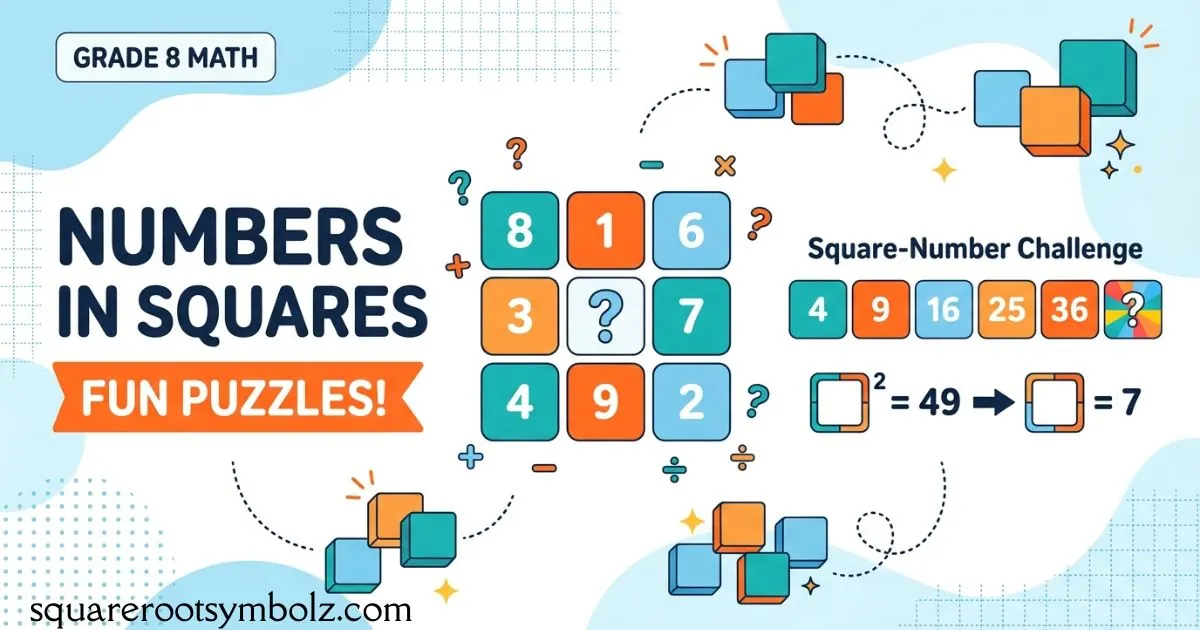
Numbers in squares puzzles are number-based challenges in which you fill empty boxes, identify hidden patterns, or arrange values according to mathematical rules. These puzzles may involve simple counting, arithmetic sequences, number grids, or more advanced logic. The key is to discover the rule that connects the numbers instead of guessing.
If you have ever looked at a square grid filled with numbers and wondered which value belongs in the empty box, you are not alone. The right approach is to examine rows, columns, number differences, and any special conditions. With a few practical techniques, these puzzles become easier to understand and much more enjoyable to solve.

Number Squares with Missing Numbers
A number square with missing numbers is a grid containing blank cells that need to be completed. The numbers usually follow an identifiable sequence across rows or down columns. In a standard hundred square, numbers increase by 1 from left to right and by 10 from top to bottom.
For example, if a row contains 21, 22, blank, 24, the missing value is 23. Similarly, if a number square shows 31 above an empty cell in a standard hundred chart, the missing value directly below it is 41. These simple relationships help solve many beginner puzzles.
Example: Find the missing numbers
1
2
3
4
11
12
?
14
21
?
23
24
31
32
33
?
Complete each row by counting forward from left to right.
Answers: 13, 22, and 34.
A helpful trick is to check the numbers immediately before and after each blank. If the sequence increases by 1, the missing value is usually easy to identify. For more difficult grids, check vertical relationships too, because a number may be constrained by both its row and its column.
Easy number square puzzles
Easy number square puzzles typically use consecutive numbers and predictable patterns. They are especially useful for elementary school students learning number order, counting, and place value. A simple 3 × 3 grid can provide enough clues to identify missing numbers without requiring complicated calculations.
For example, consider a row containing 7, 8, and an empty cell. The missing number is 9 if the sequence increases by one. When the same pattern appears in several rows, you can use it to solve an entire square systematically.
Missing Number Logical Reasoning Puzzle Question for Kids
Missing-number puzzles ask you to identify a value hidden inside a number arrangement. Unlike a standard number chart, some puzzles use different rules, such as adding neighboring numbers, multiplying values, or following a special pattern. Always inspect the available numbers before deciding which rule applies.
For children, these puzzles encourage observation and mathematical reasoning. For example, a row containing 4, 8, 12, and a blank suggests a constant increase of 4. Recognizing that difference is often more useful than trying random answers.
Puzzle: Find the missing number
2
4
6
5
?
9
8
10
12
What number completes the center row?
6
7
8
10
A good habit is to explain why your answer works. If a number fits the horizontal sequence but breaks the vertical pattern, it may not be correct. Testing the answer against all the available clues makes your solution more reliable.
What is a number grid puzzle?
A number grid puzzle is a mathematical challenge in which numbers are placed in a grid and must satisfy specific rules. Some grids use consecutive numbers, while others require arithmetic equations, non-repeating values, or particular totals. The rules determine which strategy you should use.
For instance, an arithmetic grid may require each row and column to form a valid equation. A hundred square instead follows a predictable counting structure. Although both use square-shaped cells, their solving methods differ. Identifying the puzzle type first prevents confusion and unnecessary calculations.
Common types of number grid puzzles
| Puzzle type | Main rule |
| Missing-number grid | Complete number sequences or patterns. |
| Hundred square | Follow counting patterns across rows and columns. |
| Magic square | Make the required row, column, and diagonal sums equal. |
| Arithmetic grid | Complete equations using the allowed operations. |
| Sudoku | Place digits without repeating them in specified rows, columns, and boxes. |
Magic squares are a particularly interesting variation. In a normal 3 × 3 magic square using the numbers 1 through 9 exactly once, every row, column, and main diagonal adds up to 15. That additional condition creates a different kind of reasoning challenge from ordinary missing-number grids.
Example of a 3 × 3 magic square
8
1
6
3
5
7
4
9
2
Every row, column, and main diagonal sums to 15.
How to play online
Online number-grid puzzles generally allow you to select empty cells and enter values using a keyboard or on-screen number pad. Some games provide hints, difficulty settings, timers, and automatic checks. The exact instructions depend on the puzzle’s rules, so read them before entering answers.
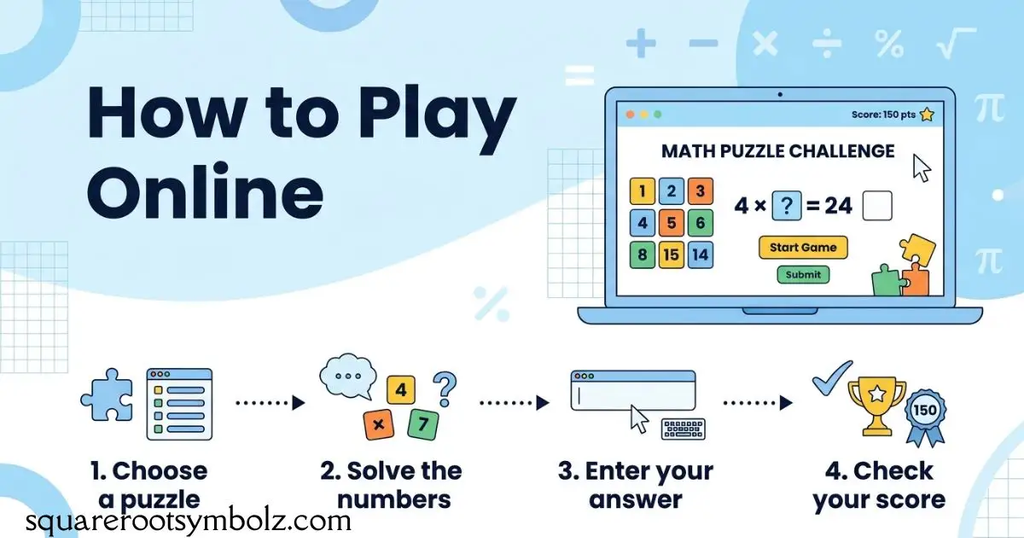
For arithmetic grids, solve equations with the fewest unknowns first. For missing-number grids, identify the sequence before filling multiple cells. In puzzles with non-repeating values, track which numbers are already used in each row and column. These habits reduce mistakes and make the solving process more organized.
A useful online practice routine is to start with easy puzzles, gradually increase the difficulty, and review incorrect answers. Rather than rushing to finish, focus on understanding why each number belongs in its position. That approach helps you recognize similar patterns in future puzzles.
Conclusion
Numbers in squares puzzles combine number patterns, logical reasoning, arithmetic, and visual problem-solving. Whether you are completing a missing-number grid, solving a number sequence, or exploring magic squares, the most important skill is recognizing the mathematical rule behind the arrangement.
Start with simple number squares and gradually move toward more challenging grids. Check both rows and columns, compare number differences, and verify each answer against the puzzle’s rules. With consistent practice, solving number puzzles becomes a more enjoyable and rewarding experience.
FAQs
What are numbers in squares puzzles?
Numbers in squares puzzles are mathematical challenges involving numbers arranged in square-shaped grids. Players fill missing cells or arrange numbers according to patterns, arithmetic rules, or logical conditions.
How do you find missing numbers in a square?
Start by checking the rows and columns for patterns. Look for consecutive numbers, constant differences, addition or multiplication rules, and relationships between neighboring cells. Then verify that your answer satisfies all the puzzle conditions.
What is a magic square?
A magic square is a square grid of numbers in which the sums of every row, every column, and the main diagonals are equal. A standard 3 × 3 magic square using the numbers 1 through 9 has a magic constant of 15.
How do number square puzzles help students?
Number square puzzles provide practice in counting, arithmetic, pattern recognition, and logical reasoning. They can help students become more comfortable identifying mathematical relationships and explaining their solutions.
What is the difference between a number square and a magic square?
A number square can be any square arrangement of numbers following a particular pattern or rule. A magic square is a specific type of number arrangement with equal sums across rows, columns, and main diagonals.
Are numbers in squares puzzles suitable for beginners?
Yes. Simple missing-number puzzles and hundred-square activities are suitable for beginners. More advanced arithmetic grids and magic squares can challenge older students and adults.
How do you solve difficult missing-number puzzles?
Look for relationships between multiple rows and columns instead of focusing on a single number. Test possible arithmetic operations, identify repeated patterns, and eliminate answers that violate the puzzle’s conditions.

I’m the creator of SquareRootSymbolz.com, where I publish easy-to-understand guides on symbols, Unicode characters, Alt codes, keyboard shortcuts, and copy-and-paste text symbols. My goal is to provide accurate, well-researched, and user-friendly content that helps readers quickly find the information they need.