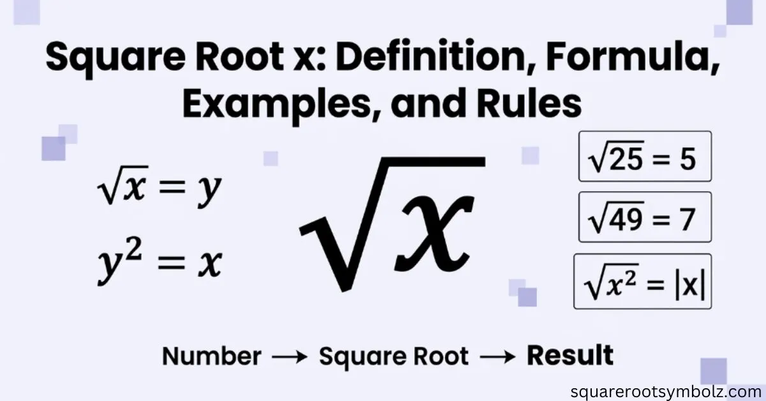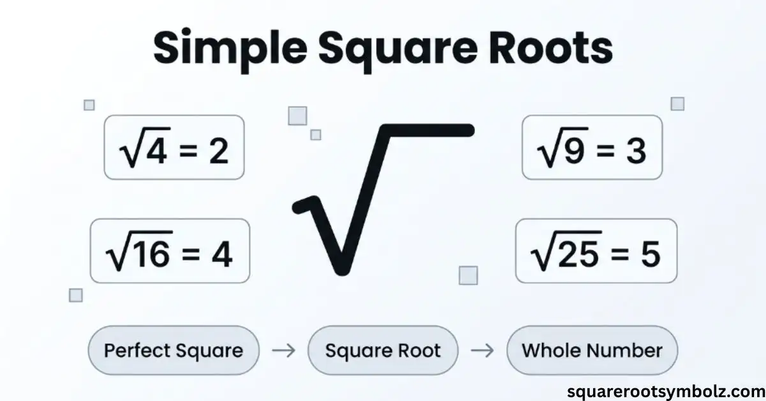
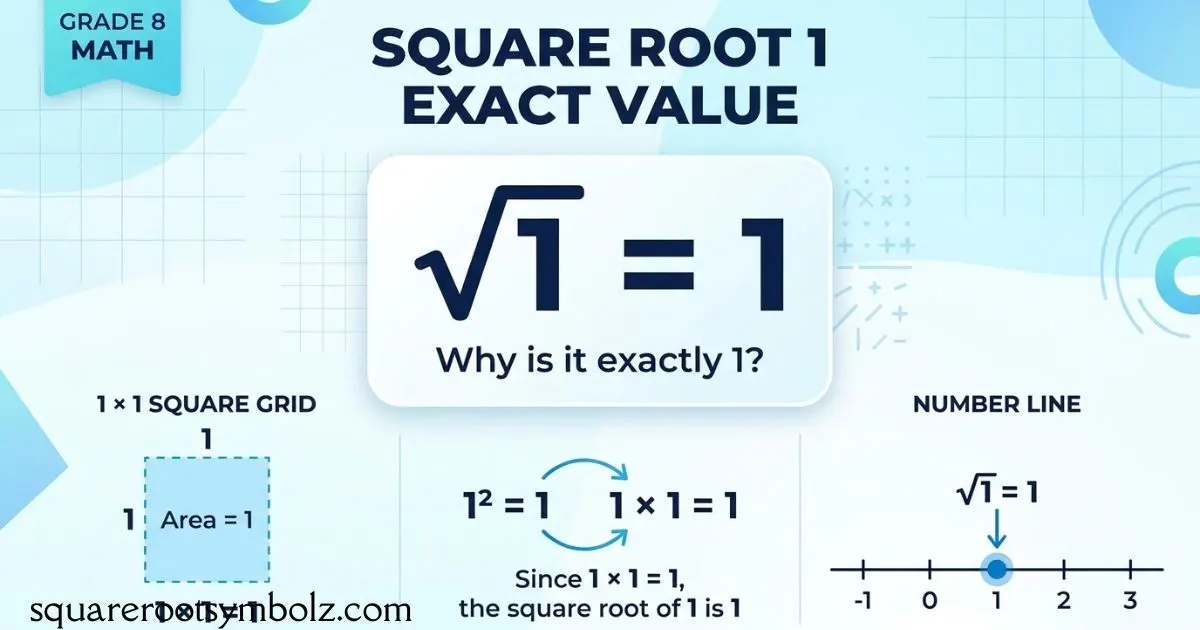
The square root 1 is exactly 1, because 1 multiplied by itself equals 1. In mathematical notation, √1 = 1. This is the principal square root, which is always nonnegative. The number 1 is also a perfect square, a rational number, and the multiplicative identity in arithmetic.
However, there is a small detail that often confuses students: both 1 and −1 produce 1 when squared. Understanding the difference between the principal square root and the solutions of a quadratic equation makes this topic much clearer. Let’s explore the calculation, mathematical properties, examples, and common questions using straightforward steps.

Value of Square Root of 1 and its Derivation
The value of the square root 1 is 1. The radical expression √1 asks which nonnegative number, when multiplied by itself, gives 1. Since 1 × 1 = 1, the exact answer is 1, without any decimal approximation.
The result can also be written in exponent form as 1^(1/2) = 1. This is because taking a square root is equivalent to raising a nonnegative number to the power of one-half. The value remains unchanged because 1 is the multiplicative identity.
Derivation of Square Root 1
To derive the square root 1, begin with the basic relationship between squaring and square roots. Since 1² = 1, taking the principal square root of both sides gives √(1²) = √1. The result is 1 = √1 because the principal square root is nonnegative.
Step-by-step derivation
- Start with 1 × 1 = 1.
- Write the multiplication as an exponent: 1² = 1.
- Take the principal square root: √1 = 1.
- Verify the result: 1 × 1 = 1.
√1 = 1
Exact value
Square Root of +1
The square root of positive one is 1 when using the principal square root convention. However, if a question asks for all numbers whose square is positive one, the answers are both +1 and −1. This distinction is essential when solving algebraic equations.
For example, the equation x² = 1 can be factored into (x − 1)(x + 1) = 0. Setting each factor equal to zero gives x = 1 or x = −1. The radical symbol √1, by contrast, represents only the principal value, 1.
| Expression | Answer | Meaning |
| √1 | 1 | Principal square root |
| −√1 | −1 | Negative of the principal root |
| x² = 1 | x = ±1 | Both real solutions |
| 1² | 1 | Square of positive one |
| (−1)² | 1 | Square of negative one |
This is one of the most important details to remember when moving from basic arithmetic to quadratic equations.
What Is the Square Root of 1?
The square root 1 is the number that produces 1 when multiplied by itself. The principal square root is 1 because 1 × 1 = 1. In radical notation, this is written as √1 = 1, while in exponential notation it is represented as 1^(1/2) = 1.
The number 1 is also a perfect square because it is the square of an integer. It is rational because it can be written as the fraction 1/1. These properties make it a useful example when learning square roots, exponents, rational numbers, and basic algebra.
Different representations of square root 1
| Form | Representation |
| Radical form | √1 = 1 |
| Exponent form | 1^(1/2) = 1 |
| Multiplication form | 1 × 1 = 1 |
| Square form | 1² = 1 |
| Fraction form | 1/1 = 1 |
| Decimal form | 1.0 |
Is Square Root of 1 Rational or Irrational?
The square root of 1 is rational because its value is 1, which can be expressed as a ratio of two integers. Specifically, 1 = 1/1, and the denominator is not zero. Therefore, √1 belongs to the set of rational numbers.
It is also a real number and an integer. Unlike irrational values such as √2, the square root of 1 has an exact terminating decimal representation. These classifications are useful when comparing number types and studying the relationships among integers, rational numbers, and real numbers.
| Number classification | Does √1 belong? | Explanation |
| Natural number | Yes | 1 is a natural number |
| Whole number | Yes | 1 is nonnegative |
| Integer | Yes | 1 is an integer |
| Rational number | Yes | 1 = 1/1 |
| Irrational number | No | It can be expressed as a fraction |
| Real number | Yes | 1 lies on the real number line |
How to Find the Square Root of 1?
You can find the square root of 1 using simple multiplication, the square-root definition, or the inverse relationship between exponents and radicals. Since 1 is already a perfect square, there is no need for long division, estimation, or a calculator.

Start by identifying a number that produces 1 when multiplied by itself. The number 1 meets this condition. Although −1 also satisfies the multiplication condition, the principal square-root convention selects the nonnegative answer.
Method 1: Multiplication
1 × 1 = 1
Therefore, √1 = 1.
Method 2: Using exponents
1² = 1
Taking the principal square root gives √1 = 1.
Method 3: Using the square-root definition
A square root of a number is a value whose square equals that number. Since 1² = 1, the principal square root of 1 is 1.
Try a square-root calculation
What is the principal square root of 1?
−1
0
1
±1
Conclusion
The square root of 1 is exactly 1 because 1 multiplied by itself equals 1. It is a perfect square, a rational number, and a real number. In mathematics, √1 always represents the principal square root, which is nonnegative.
Remember that the equation x² = 1 has two solutions, +1 and −1. This difference is especially important when studying algebra and square-root expressions. Once you understand this simple example, you have a useful foundation for exploring more complex square roots and mathematical equations.
FAQs
What is the square root of 1?
The square root of 1 is 1. This is because 1 × 1 = 1. The principal square root, represented by √1, is always nonnegative.
Is the square root of 1 positive or negative?
The principal square root of 1 is positive, meaning √1 = 1. However, both 1 and −1 are solutions to the equation x² = 1.
Why does the square root of 1 equal 1?
The square root of a number is the nonnegative value that produces the original number when squared. Since 1 × 1 = 1, the square root of 1 equals 1.
Is the square root of 1 rational or irrational?
The square root of 1 is rational because it equals 1, which can be expressed as 1/1. It is also an integer and a real number.
What is 1 squared?
One squared is 1. Multiplying 1 by itself gives 1 × 1 = 1. In exponent notation, this is written as 1² = 1.
Is √1 equal to ±1?
No. The expression √1 equals 1 because the radical symbol represents the principal square root. The equation x² = 1, however, has two solutions: x = 1 and x = −1.
What is the square root of negative 1?
The square root of negative 1 is not a real number. In complex-number mathematics, it is represented by the imaginary unit i, where i² = −1.

I’m the creator of SquareRootSymbolz.com, where I publish easy-to-understand guides on symbols, Unicode characters, Alt codes, keyboard shortcuts, and copy-and-paste text symbols. My goal is to provide accurate, well-researched, and user-friendly content that helps readers quickly find the information they need.