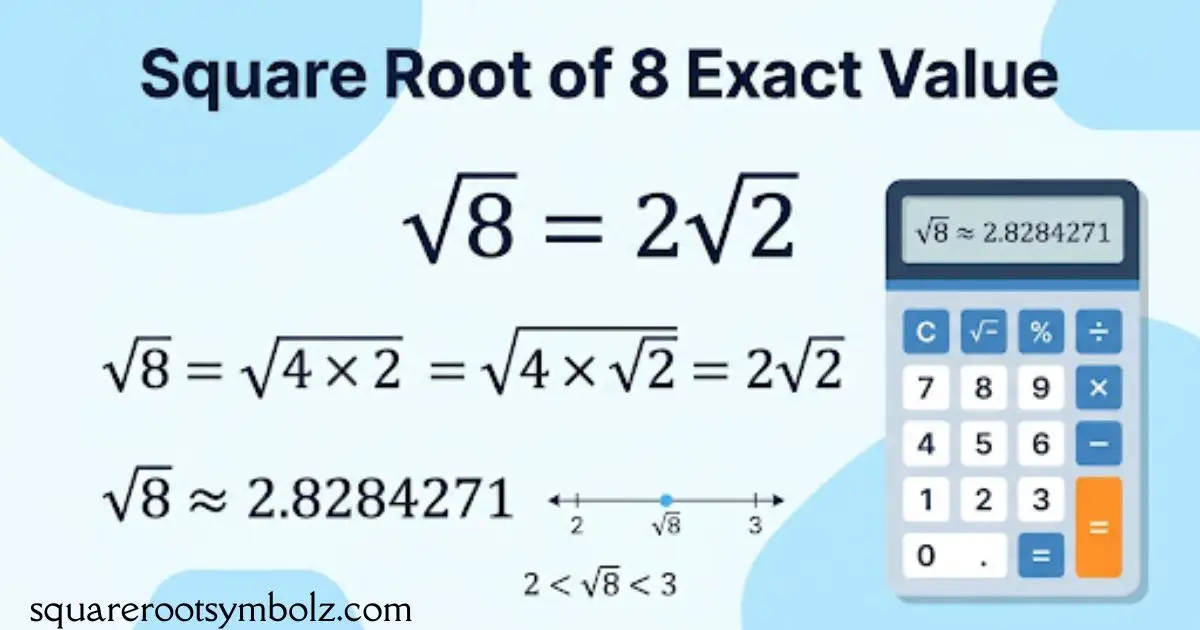
The square root of 8 is the positive number that produces 8 when multiplied by itself. It is written as √8 and has an exact simplified form of 2√2. Since 2² = 4 and 3² = 9, √8 lies between 2 and 3.
The radical sign tells you to find a number whose square equals the value beneath it. For √8, the answer is not a whole number, but it can be simplified by finding a perfect-square factor. This distinction between an exact radical and a decimal approximation is important in algebra.
Quick answer
√8 = 2√2 ≈ 2.828427
Exact form: 2√2 · Decimal form: approximately 2.828427
Is The Square Root of 8 Rational or Irrational?
The square root of 8 is an irrational number. A rational number can be expressed as a ratio of two integers, while an irrational number cannot. Because 8 is not a perfect square, √8 cannot be expressed as a whole number or a fraction of integers.
Its decimal form begins 2.8284271247 and continues without terminating or repeating. Simplifying √8 to 2√2 does not make it rational; √2 is also irrational. For school assignments, write 2√2 when an exact answer is required and use a rounded decimal when the problem asks for an approximation.
| Property | Square root of 8 |
| Exact simplified form | 2√2 |
| Decimal approximation | 2.828427 |
| Perfect square? | No |
| Rational or irrational? | Irrational |
| Between which integers? | 2 and 3 |
How To Find √8 Two Methods
You can find the square root of 8 by simplifying its radical form or by calculating a decimal approximation. Prime factorization is usually the quickest way to get the exact answer. Long division is useful when you need to understand how decimal digits are calculated without relying on a calculator.
Both methods lead to the same value, but they serve different purposes. Radical simplification keeps the result exact, while a decimal makes it easier to compare measurements or enter values into other calculations. Knowing which form a question requires can prevent an otherwise correct solution from losing marks.
Method 1 Prime factorization (the simplification)
Start by factoring 8 into 4 × 2. Since 4 is a perfect square, rewrite it as 2². Then take the square root of that factor: √(2² × 2) = 2√2. The remaining 2 stays beneath the radical because it has no additional square factor.
Step-by-step simplification
√8 = √(4 × 2)
= √4 × √2
= 2√2
Method 2 Long division (digit by digit)
To estimate √8 manually, first note that 2² = 4 and 3² = 9, so the answer starts with 2 and has a decimal part. The square-root long-division method groups digits in pairs and finds successive digits whose squares and products fit the remaining value.
For a quicker estimate, test nearby decimals. Since 2.8² = 7.84 and 2.83² = 8.0089, √8 is between 2.8 and 2.83. Refining the estimate gives approximately 2.828427. This is a decimal approximation, not an exact replacement for 2√2.
Calculating Square Roots
A square root can be estimated by comparing the number with nearby perfect squares. For 8, the closest lower and upper perfect squares are 4 and 9. Their roots are 2 and 3, which immediately tells you that √8 is between those values.
You can also use a calculator’s square-root key to obtain a decimal. The displayed result depends on the calculator’s precision and rounding settings. If a question asks for three decimal places, use 2.828; if it asks for two, use 2.83. Keep the radical form when exactness matters.
Simplify Expressions with Square Roots
The same square-factor method works for other radical expressions. For example, √18 becomes √(9 × 2), or 3√2. Similarly, √32 becomes √(16 × 2), or 4√2. Identifying the largest perfect-square factor makes simplification faster and helps you avoid leaving a radical in a reducible form.
Expressions with matching radicals can also be combined. Since √8 = 2√2, adding √8 and √2 gives 3√2. However, unlike radicals cannot usually be combined into one term: 2√2 + √3 stays as written. Simplify each radical first, then check whether the remaining radical parts match.
| Expression | Simplified form |
| √8 | 2√2 |
| √18 | 3√2 |
| √32 | 4√2 |
| √12 | 2√3 |
| √50 | 5√2 |
What are the most common mistakes with √8?
One common mistake is treating √8 as 4√2. Although 8 can be written as 4 × 2, the factor that comes outside the radical is √4, which equals 2 not 4. Another mistake is assuming that a decimal approximation is the exact value.
A third error is splitting a square root over addition. For example, √(4 + 4) is not equal to √4 + √4. The square-root product rule applies to multiplication under suitable real-number conditions, not to addition. Keeping these rules separate makes radical problems much more reliable.
Common error check
| Incorrect | Correct |
| √8 = 4√2 | √8 = 2√2 |
| √(4 + 4) = 2 + 2 | √(4 + 4) = √8 = 2√2 |
| √8 = 2.83 exactly | √8 ≈ 2.83 |
Examples of Square Root of 8
Example 1: Simplify √8.
Factor 8 as 4 × 2. Since √4 = 2, the expression becomes 2√2. This is the simplest radical form because 2 has no perfect-square factor greater than 1.
Example 2: Round √8 to two decimal places.
The decimal value is approximately 2.828427. The third digit after the decimal point is 8, so round the second decimal digit up. The result is 2.83.
Example 3: Add √8 and √2.
Rewrite √8 as 2√2. Then add like radicals: 2√2 + √2 = 3√2. The key is to simplify before combining terms.
Example 4: Find the diagonal of a square with side length 2 units.
Using the Pythagorean theorem, the diagonal is √(2² + 2²) = √8 = 2√2 units, or about 2.828 units. This is a geometric example of the same radical appearing in a measurement.
Example 5: Find the side length of a square with area 8 square units.
The area of a square is side × side. Therefore, its side length is √8, which simplifies to 2√2 units. In decimal form, that is approximately 2.828 units.
Where √8 Appears
The value √8 appears in geometry when calculating the diagonal of a square with side length 2. Each side forms a right angle, so the Pythagorean theorem gives the diagonal as √(2² + 2²) = √8. The simplified result, 2√2, expresses the same length exactly.
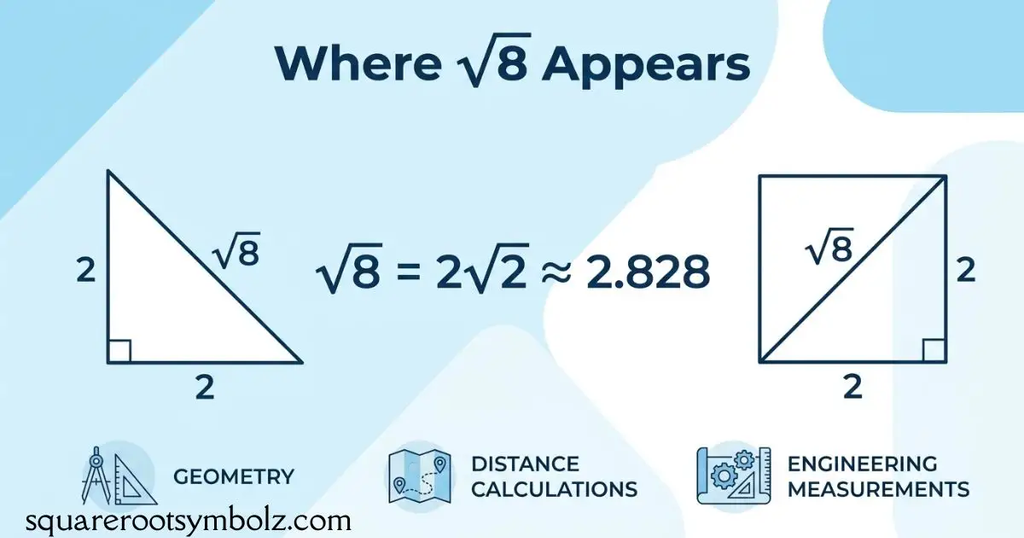
It also appears in coordinate geometry. The distance between the points (0, 0) and (2, 2) is √((2 − 0)² + (2 − 0)²), which equals √8. These examples show why a square root is more than a calculation: it represents a distance or measurement that may not be a whole number.
Conclusion
The square root of 8 has an exact simplified form of 2√2 and a decimal value of approximately 2.828427. Because 8 is not a perfect square, its square root is irrational. The simplest way to simplify it is to factor 8 into 4 × 2 and take the square root of the perfect-square factor.
Remember the central rule: a perfect-square factor can leave the radical as its square root. This approach works for √8 and many other radical expressions, making it useful in algebra, geometry, and everyday measurement problems.
FAQ Section
The following questions reflect common search intent around this topic. They are not presented as a verified live extraction of Google’s People Also Ask results.
What is the square root of 8?
The square root of 8 is 2√2, or approximately 2.828427 in decimal form.
What is √8 in simplest radical form?
The simplest radical form is 2√2. Since 8 = 4 × 2 and √4 = 2, the expression simplifies to 2√2.
Is the square root of 8 rational or irrational?
It is irrational because 8 is not a perfect square. Its decimal expansion continues without terminating or repeating.
Is 8 a perfect square?
No. A perfect square is the product of an integer multiplied by itself. Since no integer squared equals 8, it is not a perfect square.
What is the square root of 8 rounded to the nearest hundredth?
The square root of 8 rounded to the nearest hundredth is 2.83.
What two whole numbers is √8 between?
√8 is between 2 and 3, because 2² = 4 and 3² = 9.
How do you simplify √8 without a calculator?
Write 8 as 4 × 2. Then use √8 = √4 × √2 = 2√2. This gives the exact simplified answer without needing a decimal calculation.
Is √8 the same as 2√2?
Yes. They are equivalent expressions. Squaring 2√2 gives 4 × 2 = 8, confirming that 2√2 is the positive square root of 8.

I’m the creator of SquareRootSymbolz.com, where I publish easy-to-understand guides on symbols, Unicode characters, Alt codes, keyboard shortcuts, and copy-and-paste text symbols. My goal is to provide accurate, well-researched, and user-friendly content that helps readers quickly find the information they need.