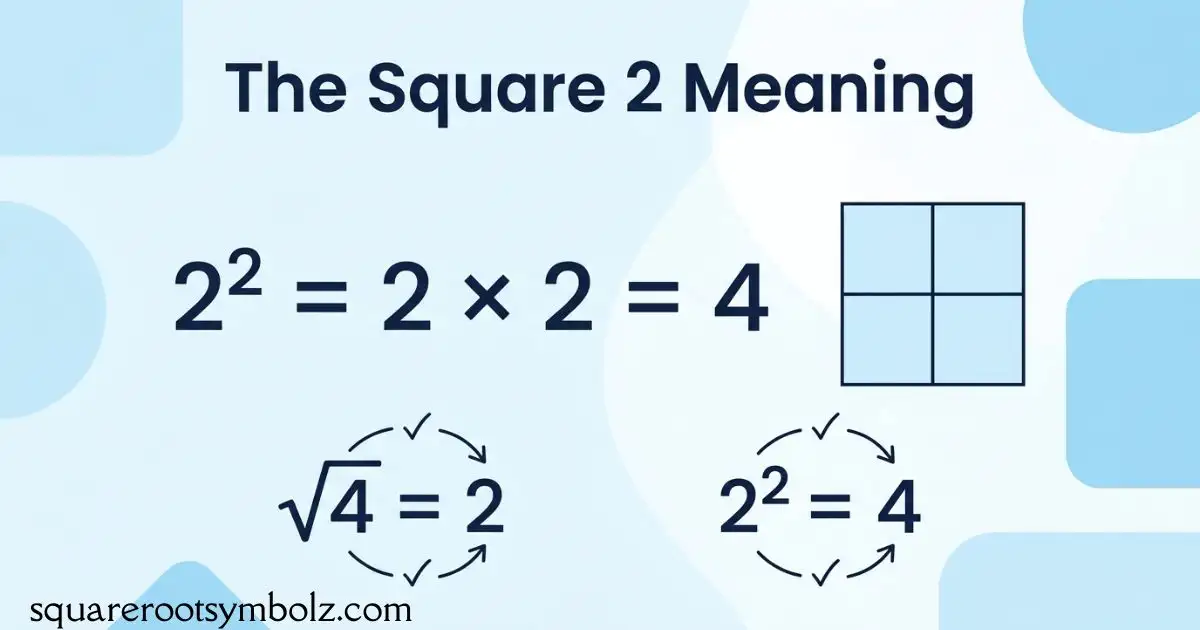
The square 2 is 4. In mathematics, squaring a number means multiplying it by itself. Therefore, 2 squared is calculated as 2 × 2 = 4.
The square of 2 can be written as 2², read as “two squared” or “two to the second power.” It is a simple example of exponents and square numbers, and it helps students understand more advanced topics such as algebra, geometry, and quadratic equations.
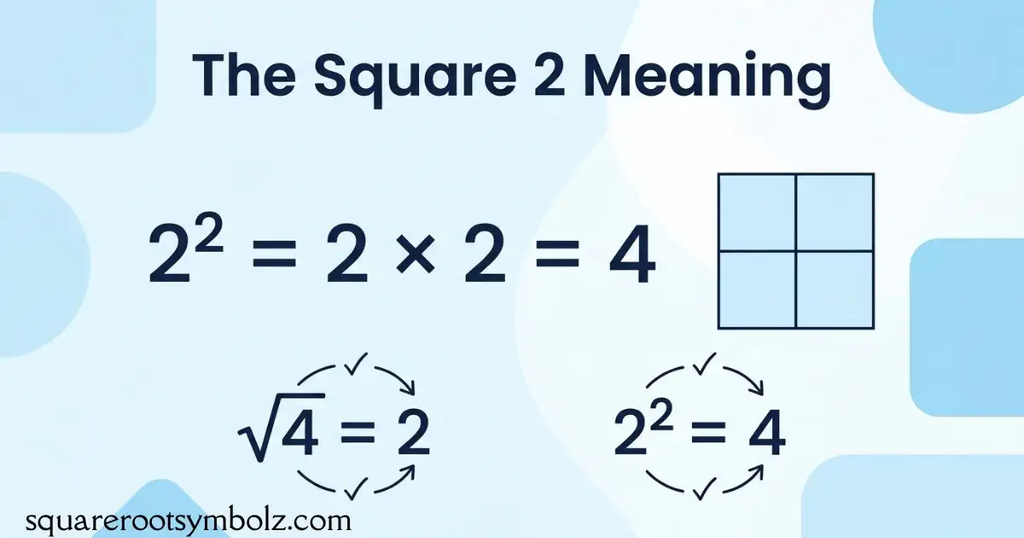
What Is the Square of 2?
The square 2 is the result of multiplying 2 by itself.
2² = 2 × 2 = 4
Here:
- 2 is the base.
- 2 is the exponent.
- 4 is the result, also called the square.
Squaring does not mean multiplying a number by 2. Instead, it means using the number as a factor twice.
For example:
- Square of 2: 2 × 2 = 4
- Square of 3: 3 × 3 = 9
- Square of 4: 4 × 4 = 16
This pattern is the foundation for understanding square numbers.
What Is 2 Squared?
Two squared means 2 multiplied by itself. Its value is 4.
The expression can be shown in three equivalent ways:
- 2²
- 2 to the second power
- 2 × 2 = 4
The small raised number 2 is called an exponent. It tells you how many times the base is used as a factor. In 2², the base is 2 and the exponent is 2.
Remember that 2² is not the same as 2 × 2² or 2 × 2. The first expression means 2 multiplied by itself, while the others include additional operations or factors.
How to Calculate 2²
You can calculate 2² by following a simple multiplication step.
Step 1: Identify the base and exponent.
In 2², the base is 2 and the exponent is 2.
Step 2: Multiply the base by itself.
2 × 2
Step 3: Find the product.
2 × 2 = 4
Therefore:
2² = 4
You can use the same method for any whole number. For example, 5² means 5 × 5, which equals 25.
Why Is the Square of 2 Equal to 4?
The square 2 equals 4 because multiplication combines two factors of 2.
You can also understand this using a geometric square. Imagine a square with a side length of 2 units. The area of a square is calculated by multiplying its side length by itself.
Area = side × side
For a square with sides of 2 units:
Area = 2 × 2 = 4 square units
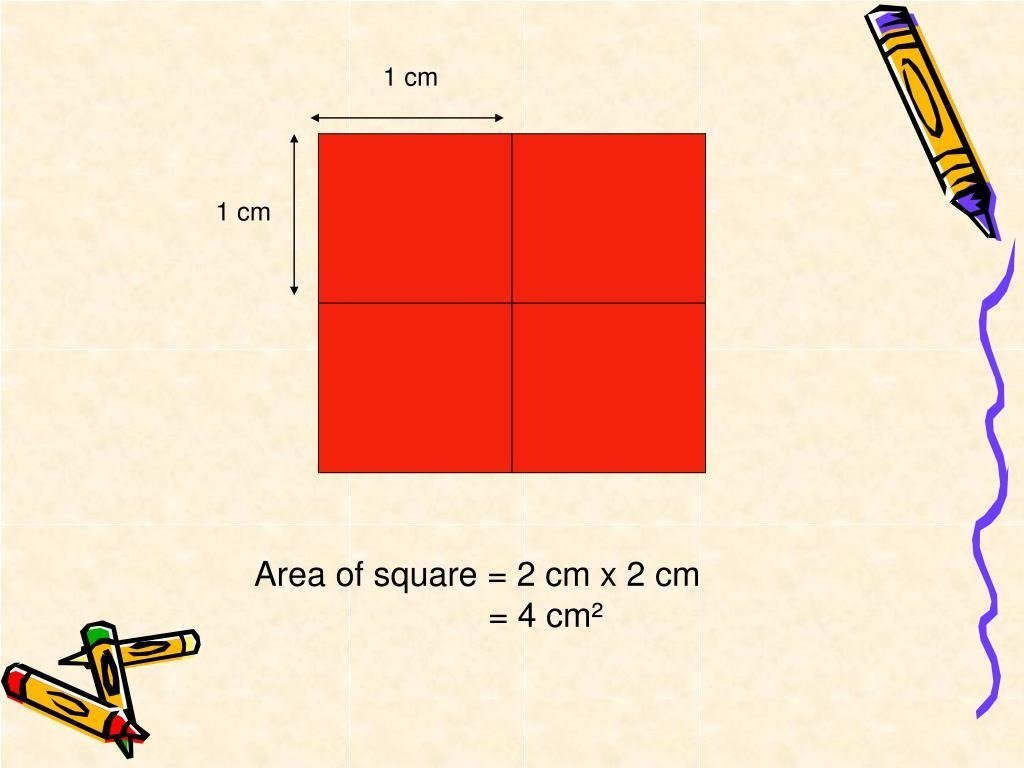
This visual representation connects the arithmetic meaning of squaring with the geometric meaning of finding the area of a square.
Square of 2 Examples
Here are a few examples that show how the square 2 relates to other calculations.
| Expression | Calculation | Result |
| 2² | 2 × 2 | 4 |
| 2³ | 2 × 2 × 2 | 8 |
| 2⁴ | 2 × 2 × 2 × 2 | 16 |
| 3² | 3 × 3 | 9 |
| 4² | 4 × 4 | 16 |
Notice that the exponent changes the number of times the base is multiplied by itself. For example, 2² uses two factors of 2, while 2³ uses three.
Example 1: Find the square of 2.
2² = 2 × 2 = 4
Answer: 4
Example 2: Find the area of a square with a side length of 2 inches.
Area = side × side Area = 2 × 2 = 4 square inches
Answer: 4 square inches
Example 3: Compare 2² and 2³.
2² = 4 2³ = 8
The value of 2³ is twice the value of 2² because it includes one additional factor of 2.
Is 4 a Perfect Square?
Yes. Four is a perfect square because it is the product of a whole number multiplied by itself.
2 × 2 = 4
A perfect square is a number that can be expressed as the square of an integer. Some examples are:
| Number | Square form |
| 1 | 1² |
| 4 | 2² |
| 9 | 3² |
| 16 | 4² |
| 25 | 5² |
| 36 | 6² |
The square root of 4 is 2 when referring to the principal, nonnegative square root. In an equation such as x² = 4, however, both 2 and −2 are solutions.
Difference Between 2² and 2 × 2
The expressions 2² and 2 × 2 look different, but they have the same value.
- 2² is exponential notation.
- 2 × 2 is multiplication notation.
- 4 is the result of both expressions.
The exponent in 2² tells you to multiply the base 2 by itself. It is a shorter way to write repeated multiplication.
Compare these expressions:
- 2² = 2 × 2 = 4
- 2 × 2 = 4
- 2 × 3 = 6
The last expression is not the square 2 because the two factors are different.
Common Mistakes When Squaring 2
Students sometimes confuse squaring with doubling or misread exponents. These are common errors to avoid.
Mistake 1: Thinking 2² means 2 × 2 only because the exponent is a 2
The result is correct, but the important concept is that the exponent tells how many factors of the base are used. This idea also works for larger exponents.
Mistake 2: Adding instead of multiplying
Incorrect: 2² = 2 + 2 = 4
Although the result happens to be the same in this example, the operation is wrong. Squaring means multiplication, not addition. This mistake becomes clear with other numbers: 3² is 9, not 6.
Mistake 3: Confusing squaring with doubling
Doubling 2 gives 2 × 2 = 4, while squaring 2 also gives 4. The results happen to match for this number. But doubling 3 gives 6, whereas squaring 3 gives 9.
Mistake 4: Forgetting the role of parentheses with negative numbers
There is an important difference between (−2)² and −2².
- (−2)² = (−2) × (−2) = 4
- −2² = −(2 × 2) = −4
Parentheses determine whether the negative sign is included in the base.
Where Is the Square of 2 Used?
The square 2 appears in several areas of mathematics and everyday problem-solving.
- Geometry: A square with a side length of 2 units has an area of 4 square units.
- Algebra: Squared numbers appear in expressions such as x² + 4 and equations such as x² = 4.
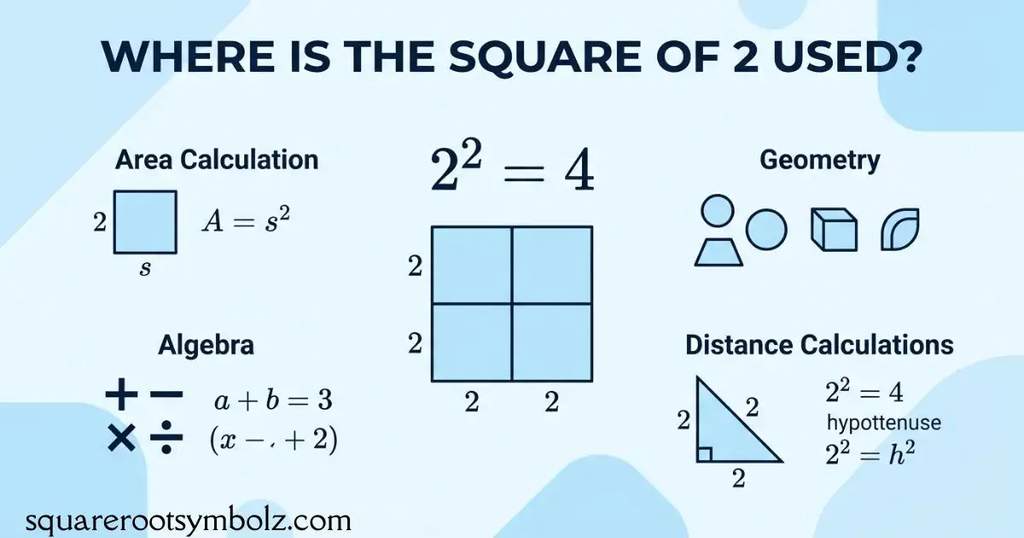
- Exponents: 2² helps introduce powers and repeated multiplication.
- Number patterns: The value 4 is one of the perfect squares in the sequence 1, 4, 9, 16, 25, and so on.
- Measurement: Squaring a length helps calculate area, which is measured in square units rather than ordinary linear units.
Understanding 2² provides a simple starting point for these broader mathematical ideas.
Conclusion
The square 2 is 4, calculated by multiplying 2 by itself. It is written as 2² and is a basic example of an exponent and a perfect square.
Understanding this simple calculation helps explain repeated multiplication, square numbers, geometric area, and algebraic expressions. Once you understand why 2² equals 4, you can apply the same method to square other numbers and solve more advanced math problems.
FAQs
What is the square of 2?
The square of 2 is 4. It is calculated by multiplying 2 by itself: 2 × 2 = 4.
What is 2 squared in math?
Two squared is written as 2². It means 2 multiplied by itself, giving a result of 4.
Is 2² the same as 2 × 2?
Yes. Both expressions have a value of 4. The expression 2² uses exponent notation, while 2 × 2 uses multiplication notation.
Why is 2 squared equal to 4 and not 8?
The exponent 2 means that the base appears as two factors: 2 × 2. Multiplying three factors of 2 would give 2³ = 8.
What is the square root of 4?
The principal square root of 4 is 2 because 2 × 2 = 4. In the equation x² = 4, the two solutions are 2 and −2.
Is 2 a perfect square?
No. The number 2 is not a perfect square because no integer multiplied by itself equals 2. However, 2 is the square root of 4.
What is the difference between 2 squared and 2 cubed?
Two squared is 2 × 2 = 4. Two cubed is 2 × 2 × 2 = 8. Squaring uses two factors, while cubing uses three.
Practice Questions
Test your understanding of the square of 2 and related concepts.
- What is 2²?
- What is 3²?
- What is 2³?
- What is the area of a square with sides of 2 feet?
- Is 4 a perfect square?
Answers:
- 4
- 9
- 8
- 4 square feet
- Yes, because 2 × 2 = 4.

I’m the creator of SquareRootSymbolz.com, where I publish easy-to-understand guides on symbols, Unicode characters, Alt codes, keyboard shortcuts, and copy-and-paste text symbols. My goal is to provide accurate, well-researched, and user-friendly content that helps readers quickly find the information they need.