A mathematical number is an abstract value used to represent quantity, order, measurement, or a mathematical relationship. It may appear as a numeral such as 5, a fraction such as 1/2, or a symbol such as π. Understanding the difference between a number, digit, numeral, quantity, and identifier makes arithmetic, algebra, fractions, decimals, and number systems much easier to follow.
If numbers have ever seemed like nothing more than symbols to memorize, you are not alone. A useful way to see them is as a language for describing patterns and quantities. In this guide, we will move from natural numbers and integers to rational, irrational, real, and complex numbers, while clearing up common confusion about zero, infinity, and numerical notation.
Number vs. numeral
A mathematical number is the underlying value or concept, while a numeral is a written representation of that value. For example, the number three can be written as 3, III, or “three.” These are different numerals referring to the same number. This distinction becomes important when studying notation, symbols, and number systems.
Think about the number five. Writing “5” on paper does not create the number itself; it gives you a convenient representation of it. The same value can appear in different forms, including a fraction such as 10/2. The notation changes, but the mathematical value remains five. This is why number and numeral should not be treated as synonyms.
| Term | Meaning | Example |
| Number | The mathematical value or concept | Five |
| Numeral | A written representation of a number | 5 |
| Digit | A single symbol used to write numbers | 5 |
| Number word | A written word representing a number | five |
This distinction also helps explain why a string of digits is not automatically a mathematical number in every context.
When digits aren’t really a number
Digits can appear in a mathematical number, but they can also serve as labels or identifiers. For example, 24 as a mathematical number has properties: it is even, composite, and has specific factors. But “24” in a model number or account identifier may simply identify something. The digits look identical, but their function is different.
Consider 2026. As a mathematical number, it can be analyzed for factors, parity, and other properties. As a year, however, it identifies a position in a calendar system. Likewise, a jersey number identifies a player, and an HTTP status code identifies a type of web response. The surrounding context tells you whether arithmetic is actually meaningful.
This distinction is useful in everyday life because people constantly encounter numbers that are not being used as quantities. A phone number, ZIP code, room number, product code, or account number may contain digits without representing an amount that can meaningfully be added, multiplied, or compared.
The major families of numbers
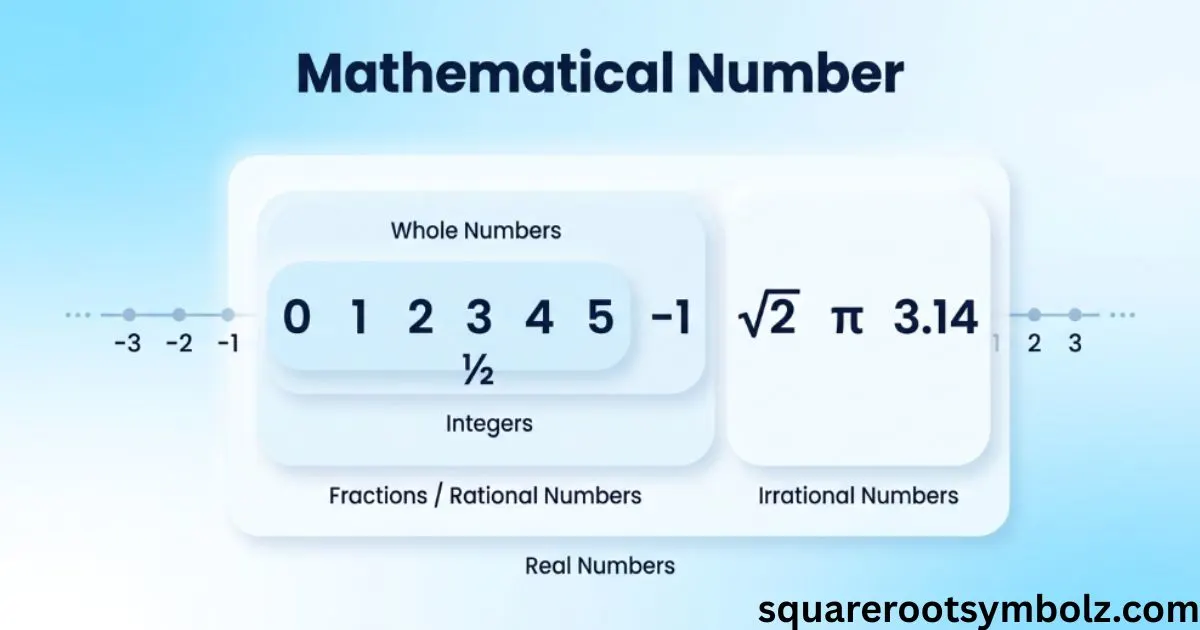
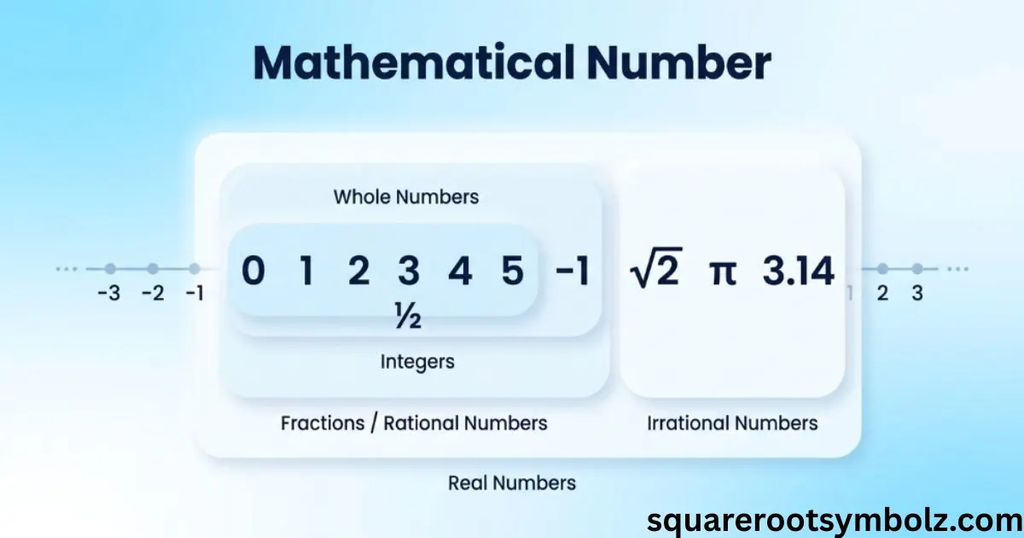
The major families of a mathematical number form an organized system rather than a random list. Natural numbers lead to whole numbers and integers; integers sit inside the rational numbers; rational and irrational numbers together make the real numbers; and real numbers are contained within the complex numbers.
This structure is easiest to understand as a series of extensions. Counting numbers are useful for counting objects, but they cannot express negative values. Integers solve that problem. Integers cannot represent every division, so rational numbers extend them. Irrational numbers fill the gaps left by rational numbers, creating the real number system.
| Number family | Typical examples | Key idea |
| Natural | 1, 2, 3 | Counting |
| Whole | 0, 1, 2 | Counting plus zero |
| Integer | −3, −2, −1, 0, 1 | Positive, negative, and zero |
| Rational | 1/2, −4, 7 | Ratio of integers |
| Irrational | √2, π | Cannot be written as a ratio of integers |
| Real | −4, 0, 1/2, √2 | Rational and irrational numbers |
| Complex | 3 + 2i | Real and imaginary components |
The hierarchy is powerful because each larger family solves problems that a smaller family cannot handle.
Number Systems
A number system is a structured collection of numbers together with conventions for representing and working with them. In everyday arithmetic, the decimal system uses the ten digits 0 through 9. Mathematical number systems also classify values into groups such as natural, integer, rational, real, and complex numbers.
The decimal system is especially familiar because place value gives each digit a position-dependent meaning. In 352, for example, the 3 represents three hundreds, the 5 represents five tens, and the 2 represents two ones. Changing the position changes the value represented by a digit.
Mathematics also uses other systems. Binary uses only 0 and 1 and is fundamental to computing. Hexadecimal uses sixteen symbols and is common in programming and digital color notation. These are systems for representing values, while mathematical classifications such as real and complex numbers describe the kinds of values being represented.
Types of Numbers
Types of numbers are classifications based on mathematical properties. Natural numbers are used for counting, integers include negative values and zero, rational numbers can be written as ratios of integers, irrational numbers cannot, and real numbers contain both rational and irrational values. Complex numbers extend the system further.
The classification becomes much easier when you stop trying to memorize isolated definitions. Ask what problem each type solves. Natural numbers handle counting. Integers make subtraction more flexible. Rational numbers make exact division possible in many cases. Irrational numbers describe values such as √2 that cannot be represented as ratios of integers.
Some classifications describe additional properties rather than completely new number systems. For example, integers can be positive, negative, even, odd, prime, or composite. A single number can belong to several categories at once. The number 7, for instance, is natural, whole, integer, rational, real, positive, odd, and prime.
Natural Numbers and Whole Numbers
Natural numbers are commonly used as counting numbers: 1, 2, 3, 4, and so on. Whole numbers include the natural numbers together with zero: 0, 1, 2, 3, and so forth. One convention starts natural numbers at 1, although some mathematical and computing contexts include zero.
The difference is small but important. If a teacher asks for the number of books on a shelf, natural numbers can describe one book, two books, three books, and so on. If the shelf is empty, zero becomes necessary. Whole numbers provide that zero while retaining the nonnegative counting values.
| Property | Natural numbers | Whole numbers |
| Starts with | Commonly 1 | 0 |
| Includes 0 | Depends on convention, commonly no | Yes |
| Negative numbers | No | No |
| Fractions | No | No |
| Decimals | No | No |
| Examples | 1, 2, 3, 4 | 0, 1, 2, 3 |
For school mathematics in the United States, checking the convention used by your textbook or teacher is sensible whenever the question specifically asks whether zero belongs to the natural numbers.
Rational Numbers and Irrational Numbers
A rational number can be written as a fraction of two integers with a nonzero denominator. Examples include 1/2, −3, 7/4, and 5, because 5 can be written as 5/1. In decimal form, rational numbers have terminating or repeating decimal expansions.
An irrational number cannot be written as a ratio of two integers. Its decimal representation continues without terminating or settling into a repeating pattern. Common examples include π and √2. These numbers are not “less exact” because their decimals continue forever; the exact mathematical value can still be defined precisely.
| Rational | Irrational |
| Can be written as a/b | Cannot be written as a/b |
| Denominator b ≠ 0 | No integer ratio represents it |
| Decimal terminates or repeats | Decimal does not terminate or repeat |
| 1/2 = 0.5 | √2 ≈ 1.414… |
| 1/3 = 0.333… | π ≈ 3.14159… |
Together, rational and irrational numbers form the real numbers. This relationship is one of the most important connections in the mathematical number system.
Real Numbers
Real numbers include every rational and irrational number and can be represented as points on the real number line. Integers, fractions, terminating decimals, repeating decimals, and irrational values such as √2 are therefore real numbers. Wolfram MathWorld describes the real numbers as the field containing both rational and irrational numbers.
Imagine a number line extending indefinitely in both directions. Numbers such as −3, 0, 1/2, 4, and √2 all have positions on that line. The distance and order relationships between these values allow real numbers to describe measurements, coordinates, quantities, rates, and many other mathematical ideas.
Real numbers are central to algebra, geometry, calculus, statistics, and science. When you measure a length, plot a coordinate, calculate an average, or solve many ordinary equations, you are usually working with real values. Their usefulness comes from the fact that they combine discrete values such as integers with continuous values such as irrational numbers.
Complex Numbers
Complex numbers extend the real number system by introducing the imaginary unit i, where i² = −1. A complex number has the form a + bi, where a and b are real numbers. Real numbers are included as complex numbers when the imaginary component is zero.
This extension solves equations that have no real-number solution. Consider x² = −1. No real number squared gives −1, but the imaginary unit satisfies i² = −1. Therefore, the solutions can be expressed using i. Complex numbers are not merely theoretical curiosities; they are used in engineering, physics, signal processing, and many areas of applied mathematics.
A useful way to picture complex numbers is on the complex plane. The horizontal axis represents the real component, while the vertical axis represents the imaginary component. Thus 3 + 2i corresponds to the point (3, 2). This geometric interpretation makes an abstract mathematical number much easier to visualize.
The Number Hierarchy
The number hierarchy shows how familiar number families fit inside broader systems. A common progression is natural numbers → whole numbers → integers → rational numbers → real numbers → complex numbers. Rational and irrational numbers together make up the real numbers, while real numbers form a subset of the complex numbers.
For example, 5 belongs to several families at once. It is a natural number, whole number, integer, rational number, real number, and complex number. The reason is that each broader set contains the previous one. Writing 5 as 5/1 makes its rational status clear, and writing it as 5 + 0i shows why it is also a complex number.
The hierarchy can be viewed like nested containers:
Natural → Whole → Integer → Rational → Real → Complex
Irrational numbers sit alongside rational numbers within the real numbers rather than forming a separate step in that simple chain. Understanding this structure makes later topics such as algebra, functions, equations, and complex analysis much easier to organize mentally.
Zero and infinity
Zero is a genuine mathematical number and serves as the additive identity: adding zero to a number leaves that number unchanged. Infinity is different. It represents an unbounded idea rather than an ordinary real value that sits at a particular point on the number line.
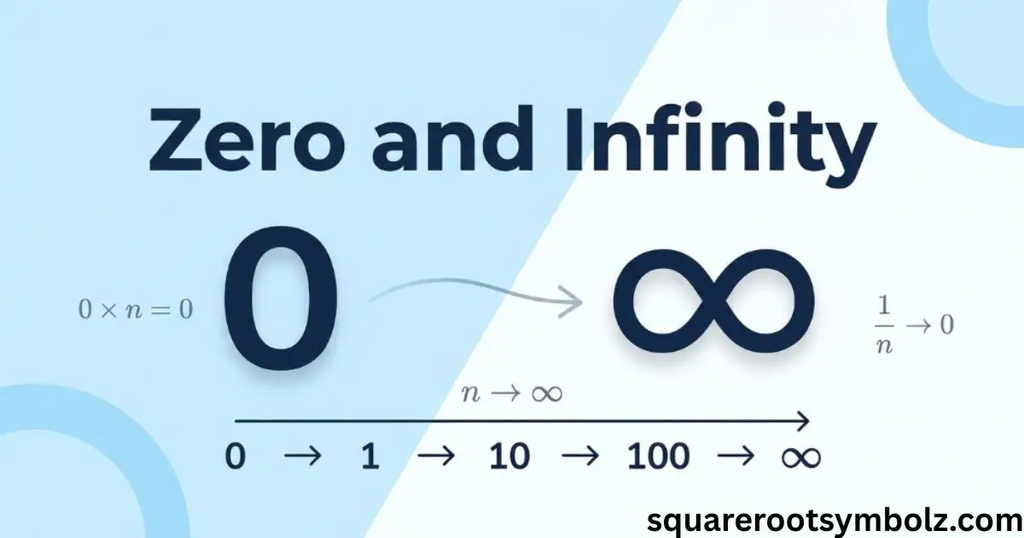
Zero often causes confusion because it sits between positive and negative numbers and because conventions differ over whether zero belongs to the natural numbers. Regardless of that classification choice, zero is a whole number, integer, rational number, and real number.
Infinity should not be treated as simply “the biggest number.” There is no largest real number because any real value can be increased by 1. Infinity is instead used to describe unbounded behavior, limits, sizes, or processes. That distinction becomes especially important in calculus and advanced mathematics.
Common misconceptions
One common mistake is treating a numeral as though it were the number itself. The symbol 7 is a representation of the mathematical number seven. Another mistake is assuming that every sequence of digits represents a quantity. A house number, phone number, or product identifier can function as a label rather than a mathematical amount.
A second misconception is that every decimal is irrational. That is false. A terminating decimal such as 0.75 is rational because it equals 3/4, and a repeating decimal such as 0.333… is rational because it equals 1/3. Irrational decimals are non-terminating and non-repeating.
A third mistake is assuming that complex numbers are somehow “fake” numbers because of the word imaginary. Complex numbers form a well-defined mathematical system and are used extensively in advanced mathematics and applied science. The word imaginary describes the component involving i; it does not mean the mathematics is unreal.
Conclusion
A mathematical number is more than a digit written on a page. It is a mathematical value that can represent quantity, measurement, order, or a relationship, while its numeral is the notation used to represent it. Once that distinction is clear, the number system becomes much easier to understand.
Natural, whole, integer, rational, irrational, real, and complex numbers are connected parts of a larger mathematical structure. Knowing how they relate helps you move confidently from basic arithmetic to algebra, geometry, calculus, statistics, and higher mathematics. The most useful habit is to focus not only on what a number looks like, but also on what mathematical role it is performing.
FAQ Section
What is a mathematical number?
A mathematical number is an abstract value used to represent quantity, measurement, order, or a mathematical relationship. Examples include 5, −3, 1/2, √2, π, and 2 + 3i.
What is the difference between a number and a numeral?
A number is the underlying mathematical value, while a numeral is a written representation of that value. For example, 3, III, and “three” are different representations of the same number.
What are the main types of mathematical numbers?
The commonly taught families are natural numbers, whole numbers, integers, rational numbers, irrational numbers, real numbers, and complex numbers. These categories overlap in a structured hierarchy.
Is zero a mathematical number?
Yes. Zero is a mathematical number and is the additive identity. It belongs to the whole numbers, integers, rational numbers, real numbers, and complex numbers. Whether zero is classified as a natural number depends on the convention being used.
Is infinity a number?
Infinity is not an ordinary real number. It describes an unbounded quantity or process rather than a specific value on the real number line.
Are decimals mathematical numbers?
Yes. A terminating decimal such as 0.5 is a rational number. Repeating decimals such as 0.333… are also rational. Non-terminating, non-repeating decimals represent irrational real numbers.
What is the difference between rational and irrational numbers?
Rational numbers can be expressed as a fraction of two integers with a nonzero denominator. Irrational numbers cannot. Rational decimals terminate or repeat, while irrational decimals do neither.
Are complex numbers mathematical numbers?
Yes. Complex numbers are a well-defined extension of the real number system. They have the form a + bi, where a and b are real numbers and i² = −1.
Why are numbers important in mathematics?
Numbers provide a way to represent quantity, compare values, measure, count, describe relationships, and perform calculations. They form the foundation for arithmetic and support later areas such as algebra, geometry, calculus, statistics, and number theory.
What is the largest mathematical number?
There is no largest ordinary mathematical number. For any number n, the number n + 1 is larger. Infinity is not the largest number; it represents an unbounded concept rather than a final real value.

I’m the creator of SquareRootSymbolz.com, where I publish easy-to-understand guides on symbols, Unicode characters, Alt codes, keyboard shortcuts, and copy-and-paste text symbols. My goal is to provide accurate, well-researched, and user-friendly content that helps readers quickly find the information they need.