The 6 square root is √6, with a decimal value of approximately 2.44948974278. It is an irrational number because 6 is not a perfect square, and √6 cannot be written exactly as a fraction. If you are stuck between the radical form, decimal answer, or simplest form, the key is simple: √6 is already fully simplified. This guide explains its value, classification, calculation methods, prime factors, long division, rounding, and practical uses in geometry.
When students first meet √6, the confusing part is often why the radical does not disappear. The reason is that 6 has factors 2 and 3, but no repeated prime factor. Once you see the connection between perfect squares, irrational numbers, radicands, and decimal approximations, the calculation becomes much less intimidating.
What Is the Square Root of 6?
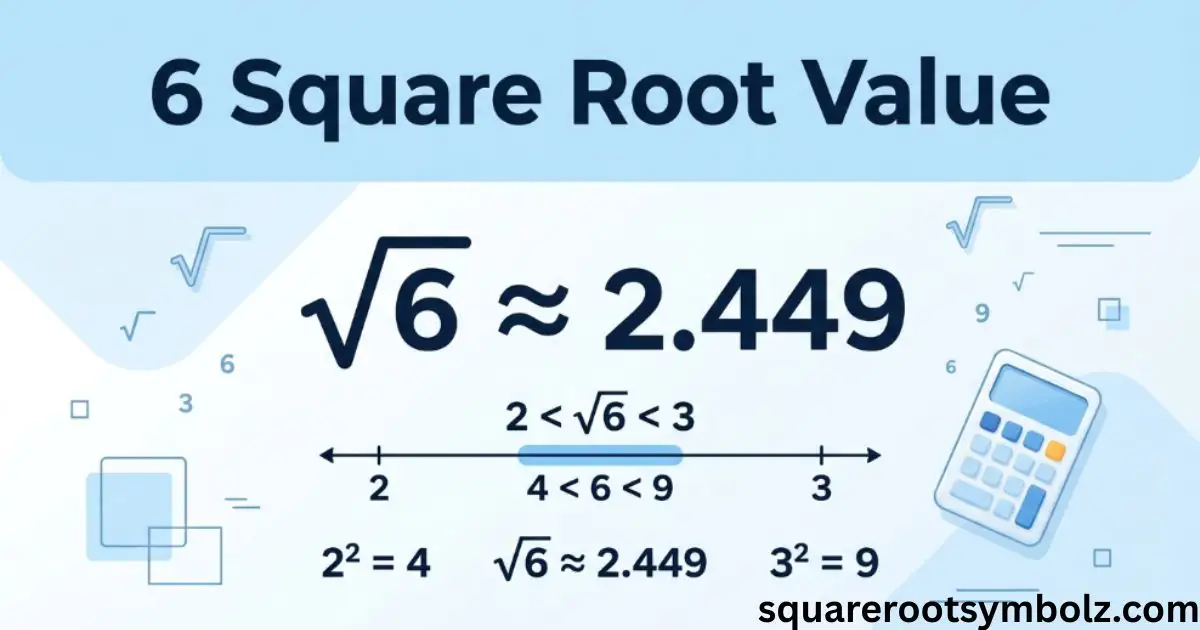
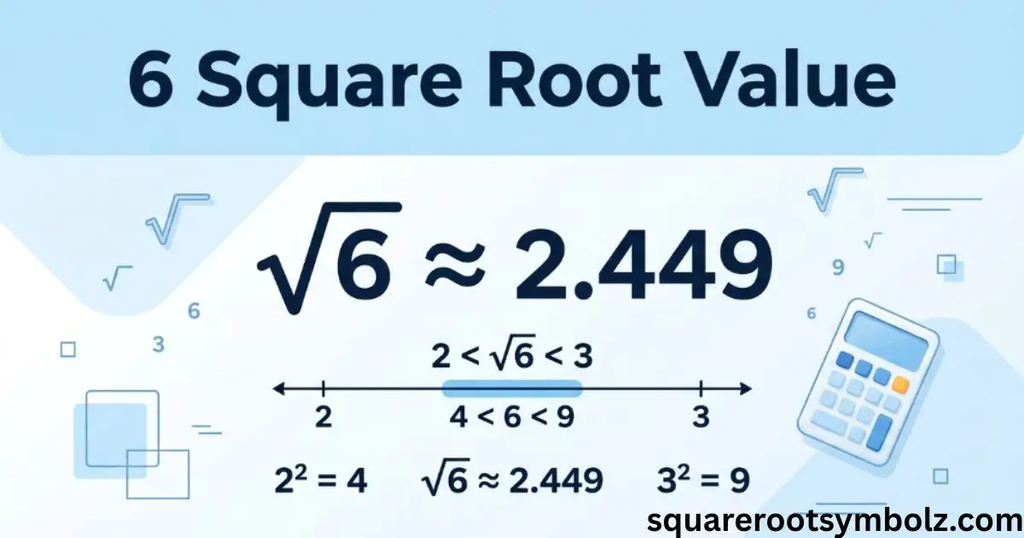
The square root of 6 is the positive number that produces 6 when multiplied by itself. In radical notation, it is written √6. Its exact form remains √6, while its decimal approximation is 2.44948974278. This places the value between 2 and 3 because 2² = 4 and 3² = 9.
Think of √6 as the answer to the question, “What number squared gives 6?” No whole number works because 2² is only 4 and 3² is 9. A calculator gives approximately 2.44949, but the radical √6 is the exact form. This distinction between exact value and decimal approximation is important.
Is the Square Root of 6 Rational or Irrational?
The square root of 6 is an irrational number. Its decimal expansion continues without ending or repeating, so √6 cannot be represented exactly as a fraction of two integers. The prime factorization of 6 is 2 × 3, and neither factor forms a complete square pair.
A useful classroom test is to check whether the number inside the radical is a perfect square. Numbers such as 4, 9, 16, and 25 have whole-number square roots. Six does not. Therefore, its principal square root remains an irrational radical rather than becoming a whole number or terminating decimal.
How to Find the Square Root of 6?
You can find √6 by estimating between perfect squares, using prime factors, using long division, or entering 6 into a calculator. For a quick answer, √6 ≈ 2.44949. For an exact mathematical answer, keep the radical as √6 because its decimal representation never terminates.
For a manual estimate, start with 2 because 2² = 4. Then test numbers between 2 and 3. Since 2.4² = 5.76 and 2.5² = 6.25, √6 must lie between 2.4 and 2.5. Refining the estimate gives 2.44949, which is very close to the exact value.
Prime Factorization
The prime factorization of 6 is 2 × 3. Therefore, √6 can be written as √(2 × 3), or √2 × √3. Neither 2 nor 3 has a matching prime factor, so there is no pair to remove from the radical. That is why √6 stays in simplest radical form.
This is different from √12. Since 12 = 4 × 3, √12 contains the perfect-square factor 4 and becomes 2√3. With √6, the only perfect-square factor is 1, which does not produce any useful simplification. The prime-factor test quickly explains why nothing can be taken outside the radical.
Long Division
The long division method provides a systematic way to calculate more decimal places of √6 without relying on a calculator. Start with 6, choose 2 because 2² = 4, subtract to get 2, and continue by bringing down pairs of zeros. Repeating the process produces increasingly accurate decimal digits.
For schoolwork, long division is useful when a problem asks you to demonstrate the calculation rather than simply state a calculator result. The process ultimately approaches 2.449489…. You can stop when you have enough decimal places for the required accuracy, such as 2.45 to the nearest hundredth.
Square Root of 6 Simplified
The simplest radical form of the 6 square root is √6. It cannot be reduced to a smaller radical because 6 contains no perfect-square factor greater than 1. Although √6 can be approximated as 2.44948974278, replacing √6 with a decimal changes an exact expression into an approximation.
You may also see √6 written as 6^(1/2). This is the exponent form of the same square root. The radical form is usually easier to recognize in elementary algebra and geometry, while fractional exponents become especially useful when working with powers and algebraic expressions.
Square Root of 6 Definition
The square root of 6 is a number whose square equals 6. In equation form, if x² = 6, then the solutions are x = √6 and x = −√6. However, the radical symbol √6 itself represents the principal, nonnegative square root, approximately 2.44949.
This distinction matters when solving equations. If you are simply evaluating √6, use the positive principal root. If an equation asks you to solve x² = 6, both positive and negative solutions must be considered. Understanding this difference prevents a common mistake when moving between radicals and equations.
How to Calculate the Under Root 6 Value?
To calculate the under root 6 value, first recognize that 6 lies between the perfect squares 4 and 9. Therefore, its square root lies between 2 and 3. Testing decimals narrows the value: 2.4² = 5.76, while 2.5² = 6.25, so √6 is between those numbers.
Continue refining the estimate if greater accuracy is required. For example, 2.45² = 6.0025, which is extremely close to 6. The calculator value is approximately 2.44948974278. In most school problems, 2.449 or 2.45 is sufficient when the question specifies three or two decimal places.
| Form | Value of √6 |
| Exact radical form | √6 |
| Exponent form | 6^(1/2) |
| Decimal | 2.44948974278… |
| To 2 decimal places | 2.45 |
| To 3 decimal places | 2.449 |
| Between integers | 2 and 3 |
| Number type | Irrational |
Simplifying the Square Root Using Perfect Square Method
The perfect-square method asks whether a perfect square divides the radicand. For 6, the factors are 1, 2, 3, and 6. None except 1 is a perfect square, so there is no factor to move outside the radical. Consequently, the simplest form remains √6.
Compare this with √48. Because 48 = 16 × 3 and 16 is a perfect square, √48 becomes 4√3. The same rule explains √6: because no useful perfect-square factor exists, nothing can be extracted. This simple comparison makes radical simplification easier to remember.
What is the Value of the Square Root of 6?
The exact value of the square root of 6 is √6, while its decimal approximation is 2.449489742783178. For everyday calculations, it is commonly rounded to 2.449, 2.45, or 2.4 depending on the required precision. The correct rounded value depends on the place specified in the question.
For example, to round √6 to the nearest hundredth, look at 2.449489. The hundredths digit is 4 and the next digit is 9, so the 4 rounds upward to 5. Therefore, √6 ≈ 2.45 to the nearest hundredth. Keeping the exact radical is preferable when no rounding is requested.
What is the Square Root of -6?
The square root of negative 6 is different from √6 because no real number multiplied by itself produces a negative result. In complex numbers, √−6 can be written as i√6, where i represents the imaginary unit and i² = −1. Thus √−6 ≈ 2.44949i.
This distinction becomes important in algebra. √6 is a real irrational number, while √−6 belongs to the complex-number system. A negative radicand does not mean that the calculation has no meaning; it means the answer moves beyond the real number system into imaginary or complex numbers.
Is the number 6 a Perfect Square?
No, 6 is not a perfect square. A perfect square is a number produced by multiplying an integer by itself, such as 1, 4, 9, 16, or 25. Because no integer squared equals 6, its square root is not a whole number and remains an irrational radical.
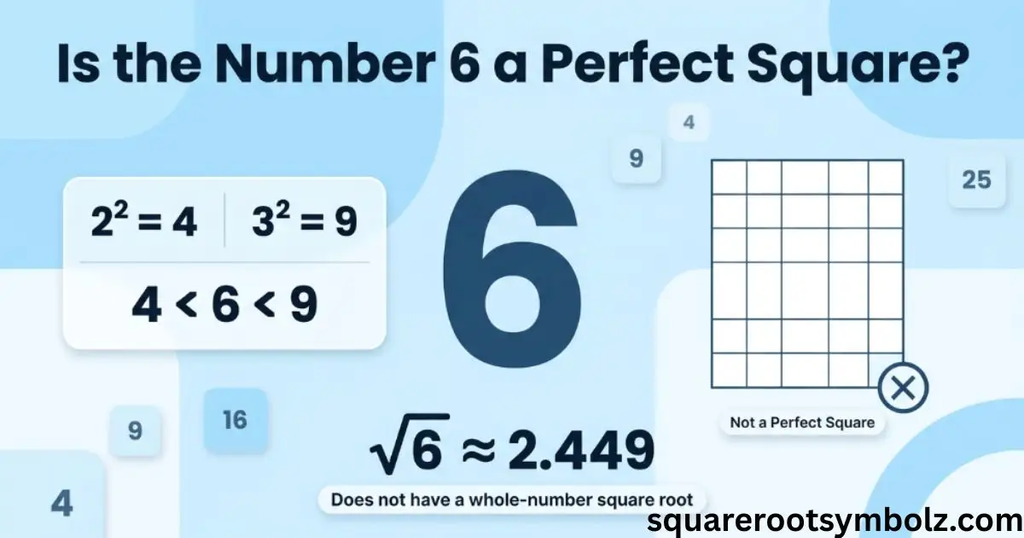
You can see this immediately from the neighboring squares. Since 2² = 4 and 3² = 9, there is no integer square between them. This also provides a fast estimate: √6 must be somewhere between 2 and 3, and because 6 is closer to 4 than 9, the answer is closer to 2.
What is the Square of the Square Root of 6?
The square of √6 is exactly 6. Squaring and taking a square root are inverse operations for this positive number, so (√6)² = 6. This relationship is one of the most useful facts to remember when simplifying radicals, solving equations, and checking whether a square-root calculation is correct.
You can also verify the decimal approximation. If √6 ≈ 2.44948974278, multiplying that approximation by itself gives a result extremely close to 6. The tiny difference that may appear on a calculator comes from rounding the decimal rather than from an error in the exact radical √6.
Conclusion
The 6 square root is √6, and its decimal value is approximately 2.44948974278. Six is not a perfect square, so √6 cannot be simplified into a whole number or a smaller radical. Its exact form is √6, its principal square root is positive, and its decimal expansion is irrational and nonterminating. For quick work, remember that √6 lies between 2 and 3, while 2.45 is its value rounded to the nearest hundredth.
FAQ Section
What is the square root of 6?
The exact square root of 6 is √6. Its decimal approximation is 2.44948974278, or 2.45 when rounded to the nearest hundredth.
Is √6 rational or irrational?
√6 is irrational because 6 is not a perfect square and √6 cannot be expressed exactly as a ratio of two integers. Its decimal expansion continues without terminating or repeating.
Can √6 be simplified?
No. √6 is already in simplest radical form because 6 has no perfect-square factor greater than 1. Its prime factorization is 2 × 3.
What is √6 rounded to the nearest hundredth?
√6 ≈ 2.45 to the nearest hundredth. The unrounded value is approximately 2.44948974278.
Is 6 a perfect square?
No. The closest perfect squares around 6 are 4 and 9:
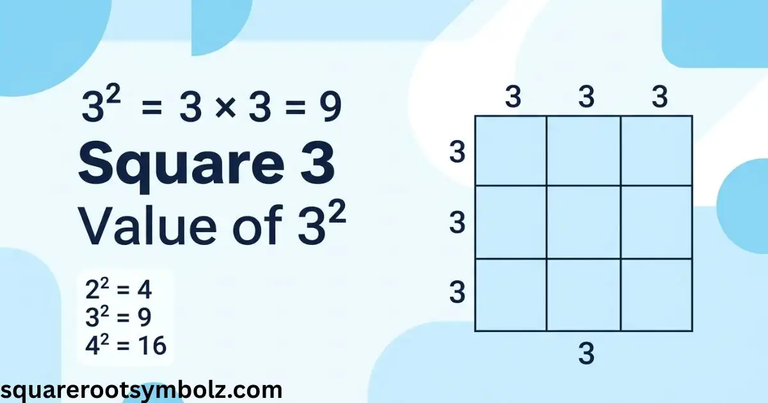
2² = 4
3² = 9
Therefore, √6 lies between 2 and 3.
What is the square of √6?
The square of √6 is exactly 6:
(√6)² = 6.
What is the square root of −6?
In the complex number system, √−6 = i√6, which is approximately 2.44949i.
What is √6 as an exponent?
The exponent form of √6 is 6^(1/2). A square root can be represented using the fractional exponent 1/2.

I’m the creator of SquareRootSymbolz.com, where I publish easy-to-understand guides on symbols, Unicode characters, Alt codes, keyboard shortcuts, and copy-and-paste text symbols. My goal is to provide accurate, well-researched, and user-friendly content that helps readers quickly find the information they need.