
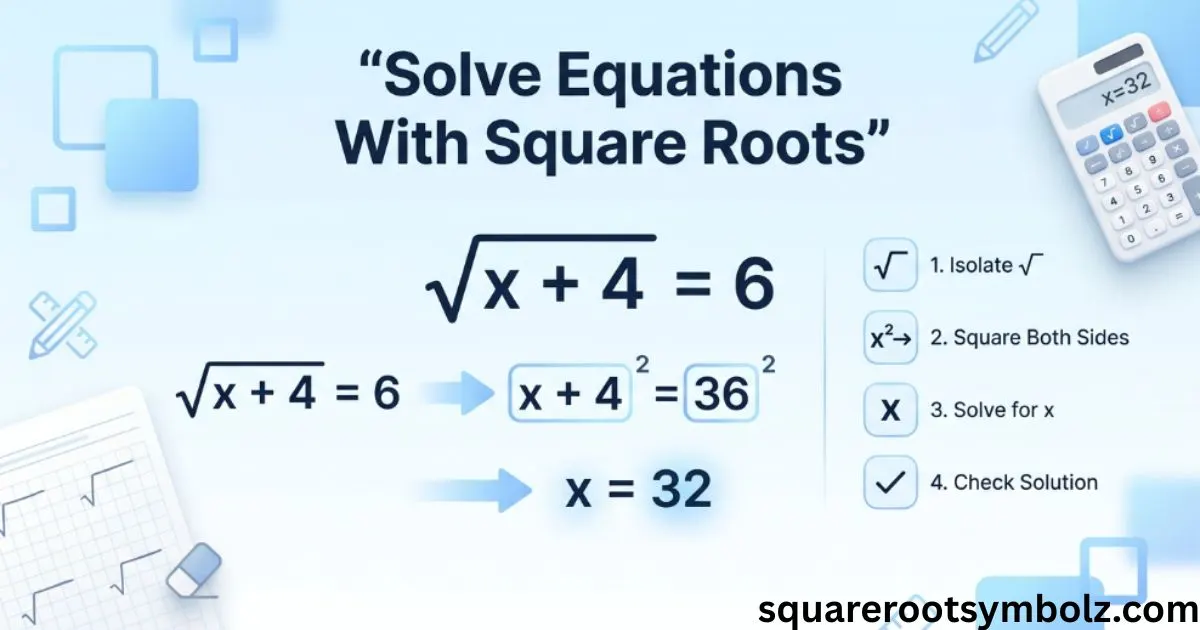
To solve equations with square roots, isolate the square root, square both sides, solve the resulting equation, and check every answer in the original equation. This process works for many radical equations, square root equations, variables, radicands, and algebraic expressions. The most important warning is that squaring can create an extraneous solution.
If square-root equations have ever felt confusing, the problem is usually not the final calculation. It is knowing what to do first. Once the radical term, square root, principal root, substitution, and original equation are handled in the right order, the process becomes much more predictable. The examples below build the method from a simple equation to problems containing multiple radicals.
Solve Equations with Square Roots
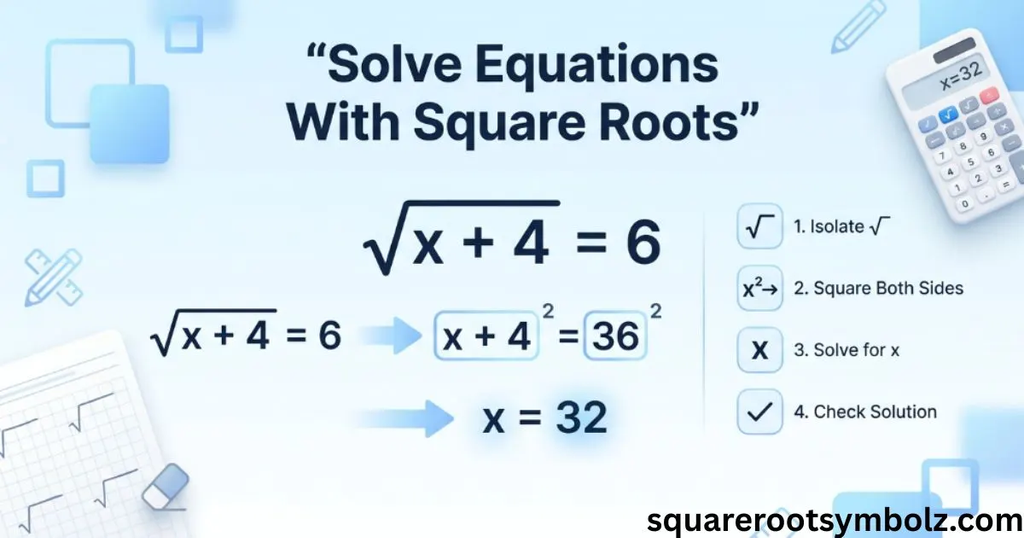
A radical equation is an equation in which a variable appears inside a radical, such as √(x + 4) = 6. The central idea is to remove the square root by squaring both sides. Before doing that, however, the radical should normally be isolated so the resulting equation stays manageable.
The basic sequence is simple: isolate the radical, square both sides, solve the new equation, and check the answer. OpenStax presents this four-step strategy directly, while Khan Academy repeatedly uses the same pattern in worked examples. This consistency makes the method easier to remember and apply.
Solve Radical Equations
A radical equation contains a radical expression involving a variable. For square-root equations, the variable is often located inside the radicand. For example, √(2x − 1) = 7 is a radical equation. Squaring both sides removes the square root and leaves an ordinary algebraic equation.
Radical Equation
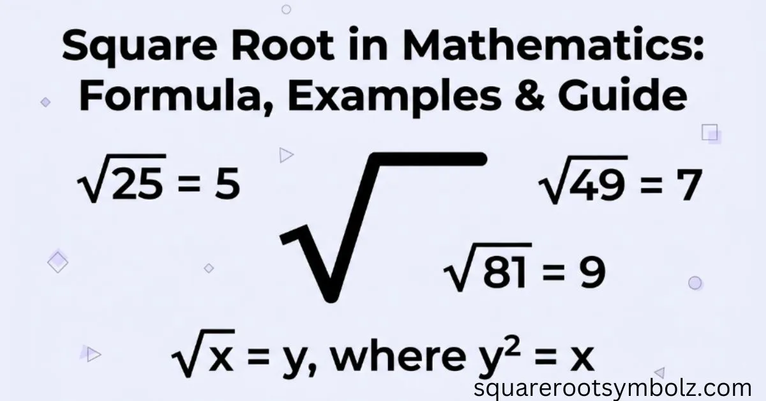
A radical equation may contain one or more radicals. The square-root symbol represents the principal, nonnegative square root. That matters during solving because a square root cannot equal a negative real number. Keeping this restriction in mind helps identify impossible equations and extraneous solutions.
Solve Equations with Square Roots Step by Step
The safest way to solve equations with square roots is to follow the same order every time. First isolate the radical. Next square both sides. Then solve the resulting equation. Finally, substitute each candidate back into the original equation. Skipping the last step can leave an incorrect answer.
Consider √(2x − 1) = 7. The radical is already isolated, so square both sides: 2x − 1 = 49. Add 1 to obtain 2x = 50, then divide by 2. The answer is x = 25. Substituting 25 back gives √49 = 7, confirming the solution.
Step 1: Solving the Equation by Taking the Square
When the square root is isolated, square both sides. For example, √(2x − 5) = 7 becomes 2x − 5 = 49. This eliminates the radical and produces a linear equation. The key is to square the complete left and right sides, not just part of an expression.
Step 2: Checking for Extraneous Solutions
Always substitute candidate answers into the original equation. Squaring can remove sign information and create an algebraic value that works in the squared equation but fails in the original. Khan Academy specifically demonstrates this check with equations that produce both valid and extraneous candidates.
Solve Equations with Square Roots Using Examples
Worked examples reveal an important detail: not every radical equation looks the same. Sometimes the square root is already isolated. Other times you must move a number first. A good solver does not rush into squaring; the expression should be prepared first so the operation actually removes the radical.
For example, consider √(2x + 9) − 5 = 0. Add 5 to both sides to get √(2x + 9) = 5. Square both sides, giving 2x + 9 = 25. Therefore, 2x = 16 and x = 8. Substitution confirms that √25 − 5 = 0.
Example: Solve √(2x + 9) − 5 = 0
First isolate the radical:
√(2x + 9) = 5
Square both sides:
2x + 9 = 25
Subtract 9:
2x = 16
Divide by 2:
x = 8
Check:
√(2(8) + 9) − 5 = √25 − 5 = 0
Answer: x = 8.
This example follows the same isolate, square, solve, and check pattern described by Math Is Fun and OpenStax.
Solve Equations with Square Roots When There Is More Than One Square Root
An equation can contain two or more square roots. In that situation, isolate one radical first and square both sides. A second radical may remain. Isolate it and square again. Each additional squaring step increases the chance of extraneous solutions, so checking becomes even more important.
For example, √(2x − 5) − √(x − 1) = 1 contains two radicals. After isolating one and squaring, another radical remains. Squaring a second time produces a quadratic equation. Math Is Fun demonstrates this exact pattern and then checks the resulting candidates.
Example: Solve √(2x − 5) − √(x − 1) = 1
Start by isolating one radical:
√(2x − 5) = 1 + √(x − 1)
Square both sides:
2x − 5 = 1 + 2√(x − 1) + x − 1
Simplify:
x − 5 = 2√(x − 1)
Isolate the remaining radical:
√(x − 1) = (x − 5) ÷ 2
Square again:
x − 1 = (x − 5)² ÷ 4
This produces a quadratic equation. Solving gives two candidates, approximately 2.53 and 11.47. Checking both in the original equation shows that 11.47 is the valid solution, while 2.53 is extraneous.
Solve Equations with Square Roots and Extraneous Solutions
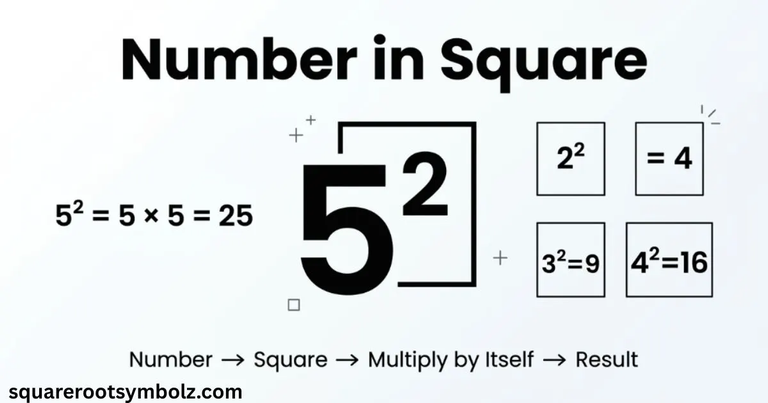
An extraneous solution is a value produced during algebraic manipulation that does not satisfy the original equation. It commonly appears after squaring both sides. The reason is that squaring makes positive and negative values look identical: both 3² and (−3)² equal 9.
For example, √(5x − 4) = x − 2 can produce x = 8 and x = 1 after squaring. Testing x = 8 gives √36 = 6, matching 8 − 2. Testing x = 1 gives √1 = 1, but 1 − 2 = −1. Therefore, x = 1 is extraneous.
Step 2: Checking for Extraneous Solutions
Checking is not an optional final decoration. It is part of the solving method. Put each candidate into the original equation, evaluate both sides, and keep only values that make the original statement true. This protects your answer from errors introduced by squaring.
Solve Equations with Square Roots and Binomial Squares
Some radical equations become quadratic after squaring. When the expression on one side is a binomial, remember the binomial-square formulas. The square of a + b contains three terms: a² + 2ab + b². Forgetting the middle term is a common algebra error.
For example, if √(x − 1) + 1 = x, isolate the radical first to obtain √(x − 1) = x − 1. Squaring gives x − 1 = (x − 1)². Expanding correctly produces a quadratic equation that can then be solved and checked.
Binomial Squares
The two essential identities are (a + b)² = a² + 2ab + b² and (a − b)² = a² − 2ab + b². When solving radical equations, these formulas matter because squaring a non-isolated expression can create a binomial on the other side.
Solve Equations with Square Roots When There Is No Solution
Some equations have no real solution. A quick example is √(9k − 2) + 1 = 0. Isolating the radical gives √(9k − 2) = −1. Because the principal square root is never negative, there is no real value of k that can satisfy the equation.
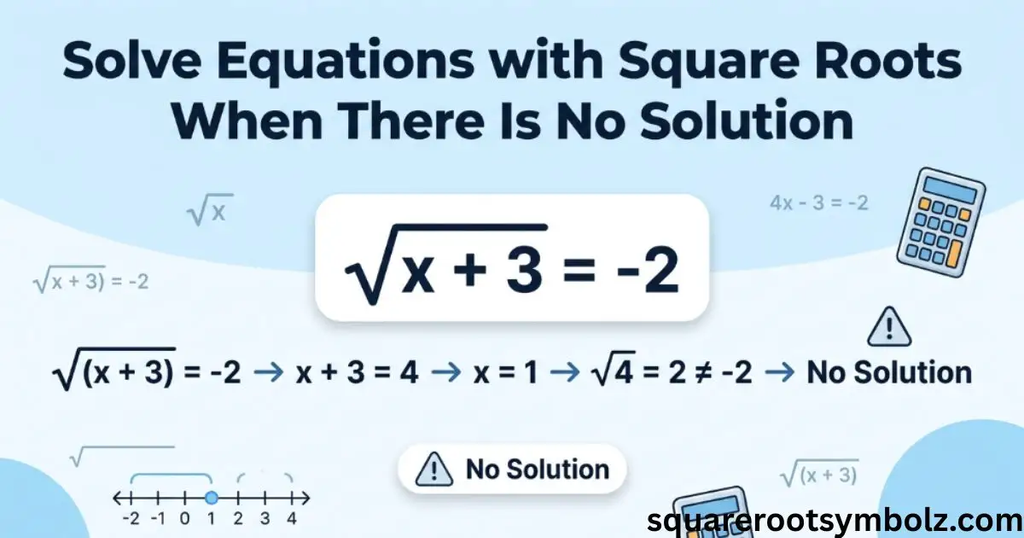
This observation can save time. Before performing several algebraic steps, look at the isolated radical. If a real square root is required to equal a negative number, the equation has no real solution. OpenStax explicitly highlights this property in its radical-equation examples.
Radical Equation
Remember that √a represents the principal square root, so for real a in its domain, √a is nonnegative. Therefore, an equation such as √x = −4 has no real solution. Squaring both sides would produce x = 16, but 16 fails in the original equation because √16 = 4, not −4.
Conclusion
The most reliable way to solve equations with square roots is to use a fixed sequence: isolate the radical, square both sides, solve the resulting equation, and check every candidate in the original equation. This approach handles simple equations as well as problems with multiple radicals and resulting quadratic equations.
The most important habit is checking. Squaring can create an extraneous solution that looks perfectly reasonable until it is substituted back into the original equation. Once you make that verification step automatic, radical equations become much less intimidating and far easier to solve accurately.
FAQ Section
How do you solve an equation with a square root?
Isolate the square root on one side, square both sides, solve the resulting equation, and substitute each candidate into the original equation to verify it.
Why do you square both sides of a square-root equation?
Squaring reverses the square-root operation and removes the radical when it is isolated. This leaves an equation that is usually easier to solve.
What is an extraneous solution?
An extraneous solution is a value produced during the algebraic process that does not satisfy the original equation. It can appear because squaring may change the solution set.
Do you always need to check a square-root equation?
Yes. Checking is especially important after squaring because an algebraically obtained candidate may fail in the original equation.
Can a square-root equation have two solutions?
Yes. After squaring, a resulting quadratic can produce two candidates. Each candidate must be substituted into the original equation to determine which ones are valid.
Can a square-root equation have no solution?
Yes. For example, √x = −2 has no real solution because a principal square root cannot be negative.
What if there are two square roots in an equation?
Isolate one radical and square both sides. If another radical remains, isolate it and square again. Then solve the resulting equation and check all candidates.
What happens if the square root is not isolated?
Squaring before isolating the radical can make the algebra much more complicated and may lead to errors. The standard method is to isolate the radical first.

I’m the creator of SquareRootSymbolz.com, where I publish easy-to-understand guides on symbols, Unicode characters, Alt codes, keyboard shortcuts, and copy-and-paste text symbols. My goal is to provide accurate, well-researched, and user-friendly content that helps readers quickly find the information they need.

One Comment