Solving by square roots is a direct way to solve certain quadratic equations by isolating a squared expression and taking its square root. If you are working with quadratic equations, perfect squares, radicals, or algebraic expressions, this method can save time and reduce complicated factoring. The key is recognizing the right equation form and remembering the ± symbol.
I have seen students understand the algebra but lose a solution by writing only the positive root. That small mistake can change the entire answer. In this guide, you will learn when the square root method works, how to isolate x², how to handle expressions such as (x − 3)², when no real solution exists, and how to check both answers.
Solving Quadratic Equations by Finding Square Roots
Solving by square roots works when the variable appears in a squared form that can be isolated. Common forms include x² = k and (x − h)² = k. The goal is simple: undo the square by taking a square root, while remembering that a positive number has two real square roots.
For example, consider 3x² − 5 = 7. First add 5 to both sides, giving 3x² = 12. Divide by 3 to obtain x² = 4. Taking square roots gives x = ±2, so the two solutions are x = 2 and x = −2. The same reasoning works with many quadratic equations.
Square roots method
The square roots method is especially useful when there is no x term between the squared term and the constant. An equation such as 2x² − 18 = 0 can be rearranged to x² = 9, making the solutions immediately visible as x = ±3.
This method also works when a complete squared expression is already present. For example, (x − 3)² = 16 can be solved by taking square roots: x − 3 = ±4. Adding 3 produces x = 7 or x = −1. The important skill is recognizing the structure before choosing a method.
When Does This Method Work?
Use solving by square roots when the equation can be rearranged into a form such as x² = k or (x − h)² = k. A missing middle term is a strong clue. The same method applies when a squared binomial is already isolated or can be isolated with ordinary algebraic operations.
It is not necessary to force this method onto every quadratic equation. If an equation contains a linear x term, such as x² + 5x + 6 = 0, factoring may be more natural. Completing the square can also transform a general quadratic into a form where square roots become useful.
The Most Important Rule: ±
The most important rule when solving by square roots is to include both signs. If x² = 9, then x can equal 3 or −3 because both numbers produce 9 when squared. Therefore, taking the square root of both sides gives x = ±3, not simply x = 3.
This distinction is easy to overlook because √9 itself means the principal square root, which is 3. But an equation asking which values of x satisfy x² = 9 has two real solutions. Keeping the ± symbol prevents one of the solutions from disappearing.
Step-by-Step Method
The process becomes much easier once you follow the same sequence each time. First identify the squared quantity, then isolate it, take square roots, solve the remaining equation, and finally check both answers. This approach turns many intimidating quadratic equations into a short series of familiar algebra steps.
Step 1: Isolate the squared expression
Move constants away from the squared expression using addition or subtraction. If a coefficient is attached to x² or a squared binomial, divide both sides by that coefficient. Your target should look like x² = k or (x − h)² = k before taking square roots.
Step 2: Take square roots on both sides
Once the square is isolated, take the square root of each side and include ± for real solutions. For x² = 25, this produces x = ±√25, which simplifies to x = ±5. Never remove the negative possibility simply because the radical symbol itself represents a principal root.
Step 3: Solve for x
If the squared expression contains a shift, continue with ordinary algebra after taking the square root. For (x − 4)² = 25, take the roots to obtain x − 4 = ±5. Then add 4 to both possibilities, giving x = 9 or x = −1.
Step 4: Check both solutions
Substitute both answers into the original equation rather than checking only one. For x² = 16, both 4 and −4 work because 4² = 16 and (−4)² = 16. Checking is especially useful when several algebraic operations were required before reaching the square-root step.
Worked Examples
Example 1: No middle term
Solve 2x² − 18 = 0.
Add 18:
2x² = 18
Divide by 2:
x² = 9
Take the square root:
x = ±3
Therefore:
x = 3 or x = −3
Both answers work because 3² and (−3)² equal 9.
Example 2: Isolate x² first
Solve x² + 7 = 23.
Subtract 7 from both sides:
x² = 16
Take the square root:
x = ±4
Therefore:
x = 4 or x = −4
The important step was isolating x² before taking the square root. Trying to take the root while the constant is still attached can lead to incorrect algebra.
Example 3: Perfect square form
Solve (x − 3)² = 16.
Take the square root of both sides:
x − 3 = ±4
Now solve both cases:
x − 3 = 4
x = 7
and
x − 3 = −4
x = −1
Therefore, the solutions are x = 7 and x = −1.
Example 4: No real solutions
Solve x² = −9.
No real number can be squared to produce −9. Therefore, the equation has no real solutions.
If complex numbers are allowed, the solutions are x = ±3i because i² = −1.
This distinction matters: an equation can have no real solution while still having solutions in the complex number system.
Why Checking Matters
Checking both solutions protects you from simple algebra mistakes and confirms that the answers actually satisfy the original equation. This is especially useful when coefficients, constants, fractions, or shifted squared expressions are involved.
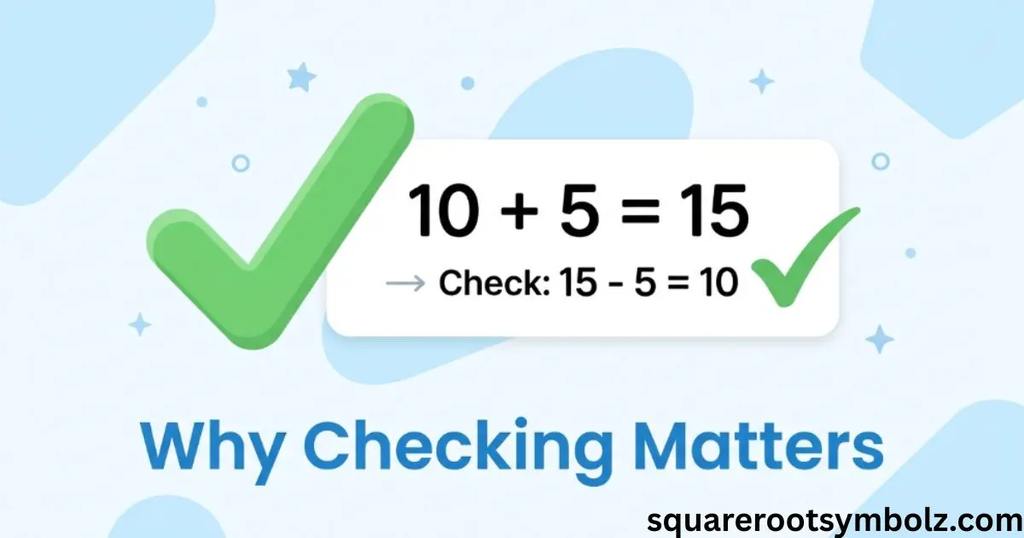
Suppose you solve (x − 2)² = 12 and obtain x = 2 ± 2√3. Substituting either value back into the original equation confirms the result. Checking also helps you notice when you accidentally dropped the negative branch or made an arithmetic error.
Common Mistakes to Avoid
One common mistake is forgetting ±. Another is taking the square root before isolating the squared expression. For example, from x² + 9 = 25, you should first obtain x² = 16. You should not treat √(x² + 9) as though it were x + 3.
Another mistake is assuming every quadratic should be solved by square roots. The method depends on the equation’s structure. A quadratic with a linear term may be better suited to factoring, completing the square, or the quadratic formula. Choosing the method based on structure is an important algebra skill.
Difference of Two Squares
An equation such as x² − 25 = 0 can be solved using square roots because it becomes x² = 25. It can also be factored as (x − 5)(x + 5) = 0. Both approaches produce x = 5 and x = −5.
This is useful because it shows that different algebraic methods can reach the same solutions. If the squared term is already easy to isolate, square roots are often quicker. Recognizing a difference of two squares can provide another efficient route, especially when the numbers are perfect squares.
Quick Reference Summary
| Equation form | What to do | Result |
| x² = 25 | Take both square roots | x = ±5 |
| 2x² = 50 | Divide by 2, then root | x = ±5 |
| x² − 16 = 0 | Add 16, then root | x = ±4 |
| (x − 3)² = 16 | Root both sides, then add 3 | x = 7 or −1 |
| x² = 5 | Take the square root | x = ±√5 |
| x² = −9 | Check the number system | No real solutions |
The fastest mental checklist is: isolate the square, make sure the right side is appropriate for the number system, take both square roots, solve for the variable, and check the answers. For a positive value, expect two real solutions unless the squared expression or context creates a special restriction.
Conclusion
Solving by square roots is one of the cleanest ways to handle a quadratic equation when the squared quantity can be isolated. The essential idea is simple: get the square alone, take the square root of both sides, keep the ±, solve for the variable, and check both results. Once you recognize forms such as x² = k and (x − h)² = k, many quadratic problems become much less intimidating.
FAQ Section
What does solving by square roots mean?
Solving by square roots means isolating a squared expression and taking the square root of both sides. When the result is positive, remember both possibilities by using ±.
When should you solve a quadratic by square roots?
Use this method when the equation can be rearranged into a form such as x² = k or (x − h)² = k. A missing x term is often a strong signal that square roots will work well.
Why do you use ± when solving square roots?
Because a positive number generally has two real square roots. For example, both 5² and (−5)² equal 25, so x² = 25 has the solutions x = 5 and x = −5.
What happens if the number under the square root is negative?
There is no real solution if x² equals a negative number. For example, x² = −9 has no real solutions. In the complex number system, however, the solutions are x = ±3i.
What is the first step when solving by square roots?
The first step is to isolate the squared expression. For example, from 3x² + 6 = 30, subtract 6 and divide by 3 to obtain x² = 8 before taking square roots.
Is solving by square roots the same as factoring?
No. They are different methods, although they can sometimes solve the same equation. Square roots are especially convenient when the squared expression can be isolated directly.

I’m the creator of SquareRootSymbolz.com, where I publish easy-to-understand guides on symbols, Unicode characters, Alt codes, keyboard shortcuts, and copy-and-paste text symbols. My goal is to provide accurate, well-researched, and user-friendly content that helps readers quickly find the information they need.