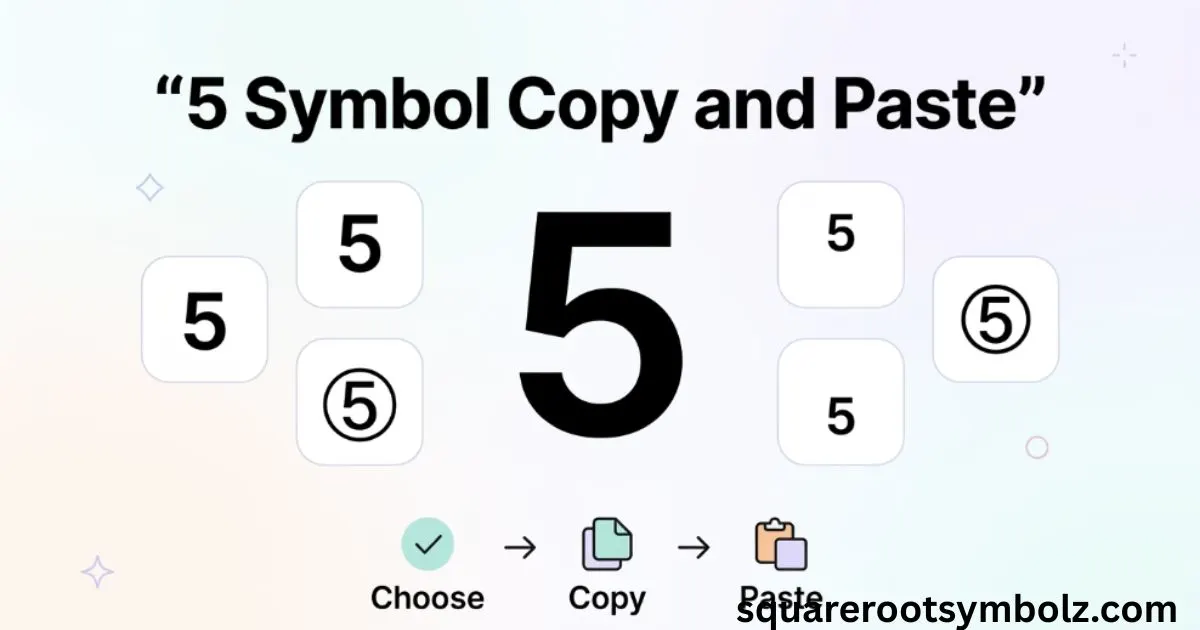
The 5 symbol can appear in many Unicode styles, including ⑤ ⑸ ⁵ ₅ ❺ Ⅴ ⅴ 5 ٥. If you need a special version of the number five for a username, heading, document, social post, label, or design, you can copy the character directly instead of searching through fonts.
The important difference is that these are not simply different fonts applied to the ordinary digit. Many are separate Unicode characters with their own code points and purposes. That means a circled five, superscript five, Roman numeral five, and fullwidth five can behave differently depending on the application, font, and platform.
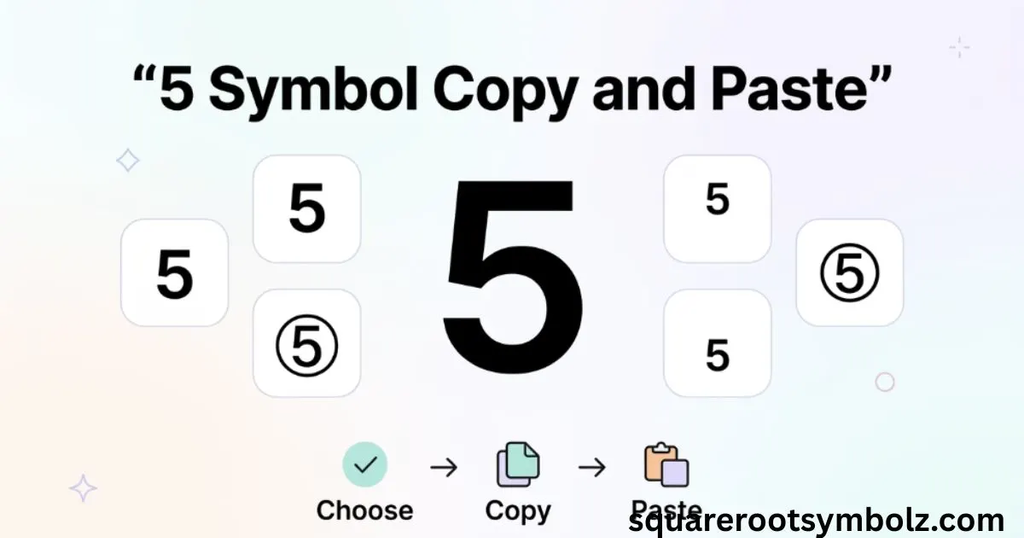
How to Copy and Paste 5 Number Symbols
Choose the version you need from the table below, copy it, and paste it wherever Unicode text is supported. Popular choices include ⑤ for an enclosed number, ⁵ for superscript notation, ₅ for subscript text, and Ⅴ for Roman numeral five.
| 5 Symbol | Name | Unicode |
| 5 | Digit Five | U+0035 |
| ⑤ | Circled Digit Five | U+2464 |
| ⑸ | Parenthesized Digit Five | U+2478 |
| ⁵ | Superscript Five | U+2075 |
| ₅ | Subscript Five | U+2085 |
| ❺ | Negative Circled Digit Five | U+277A |
| 5 | Fullwidth Digit Five | U+FF15 |
| Ⅴ | Roman Numeral Five | U+2164 |
| ⅴ | Small Roman Numeral Five | U+2174 |
| ٥ | Arabic-Indic Digit Five | U+0665 |
| 五 | Chinese character for five | U+4E94 |
The exact appearance can vary with the font, operating system, browser, and application. This is normal for Unicode text: the underlying character remains the same even when its visual design changes.
What Are 5 Number Symbols?
5 number symbols are Unicode characters or numeral representations that communicate the value five in different visual forms, writing systems, or typographic contexts. Examples include ⑤, ⑸, Ⅴ, and ٥, each of which represents five while using a different character design.
Some variants are mainly decorative, while others have a practical purpose. ⁵ is useful for superscript notation, ₅ for subscripts, Ⅴ for Roman numbering, and ⑤ for compact labels or numbered steps. Choosing the correct character is therefore more useful than simply choosing the one that looks attractive.
A useful way to think about them is this:
5 = ordinary decimal digit
⑤ = enclosed digit
⁵ = superscript digit
₅ = subscript digit
Ⅴ = Roman numeral
٥ = Arabic-Indic digit
The value or numerical meaning can relate to five, but the typographic role and Unicode identity are different.
Popular 5 Number Symbols
The most recognizable choices are ⑤, ⑸, ⁵, ₅, Ⅴ, ⅴ, and ٥. i2Symbol specifically highlights circled five, parenthesized five, Roman numeral five, and Arabic-Indic five as common representations.
MadeInText provides an even wider collection, including ➄, ➎, ⁵, ₅, ❺, ⑤, ⑸, ⒌, 5, Ⅴ, and ⅴ. This variety is useful when the ordinary 5 does not fit the visual style of your content.
| Style | Symbol | Best use |
| Standard | 5 | Normal writing |
| Circled | ⑤ | Steps and labels |
| Parenthesized | ⑸ | Numbered references |
| Superscript | ⁵ | Powers and raised text |
| Subscript | ₅ | Indices and notation |
| Roman | Ⅴ | Formal numbering |
| Small Roman | ⅴ | Lowercase Roman style |
| Fullwidth | 5 | East Asian typography |
| Arabic-Indic | ٥ | Arabic-script contexts |
Types of Number 5 Symbols
The main groups include enclosed numbers, Roman numerals, superscript/subscript forms, fullwidth characters, mathematical characters, and digits used by different writing systems. They may look similar at first glance, but Unicode treats many of them as distinct characters.
The right choice depends on what you are trying to communicate. A circled five is excellent for a numbered instruction, while a superscript five has a mathematical or typographic purpose. A Roman numeral is better suited to formal numbering, outlines, or traditional design.
Enclosed Number 5 Symbols
Enclosed versions place five inside a visual container or special form. Examples include ⑤, ⑸, ❺, and ➄. They are particularly useful for steps, lists, labels, answer choices, short headings, and other situations where the number needs to stand apart from surrounding text.
For example:
⑤ Step Five
⑸ Option Five
❺ Level Five
These characters give the number a stronger visual boundary without requiring an image or custom graphic.
Roman Numeral Symbols
The standard Roman numeral for five is Ⅴ, while the lowercase form is ⅴ. Roman numerals are commonly associated with formal numbering, outlines, historical references, clocks, chapters, and names such as Henry V.
Roman numerals should not be confused with an ordinary decorative font. Ⅴ is a Unicode Roman numeral character, while a normal letter V may only look similar. For consistent text encoding, choose the actual character when your application supports it.
Arabic-Indic Number Symbols
The Arabic-Indic digit for five is ٥. It represents five in contexts where Arabic-Indic digits are used and can be useful for multilingual text or language-specific typography.
The shape is visually different from the Western Arabic digit 5, but both represent the same numerical value. This is an important example of how the concept of five can be represented differently across writing systems.
Number 5 Symbol Usage Examples
The best 5 symbol depends on the context. For a numbered list, ⑤ is easy to scan. For an exponent, ⁵ is appropriate. For a Roman-numbered section, Ⅴ may be the natural choice. The goal is functional typography, not simply decoration.
Here are practical examples:
| Purpose | Recommended symbol | Example |
| Normal number | 5 | 5 tips |
| Step marker | ⑤ | ⑤ Check your answer |
| Exponent | ⁵ | x⁵ |
| Subscript | ₅ | x₅ |
| Roman numbering | Ⅴ | Chapter Ⅴ |
| Arabic-Indic text | ٥ | الصفحة ٥ |
| Decorative label | ❺ | ❺ Premium |
Username or Handle
A styled five can make a username visually different when ordinary numbers are already taken. Characters such as ⑤, ⁵, or Ⅴ can create variation while remaining recognizable as representations of five.
Before using one in a username, check the platform’s character restrictions. Some services permit Unicode characters freely, while others limit usernames to specific alphabets, numbers, or symbols.
Decorative Text
Decorative 5 symbols can add visual variety to short headings, profile text, captions, or labels. For example, ⑤ Tips, ❺ Ideas, or Ⅴ can create a distinctive presentation without requiring an image.
Still, readability should come first. A symbol that looks attractive but renders incorrectly on another device can turn into an empty box or an unexpected character. Preview important text before publishing it.
List or Outline
Circled and Roman forms work particularly well in outlines. For example:
⑤ Introduction
⑥ Examples
Or:
Ⅴ. Results
The choice depends on the visual system used by the rest of the document. Consistency usually looks better than mixing many unrelated number styles.
Multilingual Numbering
The character ٥ can be useful when working with Arabic-script text because it matches the numeral system used in that context. Unicode makes it possible to represent different writing systems within digital text.
This is more than a decorative choice. Matching the numeral system to the surrounding language can improve visual consistency and make multilingual documents feel properly typeset.
Using Number 5 Symbols on Social Media and Online Platforms
Unicode 5 symbols can be pasted into many social and messaging platforms, including profiles, captions, usernames, comments, chats, and gaming communities. However, support is not identical everywhere, and the final appearance can depend on the platform’s font and rendering system.
Common uses include:
- Profile names
- Display names
- Usernames
- Gaming names
- Captions
- Short posts
- Numbered steps
- Decorative headings
- Status messages
- Lists and labels
If a character does not display correctly, try a more widely supported alternative such as ⑤ or ordinary 5.
How to Type Number 5 Symbols on Any Device
The easiest method is usually copy and paste. Select the character you want, copy it, and paste it into your document, browser field, message, or social platform. This avoids remembering individual Unicode codes.
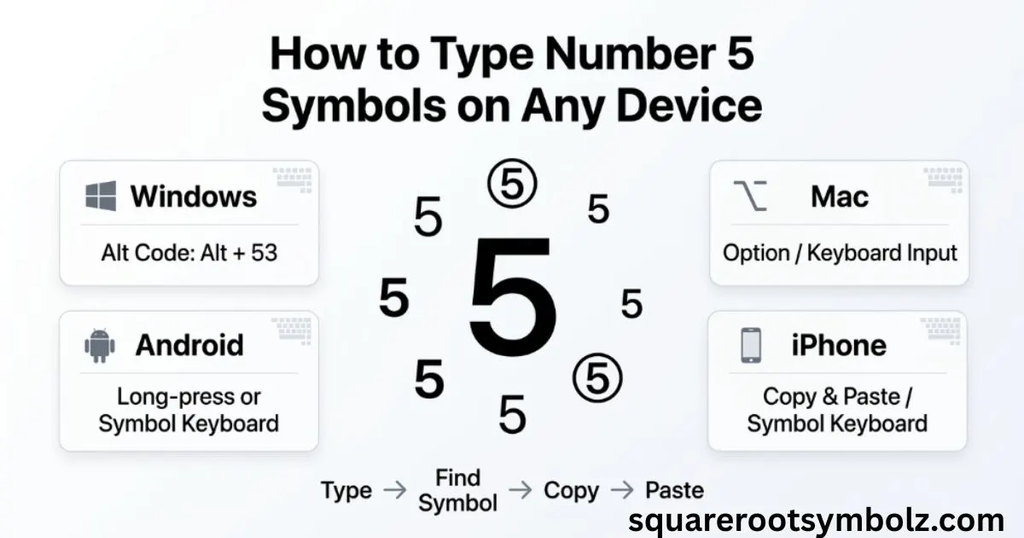
On Windows and Linux, the familiar shortcuts are Ctrl+C and Ctrl+V. On Mac, use Command+C and Command+V. If you regularly use special characters, your operating system’s character-selection tools can also help you search for Unicode symbols.
For example, you can copy these directly:
⑤ ⑸ ⁵ ₅ ❺ Ⅴ ⅴ 5 ٥
Then paste the selected character wherever your application permits Unicode text.
Unicode Number 5 Symbols and Compatibility
Unicode assigns characters unique code points so computers can identify and store them consistently. For example, ⁵ is U+2075, ₅ is U+2085, ⑤ is U+2464, and Ⅴ is U+2164. These identities distinguish the characters even when their visual appearance changes between fonts.
Compatibility is not exactly the same as appearance. A platform may support a character but display it using a different font. Another platform may not have a suitable glyph and could show a missing-character box instead.
| Character | Unicode |
| 5 | U+0035 |
| ⑤ | U+2464 |
| ⑸ | U+2478 |
| ⁵ | U+2075 |
| ₅ | U+2085 |
| ❺ | U+277A |
| 5 | U+FF15 |
| Ⅴ | U+2164 |
| ⅴ | U+2174 |
| ٥ | U+0665 |
For websites and applications, Unicode is generally preferable to creating decorative numbers as images because actual text can be copied, searched, selected, and processed as text.
5 Number Symbols List and Meanings
The following quick reference covers the most useful forms of the 5 symbol and explains where each one fits.
| Symbol | Meaning / name | Typical use |
| 5 | Digit Five | Everyday numbers |
| ⑤ | Circled Digit Five | Lists and steps |
| ⑸ | Parenthesized Digit Five | Numbered references |
| ⁵ | Superscript Five | Exponents and raised text |
| ₅ | Subscript Five | Mathematical indices |
| ❺ | Negative Circled Digit Five | Decorative labels |
| Ⅴ | Roman Numeral Five | Formal numbering |
| ⅴ | Small Roman Numeral Five | Lowercase Roman text |
| 5 | Fullwidth Digit Five | Fullwidth typography |
| ٥ | Arabic-Indic Digit Five | Arabic-script contexts |
| 五 | Chinese character for five | Chinese writing |
One detail is worth remembering: not every character that looks like a “5” is interchangeable. ⁵ has a typographic superscript role, while ⑤ is an enclosed numeral. Likewise, Ⅴ belongs to the Roman numeral system rather than being simply a stylized Western 5.
Conclusion
The 5 symbol is not limited to the ordinary 5. Unicode provides many representations, including ⑤, ⑸, ⁵, ₅, ❺, Ⅴ, ⅴ, 5, and ٥, each with its own visual or typographic purpose.
For everyday use, the standard 5 is best. For numbered steps, ⑤ is practical. For mathematical exponents, use ⁵; for subscripts, ₅; and for formal Roman numbering, Ⅴ.
If your goal is simply to copy and paste a stylish five, choose the character that fits your context and test it on the platform where you plan to use it.
FAQ Section
What is the 5 symbol?
The standard 5 symbol is 5, but Unicode provides many related forms such as ⑤, ⁵, ₅, Ⅴ, and ٥.
What is the Unicode for 5?
The ordinary digit 5 is Unicode U+0035.
What is the Unicode for ⑤?
The circled digit five ⑤ is U+2464.
What is the Unicode for superscript 5?
The superscript five ⁵ is U+2075.
What is the Unicode for subscript 5?
The subscript five ₅ is U+2085.
What is the Roman numeral for 5?
The Roman numeral for five is Ⅴ. Its lowercase Unicode form is ⅴ.
What is the Arabic-Indic number 5?
The Arabic-Indic digit for five is ٥. It is used in Arabic-script numeral contexts.
Can I copy and paste 5 symbols?
Yes. Unicode characters such as ⑤ ⁵ ₅ Ⅴ ٥ can generally be copied and pasted anywhere the relevant characters are supported.
What is the difference between ⁵ and ₅?
⁵ is a superscript five that appears above the baseline, while ₅ is a subscript five that appears below it.
Can I use 5 symbols on social media?
Yes. Unicode five characters can be used on many social and messaging platforms, although character support and visual rendering can vary by platform.
Which 5 symbol is best for a numbered list?
⑤ is a strong choice because the circle visually separates the number from the surrounding text.

I’m the creator of SquareRootSymbolz.com, where I publish easy-to-understand guides on symbols, Unicode characters, Alt codes, keyboard shortcuts, and copy-and-paste text symbols. My goal is to provide accurate, well-researched, and user-friendly content that helps readers quickly find the information they need.