
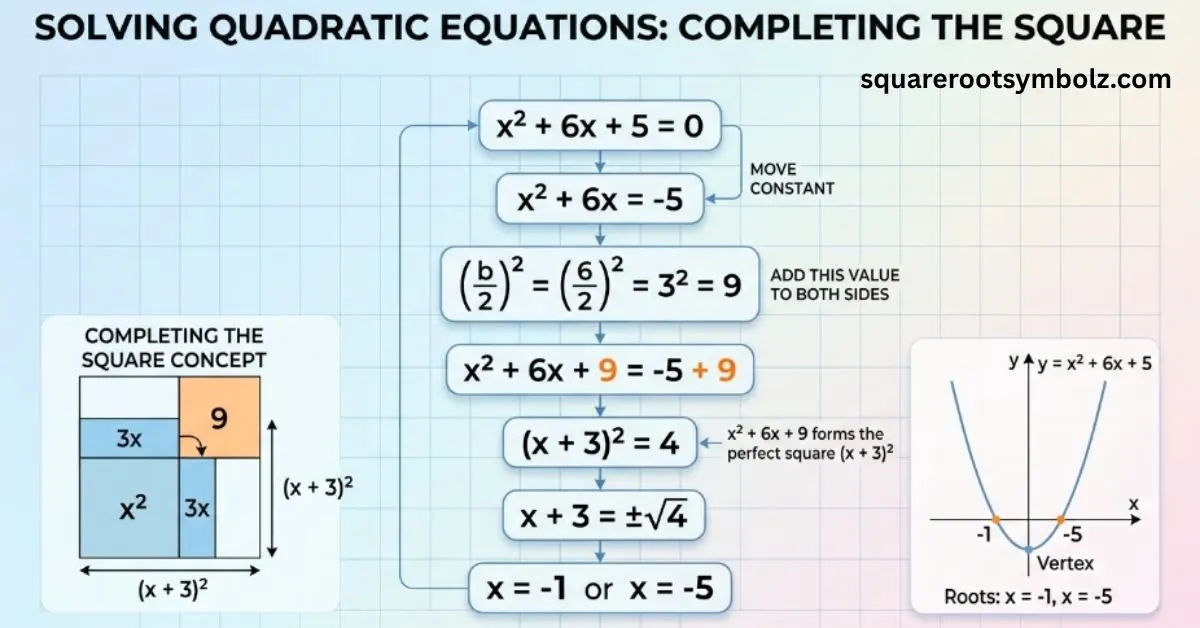
Square equations usually refer to equations containing a squared variable, such as x², and are commonly understood as quadratic equations. These problems often confuse students because one equation can produce two solutions, require a square root, or need a method called completing the square. The key is to recognize the quadratic term, coefficient, constant, and overall structure before choosing a solving method.
In practical algebra, square equations connect perfect square trinomials, binomial expressions, square roots, factoring, and the quadratic formula. After explaining these concepts through many different examples, one pattern becomes clear: students struggle less when they understand why the equation is being changed. This guide shows how a squared equation is transformed step by step until the value of the variable becomes clear.
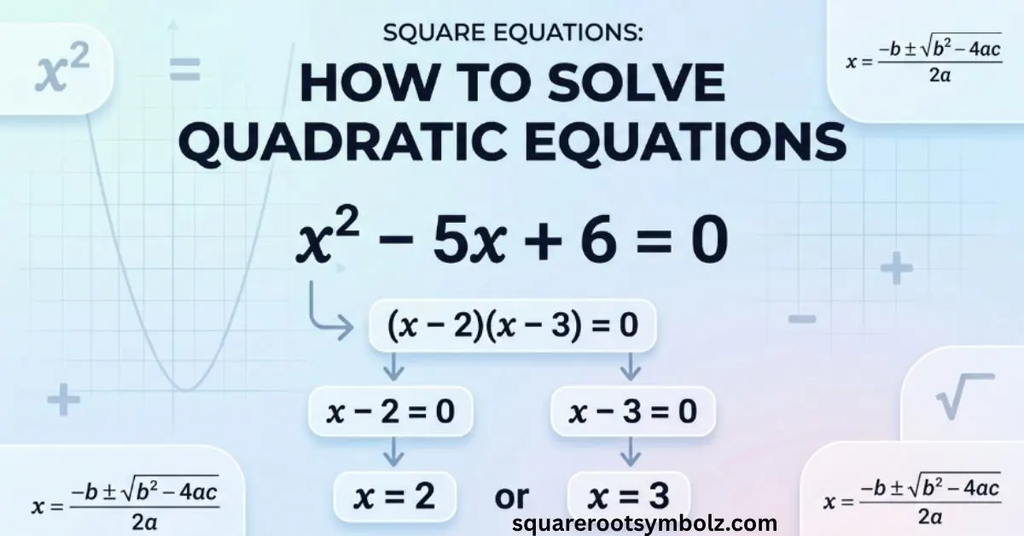
Solving General Quadratic Equations by Completing the Square
Square equations become more challenging when the expression does not factor easily. In those cases, completing the square can transform a general quadratic equation into a perfect square form. The standard structure is ax² + bx + c = 0, where the squared term gives the equation its quadratic nature.
The main goal is to rewrite the expression so one side becomes a binomial squared. Once that happens, the Square Root Property can be used. For example, an equation that looks complicated at first can gradually become (x + p)² = q, making the final solving process much easier.
A useful rule for general square equations is to make the coefficient of x² equal to 1 before completing the square. If the equation begins with ax², divide both sides by a. This prepares the expression for the same pattern used in simpler quadratic equations.
Suppose an equation begins as:
2x² + 8x = 10
Divide both sides by 2:
x² + 4x = 5
Now the coefficient of the squared variable is 1, and the equation is ready for the completing-the-square process. This simple preparation step prevents many common algebra mistakes.
Complete the Square of a Binomial Expression
To complete the square, start with an expression such as:
x² + bx
The missing value is found by taking half of the coefficient of x and squaring it:
(b/2)²
This creates a perfect square trinomial that can be factored into a binomial squared.
For example:
x² + 6x
Take half of 6:
6 ÷ 2 = 3
Then square the result:
3² = 9
So:
x² + 6x + 9 = (x + 3)²
The expression is now a perfect square trinomial. This is the heart of completing the square: adding exactly the value needed to convert a three-term quadratic expression into a squared binomial.
When solving a square equation rather than simply simplifying an expression, whatever is added to one side must also be added to the other. This preserves equality. Algebraically, the equation changes form without changing its actual solutions.
For example:
x² + 6x = 7
Add 9 to both sides:
x² + 6x + 9 = 7 + 9
Then:
(x + 3)² = 16
The equation is now ready for square roots.
Solve Quadratic Equations of the Form x² + bx + c = 0 by Completing the Square
For a square equation with a coefficient of 1 in front of x², first move the constant term away from the variable terms when necessary. The objective is to create an equation containing x² + bx on one side and a number on the other.
Consider:
x² + 8x – 48 = 0
Move the constant:
x² + 8x = 48
Now identify the coefficient of x, which is 8. Half of 8 is 4, and:
4² = 16
Add 16 to both sides:
x² + 8x + 16 = 48 + 16
The left side factors into:
(x + 4)² = 64
Now use the Square Root Property:
x + 4 = ±8
This gives two equations:
x = 4
or:
x = -12
Both answers satisfy the original quadratic equation. The plus-minus symbol matters because both a positive and negative number can produce the same positive square.
Solve Quadratic Equations of the Form ax² + bx + c = 0 by Completing the Square
Some square equations begin with a leading coefficient other than 1. In this form, the first major step is usually dividing every term by that coefficient before completing the square.
Consider:
2x² + 12x – 14 = 0
Move the constant:
2x² + 12x = 14
Divide by 2:
x² + 6x = 7
Now complete the square. Half of 6 is 3, and:
3² = 9
Add 9 to both sides:
x² + 6x + 9 = 7 + 9
Factor the left side:
(x + 3)² = 16
Take square roots:
x + 3 = ±4
Therefore:
x = 1
or:
x = -7
The important lesson is that the coefficient of the quadratic term affects the preparation, but the underlying method remains the same. Once the coefficient becomes 1, the familiar perfect-square pattern can be applied.
Solving Quadratic Equations by Completing the Square
Completing the square is especially useful when factoring is difficult or impossible using simple integers. It creates a reliable path from a general quadratic expression to a form that can be solved with square roots.
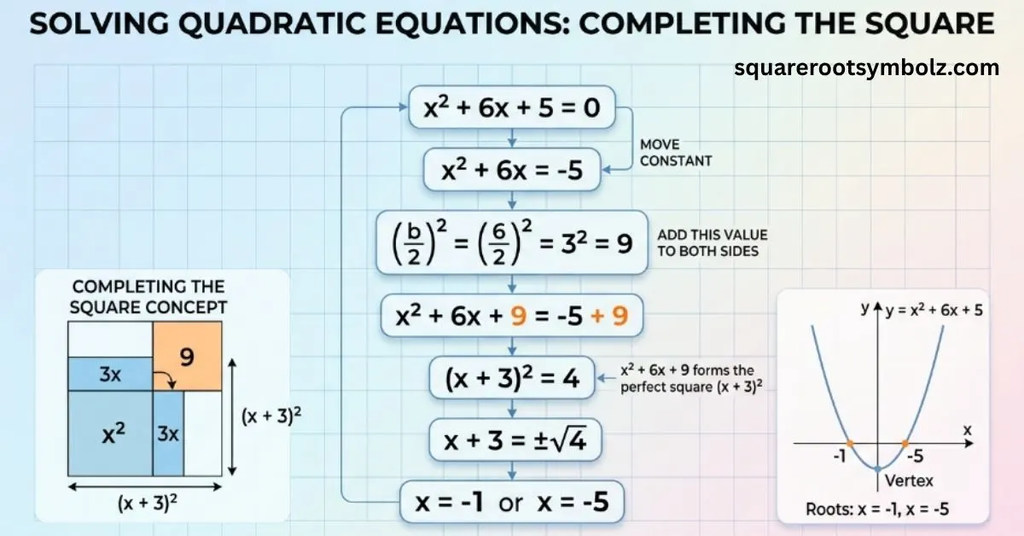
The overall process can be remembered as:
- Put the equation into a workable quadratic form.
- Make the coefficient of x² equal to 1, if needed.
- Move the constant term to the other side.
- Take half the coefficient of x.
- Square that value.
- Add it to both sides.
- Factor the perfect square trinomial.
- Use the square root symbol with ±.
- Solve for the variable.
- Check both answers.
This method also explains why completing the square is more than a memorized trick. It is a structural transformation. A difficult quadratic equation is converted into a squared expression, and the square root operation then reverses that squared form.
For example, if an equation becomes:
(x – 5)² = 36
taking the square root gives:
x – 5 = ±6
Then:
x = 11
or:
x = -1
That is why square equations often have two answers. Both 6² and (-6)² equal 36.
Quick Comparison of Common Methods
| Method | Best Used When | Main Idea |
| Factoring | The quadratic factors easily | Set each factor equal to zero |
| Square Root Property | A squared expression is isolated | Take ±√ of both sides |
| Completing the Square | The equation needs a perfect-square form | Rewrite as a binomial squared |
| Quadratic Formula | A universal formula is needed | Substitute a, b, and c |
The best method depends on the structure of the square equation. Easy factors should not be ignored, but completing the square becomes especially valuable when factoring does not reveal the solutions quickly.
Conclusion
Square equations are most commonly understood as quadratic equations containing a squared variable, such as x². Although these equations can initially look intimidating, their structure becomes easier once you recognize the coefficient, constant term, perfect square pattern, and relationship between squaring and square roots.
The most useful skill is learning how to transform a square equation into a form you can solve. Completing the square does exactly that: it turns a general quadratic expression into a binomial squared, allowing you to use the Square Root Property and find the possible solutions. With regular practice, the process becomes logical rather than mechanical.
FAQs
What is a square equation?
A square equation usually refers to an equation containing a squared variable, such as x². In algebra, this is commonly associated with a quadratic equation.
Is a square equation the same as a quadratic equation?
Usually, yes in informal usage. A quadratic equation has a highest exponent of 2, such as x² + 5x + 6 = 0.
How do you solve a square equation?
The method depends on the equation. Common methods include factoring, the Square Root Property, completing the square, and the quadratic formula.
Why do square equations have two answers?
A squared number can come from either a positive or negative value. For example, both 5² and (-5)² equal 25.
What does completing the square mean?
Completing the square means adding the correct value to a quadratic expression so it becomes a perfect square trinomial that can be written as a binomial squared.
What is the standard form of a quadratic equation?
The standard form is:
ax² + bx + c = 0
where a ≠ 0.
What is the Square Root Property?
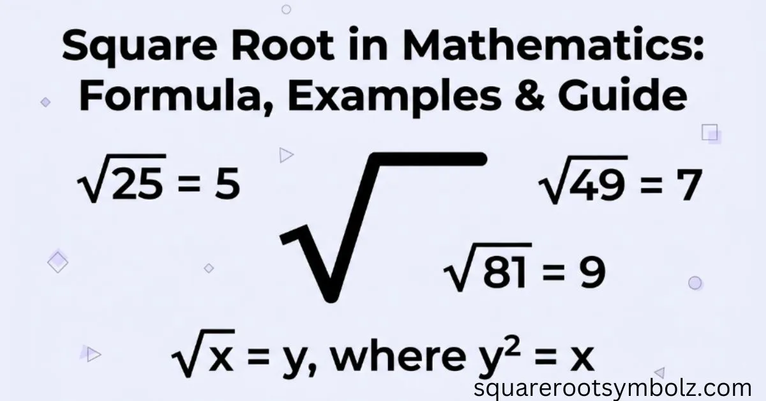
The Square Root Property says that if x² = k, then the solutions are x = ±√k, provided the equation is considered in an appropriate number system.
Can every quadratic equation be solved by completing the square?
Yes, completing the square can be used to solve general quadratic equations. Some equations may be faster to solve by factoring or the quadratic formula.

I’m the creator of SquareRootSymbolz.com, where I publish easy-to-understand guides on symbols, Unicode characters, Alt codes, keyboard shortcuts, and copy-and-paste text symbols. My goal is to provide accurate, well-researched, and user-friendly content that helps readers quickly find the information they need.
One Comment