The hour hand on a clock is the shorter hand that tells you which hour it is. On an analog clock, it works with the minute hand, clock face, and hour numbers to show the time. If you have ever looked at a clock and wondered whether the short hand means 4 or 5, you are not alone.
After years of explaining basic time concepts, I have found that the biggest difficulty is not the clock itself—it is understanding that the short hand moves continuously. Once you know how its position, movement, 12-hour cycle, o’clock times, and minute relationship work, reading an analog clock becomes much easier.
What Is the Hour Hand on a Clock?
The hour hand on a clock is normally the shorter, thicker hand on an analog clock. It indicates the current hour by pointing to a number or by sitting between two numbers. Unlike the minute hand, it moves slowly and takes 12 hours to make one complete trip around the clock face.
A traditional analog clock has numbers from 1 through 12, creating a 12-hour cycle. The hour hand travels from one number to the next during one hour rather than jumping instantly at each hour. That continuous movement is why its exact position can tell you whether the time is 3:10, 3:30, or 3:50.
How Is the Hour Hand Different From the Minute Hand on a Clock?
The easiest way to distinguish the two is by length and speed. The hour hand is usually shorter and moves slowly, while the minute hand is longer and travels around the dial much faster. The hour hand needs 12 hours for one rotation; the minute hand needs only 60 minutes.
| Clock hand | Typical appearance | Shows | Full rotation |
| Hour hand | Shorter, often thicker | Hours | 12 hours |
| Minute hand | Longer | Minutes | 60 minutes |
| Second hand | Very thin | Seconds | 60 seconds |
Some clocks may use different hand designs, so length is a useful clue rather than an absolute rule. When in doubt, compare the movement: the hand that slowly progresses around the 12 numbers is the hour hand. This distinction is fundamental to accurate time reading.
How to Read the Hour Hand on a Clock
Start by finding the short hand. If it points directly at a number and the minute hand is at 12, the clock shows that exact hour. For example, a short hand at 7 with the minute hand at 12 means 7:00, or seven o’clock. This is the simplest form of analog time.
The tricky part comes when the hour hand sits between numbers. In that situation, use the number it has already passed, not the number it is approaching. If the hand is between 4 and 5, the hour is still 4. At 4:30, for example, the hour hand is halfway between 4 and 5 because it has not reached 5 yet.
How the Hour Hand Works at Common Times
At 2:00, the hour hand points directly at 2. At 2:30, it moves halfway toward 3. At 2:45, it is three-quarters of the way toward 3. The minute hand supplies the exact minutes, while the hour hand shows which hour is currently in progress.
This is why saying “the hour hand points to the hour number” is only partly correct. At most times, it does not sit exactly on a printed number. It occupies a position between numbers, giving a visual picture of how far the current hour has progressed.
How Fast Does the Hour Hand Move on a Clock?
The hour hand on a clock moves 360 degrees during a 12-hour rotation. Dividing 360 by 12 gives 30 degrees per hour. Because every hour contains 60 minutes, the hand moves 0.5 degrees per minute. That steady motion explains its gradual movement between adjacent hour numbers.
A useful way to visualize this is to watch the hand during a single hour. From 8:00 to 9:00, it travels exactly 30 degrees. At 8:30, it has covered 15 degrees. At 8:15, it has covered 7.5 degrees. The hand never needs to wait for the next hour before moving.
| Time elapsed | Hour-hand movement |
| 1 minute | 0.5° |
| 15 minutes | 7.5° |
| 30 minutes | 15° |
| 45 minutes | 22.5° |
| 60 minutes | 30° |
This continuous movement matters in both everyday time measurement and mathematical clock-angle problems. It also explains why the hour hand at 3:30 is not still sitting directly on 3—it has already moved halfway toward 4.
Common Mistakes When Reading the Hour Hand on a Clock
One common mistake is choosing the number closest to the hour hand. That can produce the wrong answer when the hand is near the next hour. If the short hand is between 6 and 7, the current hour remains 6 until the hand actually reaches 7.
Another mistake is confusing the minute hand with the hour hand. A simple memory trick is short hand = hour, long hand = minute. Also remember that the hour hand moves even while the minute hand completes its rotation. Ignoring that movement can lead to incorrect readings and clock-angle calculations.
Solved Examples on the Hour Hand on a Clock
Example 1: 5:00
At 5:00, the minute hand points to 12 and the hour hand points directly to 5. Therefore, the time is five o’clock. This is an exact-hour position because the minute hand has completed its 60-minute cycle and the hour hand has arrived at the next number.
Example 2: 5:30
At 5:30, the minute hand points to 6. The hour hand is halfway between 5 and 6. The correct hour is still 5, so the time is 5:30. The hour hand has moved 15 degrees from its 5 o’clock position.
Example 3: 9:45
At 9:45, the minute hand points to 9, while the hour hand has traveled three-quarters of the way from 9 toward 10. The hour is therefore 9, not 10. Its angular position from 12 is 30 × 9 + 0.5 × 45 = 292.5 degrees.
Example 4: 6:45
The hour-hand formula is:
Hour-hand angle = 30H + 0.5M
For 6:45:
30 × 6 + 0.5 × 45
= 180 + 22.5
= 202.5°
So the hour hand is 202.5 degrees clockwise from the 12 position.
How To Calculate Angle Of Hour Hand on a Clock With Examples
To calculate the hour-hand position from 12 o’clock, use 30H + 0.5M, where H represents the hour and M represents the minutes. The 30H component accounts for the hour hand’s 30-degree movement per hour, while 0.5M accounts for its movement during the minutes.
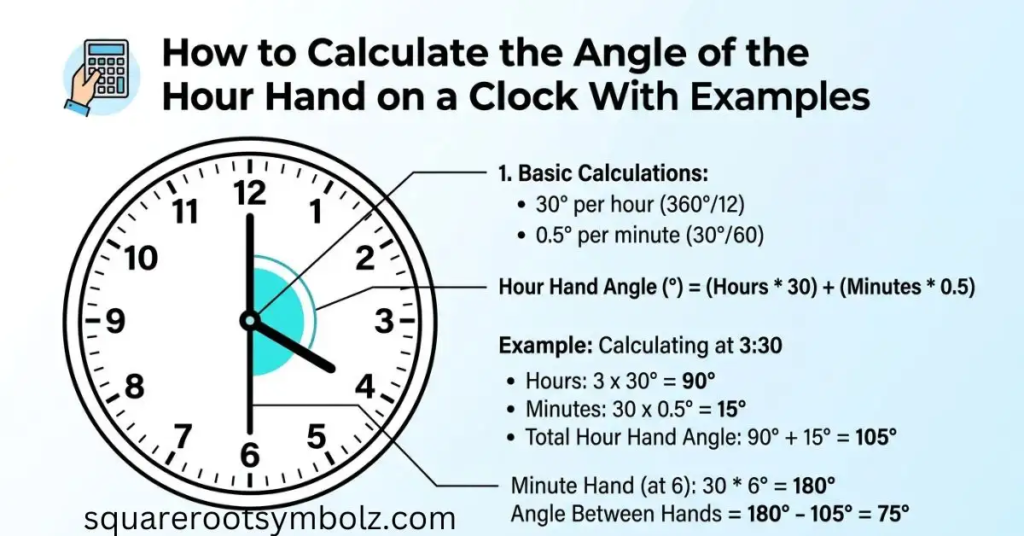
For example, at 3:20, the calculation is 30 × 3 + 0.5 × 20 = 90 + 10 = 100 degrees. This illustrates an important idea: the hour hand has already moved beyond the exact 3 o’clock position because 20 minutes have passed.
For the angle between the hour and minute hands, the commonly used expression is:
|30H − 5.5M|
If the result is greater than 180 degrees, subtract it from 360 to obtain the smaller angle. This calculation is useful for more advanced clock-math questions involving overlapping hands, right angles, and other geometric relationships.
Conclusion
Understanding the hour hand on a clock becomes easy once you remember a few simple rules: it is usually the shorter hand, it moves continuously, and it completes one full rotation every 12 hours. Its position tells you the current hour, even when it sits between two numbers. For clock-angle problems, remember that it moves 30° per hour or 0.5° per minute. With these basics, you can confidently read an analog clock, identify the correct hour, and calculate the angle between the hour and minute hands.
FAQs
Which Hand Is the Hour Hand on a Clock?
The hour hand is usually the shorter and thicker hand on an analog clock. It moves more slowly than the minute hand and indicates the current hour.
How Do You Read the Hour Hand?
Find the short hand and identify the number it points to or has most recently passed. If it lies between two numbers, use the smaller, earlier number as the current hour.
How Long Does the Hour Hand Take to Go Around the Clock?
The hour hand takes 12 hours to complete one full rotation of an analog clock. Because a day contains 24 hours, it completes two full rotations during a day.
What Is the Difference Between the Hour Hand and the Minute Hand?
The hour hand is shorter and slower and indicates hours. The minute hand is usually longer and faster and indicates minutes. The hour hand takes 12 hours to rotate once, while the minute hand takes 60 minutes.
Why Does the Hour Hand Move So Slowly?
It must complete only one rotation in 12 hours. That means it moves 30 degrees each hour, or 0.5 degrees each minute, allowing it to show the gradual progress of an hour.
What Happens When the Hour Hand Is Between Two Numbers?
Read the number the hand has already passed. For example, if it is between 8 and 9, the hour is still 8 until the hand reaches 9.
How Many Degrees Does the Hour Hand Move in 30 Minutes?
It moves 15 degrees because the rate is 0.5 degrees per minute. Therefore, 30 × 0.5 = 15 degrees. At half past an hour, the hand is halfway between two hour numbers.
Can You Tell the Exact Time With Only the Hour Hand?
Only approximately. The hour hand can identify the hour and show whether the hour is progressing, but the minute hand is needed to determine the exact minutes on a conventional analog clock.
Does the Hour Hand Always Point Directly at an Hour Number?
No. It points directly at an hour number at exact o’clock times, but between those times it gradually moves toward the next number. That continuous movement is an important part of analog clock reading.
Is the Hour Hand Always the Shortest Hand?
On standard analog clocks, it is usually shorter than the minute hand. However, clock designs vary, so identifying the hand should also consider its function and movement rather than relying on length alone.
Bottom line: the hour hand is the slow-moving hand that tracks the current hour. Once you learn to recognize its position and understand that it moves continuously, reading an analog clock becomes far less confusing. The key rule is simple: when the hour hand is between two numbers, read the number it has already passed.
Which hand is the hour hand on a clock?
The hour hand is usually the shorter hand on an analog clock. It moves slowly around the clock face and shows the current hour.
How do you read the hour hand?
Look at the shorter hand and see which number it points to or has already passed. If it is between two numbers, use the number it has already passed to identify the current hour.
How long does the hour hand take to go around the clock?
The hour hand takes 12 hours to complete one full rotation around an analog clock. It therefore makes two complete rotations during a 24-hour day.
What is the difference between the hour hand and minute hand?
The hour hand is usually shorter and moves more slowly, while the minute hand is usually longer and moves faster. The hour hand shows hours, and the minute hand shows minutes.
Why does the hour hand move slowly?
The hour hand moves slowly because it needs to complete only one full rotation every 12 hours. This allows it to gradually show the passage of each hour.
How fast does the hour hand move?
The hour hand moves at 30 degrees per hour, which is equal to 0.5 degrees per minute. This steady movement allows it to travel smoothly between hour numbers.
How many degrees does the hour hand move in one hour?
The hour hand moves 30 degrees in one hour. A clock has 360 degrees and 12 hours, so 360 ÷ 12 = 30 degrees per hour.
How many degrees does it move in 30 minutes?
The hour hand moves 15 degrees in 30 minutes. Since it moves 0.5 degrees per minute, 30 × 0.5 = 15 degrees.

I’m the creator of SquareRootSymbolz.com, where I publish easy-to-understand guides on symbols, Unicode characters, Alt codes, keyboard shortcuts, and copy-and-paste text symbols. My goal is to provide accurate, well-researched, and user-friendly content that helps readers quickly find the information they need.