
A sign symbol in mathematics tells you how numbers relate or what operation to perform. The plus sign (+) adds, the minus sign (−) subtracts, the multiplication sign (×) multiplies, and the equal sign (=) shows that two expressions have the same value. Understanding mathematical signs, arithmetic operators, inequality symbols, and algebraic notation makes calculations easier to read and solve.
If mathematical symbols seem confusing, you are not alone. Students often mix up less than and greater than, or treat the minus sign as if it always means subtraction. This guide explains the most common math symbols with names, meanings, examples, and practical explanations based on standard mathematical notation. You will learn how to recognize each sign, interpret its purpose, and use it correctly in equations and everyday calculations.
Common Math Symbols
Mathematical signs and symbols are a concise way to communicate numerical information. Instead of writing “add five to three,” we write 3+5=8. The plus sign indicates addition, while the equal sign expresses a relationship between the two sides of the equation.
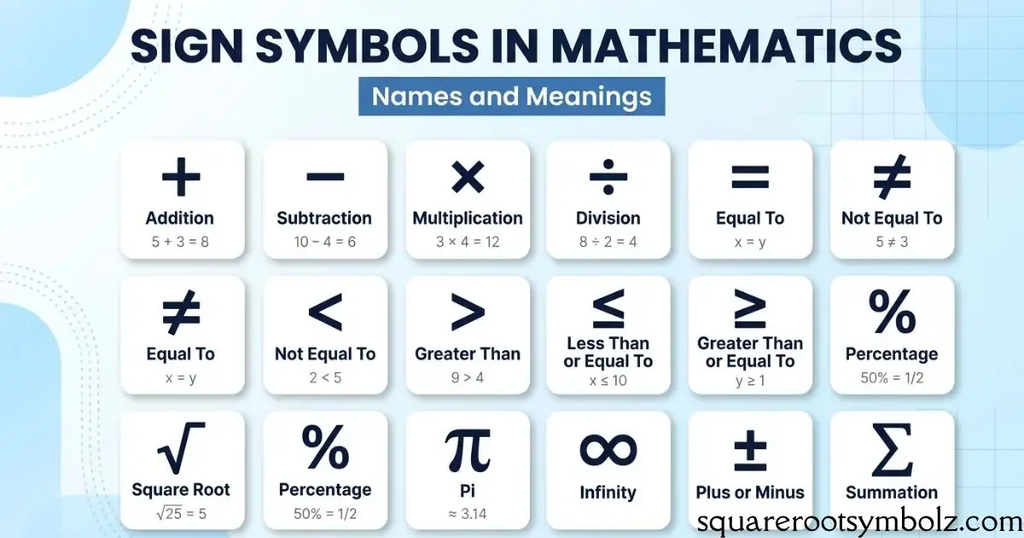
The table below covers the symbols most learners encounter first. It includes arithmetic operators, comparison signs, approximation, percentages, and roots. Learning the name, meaning, and a short example for each mathematical symbol builds a strong foundation for arithmetic, pre-algebra, and more advanced mathematical notation.
| Symbol | Name | Meaning | Example |
| + | Plus sign | Addition | 4+3=7 |
| − | Minus sign | Subtraction or negative value | 8-5=3 |
| × | Multiplication sign | Multiplication | 34=12 |
| ÷ | Division sign | Division | 123=4 |
| = | Equal sign | Same value | 2+3=5 |
| ≠ | Not equal sign | Different values | 46 |
| < | Less than | Left value is smaller | 2<7 |
| > | Greater than | Left value is larger | 9>4 |
| ≤ | Less than or equal to | Smaller than or equal | x5 |
| ≥ | Greater than or equal to | Larger than or equal | x3 |
| ≈ | Approximately equal to | Close in value | 3.14159 |
| ± | Plus or minus | Positive and negative alternatives | x=52 |
| % | Percent sign | Per hundred | \(25\%=0.25\) |
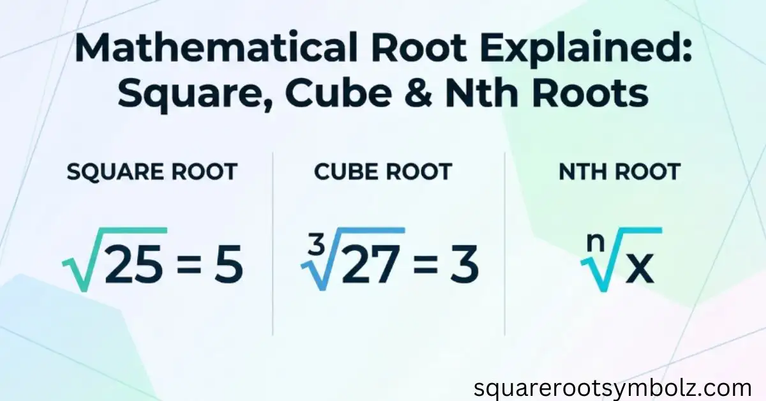
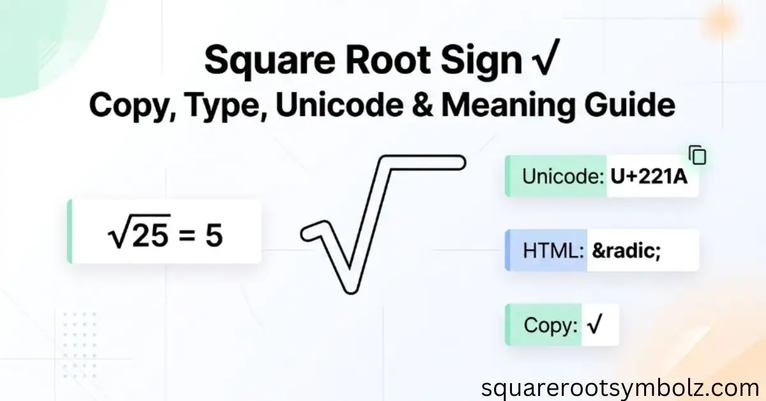
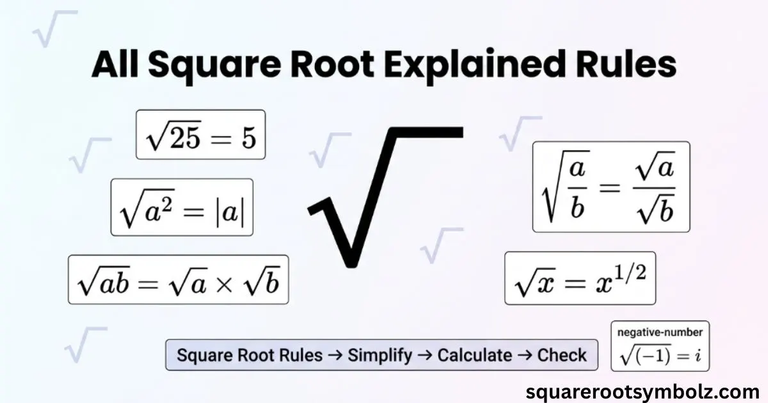
| √ | Square root sign | Principal square root | 25=5 |
| ∞ | Infinity symbol | Unboundedness or infinity | x |
The meaning of a symbol depends on its mathematical context. For instance, the minus sign can represent subtraction in 9-4=5 or a negative number in -4. Likewise, the multiplication sign is not interchangeable with the letter x in every setting.
Basic Mathematical Symbols With Name, Meaning and Examples
The four basic arithmetic operations are addition, subtraction, multiplication, and division. Each has a conventional sign that tells the reader how to work with the numbers. These symbols also appear in word problems, spreadsheets, algebraic expressions, and calculator inputs.
A practical way to learn them is to connect each symbol to an action. Addition combines quantities; subtraction finds a difference; multiplication calculates a product; and division separates a quantity into equal groups or determines how many times one value fits into another. The examples below demonstrate these roles.
| Sign | Operation | Example | Result |
| + | Addition | 7+6 | 13 |
| − | Subtraction | 15-8 | 7 |
| × | Multiplication | 54 | 20 |
| ÷ | Division | 246 | 4 |
Plus and minus signs
The plus sign (+) indicates addition, but it can also mark a positive number, as in +7. The minus sign (−) indicates subtraction or a negative value, as in 10-6=4 and -6. In the expression (-3)+5, the result is 2.
Multiplication and division signs
The multiplication sign (×) means “multiply by,” while the division sign (÷) means “divide by.” For example, 43=12, and 124=3. In algebra, a centered dot or adjacent factors may also indicate multiplication, while a slash or fraction bar can represent division.
Equal and not equal signs
The equal sign (=) states that both sides have the same value. For example, 3+4=7. The not equal sign (≠) states that two quantities are different, as in 85. An equation asserts equality; an inequality expresses a different type of relationship.
Less than and greater than signs
The less than sign () means the left value is larger. For example, 3<8, while 10>6. Think of these signs as comparisons between two numbers.
Constants Used as Math Symbols
Some mathematical symbols stand for fixed numbers or important mathematical constants. The pi symbol () represents the ratio of a circle’s circumference to its diameter. Euler’s number (e) is central to exponential growth and natural logarithms, while the imaginary unit (i) is used in complex numbers.
Constants differ from variables. A constant has a fixed value in a given mathematical context, whereas a variable such as x can represent an unknown or changing value. Recognizing this distinction helps students interpret formulas in geometry, algebra, statistics, and calculus without confusing a symbol’s name with its mathematical role.
| Symbol | Name | Meaning or use |
| Pi | Circle circumference divided by diameter | |
| e | Euler’s number | Base of natural logarithms |
| i | Imaginary unit | i2=-1 |
| 2 | Square root of two | Positive number whose square is 2 |
| Phi | Commonly denotes the golden ratio |
For example, the circle-area formula is A=r2, where A represents area and r represents radius. The symbol remains constant, but the radius can vary. This is a useful example of how mathematical notation combines constants, variables, and operations.
Maths Logic symbols With Meaning
Mathematical logic uses symbols to express statements, conditions, and relationships between propositions. These signs appear in discrete mathematics, proofs, computer science, and formal reasoning. Unlike arithmetic operators, logical symbols usually describe whether statements are true, connected, or implied rather than calculating a numerical result directly.
For example, the symbol means “and,” while means “or.” The negation symbol means “not.” Other signs, such as , represent implication. Learning these mathematical logic symbols helps readers interpret formal proofs and distinguish logical relationships from arithmetic calculations.
| Symbol | Name | Meaning |
| Logical AND | Both statements are true | |
| Logical OR | At least one statement is true | |
| Logical NOT | Negates a statement | |
| Implies | Indicates logical implication | |
| If and only if | Equivalence of statements | |
| Universal quantifier | For all | |
| Existential quantifier | There exists |
Consider the statement “n is even and n is greater than zero.” The logical AND symbol connects both conditions. If either condition fails, the combined statement is false. This is different from the plus sign, which combines numerical quantities rather than logical propositions.
Venn Diagram and Set Theory Symbols
Set theory studies collections of objects, called sets. Its notation helps mathematicians describe membership, shared elements, and relationships between groups. These symbols are used in probability, data analysis, computer science, and foundational mathematics. A set may contain numbers, letters, geometric objects, or other defined elements.
Suppose A={1,2,3} and B={3,4,5}. The intersection contains elements shared by both sets, so AB={3}. The union contains every distinct element in either set, so AB={1,2,3,4,5}. These examples show how symbols express relationships compactly.
| Symbol | Name | Meaning | Example |
| Element of | Belongs to a set | 2A | |
| Not an element of | Does not belong to a set | 5A | |
| Union | Elements in either set | AB | |
| Intersection | Elements common to both | AB | |
| Subset | Every element is in another set | AB | |
| \(\varnothing\) | Empty set | A set with no elements | \(C=\varnothing\) |
A Venn diagram makes these relationships easier to see. Overlapping circles represent sets with shared elements, while the full area of both circles represents their union. Learning the corresponding notation makes it easier to move between visual explanations and written mathematical expressions.
Numeral Symbols
Numeral symbols represent numbers. In everyday American mathematics, the Hindu-Arabic digits 0 through 9 are the standard system used for counting, calculations, measurements, and decimal notation. Roman numerals, such as I, V, X, and L, appear in contexts such as book chapters, clock faces, and historical dates.
Numerals should not be confused with operation signs. The digit 5 represents a numerical value, whereas the plus sign tells you to add values. In more advanced notation, letters such as N, Z, and R are used to represent sets of numbers, although conventions for natural numbers can vary between textbooks.
| Symbol | Name | Common use |
| 0–9 | Hindu-Arabic digits | Standard decimal numerals |
| I | Roman numeral I | Represents 1 |
| V | Roman numeral V | Represents 5 |
| X | Roman numeral X | Represents 10 |
| N | Natural numbers | Counting-number set, with convention-dependent inclusion of zero |
| Z | Integers | Whole numbers, including negatives and zero |
| Q | Rational numbers | Numbers expressible as fractions of integers |
| R | Real numbers | Rational and irrational real values |
For example, -3 combines a negative sign with the numeral 3. The sign indicates that the number lies below zero, while the numeral identifies its magnitude. This distinction is useful when comparing signed numbers or reading temperatures, bank balances, and coordinate values.
Geometry and Algebra Symbols
Geometry symbols describe shapes, angles, lines, and spatial relationships. Algebra symbols represent variables, coefficients, expressions, and equations. Both fields rely on notation to express relationships without repeating lengthy verbal explanations. A symbol may have a specific meaning in one branch of mathematics and a different meaning in another.
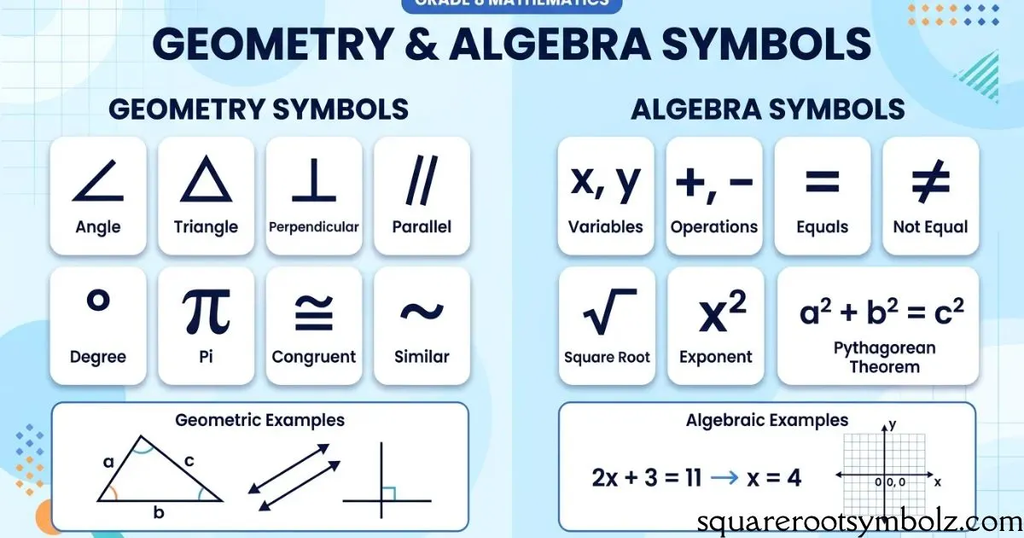
For instance, indicates parallel lines, while indicates perpendicular lines. In algebra, x commonly represents a variable, and f(x) denotes a function evaluated at x. Reading these symbols correctly allows students to interpret diagrams, formulas, and mathematical statements.
| Symbol | Name | Meaning |
| Angle | An angle in geometry | |
| Parallel | Lines that do not intersect in a plane | |
| Perpendicular | Lines meeting at a right angle | |
| \(\cong\) | Congruent | Same shape and size |
| Similar | Same shape, possibly different size | |
| x,y | Variables | Quantities that can vary or be unknown |
| f(x) | Function notation | Output of a function for input x |
| Proportional to | Two quantities vary in a specified proportional relationship |
Algebra Symbols
In algebra, letters and operation signs work together to form expressions and equations. For example, 3x+2=11 contains a coefficient, a variable, an addition sign, and an equal sign. Solving the equation means finding the value of x that makes the statement true; here, x=3.
The same symbol can take on different roles depending on its position. The letter x may be a variable, while is a multiplication operator. Similarly, a minus sign can denote subtraction or indicate that a number is negative. Context helps determine the correct interpretation.
Greek Alphabets and Combinatorics Symbols
Greek letters are common in mathematics because they provide convenient notation for constants, angles, parameters, and other quantities. For example, , , and often represent angles or parameters, while can denote a sum and represents the familiar circle constant. Their exact meanings depend on the formula or subject.
Combinatorics studies counting, arrangements, and selections. The factorial symbol (!) is used to calculate products of consecutive positive integers. For example, 4!=4321=24. Combination notation represents selecting items without regard to order, while permutation notation is used when order matters.
| Symbol | Name | Common use |
| , | Alpha, beta | Angles or parameters |
| Theta | Often an angle | |
| Capital sigma | Summation notation | |
| Delta | A change or other context-specific quantity | |
| n! | Factorial | Product n(n-1)1 |
| nr | Binomial coefficient | Selecting r items from n |
| Pi | Circle constant |
For instance, 5!=120, while 52=10 counts the ways to choose two items from five distinct items. These examples show how advanced mathematical signs can describe structured counting problems, not just basic arithmetic.
Solved Examples
Worked examples help connect mathematical symbols to the steps required to solve a problem. Instead of memorizing a sign in isolation, identify the operation or relationship it expresses, apply the relevant rule, and check whether the result makes sense. This approach is useful for arithmetic, inequalities, and introductory algebra.
The examples below cover different kinds of notation. Each solution explains what the symbol means and how it affects the calculation. As you practice, pay attention to the difference between a symbol that performs an operation and one that states a relationship between values.
Example 1: Addition
8+5=13
The plus sign tells us to combine 8 and 5. Their sum is 13, so the equation is true.
Example 2: Comparison
4<9
The less than sign states that 4 is smaller than 9. Reversing the values changes the correct sign: 9>4.
Example 3: Approximation
3.14159
The approximately equal sign indicates that 3.14159 is a rounded decimal representation of pi, not its exact value.
Example 4: Algebra
2x+4=12
Subtract 4 from both sides to get 2x=8. Divide both sides by 2, giving x=4. Substituting 4 into the original equation confirms that both sides equal 12.
Practice Questions on Math Symbols
Practice helps you recognize a mathematical sign quickly and choose its correct meaning. Try answering these questions before checking the solutions. They cover arithmetic, comparisons, constants, and simple algebra—the foundations of reading mathematical notation accurately.
- What does + mean in 6+7=13?
- Which sign makes this statement true: \(3\ \square\ 10\)?
- What does mean?
- What is the value of 45?
- What does communicate?
- Solve x+3=9.
- What does mean in set notation?
- What is 3!?
Answers
- Addition.
- Less than (<).
- Not equal to.
- Approximately equal to.
- x=6.
- “Is an element of” or “belongs to.”
- 3!=321=6.
If an answer is incorrect, return to the corresponding symbol and read its example again. The goal is not simply to memorize the shapes, but to understand the relationship or operation each sign represents.
FAQs on Math Symbols
The following questions are taken from the FAQ section of the inspected Cuemath page. They reflect related user questions found in the source, but they should not be represented as a verified, live Google People Also Ask extraction.
What is U in Math Symbols?
The letter U is often used informally to describe the union symbol, . In set theory, AB contains every element that belongs to set A, set B, or both. The actual union symbol is , not the ordinary letter U.
How Many Mathematical Symbols are there?
There is no single universally fixed number of mathematical symbols because notation varies across mathematical fields and classification systems. Basic arithmetic uses a small set of familiar signs, while logic, calculus, geometry, and advanced mathematics use many additional symbols.
What is the Math Symbol Used for the Period Of a Wave?
The Greek letter lambda () is commonly used for wavelength. However, wavelength and period are different physical quantities: wavelength measures distance, while period measures time for one cycle. The correct symbol depends on the quantity being described.
What are the Uses of the Addition Math Symbol?
The plus sign (+) indicates addition, such as 5+5=10. It can also indicate a positive value, as in +7. Its precise role depends on where it appears in the expression.
List Some of the Common Arithmetic Math Symbols.
The four common arithmetic signs are plus (+) for addition, minus (−) for subtraction, multiplication (×) for multiplication, and division (÷) for division. A slash (/) and an asterisk (*) are also used for division and multiplication in many mathematical and computing contexts.
A sign symbol in mathematics is much easier to understand when you connect its appearance to its function. The plus and minus signs change quantities through arithmetic operations, equality and inequality signs express relationships, and other mathematical symbols represent constants, sets, functions, and logical statements. Learning these distinctions gives students a reliable foundation for reading equations, solving problems, and progressing to algebra, geometry, and advanced mathematics.

I’m the creator of SquareRootSymbolz.com, where I publish easy-to-understand guides on symbols, Unicode characters, Alt codes, keyboard shortcuts, and copy-and-paste text symbols. My goal is to provide accurate, well-researched, and user-friendly content that helps readers quickly find the information they need.