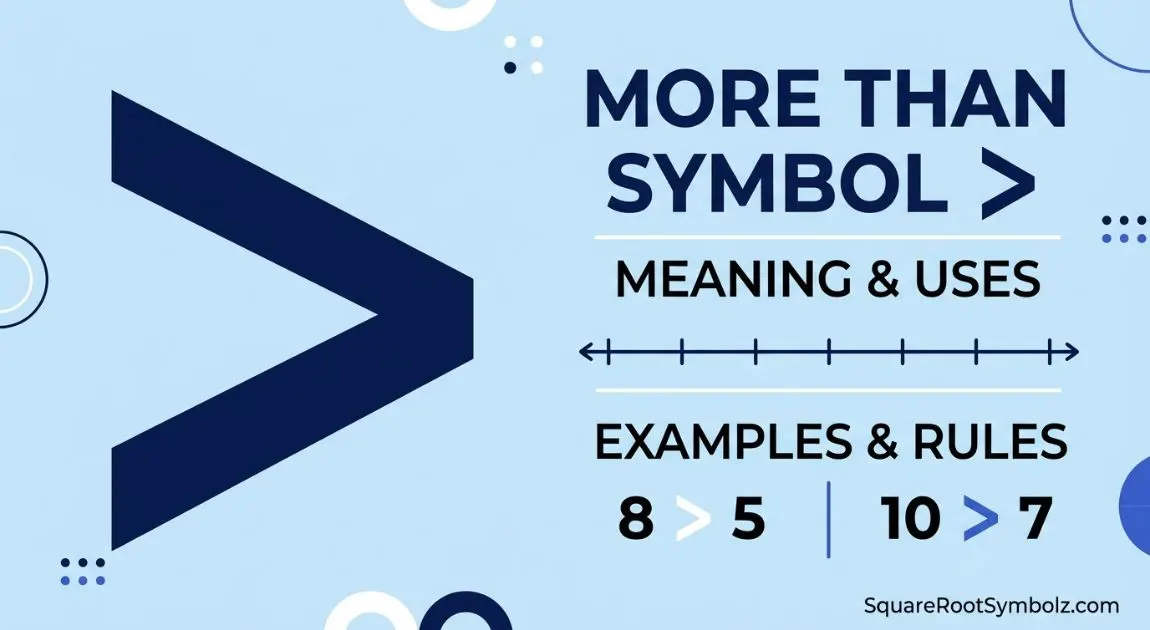
The more than symbol, written as >, is one of the most common mathematical symbols used to compare two numbers, values, or quantities. It indicates that the value on the left is larger than the value on the right. From solving simple arithmetic problems to working with algebraic expressions and inequalities, the greater than sign plays an essential role in mathematics.
For example:
8 > 5
This statement is read as “8 is greater than 5” because 8 has a larger value than 5.
Learning how to use the more than symbol correctly helps students solve math problems with confidence and understand comparisons in everyday situations. In this guide, you’ll learn the meaning of the greater than symbol, its rules, examples, differences from other comparison symbols, and practical applications.
What Is the Greater Than Symbol?
Greater Than Symbol Meaning
The more than symbol (>) is a comparison symbol used to show that one number or value is larger than another.
For example:
- 10 > 4
- 25 > 18
- 100 > 99
In each example, the number on the left has a greater value than the number on the right.
Definition of the Greater Than Sign (>)
The more than symbol is a mathematical symbol that compares two values and indicates that the first value is larger than the second.
Its basic format is:
A > B
which means:
A is greater than B.
The open side of the symbol always faces the larger number, while the pointed end faces the smaller number.
How the Greater Than Symbol Works in Mathematics
The greater than symbol compares the value of two numbers.
| Expression | Meaning | Result |
| 9 > 5 | 9 is greater than 5 | True |
| 15 > 20 | 15 is greater than 20 | False |
| 100 > 75 | 100 is greater than 75 | True |
| 3 > 3 | 3 is greater than 3 | False |
Whenever the number on the left is larger, the mathematical statement is true.
Understanding the Greater Than Sign (>)
How to Read the Greater Than Symbol
The greater than sign is read from left to right.
Examples:
- 12 > 8 → Twelve is greater than eight.
- 45 > 21 → Forty-five is greater than twenty-one.
- 7 > 3 → Seven is greater than three.
Reading the expression correctly helps avoid mistakes while solving inequality problems.
What Does “Greater Than” Mean?
The phrase greater than simply means having a higher value. It can compare:
- Whole numbers
- Negative numbers
- Decimals
- Fractions
- Measurements
- Money
- Age
- Distance
For example:
- $50 is greater than $20.
- 18 years is greater than 16 years.
- 7.8 is greater than 7.3.
How to Use the Greater Than Symbol in Math
Rules for Using the Greater Than Sign
Follow these simple rules:
- Compare the two values.
- Identify the larger number.
- Place the greater number on the left side.
- Write the greater than symbol between them.
- Ensure the open side faces the larger number.
Example:
Compare 18 and 11.
Correct: 18 > 11 Incorrect: 11 > 18
Comparing Numbers Using the > Symbol
Whole Numbers
- 25 > 13
- 90 > 50
- 100 > 99
Negative Numbers
Negative numbers often confuse beginners. Remember that numbers closer to zero are greater.
- -2 > -6
- -4 > -10
Although both numbers are negative, -2 is greater because it is closer to zero.
Decimals and Fractions
Decimals are compared digit by digit.
- 5.8 > 5.3
- 12.75 > 12.50
- 0.9 > 0.6
Fractions can also be compared.
- 3/4 > 1/4
- 5/8 > 2/8
- 7/10 > 3/10
Writing Mathematical Expressions With Greater Than
The greater than symbol is widely used in mathematical expressions.
- x > 8
- y > 15
- 2a > 20
These expressions tell us that the variable must have a value larger than the number shown.
Greater Than Symbol Examples
Examples With Whole Numbers
| Comparison | Explanation |
| 9 > 2 | Nine is greater than two. |
| 50 > 18 | Fifty is greater than eighteen. |
| 100 > 99 | One hundred is greater than ninety-nine. |
Examples With Negative Numbers
Negative numbers become larger as they move closer to zero.
- -1 > -5
- -3 > -8
- -10 > -20
Examples With Decimals and Fractions
- 7.5 > 6.9
- 15.25 > 15.20
- 4/5 > 2/5
- 9/10 > 3/10
Real-Life Examples of Greater Than
The greater than sign appears in many everyday situations, such as comparing prices, exam scores, temperatures, distances, and heights.
| Situation | Comparison |
| Price | $80 > $45 |
| Temperature | 35°C > 22°C |
| Age | 16 years > 12 years |
| Distance | 120 km > 80 km |
| Exam Score | 92 > 75 |
| Ticket Price | $75 > $50 |
| Daily Sales | 500 > 350 |
| Height | 175 cm > 165 cm |
Using comparison section symbols makes information easier to understand quickly.
Greater Than or Equal To Symbol (≥)
Meaning of the Greater Than or Equal To Symbol
The greater than or equal to symbol (≥) means that one value is either greater than another value or exactly equal to it.
For example:
x ≥ 10
Possible values include 10, 11, 20, and 100. Unlike the greater than symbol, it also includes the value 10 itself.
Difference Between > and ≥ Symbols
| Symbol | Meaning | Equality Included? |
| > | Greater than | No |
| ≥ | Greater than or equal to | Yes |
Example:
- 5 > 5 ❌ False
- 5 ≥ 5 ✅ True
Greater Than Symbol in Algebra and Inequalities
Using Greater Than in Algebraic Expressions
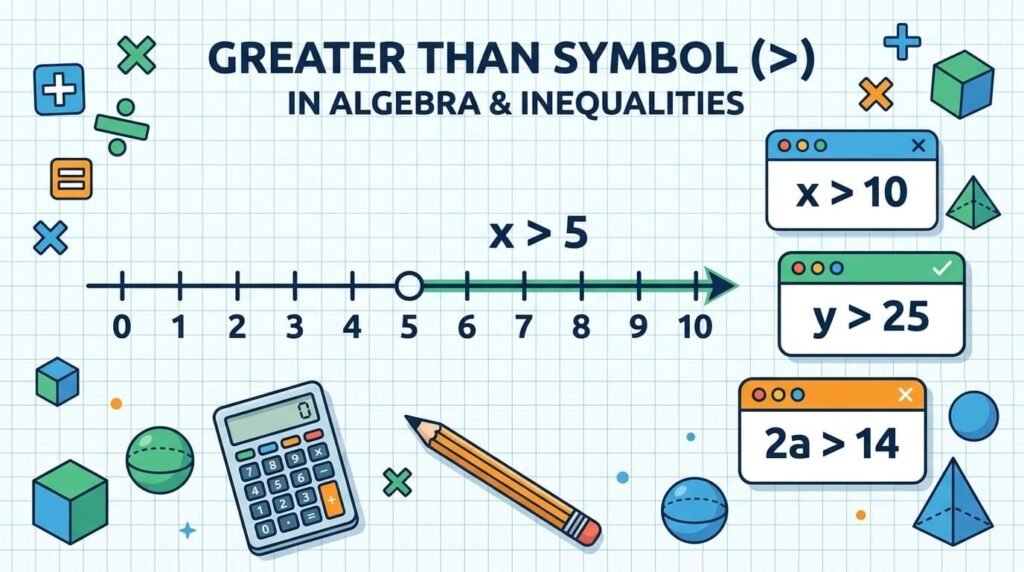
In algebra, the greater than symbol is used with variables to represent a range of possible values.
- x > 10
- y > 25
- 3a > 15
Instead of one answer, these expressions represent many possible solutions.
Solving Inequalities With the Greater Than Symbol
To solve an inequality, use the same basic steps as solving an equation.
Example:
x + 6 > 15
Subtract 6 from both sides:
x > 9
This means every number greater than 9 satisfies the inequality for example, 10, 15, 100, or 500.
Greater Than vs Less Than Symbols
Difference Between Greater Than (>) and Less Than (<)
The greater than symbol (>) shows that the value on the left is larger than the value on the right. In contrast, the less than symbol (<) shows that the value on the left is smaller.
| Symbol | Meaning | Example | Read As |
| > | Greater than | 15 > 8 | 15 is greater than 8 |
| < | Less than | 8 < 15 | 8 is less than 15 |
Greater Than or Equal To (≥) vs Less Than or Equal To (≤)
These inequality symbols include equality as well as comparison.
| Symbol | Meaning | Example |
| ≥ | Greater than or equal to | x ≥ 12 |
| ≤ | Less than or equal to | y ≤ 20 |
For example:
- 10 ≥ 10 is true because the numbers are equal.
- 7 ≤ 10 is true because 7 is less than 10.
Easy Tricks to Remember These Symbols
If you often confuse the symbols, these tricks can help:
- The open side always faces the larger number.
- The pointed end always points toward the smaller number.
- Think of the symbol as a hungry crocodile it always opens its mouth toward the larger value because it wants the bigger meal.
Example: 12 > 5 the open side faces 12 because it is the greater number.
Common Uses of the Greater Than Symbol
Solving Inequality Problems
The symbol is widely used in inequalities to describe a range of possible values.
Example: x > 15 means x can be any number greater than 15, such as 16, 20, 50, or 100.
Using Greater Than Symbols on Number Lines
A number line helps visualize inequalities.
For example, for x > 5:
- Place an open circle at 5 because 5 is not included.
- Draw a line with an arrow extending to the right to show all numbers greater than 5.
This method is commonly used when solving algebraic expressions and graphing inequalities.
Applications in Real-Life Situations
The greater than symbol is useful beyond the classroom, including:
- Comparing product prices
- Comparing exam scores
- Measuring heights and weights
- Checking age requirements
- Comparing temperatures
- Analyzing business profits and sales
- Evaluating sports statistics
Practice Questions on Greater Than Symbol
Practice is the best way to understand comparison symbols.
Identify the Correct Symbol
Fill in the blank using > or <.
- 18 ___ 9
- 45 ___ 60
- 100 ___ 99
- 15 ___ 15
Answers
- 18 > 9
- 45 < 60
- 100 > 99
- 15 = 15 the two values are equal, so neither > nor < applies here.
Compare Numbers Using >
- 75 and 50 → 75 > 50
- 200 and 125 → 200 > 125
- 9.8 and 9.1 → 9.8 > 9.1
- 5/6 and 2/6 → 5/6 > 2/6
Solve Greater Than Inequality Questions
1. x + 8 > 20 Subtract 8 from both sides. Answer: x > 12
2. y − 4 > 10 Add 4 to both sides. Answer: y > 14
3. 2a > 18 Divide both sides by 2. Answer: a > 9
These simple exercises help build confidence in solving inequalities and algebraic expressions.
Conclusion
The greater than symbol (>) is one of the most important comparison symbols in mathematics. It helps compare numbers, solve inequalities, and write accurate mathematical expressions in arithmetic, algebra, and real-life situations.
Whether you’re comparing whole numbers, negative numbers, fractions, or decimals, the same rule always applies: the open side of the symbol faces the larger value.
By understanding the difference between greater than (>), less than (<), greater than or equal to (≥), and less than or equal to (≤), you’ll be able to solve math problems more confidently and accurately. Practice using these symbols regularly, and they’ll soon become second nature in both schoolwork and everyday calculations.
FAQs
What Is the Greater Than Symbol?
The greater than symbol (>) is a mathematical symbol used to show that one number or value is larger than another.
How Do You Write the Greater Than Sign?
The greater than sign is written as >, with the open side facing the larger number.
How Do You Remember the Greater Than Symbol?
Remember that the open side always faces the greater value, or think of it as a hungry crocodile opening its mouth toward the larger number.
Is 75 Greater Than 74? Yes. 75 > 74 because 75 has a higher value than 74.
What Is the Difference Between Greater Than and Equal To?
Greater than (>) means one value is larger, while equal to (=) means both values are exactly the same.
What Does ≥ Mean in Mathematics?
The symbol ≥ means greater than or equal to, indicating that a value can be either larger than or exactly equal to another value.
How Do You Use the Greater Than Symbol in Algebra?
In algebra, the greater than symbol is used to write inequalities, such as x > 10, where the variable can have any value greater than 10.
What Numbers Are Greater Than 1?
Every number larger than 1, including 2, 5, 10, 100, and positive decimals like 1.5, is greater than 1.

I’m the creator of SquareRootSymbolz.com, where I publish easy-to-understand guides on symbols, Unicode characters, Alt codes, keyboard shortcuts, and copy-and-paste text symbols. My goal is to provide accurate, well-researched, and user-friendly content that helps readers quickly find the information they need.