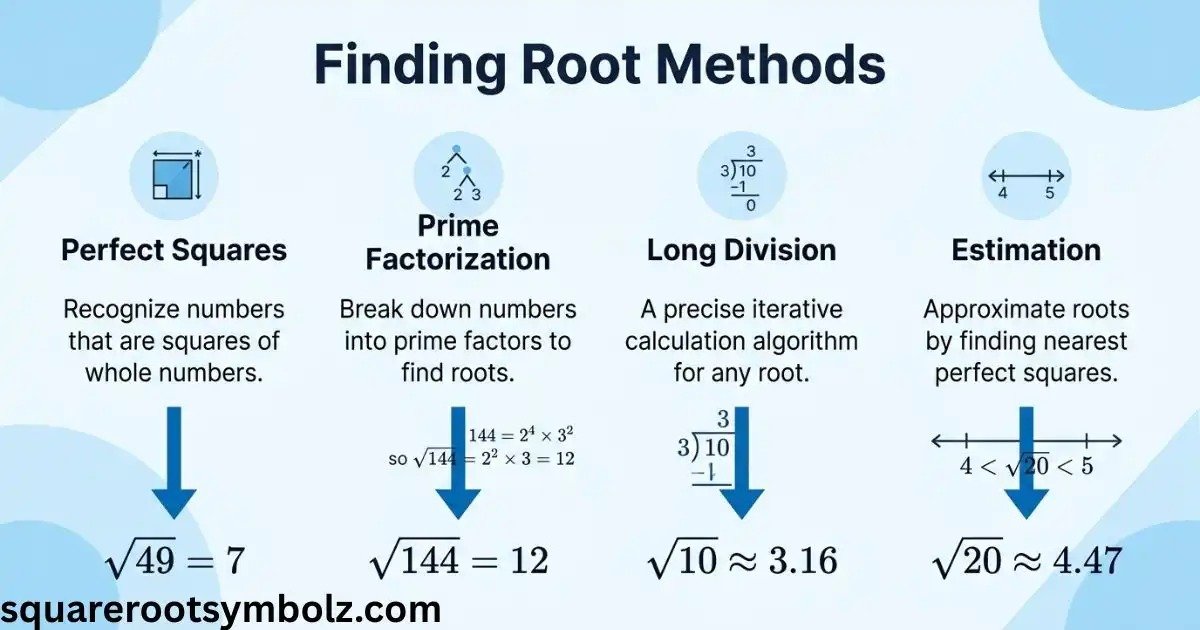
Finding root in math means determining the value that makes a mathematical relationship work. In a function, that value makes f(x) = 0; with a square root, it is the number that produces the given value when multiplied by itself. The same idea connects equations, factors, radicals, square roots, cube roots, and numerical methods.
If roots have ever felt confusing, you are not alone. Students often see “root” used in two different ways: a root of an equation and a root operation such as √25. This guide brings those meanings together with clear examples, familiar numbers, factorization, radical notation, and practical ways to check an answer.

Section 2.2 Finding roots
A root of a function is a value of x for which the function equals zero. In other words, if f(a) = 0, then a is a root of f. On a graph, a real root corresponds to an x-intercept. This definition is broader than simply finding square roots.
The phrase finding root therefore depends on the mathematical context. You may be finding a square root, solving a polynomial equation, locating a zero on a graph, or approximating a nonlinear equation numerically. Before choosing a method, identify what kind of root the problem actually asks for.
Finding the Square Root
Finding a square root means asking which number multiplied by itself gives the original number. For example, 8 × 8 = 64, so √64 = 8. Perfect squares such as 1, 4, 9, 16, 25, and 36 are especially useful because their roots are whole numbers.
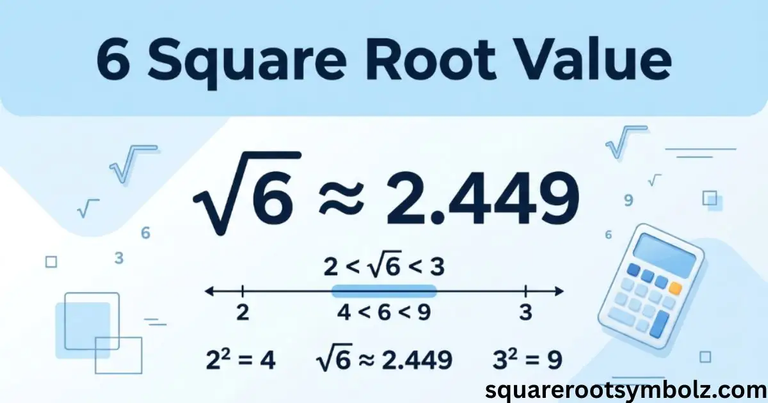
For numbers that are not perfect squares, the answer may be irrational. For example, √2 is approximately 1.414, while √15 is approximately 3.873. A useful first step is to locate the number between nearby perfect squares, then estimate or calculate the decimal value.
Finding the Cube Root
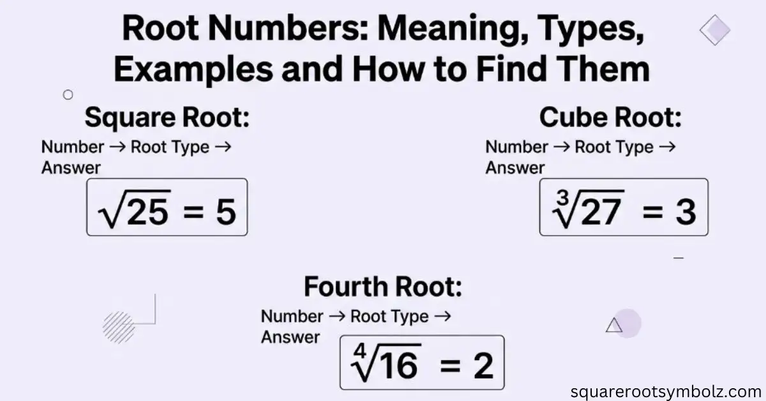
Finding a cube root means looking for a number that is multiplied by itself three times to produce the given value. Since 4 × 4 × 4 = 64, the cube root of 64 is 4. This is the inverse operation of cubing a number.
Cube roots behave differently from square roots when negative numbers appear. For example, −2 × −2 × −2 = −8, so the cube root of −8 is −2. Every real number has a real cube root, whereas negative real numbers do not have real square roots.
Perfect Squares
A perfect square is a number that can be written as an integer multiplied by itself. Examples include 1, 4, 9, 16, 25, 36, 49, and 64. Knowing these values makes finding root much faster because you can recognize exact answers without using long calculations.
| Number | Square | Square root |
| 1 | 1² | 1 |
| 4 | 2² | 2 |
| 9 | 3² | 3 |
| 16 | 4² | 4 |
| 25 | 5² | 5 |
| 36 | 6² | 6 |
| 49 | 7² | 7 |
| 64 | 8² | 8 |
| 81 | 9² | 9 |
| 100 | 10² | 10 |
A quick mental strategy is to remember these squares before tackling unfamiliar values. If you need √50, notice that 49 < 50 < 64. Therefore, its square root must be between 7 and 8. This simple comparison gives you a useful estimate before reaching for a calculator.
Perfect Cubes
A perfect cube is a number produced by multiplying an integer by itself three times. The first few are 1, 8, 27, 64, 125, 216, 343, 512, and 729. Recognizing these values makes cube-root calculations almost immediate.
| Number | Cube | Cube root |
| 1 | 1³ | 1 |
| 8 | 2³ | 2 |
| 27 | 3³ | 3 |
| 64 | 4³ | 4 |
| 125 | 5³ | 5 |
| 216 | 6³ | 6 |
| 343 | 7³ | 7 |
| 512 | 8³ | 8 |
| 729 | 9³ | 9 |
| 1,000 | 10³ | 10 |
Perfect cubes grow faster than perfect squares, so memorizing a short reference list is particularly useful. If you need the cube root of 200, for example, you know it must lie between 5 and 6 because 125 < 200 < 216.
Radical
A radical is the notation used to represent a root. The familiar √ symbol represents a square root when no index is written. For higher roots, a small number called the index appears on the radical, such as ∛27 for the cube root of 27.
Consider √49. The radical symbol is √, while 49 is the number inside it. The result is 7 because 7 × 7 = 49. Understanding this notation makes expressions involving square roots, cube roots, and higher roots much easier to read.
Radicand
The radicand is the number or expression placed under a radical symbol. In √36, the radicand is 36. In √(x + 4), the radicand is x + 4. Identifying the radicand tells you exactly which quantity the root operation applies to.
This small vocabulary point prevents common mistakes. In ∛125, the radical represents the root operation, the 3 is the index, and 125 is the radicand. Since 5 × 5 × 5 = 125, the cube root is 5. Learning these parts makes complicated radical expressions less intimidating.
Index
The index tells you which root is being requested. An index of 2 means square root, although the 2 is normally omitted. An index of 3 means cube root. Thus √25 means the second root of 25, while ∛64 means the third root of 64.
The index also connects roots with fractional exponents. For example, a cube root can be written as a power of 1/3, while a fourth root can be written with an exponent of 1/4. The denominator of the fractional exponent corresponds to the root’s index.
Exponent Notation
Roots and exponents are two ways of expressing the same mathematical relationship. A square root can be written as a number raised to the power 1/2, while a cube root can be written with the power 1/3. This connection becomes especially useful when simplifying algebraic expressions.
For example, √25 can be viewed as 25^(1/2), which equals 5. Likewise, ∛125 can be written as 125^(1/3), which equals 5. When the radicand already has a power, the exponent and root index work together to produce fractional exponents.
Example 2.2.1. Finding Roots of a Linear Function.
Consider the equation 3x − 2 = 0. To find its root, isolate x by adding 2 to both sides and then dividing by 3. This gives x = 2/3. Substituting 2/3 back into the original function produces zero, confirming the root.
This example shows why a function root is also called a zero. The goal is not to take a square or cube root. Instead, you are finding the input that makes the function’s output equal zero. That distinction becomes important when moving from arithmetic into algebra.
Example 2.2.2. Finding Roots by Factoring.
Consider 3x² − 7x + 4 = 0. Factor the expression as (3x − 4)(x − 1) = 0. The zero-product property tells us that either factor can equal zero. Therefore, the roots are x = 4/3 and x = 1.
Factoring is often one of the quickest ways of finding root values for polynomials that break into simple factors. After solving, substitute each answer into the original equation. If the result is zero, the candidate is confirmed as a root.
Example 2.2.3. Finding Roots with the Quadratic Formula.
For a quadratic equation ax² + bx + c = 0, the quadratic formula provides the roots when factoring is difficult. Consider x² − 6x + 7 = 0. Substituting a = 1, b = −6, and c = 7 produces x = 3 ± √2.
This example also shows why square roots appear naturally when finding roots of equations. The discriminant, b² − 4ac, determines the type of solution. A positive discriminant gives two distinct real roots, zero gives one repeated real root, and a negative discriminant gives no real roots.
Example 2.2.4. Finding Roots of an Exponential Function.
Take f(x) = 1 − 2^x. To find its root, set the function equal to zero: 1 − 2^x = 0. Rearranging gives 2^x = 1. Because 2 raised to the zero power equals 1, the root is x = 0.
The important lesson is that finding root does not always involve factoring or radicals. The structure of the function determines the appropriate method. Exponential functions may require exponent rules or logarithms, while polynomials often allow factoring or the quadratic formula.
Example 2.2.5. Finding Roots of a Square Root.
Consider f(x) = √(x − 1). To find its root, set the function equal to zero: √(x − 1) = 0. The only way a square root can equal zero is when its radicand equals zero, giving x − 1 = 0 and therefore x = 1.
This example highlights an important difference between a square-root operation and a root of a function. Here, you are not calculating √1 merely to get a number. You are finding the input value that causes the entire function to equal zero.
Example (Bisection method)
The bisection method finds a root by repeatedly narrowing an interval in which the function changes sign. If f(a) and f(b) have opposite signs, a root lies between them under the usual continuity condition. The midpoint becomes the next test value, and the interval is repeatedly reduced.
For example, to approximate √2, consider f(x) = x² − 2. Since f(1) is negative and f(2) is positive, the root lies between 1 and 2. Repeatedly testing midpoints gradually narrows the interval around √2.
Order of convergence of the bisection method
The bisection method is reliable because each iteration cuts the interval in half. Its strength is predictability rather than extreme speed. If the starting interval brackets a root and the function is continuous, repeated bisection steadily narrows the possible location of the solution.
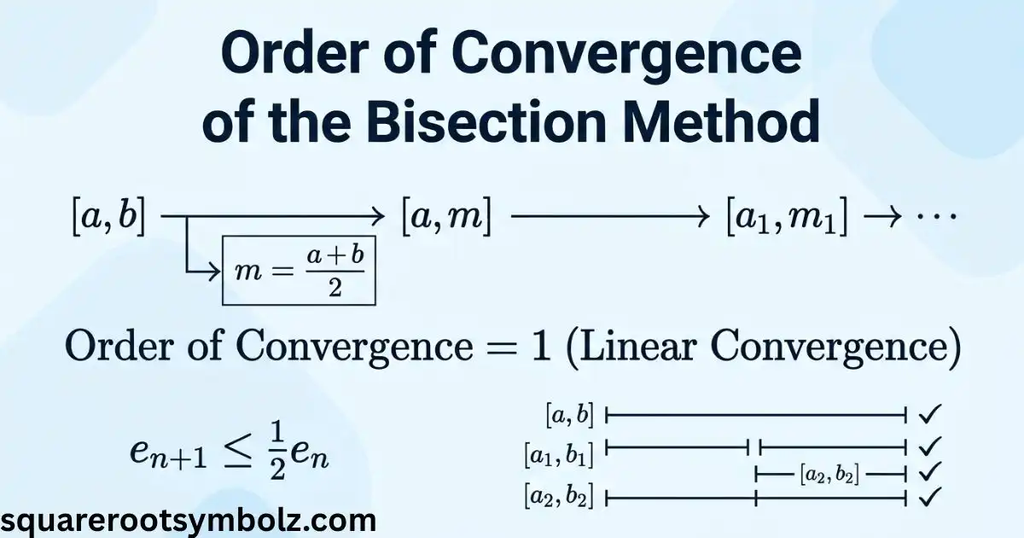
This matters when finding root numerically because an approximate answer should come with a clear idea of its accuracy. Faster methods such as Newton’s method can converge more quickly, but they depend on additional conditions and a suitable starting value.
Conclusion
Finding root has more than one meaning in mathematics. It can mean calculating a square root or cube root, but it can also mean finding an input that makes a function equal to zero. Once you identify which meaning applies, the correct method becomes much easier to choose.
For basic arithmetic, recognize perfect squares and cubes. For polynomial equations, try factoring or the quadratic formula. For nonlinear equations, numerical methods such as bisection and Newton’s method can approximate the solution. The common idea is always the same: identify the value that satisfies the mathematical condition.
FAQ Section
What is a root in math?
A root is a value that satisfies a mathematical condition. For a function, a root is an input x for which f(x) = 0. For a square root, the term refers to a number that produces the radicand when squared.
How do you find the roots in math?
The method depends on the problem. You may use factoring, the quadratic formula, square-root or cube-root recognition, or numerical methods such as bisection and Newton’s method.
What does √ mean in math?
The symbol √ represents the square root. For example, √36 = 6 because 6 × 6 = 36.
What is the easiest way to find cube roots?
Start by checking whether the number is a familiar perfect cube. For example, because 5 × 5 × 5 = 125, ∛125 = 5.
What is a radical in math?
A radical is notation used to represent a root. The expression √49 contains a radical symbol and has 49 as its radicand.
What is a radicand?
The radicand is the number or expression underneath a radical. In √100, the radicand is 100.
What is the index of a radical?
The index identifies the type of root. A 3 indicates a cube root, while a missing index normally means square root.
How do you solve a radical?
First identify the radicand and determine whether it contains a perfect square or another simplifiable factor. For example, √18 can be simplified to 3√2.
These questions closely reflect the FAQ/search-question patterns visible in the current Mometrix result.

I’m the creator of SquareRootSymbolz.com, where I publish easy-to-understand guides on symbols, Unicode characters, Alt codes, keyboard shortcuts, and copy-and-paste text symbols. My goal is to provide accurate, well-researched, and user-friendly content that helps readers quickly find the information they need.