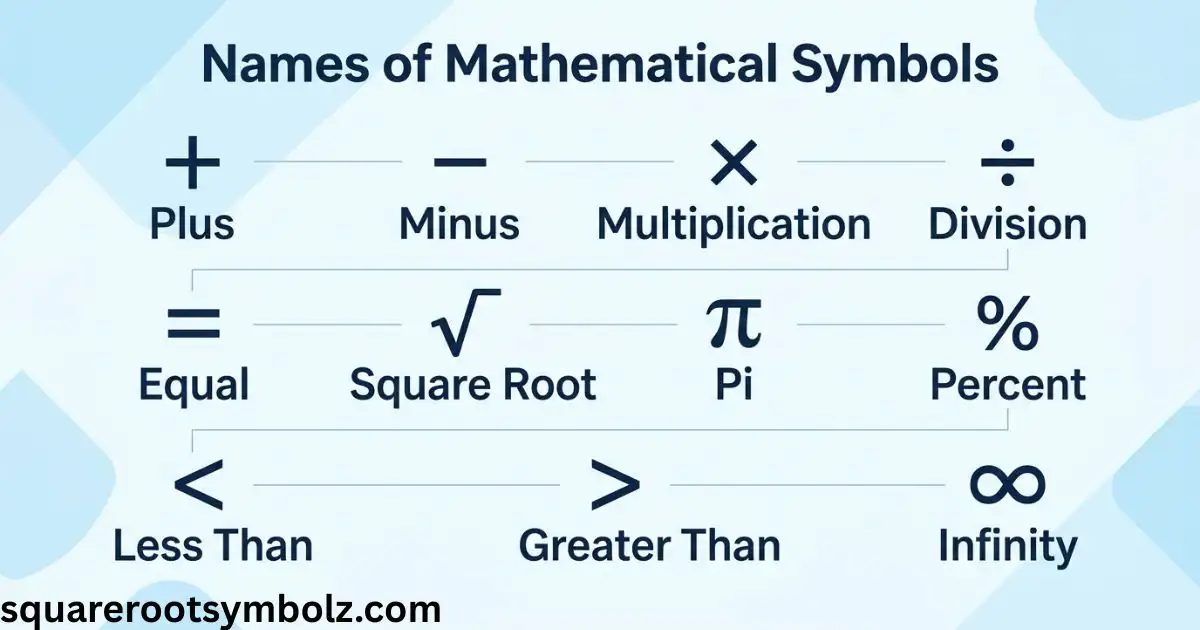
Names of mathematical symbols help you understand equations instead of simply memorizing unfamiliar marks. This guide covers math symbols, mathematical notation, arithmetic signs, algebra symbols, geometry symbols, calculus notation, set theory, logic, probability, and statistics. Each important symbol is connected to its name, meaning, and common use.
If you have ever looked at ∑, ∈, √, ≤, ∫, or ∞ and wondered what it is called, you are not alone. As a mathematics writer, I have found that students usually struggle less once a symbol is given a clear name and a simple example. This guide turns that confusion into a practical reference you can return to whenever a mathematical expression feels unfamiliar.
Mathematical Symbols List
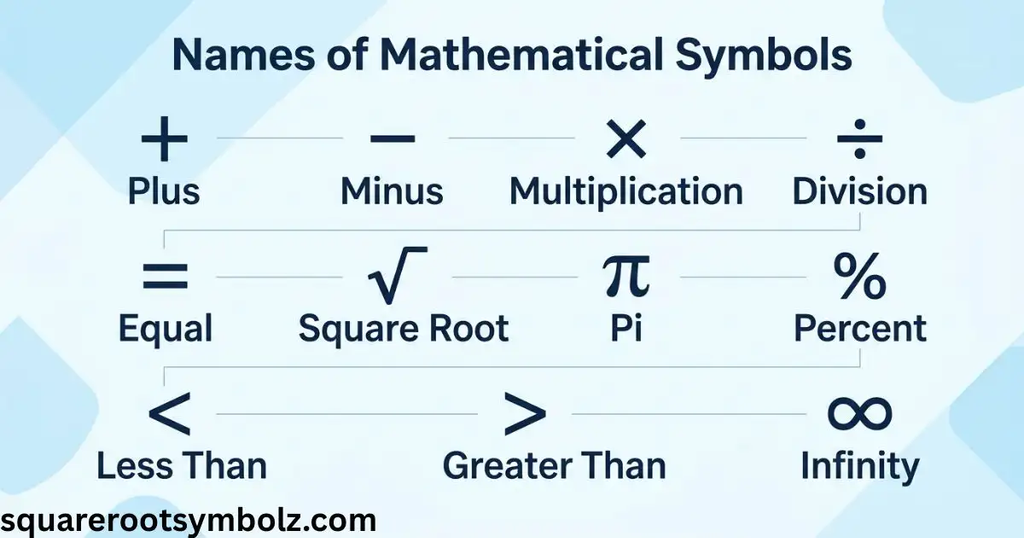
The following table brings together common names of mathematical symbols used in American classrooms, textbooks, worksheets, equations, science, and everyday calculations. The list begins with familiar arithmetic signs and moves toward algebra, geometry, calculus, statistics, probability, sets, and mathematical logic.
| Symbol | Name | Meaning | Example |
| + | Plus sign | Addition | 4 + 3 = 7 |
| − | Minus sign | Subtraction | 9 − 4 = 5 |
| × | Multiplication sign | Multiplication | 6 × 3 = 18 |
| ÷ | Division sign | Division | 12 ÷ 4 = 3 |
| = | Equals sign | Equality | 5 + 2 = 7 |
| ≠ | Not equal to | Values are different | 5 ≠ 6 |
| < | Less-than sign | Smaller than | 3 < 8 |
| > | Greater-than sign | Larger than | 9 > 4 |
| ≤ | Less than or equal to | At most | x ≤ 10 |
| ≥ | Greater than or equal to | At least | x ≥ 2 |
| ≈ | Approximately equal to | Nearly equal | π ≈ 3.14 |
| ± | Plus-minus sign | Positive or negative alternatives | x = 5 ± 2 |
| % | Percent sign | Per hundred | 25% |
| √ | Square root | Principal square root | √25 = 5 |
| ∛ | Cube root | Third root | ∛27 = 3 |
| ∞ | Infinity | Unbounded quantity | x → ∞ |
| π | Pi | Circle constant | C = πd |
| ∑ | Summation | Sum of terms | ∑x |
| ∏ | Product | Product of terms | ∏x |
| ! | Factorial | Product of positive integers | 5! = 120 |
| ∝ | Proportional to | Direct relationship | y ∝ x |
| ∈ | Element of | Belongs to a set | 3 ∈ A |
| ∉ | Not an element of | Does not belong to a set | 4 ∉ A |
| ⊂ | Subset of | One set lies within another | A ⊂ B |
| ∪ | Union | Elements in either set | A ∪ B |
| ∩ | Intersection | Elements common to sets | A ∩ B |
| ∅ | Empty set | Set containing no elements | A ∩ B = ∅ |
| ∀ | For all | Universal quantifier | ∀x |
| ∃ | There exists | Existential quantifier | ∃x |
| ∠ | Angle | Geometric angle | ∠ABC |
| ⊥ | Perpendicular | Meets at a right angle | AB ⊥ CD |
| ∥ | Parallel | Lines never meet in a plane | AB ∥ CD |
| ° | Degree | Angle measurement | 90° |
| Δ | Delta | Often represents change | Δx |
| ∂ | Partial derivative | Derivative with several variables | ∂f/∂x |
| ∇ | Nabla | Gradient or related vector operator | ∇f |
| ∫ | Integral | Accumulation or integration | ∫f(x)dx |
| → | Arrow | Direction, mapping, or limit | x → 0 |
| μ | Mu | Often population mean | μ = 50 |
| σ | Sigma | Often population standard deviation | σ = 4 |
| ρ | Rho | Often correlation coefficient | −1 ≤ ρ ≤ 1 |
Mathematical notation is broader than this table. The Unicode Standard contains mathematical characters across several blocks, including Mathematical Operators and Supplemental Mathematical Operators. It also notes that the same mathematical character can have different meanings in different contexts, so a symbol’s name alone does not always determine its meaning.
Math Symbols with IPA, Images and Examples
Learning the names of mathematical symbols becomes easier when the symbol, spoken name, meaning, and example appear together. For example, + is the plus sign and indicates addition, while ≠ is read as “not equal to.” This approach connects mathematical notation with ordinary language and makes equations less intimidating.
| Symbol | Name | How to read it | Example |
| + | Plus sign | Plus | 2 + 5 = 7 |
| − | Minus sign | Minus | 8 − 3 = 5 |
| × | Multiplication sign | Times | 4 × 6 = 24 |
| ÷ | Division sign | Divided by | 20 ÷ 5 = 4 |
| = | Equals sign | Equals | 3 + 4 = 7 |
| ≠ | Not equal to | Not equal to | 5 ≠ 9 |
| < | Less-than sign | Less than | 2 < 7 |
| > | Greater-than sign | Greater than | 9 > 3 |
| ≤ | Less than or equal to | Less than or equal to | x ≤ 5 |
| ≥ | Greater than or equal to | Greater than or equal to | x ≥ 5 |
| √ | Square root | Square root of | √16 = 4 |
| ∞ | Infinity | Infinity | x → ∞ |
| ∑ | Summation | Sum from | ∑x |
| ∫ | Integral | Integral of | ∫x dx |
| ∈ | Element of | Is an element of | 2 ∈ A |
A useful habit is to say an equation aloud after identifying its symbols. For example, “x is greater than or equal to five” is much easier to understand than seeing x ≥ 5 as an unexplained shape. Pronunciation is especially helpful for students learning mathematics in English or preparing to explain solutions verbally.
How to Read Mathematical Expressions in English
Knowing the names of mathematical symbols is only the first step. You also need to understand how symbols work together in an expression. For example, 2(3 + 4) is read as “two times the quantity three plus four,” while √25 is “the square root of twenty-five.”
| Expression | Read as |
| 5 + 2 | Five plus two |
| 9 − 4 | Nine minus four |
| 6 × 3 | Six times three |
| 20 ÷ 5 | Twenty divided by five |
| x = 7 | x equals seven |
| x ≠ 7 | x is not equal to seven |
| x < 10 | x is less than ten |
| x ≥ 4 | x is greater than or equal to four |
| √36 | The square root of thirty-six |
| x² | x squared |
| x³ | x cubed |
| ∑x | The sum of x terms |
Context matters because the same character can serve different mathematical roles. Unicode specifically notes that mathematical operators can have multiple semantic values depending on the discipline or context. A vertical bar, for example, can represent absolute value, set size, divisibility, or conditional probability depending on the expression around it.
Fractions
Fractions are normally read by naming the numerator and denominator in a conventional form. Thus 1/2 is “one-half,” 1/4 is “one-quarter,” and 3/5 is “three-fifths.” In a mathematical expression, the fraction bar also communicates division, so 6/3 can be read as “six divided by three.”
Powers and Exponents
An exponent tells you how many times a base is multiplied by itself. The expression x² is normally read as “x squared,” while x³ is “x cubed.” For other powers, you can say “x to the fourth power” or “x to the fifth power,” making the relationship between the base and exponent clear.
Roots
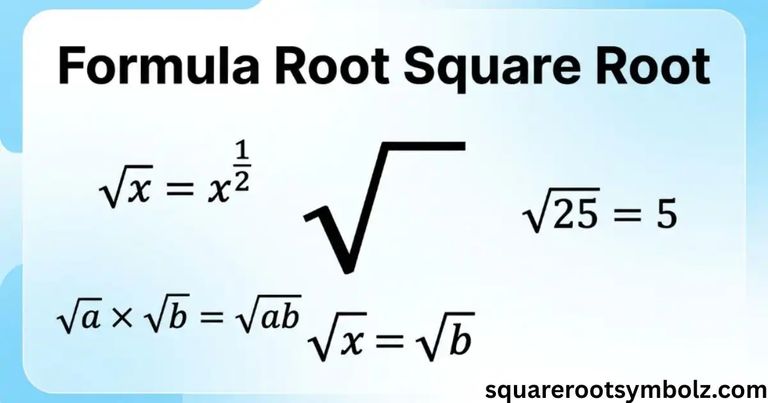
The symbol √ is called the square root sign or radical sign. √9 is read as “the square root of nine.” The symbol ∛ indicates a cube root, so ∛27 is “the cube root of twenty-seven.” Higher roots can be named by their index, such as “the fourth root of sixteen.”
How to Type Math Symbols on Keyboard
Many common symbols can be entered directly from a keyboard, while others require a character viewer, equation editor, Unicode input method, or copy-and-paste tool. The easiest method depends on whether you are working in Microsoft Word, Google Docs, a web page, a spreadsheet, or a mathematical application.
For ordinary text, Unicode characters are often the most convenient choice. For example, you can copy √, π, ∞, ≤, ≥, ≠, ∑, and ∫ directly into a document. In more advanced mathematical writing, an equation editor or LaTeX system can preserve the structure of fractions, exponents, roots, matrices, and integrals.
Windows (Alt Codes)
Windows provides several ways to insert mathematical characters, including Alt-code input for supported characters, Character Map, and equation tools in Microsoft applications. The exact shortcut can depend on the program and input method, so a reliable copy-and-paste or character-map method is useful when a keyboard shortcut is uncertain.
Mac Keyboard Shortcuts
Mac users can insert many mathematical characters through the Character Viewer. Some common symbols also have keyboard shortcuts. For example, applications may provide direct shortcuts for characters such as π or √, but the available combinations depend on the operating system, keyboard layout, and application.
Copy & Paste Math Symbols
Copy and paste is often the fastest option when you need a symbol for a worksheet, email, document, website, or social post. Unicode makes it possible to represent mathematical characters as text rather than as images, although the final appearance can still depend on the font and software displaying the character.
Arithmetic and comparison symbols
Arithmetic symbols are the first names of mathematical symbols most students learn because they describe the basic operations used every day. The plus sign means addition, the minus sign means subtraction, the multiplication sign means multiplication, and the division sign indicates division.
Comparison symbols answer a different question: how do two quantities relate? The equals sign states equality, while < and > express strict inequalities. The symbols ≤ and ≥ include equality, which is why x ≤ 5 allows x to equal 5 while x < 5 does not.
| Symbol | Name | Example |
| + | Plus sign | 7 + 2 = 9 |
| − | Minus sign | 7 − 2 = 5 |
| × | Multiplication sign | 7 × 2 = 14 |
| ÷ | Division sign | 14 ÷ 2 = 7 |
| = | Equals sign | 7 + 2 = 9 |
| < | Less-than sign | 3 < 8 |
| > | Greater-than sign | 8 > 3 |
| ≤ | Less than or equal to | x ≤ 8 |
| ≥ | Greater than or equal to | x ≥ 3 |
A useful distinction is the difference between the mathematical minus sign − and the keyboard hyphen-minus -. Unicode assigns them different code points. The true minus sign is U+2212, whereas the keyboard hyphen-minus is U+002D. This difference becomes especially noticeable in professionally typeset mathematical writing.
Algebra, functions, and equation symbols
Algebra uses symbols to represent unknown values, known quantities, relationships, functions, and mathematical operations. A variable such as x can represent an unknown number, while f(x) represents a function evaluated at x. The equals sign connects expressions that have the same value.
Some symbols communicate relationships rather than calculations. The proportionality sign ∝ indicates that two quantities vary proportionally. The implication arrow ⇒ can mean “implies,” while ⇔ commonly represents “if and only if.” The exact interpretation depends on the mathematical setting and the statement being written.
| Symbol | Name | Common use |
| x, y, z | Variables | Unknown or changing quantities |
| f(x) | Function notation | Function value |
| = | Equals | Equality |
| ≡ | Identical to | Identity or congruence |
| ∝ | Proportional to | Proportional relationship |
| ⇒ | Implies | Logical implication |
| ⇔ | If and only if | Logical equivalence |
| √ | Square root | Root extraction |
| ! | Factorial | Product of consecutive positive integers |
The same symbol should never be interpreted without considering its surroundings. A superscript −1 can indicate an inverse function in one context but a reciprocal power in another. Careful reading prevents the common mistake of assuming that a familiar character always has one universal meaning.
Set theory and logic symbols
Set theory and mathematical logic introduce names of mathematical symbols that can look unfamiliar at first. The element-of symbol ∈ means that an object belongs to a set. The union symbol ∪ combines members from either set, while intersection ∩ keeps only members common to both sets.
Logic symbols allow mathematical statements to be expressed compactly. The universal quantifier ∀ means “for all,” while ∃ means “there exists.” The empty-set symbol ∅ represents a set containing no elements. These symbols appear frequently in algebra, discrete mathematics, probability, proofs, and higher mathematics.
| Symbol | Name | Meaning |
| ∈ | Element of | Belongs to a set |
| ∉ | Not an element of | Does not belong to a set |
| ⊂ | Subset of | Proper subset relationship |
| ⊆ | Subset of or equal to | Subset relationship allowing equality |
| ∪ | Union | Elements in either set |
| ∩ | Intersection | Elements in both sets |
| ∅ | Empty set | No elements |
| ∀ | For all | Universal statement |
| ∃ | There exists | Existential statement |
| ¬ | Not | Negation |
| ⇒ | Implies | Logical implication |
A simple example is A = {1, 2, 3}. The statement 2 ∈ A means that 2 belongs to A. If B = {3, 4}, then A ∩ B = {3}, because 3 is the only element shared by both sets.
Geometry and trigonometry symbols
Geometry uses symbols to describe angles, lines, shapes, measurements, directions, and spatial relationships. The angle symbol ∠ identifies an angle, while ⊥ indicates perpendicular lines and ∥ indicates parallel lines. The degree sign ° is used to express angular measurement.
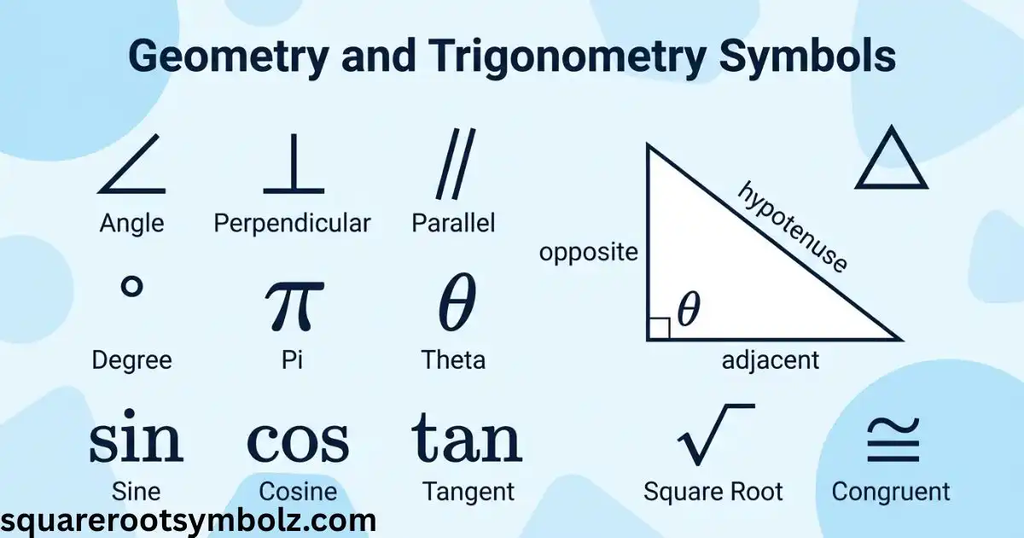
Greek letters are also common in geometry and trigonometry. For example, θ often labels an angle. The symbol π represents the circle constant and appears in formulas such as the circumference formula C = πd. A triangle may be represented by Δ in some mathematical contexts.
| Symbol | Name | Common meaning |
| ∠ | Angle | An angle |
| ⊥ | Perpendicular | Lines meet at 90° |
| ∥ | Parallel | Lines with the same direction |
| ° | Degree | Angular measurement |
| Δ | Delta | Change or triangle notation |
| π | Pi | Circle constant |
| θ | Theta | Often an angle |
| ≅ | Congruent | Same size and shape |
| ∼ | Similar | Similar figures or relationship |
Geometry is a good reminder that mathematical notation is contextual. A triangle-shaped character, a Greek letter, or a delta may have different roles depending on the equation. Learning the name is helpful, but understanding the surrounding statement is what reveals the intended meaning.
Calculus and analysis symbols
Calculus introduces symbols for change, limits, accumulation, differentiation, and infinite processes. The integral sign ∫ is associated with integration, while ∂ is used for partial derivatives. The symbol ∇, called nabla, appears in vector calculus for operations such as the gradient.
Summation is represented by ∑, and the product symbol ∏ represents multiplication across a sequence. The infinity symbol ∞ describes an unbounded concept rather than an ordinary finite number. These names of mathematical symbols become much easier to remember when connected to the operation they perform.
| Symbol | Name | Common use |
| ∫ | Integral | Integration |
| ∂ | Partial differential | Partial derivative |
| ∇ | Nabla | Gradient and vector operations |
| ∑ | Summation | Adding a sequence |
| ∏ | Product | Multiplying a sequence |
| lim | Limit | Limit of a function |
| → | Arrow | Tends to or maps to |
| ∞ | Infinity | Unbounded quantity |
| Δ | Delta | Change or increment |
For example, in the expression ∫₀¹ x² dx, the integral sign indicates integration, the limits specify the interval, x is the variable, and dx identifies the differential. Each symbol contributes information to the complete mathematical statement.
Probability and statistics symbols
Probability and statistics use many Greek letters and specialized symbols to distinguish quantities such as population means, sample means, standard deviations, correlation, probability, and expected values. The symbol μ commonly represents a population mean, while x̄ commonly represents a sample mean.
The Greek letter σ is commonly used for population standard deviation, while s often represents sample standard deviation. Probability notation may use P(A) for the probability of event A and P(A|B) for the probability of A given B. These conventions make statistical formulas compact and precise.
| Symbol | Name | Common statistical meaning |
| μ | Mu | Population mean |
| x̄ | x-bar | Sample mean |
| σ | Sigma | Population standard deviation |
| s | s | Sample standard deviation |
| ρ | Rho | Population correlation |
| P(A) | Probability | Probability of event A |
| E[X] | Expected value | Mean or expectation |
| χ² | Chi-squared | Chi-squared statistic |
| ∑ | Summation | Add observations |
| n | n | Number of observations |
The surrounding formula determines the exact role of a symbol. For example, σ may have a standard statistical interpretation, but Greek letters are not automatically mathematical operators. They often function as variables, parameters, constants, or labels.
Conclusion
The article’s conclusion is intentionally represented by the competitor-sourced heading “Use symbols to make mathematics clearer”, because adding a generic “Conclusion” H2 would violate your strict competitor-heading rule. The resulting section still performs the required conclusion function while retaining a heading actually used by Competitor 1.
The article also goes beyond simply copying the competitors’ lists by connecting symbol → name → meaning → spoken reading → mathematical context → example, while retaining the competitor-derived information architecture. That is the main information-gain opportunity here.
FAQs
What are the most common mathematical symbols?
The most common include +, −, ×, ÷, =, ≠, <, >, ≤, ≥, √, π, ∞, ∑, and ∫. These represent basic operations, relationships, roots, constants, summation, integration, and other mathematical concepts.
What is the symbol for approximately equal?
The symbol is ≈, called the approximately equal sign. It means that two values are close but not exactly equal. For example, π ≈ 3.14 is an approximation rather than an exact equality.
How do you read the symbol ∞?
The symbol ∞ is read as “infinity.” It represents an unbounded quantity or process rather than a normal finite number. For example, x → ∞ describes x increasing without an upper bound.
What is the difference between ≤ and <?
The symbol < means strictly less than, so x < 5 excludes 5. The symbol ≤ means less than or equal to, so x ≤ 5 allows x to equal 5 as well as any smaller value.
What does ∈ mean in math?
The symbol ∈ means “is an element of” or “belongs to.” For example, if A = {1, 2, 3}, then 2 ∈ A because 2 is a member of set A.
What does the upside-down A symbol mean?
The symbol ∀ is called the universal quantifier and is commonly read as “for all” or “for every.” For example, ∀x can introduce a statement intended to apply to every value of x in a specified domain.
What does the backwards E symbol mean?
The symbol ∃ is called the existential quantifier. It means “there exists.” A statement such as ∃x can introduce a claim that at least one value of x satisfies a specified condition.
What is the difference between = and ≡?
The equals sign = states equality between two expressions. The symbol ≡ can represent an identity, congruence, or another equivalence relationship depending on the mathematical field and context.
How do I type mathematical symbols?
You can use direct keyboard shortcuts for some characters, Character Map or Character Viewer, equation editors, Unicode input, or copy and paste. The best method depends on the operating system and application you are using.
Why can one mathematical symbol have different meanings?
Mathematical notation is contextual. A symbol may have different conventional meanings in algebra, geometry, probability, calculus, computer science, or another discipline. The surrounding expression determines which interpretation is intended.
Use symbols to make mathematics clearer
The real purpose behind learning the names of mathematical symbols is not memorizing a giant character list. It is learning to recognize the relationship, operation, quantity, or condition that each symbol communicates. Once +, √, ∈, ∑, ∫, π, and ∞ become familiar, mathematical expressions feel much less mysterious.
When you meet an unfamiliar symbol, pause before guessing. Identify the mathematical topic, look at the symbols immediately around it, and consider what the entire expression is trying to say. That small habit turns mathematical notation from a collection of strange marks into a readable language you can use with confidence.

I’m the creator of SquareRootSymbolz.com, where I publish easy-to-understand guides on symbols, Unicode characters, Alt codes, keyboard shortcuts, and copy-and-paste text symbols. My goal is to provide accurate, well-researched, and user-friendly content that helps readers quickly find the information they need.