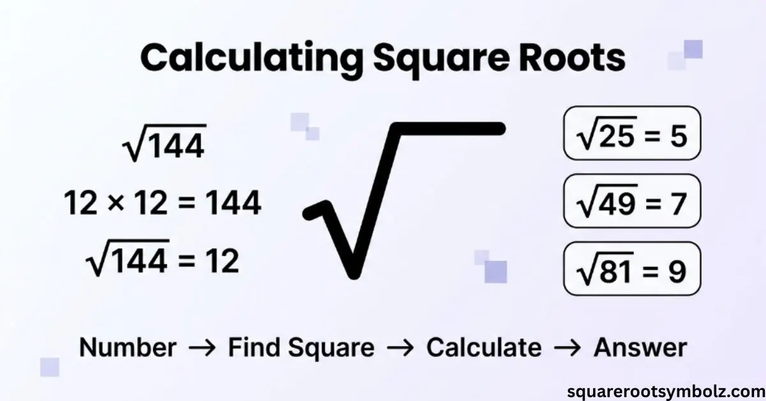
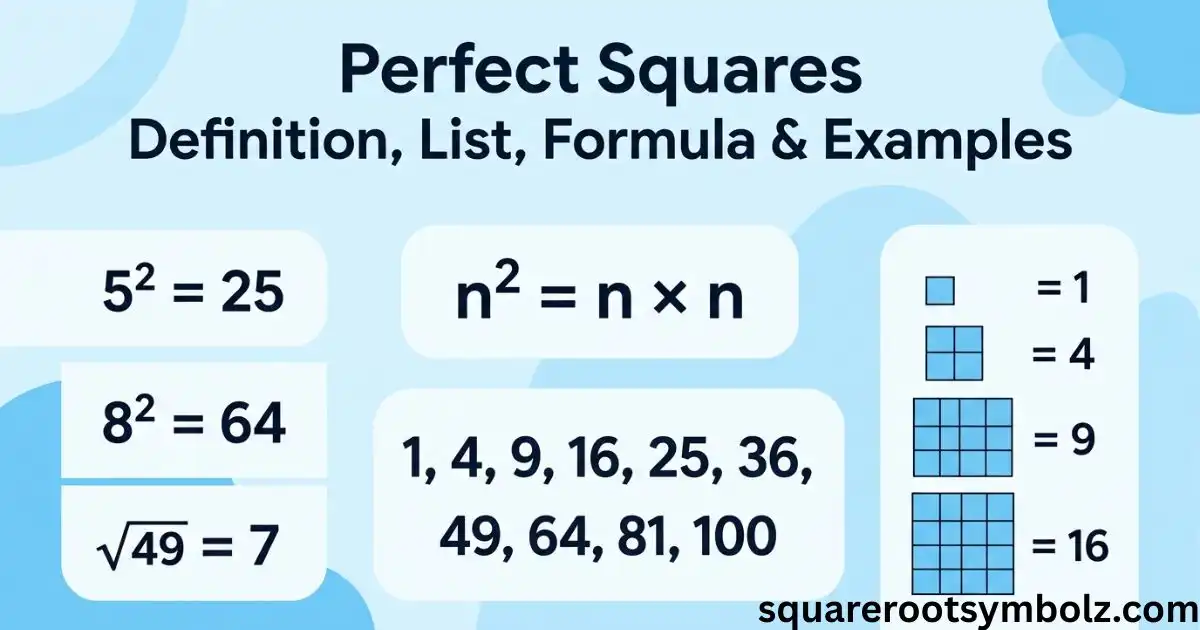
Perfect squares are numbers made by multiplying an integer by itself, such as 1, 4, 9, 16, and 25. In simple terms, if a number can be written as a whole number multiplied by the same whole number, it is a perfect square. This connects multiplication, exponents, square roots, factors, and area.
After teaching square numbers, I’ve found that students usually struggle with one question: “How can I tell quickly whether a number is a perfect square?” The easiest starting point is the square root. If the square root is an integer, the number is a perfect square. From there, patterns, factors, lists, and formulas make the process faster.
What Are Perfect Squares?
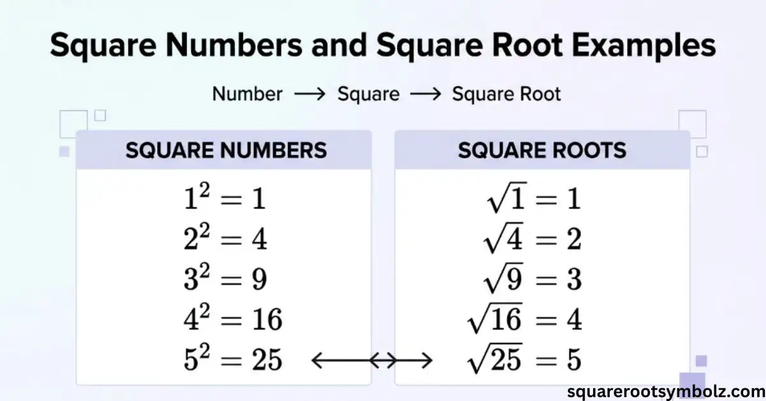
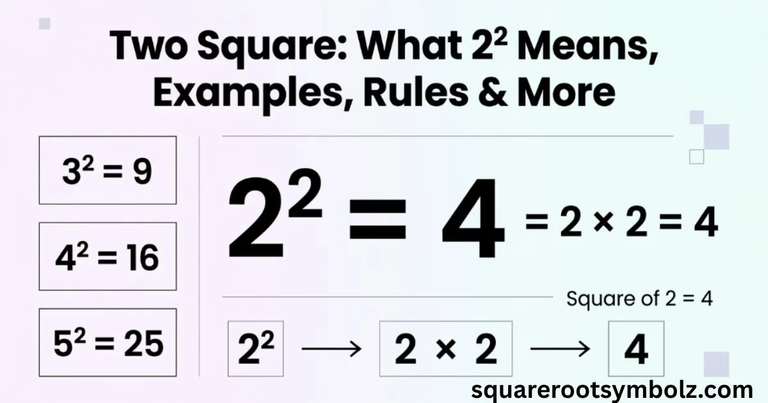
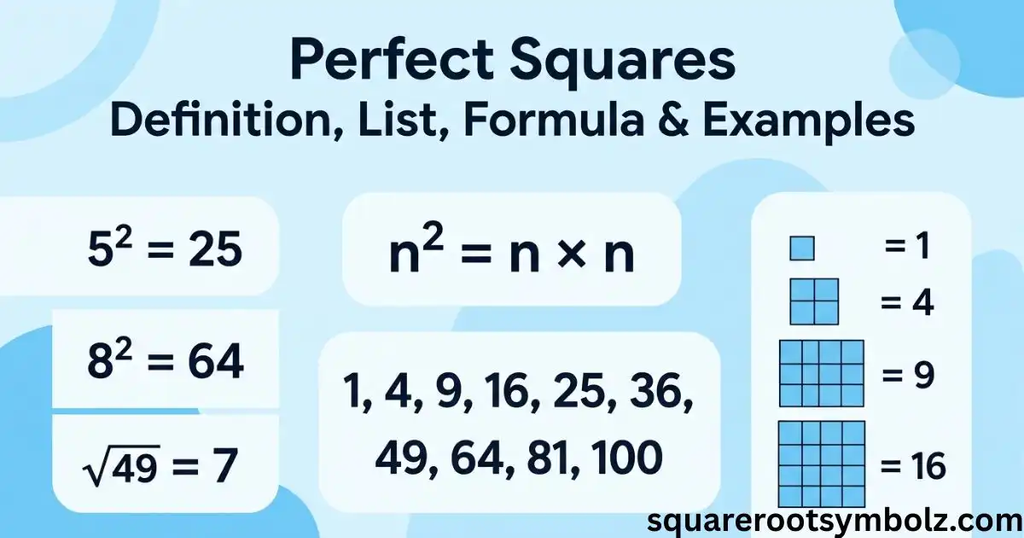
A perfect square is a number that results when an integer is multiplied by itself. For example, 6 × 6 = 36, so 36 is a perfect square. The same idea can be written using an exponent: 6² = 36. The integer being squared is called the square root of the result.
The word “square” has a geometric connection. If four objects form two equal rows and two equal columns, they make a square arrangement. Nine objects can form three rows of three, while 16 can form four rows of four. This gives perfect squares a natural connection between arithmetic, multiplication, geometry, and area.
| Integer | Multiplication | Perfect square |
| 1 | 1 × 1 | 1 |
| 2 | 2 × 2 | 4 |
| 3 | 3 × 3 | 9 |
| 4 | 4 × 4 | 16 |
| 5 | 5 × 5 | 25 |
| 6 | 6 × 6 | 36 |
| 7 | 7 × 7 | 49 |
| 8 | 8 × 8 | 64 |
| 9 | 9 × 9 | 81 |
| 10 | 10 × 10 | 100 |
A useful detail is that positive and negative integers produce the same positive square. For example, 7 × 7 = 49 and (−7) × (−7) = 49. Zero also belongs in the standard list because 0 × 0 = 0. Thus, for integer squares, the results are always nonnegative.
Examples of Perfect Squares
Common perfect squares begin with 0, 1, 4, 9, 16, 25, 36, 49, 64, and 81. Each comes from an integer multiplied by itself. For example, 9 = 3 × 3, 25 = 5 × 5, and 81 = 9 × 9. These examples are worth memorizing because they simplify later square-root work.
A visual example can make the pattern easier to remember. Imagine arranging 25 tiles into five rows of five. Because both dimensions contain five tiles, the arrangement forms a square. That same reasoning works for 36 tiles in a 6 × 6 arrangement and 49 tiles in a 7 × 7 arrangement.
Here are the first 20 positive perfect squares:
| Number squared | Result |
| 1² | 1 |
| 2² | 4 |
| 3² | 9 |
| 4² | 16 |
| 5² | 25 |
| 6² | 36 |
| 7² | 49 |
| 8² | 64 |
| 9² | 81 |
| 10² | 100 |
| 11² | 121 |
| 12² | 144 |
| 13² | 169 |
| 14² | 196 |
| 15² | 225 |
| 16² | 256 |
| 17² | 289 |
| 18² | 324 |
| 19² | 361 |
| 20² | 400 |
This sequence is infinite because there is no largest integer. Brighterly and SplashLearn both extend their lists through 20 and beyond, while emphasizing that the complete collection cannot be listed because perfect squares continue indefinitely.
Non Examples of Perfect Squares
A non-perfect square cannot be expressed as an integer multiplied by itself. For example, 6 is not a perfect square because no integer multiplied by itself equals 6. Its square root is approximately 2.449, which is not an integer. The same reasoning shows why 10, 15, 20, and 30 are not perfect squares.
A useful comparison is 49 versus 50. Since 7 × 7 = 49, 49 is a perfect square. But there is no integer whose square equals 50, so 50 is not. Notice that 50 can still contain a perfect-square factor, 25. That distinction becomes important when simplifying radicals.
Some endings immediately rule a number out. A whole number ending in 2, 3, 7, or 8 cannot be a perfect square. However, ending in 0, 1, 4, 5, 6, or 9 does not guarantee that a number is a perfect square. For example, 300 ends in 0 but is not a perfect square.
Perfect Squares: Formula
The basic formula for perfect squares is simple: P = n × n = n², where n is an integer and P is the resulting perfect square. For example, if n = 12, then P = 12 × 12 = 144. This formula is the foundation for generating, recognizing, and working with square numbers.
The same relationship works backward through the square root. If 144 = 12², then √144 = 12. This inverse relationship is one reason perfect squares are so useful in algebra. They let you recognize exact square roots instead of relying on decimal approximations or a calculator.
Perfect Square Formula in Algebra
Perfect squares also appear in algebraic identities. One important pattern is (a + b)² = a² + 2ab + b². For example, 35² can be found by treating 35 as 30 + 5. The calculation becomes 900 + 300 + 25 = 1,225, giving the same result as 35 × 35.
Perfect Squares List
The first positive perfect squares are 1, 4, 9, 16, 25, 36, 49, 64, 81, and 100. These correspond to 1² through 10². Extending the sequence gives 121, 144, 169, 196, 225, 256, 289, 324, 361, and 400. This list is especially useful for mental math and square-root problems.
| Range | Perfect squares |
| 1–100 | 1, 4, 9, 16, 25, 36, 49, 64, 81, 100 |
| 101–200 | 121, 144, 169, 196 |
| 201–300 | 225, 256, 289 |
| 301–400 | 324, 361, 400 |
| 401–500 | 441, 484 |
There are 10 perfect squares from 1 through 100. This is easy to verify because the positive integers from 1 through 10 produce the squares 1² through 10². SplashLearn gives the same count and list in its FAQ section.
One practical memory trick is to learn the squares through 10 first, then extend toward 20. Knowing these values makes square-root questions much faster because you can immediately recognize values such as 144, 225, 324, or 400 without calculating from scratch.
How to Identify Perfect Squares
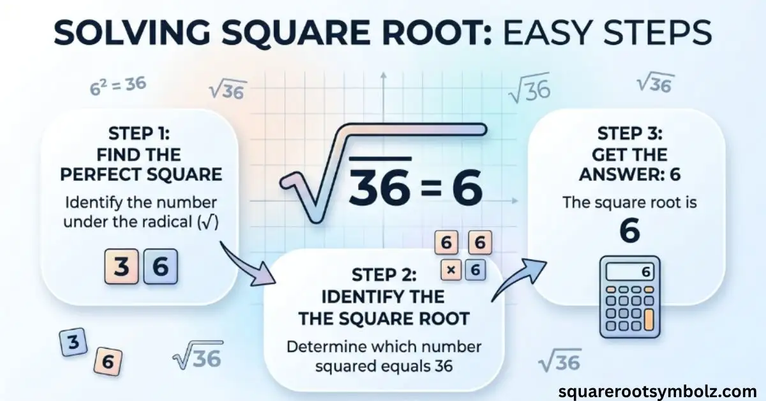
The most direct test is to find the square root. If √n is an integer, n is a perfect square. For example, √64 = 8, so 64 is a perfect square. By contrast, √66 is approximately 8.124, so 66 is not a perfect square.
You can also use the last digit as a quick screening tool. Perfect squares can end in 0, 1, 4, 5, 6, or 9. A number ending in 2, 3, 7, or 8 can immediately be rejected. This is only a screening rule, however; a number ending in 1 or 9 still needs another test.
Another method uses factors. If a number can be expressed as the product of equal integer factors, it is a perfect square. For example, 100 = 10 × 10. Prime factorization gives an even exponent for every prime in a perfect square: 36 = 2² × 3², so every prime factor occurs in a pair.
Using Square Roots
Square roots provide the clearest confirmation. If √121 = 11, then 121 is a perfect square. If √122 is not an integer, 122 is not. This method works even when the number is too large to recognize from memory, although factorization or estimation may sometimes be faster.
Solved Examples on Perfect Squares
Consider 13. To find its square, multiply 13 by itself: 13 × 13 = 169. Therefore, 169 is a perfect square. Using the identity (a + b)² with 13 = 10 + 3 also gives 100 + 60 + 9 = 169, showing how arithmetic and algebra produce the same result.
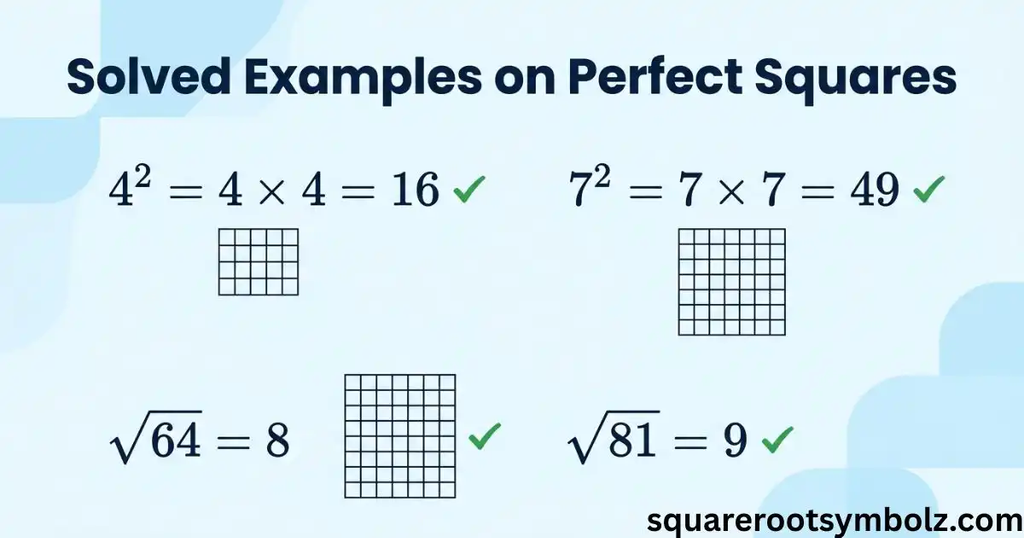
Now consider 3,600. Since 60 × 60 = 3,600, the number is a perfect square and √3,600 = 60. A factorization check gives another route. This kind of larger-number example is useful because it shows that perfect-square recognition is not limited to small values.
Example: Is 225 a Perfect Square?
Yes. Since 15 × 15 = 225, the number 225 is a perfect square. Its principal square root is 15. This also appears as a useful practice pattern in educational material: when the square root is an integer, the original number belongs to the perfect-square set.
Example: Is 50 a Perfect Square?
No. There is no integer that multiplies by itself to produce 50, and √50 is not an integer. However, 50 contains the perfect-square factor 25 because 50 = 25 × 2. Therefore, √50 can be simplified to 5√2, which illustrates how perfect-square factors help with radicals.
Example: Is 0 a Perfect Square?
Yes. Zero is a perfect square because 0 × 0 = 0. It is important to distinguish this from statements that describe perfect squares only as positive integers. In the standard integer-square definition, zero is included because it is the square of the integer 0.
Conclusion
Perfect squares are numbers that can be written as an integer multiplied by itself. The most useful examples to remember are 1, 4, 9, 16, 25, 36, 49, 64, 81, and 100. If the square root of a number is an integer, that number is a perfect square.
The key skill is recognizing the relationship between squaring and square roots. Once you know the common perfect squares and understand the last-digit and factorization checks, numbers that initially look difficult become much easier to identify and use in algebra, geometry, and radical expressions.
FAQs
How many perfect square numbers are there between 1 and 100?
There are 10 perfect squares between 1 and 100: 1, 4, 9, 16, 25, 36, 49, 64, 81, and 100. They are the squares of the integers 1 through 10.
What is a perfect square?
A perfect square is a number that can be written as an integer multiplied by itself. For example, 64 is a perfect square because 8 × 8 = 64. Equivalently, 64 = 8² and √64 = 8.
How do you know if a number is a perfect square?
Find its square root. If the result is an integer, the original number is a perfect square. You can also use factorization and last-digit patterns as quick checks, but the square-root test provides a direct confirmation.
Is 0 a perfect square?
Yes. Zero is a perfect square because 0 × 0 = 0. Its square root is also 0.
Can negative numbers be perfect squares?
A negative integer cannot be the square of a real integer because multiplying a real number by itself produces a nonnegative result. For example, 7² and (−7)² both equal 49, never −49.
What are the first 10 perfect squares?
The first 10 positive perfect squares are:
1, 4, 9, 16, 25, 36, 49, 64, 81, and 100.
Is 50 a perfect square?
No. √50 is not an integer, so 50 is not a perfect square. However, 25 is a perfect-square factor of 50, which allows √50 to be simplified.
Why are perfect squares useful?
Perfect squares make square roots easier to recognize and simplify. They are also used in algebra, quadratic equations, geometry, area calculations, factorization, and radical expressions. Knowing common squares can save substantial time during calculations.
What is a perfect square trinomial?
A perfect square trinomial is an algebraic expression produced by squaring a binomial. For example, (x + 3)² expands to x² + 6x + 9. The pattern connects perfect squares with factoring and quadratic expressions.

I’m the creator of SquareRootSymbolz.com, where I publish easy-to-understand guides on symbols, Unicode characters, Alt codes, keyboard shortcuts, and copy-and-paste text symbols. My goal is to provide accurate, well-researched, and user-friendly content that helps readers quickly find the information they need.