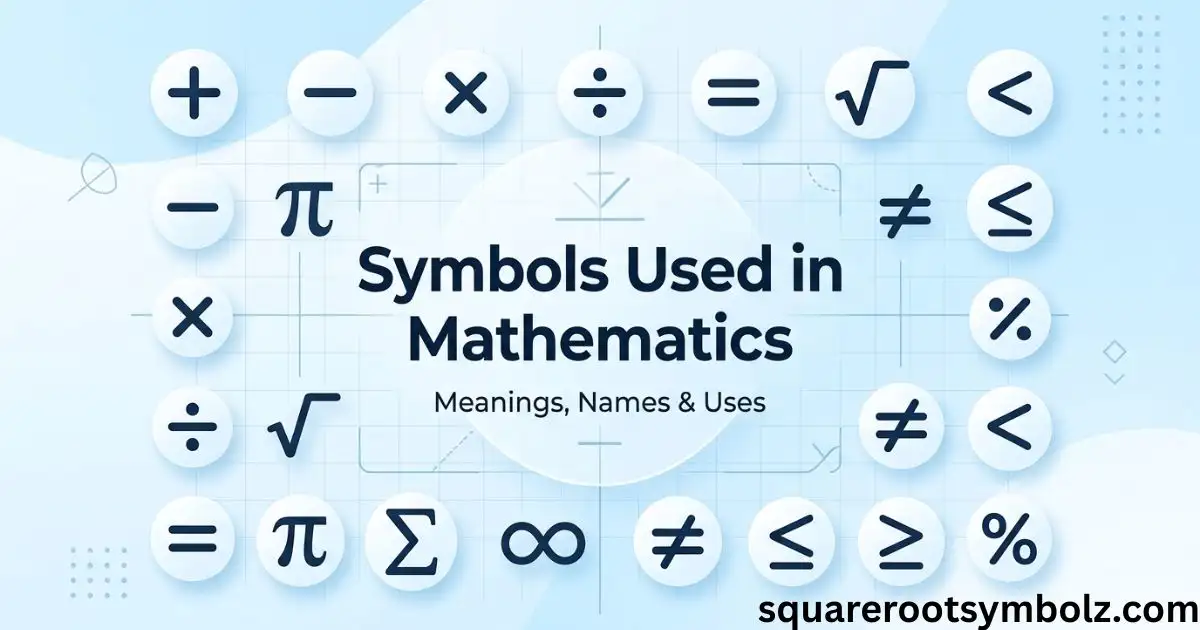
Symbols used in mathematics are visual shortcuts that represent operations, quantities, relationships, sets, functions, numbers, and mathematical ideas. Instead of writing “is greater than” every time, we can write >; instead of describing a square root in words, we can use √. These compact signs make equations faster to read and easier to communicate.
If you have ever looked at an equation and recognized the numbers but felt lost because of the symbols, you are not alone. Mathematical notation becomes much easier once each sign is connected with its name, meaning, and an example. This guide brings those relationships together, from basic arithmetic and geometry to algebra, logic, statistics, calculus, Greek letters, and Roman numerals.
Basic math symbols
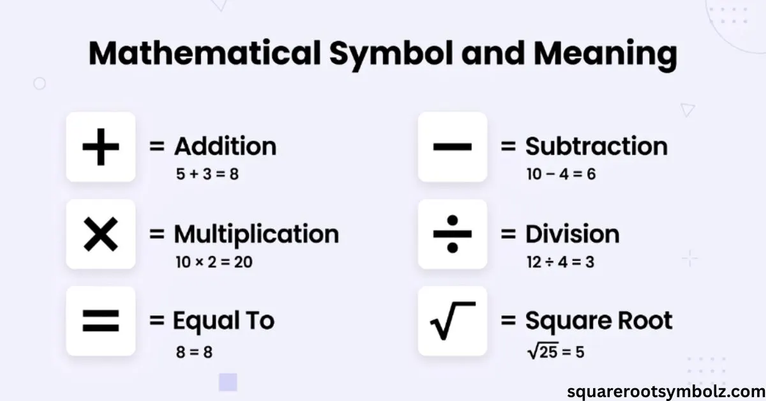
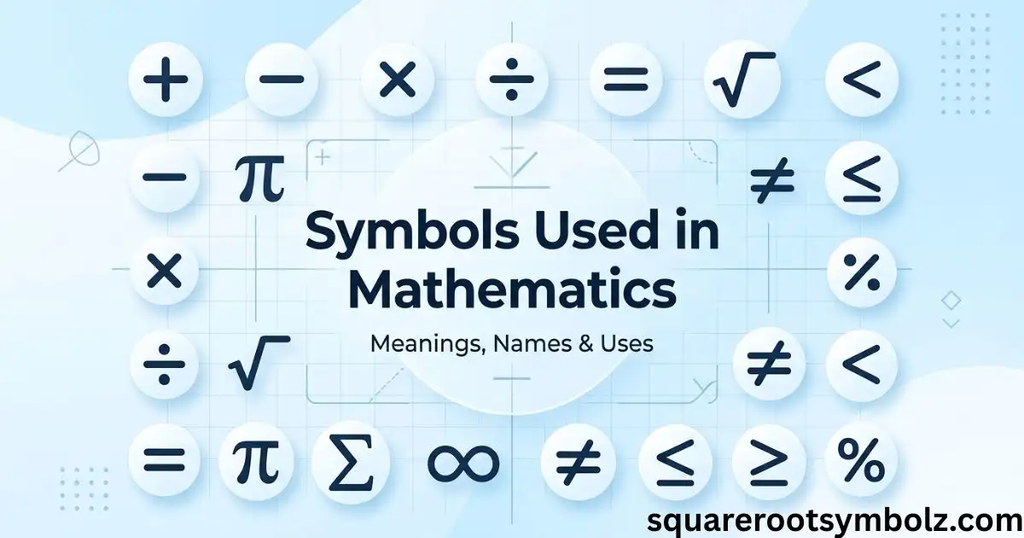
Basic arithmetic symbols are the first symbols most students learn. The plus sign means addition, the minus sign means subtraction, × means multiplication, and ÷ means division. Comparison symbols such as =, ≠, <, >, ≤, and ≥ show relationships between values.
| Symbol | Name | Meaning | Example |
| + | Plus sign | Addition | 4 + 3 = 7 |
| − | Minus sign | Subtraction | 8 − 3 = 5 |
| × | Times sign | Multiplication | 4 × 5 = 20 |
| ÷ | Division sign | Division | 20 ÷ 4 = 5 |
| = | Equal sign | Equality | 5 = 2 + 3 |
| ≠ | Not equal | Inequality | 5 ≠ 7 |
| < | Less than | Smaller value | 3 < 8 |
| > | Greater than | Larger value | 9 > 4 |
| ≤ | Less than or equal to | Comparison | x ≤ 10 |
| ≥ | Greater than or equal to | Comparison | x ≥ 2 |
Other common symbols include ± for plus or minus, parentheses for grouping, brackets for grouping expressions, % for percent, and √ for square root. The same character can sometimes have different meanings depending on context, so reading the surrounding expression matters.
For example, 3 + 4 is an arithmetic expression, while x > 2 is an inequality. The symbols do more than decorate the numbers. They tell you what operation to perform or what relationship exists between mathematical quantities.
Geometry symbols
Geometry uses symbols to describe shapes, angles, lines, distances, relationships, and measurements. The angle symbol ∠, degree sign °, perpendicular symbol ⊥, and parallel symbol ∥ appear frequently in geometry problems. These signs allow a diagram to communicate information without lengthy sentences.
| Symbol | Name | Meaning | Example |
| ∠ | Angle | Formed by two rays | ∠ABC |
| ° | Degree | Angle measurement | 90° |
| ∟ | Right angle | 90-degree angle | ∟ |
| ⊥ | Perpendicular | Meets at 90° | AB ⊥ CD |
| ∥ | Parallel | Lines that do not meet | AB ∥ CD |
| ≅ | Congruent | Same shape and size | △ABC ≅ △DEF |
| ~ | Similar | Same shape, proportional size | △ABC ~ △DEF |
| Δ | Triangle | Three-sided figure | ΔABC |
| π | Pi | Circle constant | C = 2πr |
Geometry notation becomes especially helpful when a diagram contains many relationships. Rather than writing “line AB is perpendicular to line CD,” a textbook can simply write AB ⊥ CD. A student who knows the symbol can understand the relationship immediately.
Some symbols also connect geometry with other areas of mathematics. The absolute-value notation |x − y| can represent distance on a number line, while π connects the geometry of circles with a mathematical constant used throughout mathematics and science.
Algebra symbols
Algebra introduces symbols that represent unknown values, functions, relationships, powers, intervals, and mathematical constants. A letter such as x can represent an unknown number, while f(x) describes a function. Symbols such as ∝, ∞, ∑, and Δ communicate more specialized ideas.
| Symbol | Name | Meaning | Example |
| x | Variable | Unknown or changing value | 2x = 10 |
| ≡ | Equivalent | Identically equal | a ≡ a |
| ≈ | Approximately equal | Close numerical value | π ≈ 3.14 |
| ∝ | Proportional to | Changes in a proportional relationship | y ∝ x |
| ∞ | Infinity | Unbounded quantity | x → ∞ |
| ! | Factorial | Product of positive integers | 5! = 120 |
| x | Absolute value | ||
| f(x) | Function | Function of x | f(x) = x² |
| ∑ | Summation | Adds terms | ∑x |
| Δ | Delta | Change or difference | Δx |
A useful way to read algebra notation is from the relationship between symbols. In 2x = 10, the 2 is a coefficient, x is a variable, and = states that both sides have the same value. The symbols work together as a compact mathematical sentence.
Algebra also uses brackets, parentheses, braces, exponents, intervals, and function notation. As expressions become more advanced, these symbols make complicated relationships manageable. Learning their meanings early creates a strong foundation for equations, functions, polynomials, and later calculus.
Linear Algebra Symbols
Linear algebra uses symbols to describe vectors, matrices, transformations, products, determinants, dimensions, and related structures. A dot can represent a scalar product, × can represent a cross product, and vertical bars may indicate a determinant or magnitude depending on the context.
| Symbol | Name | Common meaning |
| · | Dot product | Scalar product |
| × | Cross product | Vector product |
| A ⊗ B | Tensor product | Product of mathematical objects |
| ⟨x,y⟩ | Inner product | Product between vectors |
| |A| | Norm | Size or magnitude |
| det(A) | Determinant | Scalar associated with a square matrix |
| Aᵀ | Transpose | Rows and columns exchanged |
| A⁻¹ | Inverse | Matrix inverse |
| rank(A) | Rank | Dimension of the matrix’s row or column space |
| dim(U) | Dimension | Number of independent directions |
The same symbol can change meaning when the mathematical setting changes. For instance, vertical bars may represent absolute value in elementary algebra, determinant notation in linear algebra, or magnitude in vector mathematics. Context is therefore part of learning mathematical symbols.
A simple matrix such as a 2 × 2 array already introduces several concepts. As students progress, notation for transpose, inverse, rank, determinant, inner product, and vector operations lets them describe large mathematical structures in a surprisingly compact form.
Probability and statistics symbols
Probability and statistics use symbols to describe events, averages, distributions, variation, expectation, and relationships between data. P(A) commonly represents the probability of event A, while μ can represent a population mean and σ can represent a population standard deviation.
| Symbol | Name | Meaning |
| P(A) | Probability | Probability of event A |
| P(A ∩ B) | Intersection probability | Probability of both events |
| P(A ∪ B) | Union probability | Probability of either event |
| P(A | B) | Conditional probability | Probability of A given B |
| μ | Population mean | Average of a population |
| σ² | Population variance | Measure of spread |
| σ | Population standard deviation | Typical spread |
| E(X) | Expected value | Mean of a random variable |
| var(X) | Variance | Measure of variability |
| ρ | Correlation | Relationship between variables |
| ∑ | Summation | Adds values |
Statistics becomes easier when the notation is treated as a vocabulary rather than a collection of mysterious marks. For example, P(A | B) tells you that the probability of A is being considered under the condition that B has occurred.
You may also see x̄ for a sample mean, s for sample standard deviation, Q₁ and Q₃ for quartiles, and symbols for distributions such as normal, binomial, Poisson, or uniform distributions. These notations allow large amounts of information to fit into equations, tables, and statistical models.
Combinatorics Symbols
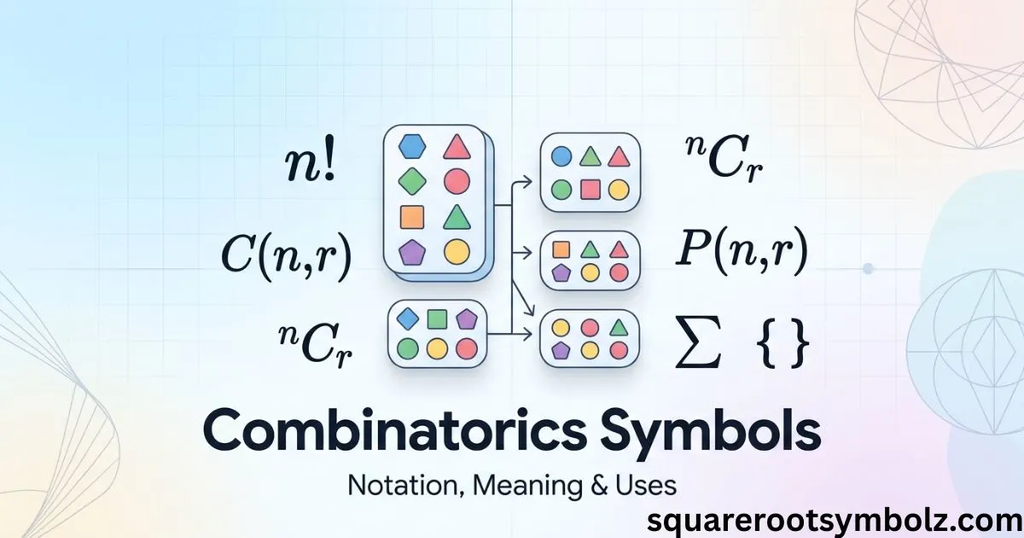
Combinatorics studies counting arrangements, selections, and structures. Its notation helps describe permutations, combinations, and factorials without writing every possible arrangement individually. The factorial symbol ! is especially important because it represents multiplication of consecutive positive integers.
| Symbol | Name | Meaning |
| n! | Factorial | n × (n − 1) × … × 1 |
| nPₖ | Permutation | Ordered selection |
| nCₖ | Combination | Unordered selection |
For example, 5! means 5 × 4 × 3 × 2 × 1, which equals 120. The factorial becomes useful when counting how many ways objects can be arranged. Permutations and combinations then refine the idea depending on whether order matters.
Imagine choosing three students from a group of five. If the order of selection matters, permutation notation is appropriate. If you only care about which three students were selected, combination notation is more suitable. The symbols make that distinction concise.
Set theory symbols
Set theory symbols describe collections of objects and relationships between those collections. Common notation includes braces for a set, ∈ for “is an element of,” ∪ for union, ∩ for intersection, ⊆ for subset, and ⊇ for superset.
| Symbol | Name | Meaning |
| { } | Set | Collection of elements |
| ∈ | Element of | Belongs to a set |
| ∉ | Not an element of | Does not belong |
| ∪ | Union | Elements in either set |
| ∩ | Intersection | Elements common to both sets |
| ⊆ | Subset | Every element is contained in another set |
| ⊂ | Proper subset | Subset that is not equal |
| ⊇ | Superset | Contains another set |
| ∅ | Empty set | Set with no elements |
| P(A) | Power set | Set of all subsets |
Suppose A = {1, 2, 3} and B = {3, 4, 5}. Their intersection is {3}, because 3 is the only element they share. Their union is {1, 2, 3, 4, 5}, because it contains every element appearing in either set.
Set notation also connects naturally with logic. Symbols such as ∀, meaning “for all,” and ∃, meaning “there exists,” are frequently used when mathematical statements describe every element or at least one element in a set.
Logic symbols
Logic symbols are used to express statements, conditions, implications, equivalence, negation, and quantification. They are especially important when mathematics moves from calculation into formal reasoning. Common symbols include ¬ for not, ⇒ for implies, ⇔ for if and only if, ∀ for for all, and ∃ for there exists.
| Symbol | Name | Meaning |
| ¬ | Not | Negation |
| ∨ | Or | Logical OR |
| ∧ | And | Logical AND |
| ⇒ | Implies | Logical implication |
| ⇔ | Equivalent | If and only if |
| ∀ | For all | Universal quantifier |
| ∃ | There exists | Existential quantifier |
| ∄ | There does not exist | Negated existence |
| ∴ | Therefore | Logical conclusion |
| ∵ | Because / since | Reason |
Consider the statement “If a number is divisible by 2, then it is even.” Logic notation can express the relationship between the condition and its consequence much more compactly. This is one reason mathematical symbols are sometimes described as a universal language.
Logic symbols also appear in proofs, set theory, computer science, discrete mathematics, and theoretical mathematics. Understanding them helps readers follow not just what a mathematical statement calculates, but why the statement is valid.
Calculus & analysis symbols
Calculus uses a specialized vocabulary of symbols for limits, derivatives, integrals, functions, rates of change, and infinite processes. The integral sign ∫, derivative notation, limit notation, partial derivative symbol ∂, and infinity symbol ∞ are among the most recognizable.
| Symbol | Name | Meaning |
| lim | Limit | Value approached by a function |
| ε | Epsilon | Often represents a small positive quantity |
| e | Euler’s number | Approximately 2.71828 |
| dy/dx | Derivative | Rate of change |
| ∂ | Partial derivative | Derivative with respect to one variable |
| ∫ | Integral | Accumulation or antiderivative |
| ∬ | Double integral | Integration over two variables |
| ∭ | Triple integral | Integration over three variables |
| ∮ | Closed contour integral | Integral around a closed path |
| ∇ | Nabla | Gradient and related operators |
A derivative can describe how quickly something changes. If position changes with time, its derivative can describe velocity. An integral can work in the opposite direction by accumulating quantities or finding areas under curves.
Advanced calculus introduces several layers of notation, but the same principle remains: each symbol carries information. Once the reader recognizes ∫ as an integral or ∂ as a partial derivative, a complicated expression becomes much less intimidating.
Numeral symbols
Numeral symbols are written representations of numbers. The familiar Western Arabic digits 0 through 9 are used throughout modern American mathematics, while Roman numerals remain common in clocks, chapter numbering, historical references, and some formal labels.
| Number | Roman numeral | Eastern Arabic digit |
| 1 | I | ١ |
| 2 | II | ٢ |
| 3 | III | ٣ |
| 4 | IV | ٤ |
| 5 | V | ٥ |
| 6 | VI | ٦ |
| 7 | VII | ٧ |
| 8 | VIII | ٨ |
| 9 | IX | ٩ |
| 10 | X | ١٠ |
A numeral is not quite the same thing as the abstract number it represents. Different writing systems can represent the same numerical value with different symbols. For example, the value ten can appear as 10 in Western Arabic notation, X in Roman numerals, and ١٠ in Eastern Arabic notation.
This distinction becomes useful when studying number systems and the history of mathematics. It also explains why mathematical communication can remain understandable across languages even when the written forms surrounding the numbers differ.
Greek alphabet letters
Greek letters are deeply embedded in mathematical notation. Symbols such as α, β, γ, Δ, θ, λ, μ, π, σ, φ, and Ω can represent variables, constants, angles, functions, sets, statistical quantities, or physical measurements depending on context.
| Symbol | Name | Common mathematical association |
| α | Alpha | Angle or parameter |
| β | Beta | Parameter or angle |
| γ | Gamma | Angle, function, or constant |
| Δ | Delta | Change or difference |
| θ | Theta | Angle |
| λ | Lambda | Parameter or eigenvalue |
| μ | Mu | Population mean |
| π | Pi | Circle constant |
| σ | Sigma | Standard deviation or summation-related notation |
| φ | Phi | Golden ratio or angle |
| Ω | Omega | Final Greek letter; various mathematical uses |
Greek notation is particularly valuable because the Latin alphabet can quickly become crowded. Once x, y, z, a, b, and c are already being used, a mathematician can introduce θ or λ without changing the underlying language of the equation.
Unicode’s mathematical documentation also recognizes Greek characters as part of the basic repertoire used in mathematical notation, along with Latin letters, digits, specialized symbols, operators, and other mathematical characters.
Roman numerals
Roman numerals use letters to represent numerical values. The best-known symbols are I, V, X, L, C, D, and M. Although they are not the primary numeral system used for modern mathematical calculation, they remain familiar and useful in everyday life.
| Value | Roman numeral |
| 1 | I |
| 2 | II |
| 3 | III |
| 4 | IV |
| 5 | V |
| 10 | X |
| 20 | XX |
| 50 | L |
| 100 | C |
| 500 | D |
| 1,000 | M |
Roman numerals are often seen on clocks, outlines, book chapters, movie sequels, monarch names, and historical dates. Their continued presence gives students a useful example of how a numerical value can be represented by a symbolic system different from the decimal notation used for ordinary calculation.
Learning Roman numerals also helps reinforce the broader idea behind symbols used in mathematics: the mark itself is not the complete meaning. Its meaning comes from the system and context in which it is being used.
Conclusion
Symbols used in mathematics turn complicated ideas into compact, readable notation. A few marks such as +, =, √, ∑, ∫, ∈, and ∞ can communicate operations, relationships, quantities, sets, or mathematical processes without lengthy explanations.
The easiest way to learn them is not to memorize a giant list blindly. Learn each symbol through three connections: its name, its meaning, and an example. Then place it in its mathematical category, such as arithmetic, geometry, algebra, logic, statistics, calculus, or set theory.
Once those relationships become familiar, mathematical expressions stop looking like collections of strange marks and start reading more like a language.
FAQ Section
What are symbols used in mathematics?
Symbols used in mathematics are signs, characters, letters, and notation that represent mathematical operations, quantities, relationships, functions, sets, constants, and concepts. Examples include + for addition, = for equality, √ for square root, and ∫ for integration.
What are the four basic mathematical symbols?
The four basic arithmetic operation symbols are + for addition, − for subtraction, × for multiplication, and ÷ for division.
Why are mathematical symbols used?
Mathematical symbols make mathematical communication shorter, clearer, and more consistent. Instead of writing an entire phrase such as “is greater than,” a mathematician can use >.
What are the most common math symbols?
Common examples include +, −, ×, ÷, =, ≠, <, >, ≤, ≥, %, √, ∞, π, and symbols for powers and roots. The symbols used depend on the mathematical subject.
What does ∑ mean in mathematics?
The symbol ∑, called capital sigma, represents summation. It tells the reader that a sequence of values should be added together.
What does ∫ mean in mathematics?
The symbol ∫ represents an integral. Depending on context, integration can describe accumulation, area, total change, or an antiderivative.
What does ∈ mean?
The symbol ∈ means “is an element of” or “belongs to.” For example, if A = {1, 2, 3}, then 2 ∈ A.
What does ∀ mean?
The symbol ∀ means “for all” and is called the universal quantifier. It is used when a mathematical statement applies to every member of a specified set.
What does ∃ mean?
The symbol ∃ means “there exists.” It is called the existential quantifier and indicates that at least one object satisfies a stated condition.
Are Greek letters mathematical symbols?
Yes. Greek letters are widely used in mathematical notation. For example, π represents the circle constant, θ commonly represents an angle, μ can represent a population mean, and σ commonly represents standard deviation.
Is infinity a number?
Infinity, represented by ∞, is used to describe an unbounded quantity or process. It is not treated as an ordinary real number in standard arithmetic.
What is the difference between a mathematical symbol and a mathematical operation?
A mathematical symbol is a broad category that includes signs, letters, constants, operators, and notation. An operation is a specific mathematical process such as addition, subtraction, multiplication, or division.

I’m the creator of SquareRootSymbolz.com, where I publish easy-to-understand guides on symbols, Unicode characters, Alt codes, keyboard shortcuts, and copy-and-paste text symbols. My goal is to provide accurate, well-researched, and user-friendly content that helps readers quickly find the information they need.