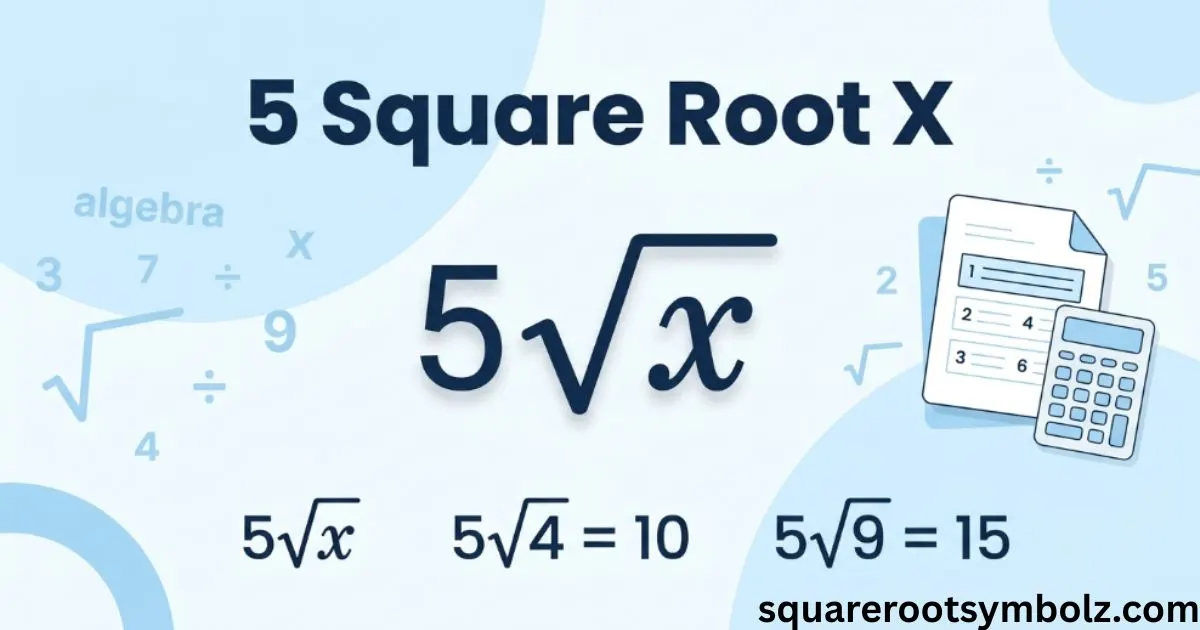
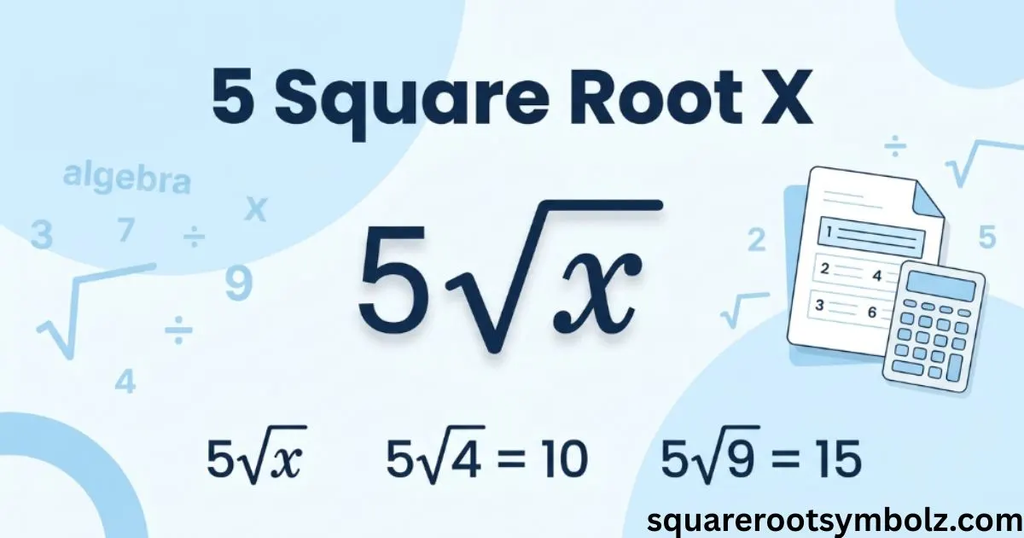
5 square root x means 5√x, or five times the square root of x. It is a radical expression in which 5 is the coefficient and x is the radicand. If you are trying to simplify, graph, evaluate, or solve an equation containing 5√x, the key is to understand that the 5 sits outside the square root.
The expression can appear in algebra, functions, radical equations, and graphing problems. A common source of confusion is treating 5√x as though the 5 were inside the radical. It is not. For example, 5√x and √(5x) are different expressions. Understanding that small distinction makes the rest of the calculation much easier.
The basic meaning
In 5√x, the number 5 multiplies the square root of x:
5√x = 5 × √x
The square root symbol applies only to x. This means that when x = 4, the expression becomes:
5√4 = 5 × 2 = 10
When x = 9:
5√9 = 5 × 3 = 15
The expression is therefore a multiple of the square root function. In function notation, it can be written as f(x) = 5√x. This interpretation is especially important when a problem asks for the domain, range, graph, or inverse function.
Do not confuse 5√x with √(5x)
These expressions look similar when written quickly, but they are not generally equal.
For example:
5√4 = 5 × 2 = 10
while:
√(5 × 4) = √20 = 2√5
So the position of the coefficient matters. In 5√x, the 5 is outside the radical. In √(5x), the 5 is part of the radicand.
This is one of the easiest mistakes to make when typing a radical expression with plain text. Writing the parentheses clearly prevents the ambiguity.
How to simplify 5√x
The expression 5 square root x is already in simplest form when x does not contain a known perfect-square factor. The coefficient 5 cannot simply be moved under the radical without changing the expression.
If x contains a perfect-square factor, however, the radical can sometimes be simplified.
For example:
5√(4x)
Since √4 = 2:
5√(4x) = 5 × 2√x = 10√x
Another example is:
5√(9x)
Because √9 = 3:
5√(9x) = 15√x
The useful idea is to look inside the radicand for perfect-square factors. The coefficient outside the radical then multiplies the simplified result.
What happens when 5√x is squared?
If the entire expression is squared, the result is:
(5√x)² = 25x
The square applies to both the coefficient and the square root.
First square 5:
5² = 25
Then square √x:
(√x)² = x
Therefore:
(5√x)² = 25x
This is one of the most common algebraic forms associated with the expression. A step-by-step mathematical solution from Mathway uses the product rule and power rules to reach the same simplification.
Notice the parentheses. There is an important difference between (5√x)² and an expression where only part of the radical expression is squared.
Domain of 5√x
If 5 square root x is treated as a real-valued function, the value under the square root must be nonnegative.
Therefore:
x ≥ 0
The domain is:
[0, ∞)
This means x can be 0 or any positive real number, but negative real values are not allowed when working with real square roots.
For example:
x = 0 → 5√0 = 0
x = 4 → 5√4 = 10
x = 25 → 5√25 = 25
But x = −4 does not produce a real value for √x.
Mathway’s graphing treatment of y = 5√x likewise identifies the domain as [0, ∞).
Range of 5 square root x
Because the principal square root is nonnegative for x ≥ 0, multiplying it by the positive number 5 keeps the result nonnegative.
Therefore:
y ≥ 0
The range is:
[0, ∞)
The smallest output occurs at x = 0:
5√0 = 0
As x becomes larger, √x increases, so 5√x also increases. A corresponding domain-and-range result for the same function gives both domain and range as [0, ∞).
Graph of y = 5√x
The graph of y = 5√x has the familiar square-root shape, but the coefficient 5 changes its vertical scale.
The graph begins at:
(0, 0)
Some useful points are:
| x | √x | y = 5√x |
| 0 | 0 | 0 |
| 1 | 1 | 5 |
| 4 | 2 | 10 |
| 9 | 3 | 15 |
| 16 | 4 | 20 |
| 25 | 5 | 25 |
These points show why choosing perfect squares makes graphing easier. Mathway’s graphing procedure similarly starts with the domain restriction, finds the endpoint at (0,0), and then selects convenient x-values.
Solving an equation involving 5√x
Suppose you have:
5√x = 10
First divide both sides by 5:
√x = 2
Then square both sides:
x = 4
Check the result:
5√4 = 5 × 2 = 10
So:
x = 4
The important sequence is to isolate the square root first and then square both sides. Similar radical-equation solutions in the search results use this same general strategy.
Consider another example:
5√x + 2 = 12
Subtract 2:
5√x = 10
Divide by 5:
√x = 2
Square:
x = 4
Again, substitution confirms the solution.
Finding the inverse of f(x) = 5√x
The expression 5√x can also define a function:
f(x) = 5√x
To find its inverse, replace f(x) with y:
y = 5√x
Interchange x and y:
x = 5√y
Divide by 5:
x/5 = √y
Square both sides:
x²/25 = y
Therefore:
f⁻¹(x) = x²/25
The original Mathway result for this exact function reaches f⁻¹(x) = x²/25 and then verifies the result using function composition.
The domain and range must also be considered when discussing the inverse. The original square-root function has domain [0, ∞) and range [0, ∞), so the inverse uses the corresponding restricted values.
Why 5√x and √(25x) can look confusing
There is an interesting relationship between these expressions:
5√x = √25 × √x = √(25x)
for real x ≥ 0.
So in this specific case, 5√x can be represented as √(25x). But that does not mean the number outside a radical can always be moved inside unchanged.
When a positive coefficient moves inside a square root, it must be squared:
a√x = √(a²x)
for a ≥ 0 and appropriate real-domain conditions.
For a = 5:
5√x = √(25x)
This relationship is useful when multiplying radicals or comparing different forms of the same expression.
A quick example from algebra
Suppose:
5√x = √(15x + 60)
To remove the radicals, square both sides:
(5√x)² = (√(15x + 60))²
This gives:
25x = 15x + 60
Subtract 15x:
10x = 60
Therefore:
x = 6
Checking the original equation is important after squaring because squaring can sometimes introduce values that were not solutions to the original equation. Radical-equation solutions commonly recommend checking candidate values in the original equation.
Common mistake to avoid
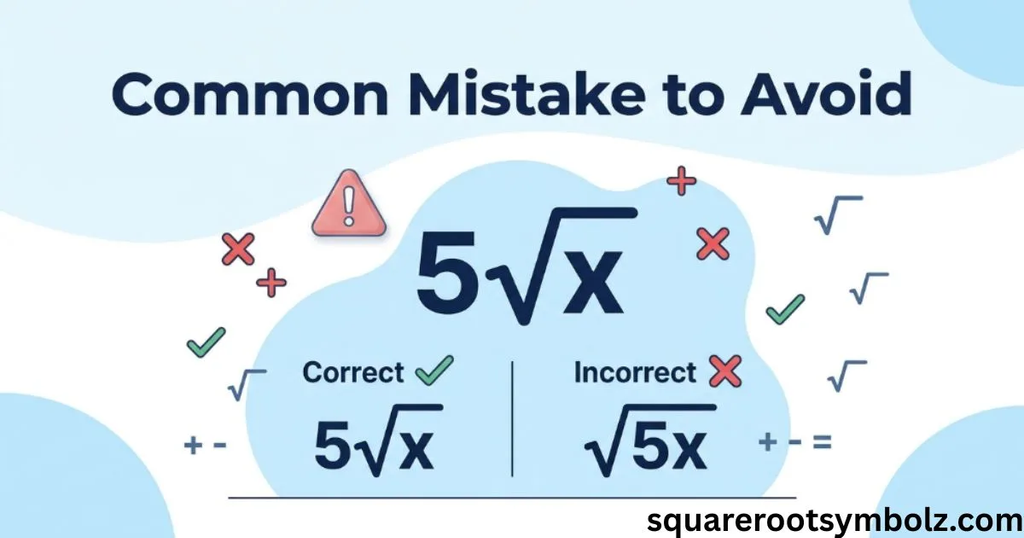
The most common mistake is reading 5√x as √(5x).
They are different:
5√x = 5 × √x
√(5x) = square root of 5x
For x = 4:
5√4 = 10
but:
√(5 × 4) = √20 ≈ 4.472
A second common mistake is forgetting that (5√x)² = 25x, not 5x. The exponent applies to the entire expression inside the parentheses.
The key idea to remember
When you see 5 square root x, write it clearly as 5√x. The 5 is a coefficient, the radical is √, and x is the radicand.
For real-number work, x must be at least 0. The function has domain [0, ∞), range [0, ∞), and begins at the point (0,0). If the whole expression is squared, (5√x)² = 25x. If it appears in an equation, isolate the radical before squaring and check the resulting solution in the original equation.
Understanding the placement of the coefficient is the small step that prevents most mistakes with this expression.
Conclusion
The expression 5 square root x, written 5√x, means five times the square root of x. Its most useful forms include (5√x)² = 25x, domain [0, ∞), and range [0, ∞) when treated as a real-valued function. It can also be graphed, evaluated, used in radical equations, and treated as a function with inverse x²/25 on the appropriate domain. Once you recognize what belongs inside and outside the radical, problems involving 5√x become much more straightforward.
FAQs
What is 5 square root x?
5 square root x means 5√x, or 5 multiplied by the square root of x. The 5 is outside the radical, so it is a coefficient rather than part of the radicand.
What is the square of 5√x?
The square is 25x because (5√x)² = 5²(√x)² = 25x.
What is the domain of 5√x?
For real-valued mathematics, the domain is [0, ∞) because x must be greater than or equal to zero for √x to be real.
What is the range of 5√x?
The range is [0, ∞). The smallest value is 0, which occurs when x = 0.
Is 5√x the same as √(5x)?
No. In general, 5√x ≠ √(5x). For example, when x = 4, 5√4 = 10, while √20 is approximately 4.472.
What is the inverse of 5√x?
If f(x) = 5√x, its inverse is f⁻¹(x) = x²/25, with the appropriate domain and range restrictions. Mathway verifies this inverse using function composition.
How do you solve 5√x = 10?
Divide both sides by 5 to get √x = 2, then square both sides. The solution is x = 4.

I’m the creator of SquareRootSymbolz.com, where I publish easy-to-understand guides on symbols, Unicode characters, Alt codes, keyboard shortcuts, and copy-and-paste text symbols. My goal is to provide accurate, well-researched, and user-friendly content that helps readers quickly find the information they need.