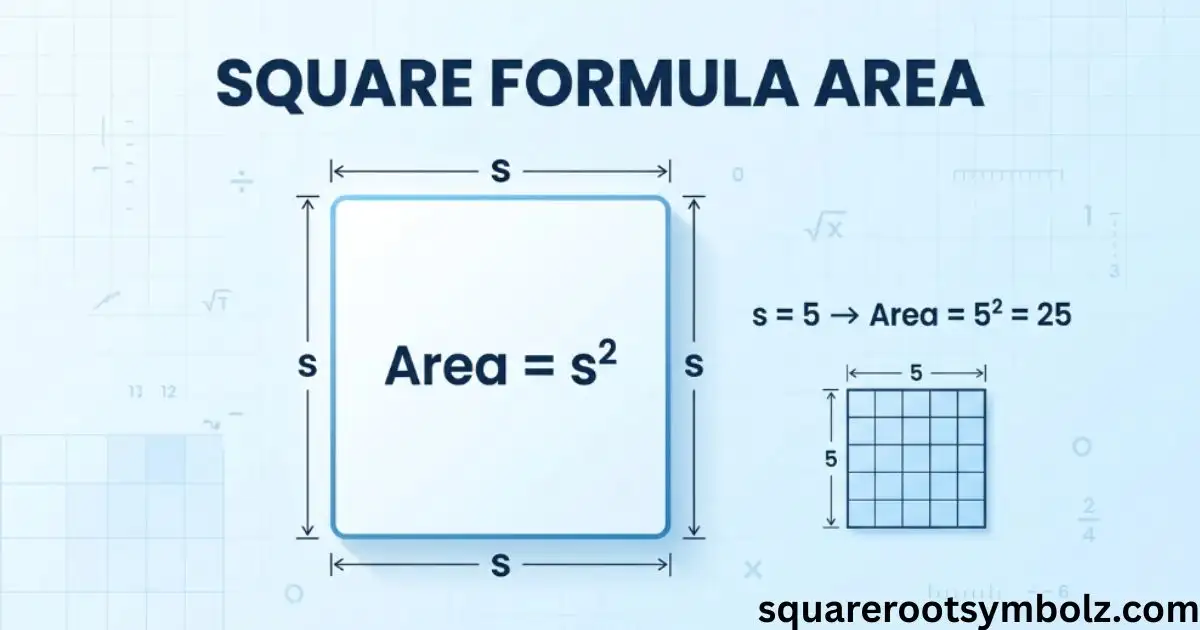
The square formula gives you a quick way to calculate the area, perimeter, or diagonal of a square. For a side length s, the main formulas are Area = s², Perimeter = 4s, and Diagonal = s√2. If you know the area, perimeter, or diagonal instead, you can work backward to find the side.
If you have ever mixed up area and perimeter or wondered why √2 appears in the diagonal formula, you are not alone. In classroom and homework problems, the hardest part is often choosing the correct formula before calculating. This guide connects geometry, side length, square units, perimeter, diagonal, and the Pythagorean theorem so you can recognize the right formula with confidence.
Square Formulas
A square has four equal sides and four right angles. Its basic measurements are connected by three formulas: area = s², perimeter = 4s, and diagonal = s√2. These relationships make a square unusually simple because knowing one measurement often lets you find the others.
For example, if a square has a side of 6 cm, its area is 36 cm², its perimeter is 24 cm, and its diagonal is 6√2 cm. Notice the units carefully: area uses square units, while perimeter and diagonal use ordinary length units.
Area of Square Formula
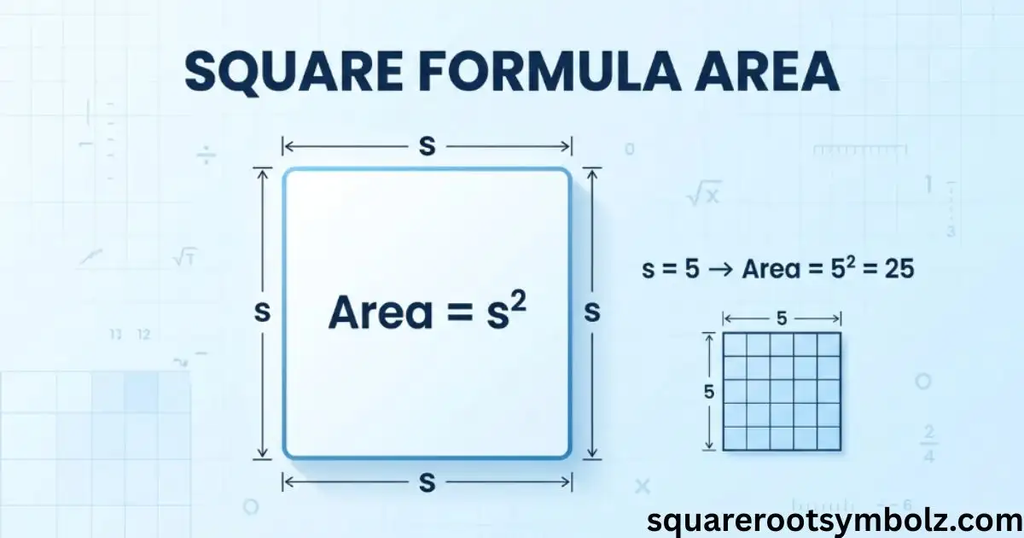
The area formula is A = s². It means you multiply the side length by itself. If the side is 8 inches, then A = 8² = 64 square inches. This formula measures the entire surface enclosed inside the four equal sides.
Perimeter of Square Formula
The perimeter formula is P = 4s because a square has four equal sides. If one side measures 9 meters, the perimeter is 4 × 9 = 36 meters. The perimeter measures the complete boundary, so its units remain meters rather than square meters.
Diagonal of Square Formula
The diagonal formula is d = s√2. A diagonal connects opposite corners and divides the square into two right triangles. The √2 comes from the Pythagorean theorem, making the diagonal longer than the side by a factor of approximately 1.414.
Derivations of Square Formula
Understanding where each formula comes from is more useful than memorizing three isolated equations. Area follows directly from multiplying equal side lengths, while perimeter comes from adding four identical sides. The diagonal requires a right triangle, which is where the Pythagorean theorem enters.
Suppose the side of a square is s and its diagonal is d. Drawing the diagonal creates a right triangle with two legs measuring s. Therefore, d² = s² + s², giving d² = 2s² and finally d = s√2.
Derivation of Area of Square Formula
A square can be viewed as a rectangle whose length and width are equal. Since the rectangle area is length × width, replacing both measurements with s gives A = s × s = s². That is why the square formula for area uses the side squared.
Derivation of Perimeter of Square Formula
Perimeter means the total distance around a figure. A square has four equal sides, each measuring s. Adding them gives s + s + s + s, which simplifies to P = 4s. The formula works for any positive side length and produces linear units.
Derivation of Diagonal of Square Formula
Draw a diagonal through a square and you create a right triangle. The two shorter sides are both s, while the diagonal is the hypotenuse. Applying the Pythagorean theorem gives d² = 2s², so taking the positive square root produces d = s√2.
Square Formula Using Different Given Values
The useful part of the square formula is that you can rearrange it when a problem gives you something other than the side. From area, use s = √A. From perimeter, use s = P ÷ 4. From diagonal, use s = d ÷ √2.
You can also find an area directly from a diagonal. Because d = s√2, squaring gives d² = 2s². Since s² is the area, the result is A = d² ÷ 2. These inverse relationships are especially useful in multi-step geometry questions.
| Given | Find | Formula |
| Side | Area | A = s² |
| Side | Perimeter | P = 4s |
| Side | Diagonal | d = s√2 |
| Area | Side | s = √A |
| Perimeter | Side | s = P ÷ 4 |
| Diagonal | Side | s = d ÷ √2 |
| Diagonal | Area | A = d² ÷ 2 |
Square Formula Solved Examples
A good way to remember a formula is to see it used with different types of information. Start by identifying what the problem gives you, then identify what it asks for. Only after those two steps should you choose the equation. This simple habit prevents many calculation mistakes.
Example 1: Find the Area
A square has a side length of 7 cm.
Use:
A = s²
A = 7²
A = 49 cm²
Answer: 49 cm²
Example 2: Find the Perimeter
A square has a side length of 12 units.
Use:
P = 4s
P = 4 × 12
P = 48 units
Answer: 48 units
Example 3: Find the Diagonal
A square has a side length of 10 cm.
Use:
d = s√2
d = 10√2
d ≈ 14.14 cm
Answer: 10√2 cm, or approximately 14.14 cm
Example 4: Find the Side From Area
The area of a square is 81 m².
Use:
s = √A
s = √81
s = 9 m
Answer: 9 m
Example 5: Find Area From the Diagonal
A square has a diagonal of 20 cm.
Use:
A = d² ÷ 2
A = 20² ÷ 2
A = 400 ÷ 2
A = 200 cm²
Answer: 200 cm²
Square Formula Questions Based on Change in Side
One important pattern appears when the side length changes. If the original side is s, the original area is s². When the side becomes 2s, the new area becomes (2s)² = 4s². Therefore, doubling the side makes the area four times larger.
Perimeter behaves differently. The original perimeter is 4s, while the new perimeter after doubling the side is 8s. So doubling a side doubles the perimeter but quadruples the area. This difference is a common feature of geometry and scale problems.
Example 6: Side Doubled
A square has side length s. If its side is doubled, what happens to its area?
Original area:
A = s²
New side:
2s
New area:
A = (2s)² = 4s²
Answer: The area becomes four times the original area.
Common Mistakes in Square Formula Questions
The most frequent errors are not difficult mathematical ideas. They usually happen because a student selects the wrong relationship, forgets units, or treats a square’s diagonal like its side. Checking what the question gives and what it asks can prevent most of these errors.
Another useful habit is to estimate the answer before calculating. If a square has a side of 10 units, its area should be 100 square units and its perimeter should be 40 units. A result such as 20 for the area immediately deserves another look.
1. Confusing Area and Perimeter
Area uses s², while perimeter uses 4s. They answer different questions. Area measures the surface inside the square, whereas perimeter measures the distance around it. For a side of 5 cm, the area is 25 cm², but the perimeter is 20 cm.
2. Forgetting Square Units
The area must use square units such as cm², m², or ft². Perimeter and diagonal use linear units such as cm, m, or ft. Writing 36 cm instead of 36 cm² for an area changes the meaning of the answer.
3. Using s√2 for Area
The expression s√2 gives the diagonal, not the area. If the side is 6 units, the diagonal is 6√2 units, while the area is 36 square units. Keeping these two formulas visually separate makes this mistake easier to avoid.
4. Missing the Square Root
If the area is 225 cm², the side is not 225 cm. You must take the square root: s = √225 = 15 cm. The square root reverses the squaring operation used in the area formula.
5. Forgetting to Square the Diagonal
When finding an area from a diagonal, use A = d² ÷ 2, not d ÷ 2. For a 10 cm diagonal, the area is 10² ÷ 2 = 50 cm². Squaring the diagonal is an essential part of the relationship.
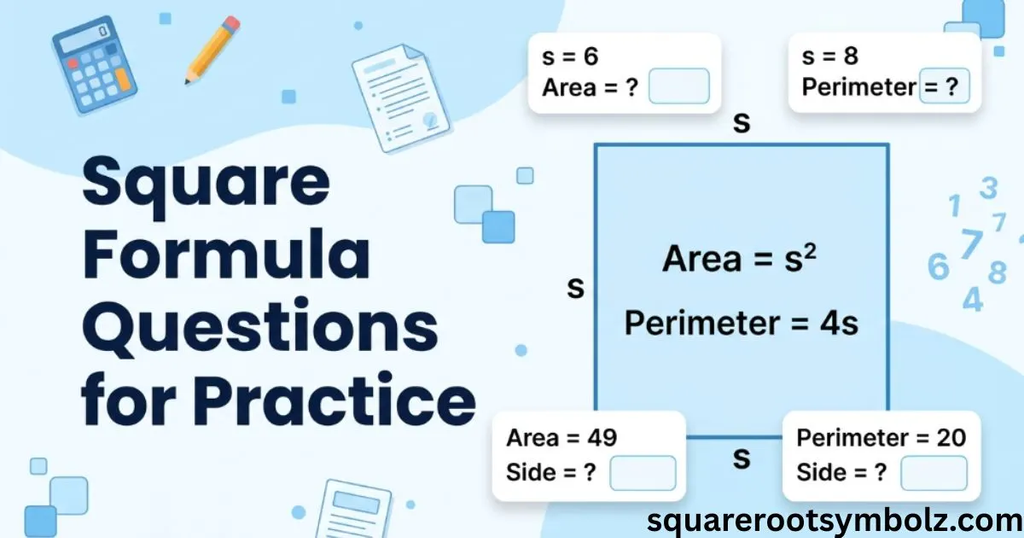
Square Formula Questions for Practice
Practice becomes more useful when you identify the required formula before touching the numbers. Try these questions without looking at the answers. This approach strengthens formula recognition rather than encouraging simple memorization.
- A square has a side of 9 cm. What is its area?
- A square has a perimeter of 48 cm. What is its side length?
- A square has a side of 7 cm. What is its diagonal in exact form?
- A square has an area of 256 cm². What is its side?
- A square has a diagonal of 12 cm. What is its area?
- If the side of a square changes from s to 3s, how many times larger is its area?
Answers:
- 81 cm²
- 12 cm
- 7√2 cm
- 16 cm
- 72 cm²
- 9 times
Conclusion
The square formula becomes much easier once the three core relationships are connected: area = s², perimeter = 4s, and diagonal = s√2. From these formulas, you can find a missing side, calculate area from a diagonal, and solve many geometry problems without memorizing a long list of unrelated equations.
The key is to identify the measurement you are given, identify what you need to find, and then select the matching formula. Remember that area uses square units, perimeter uses linear units, and the diagonal comes from the Pythagorean theorem. With that framework, square problems become much more predictable.
FAQs
Can the square formula find side length with area or perimeter?
Yes. If the area is known, take its square root: s = √A. If the perimeter is known, divide it by four: s = P ÷ 4. Both methods work because all four sides of a square have equal length.
What is the formula for the area of a square?
The area of a square is A = s², where s represents the length of one side. For example, a square with a side of 5 units has an area of 25 square units.
What is the formula for the perimeter of a square?
The perimeter is P = 4s, where s is the side length. The multiplication by four represents the four equal sides of the square. If s = 8 cm, the perimeter is 32 cm.
What is the formula for the diagonal of a square?
The diagonal is d = s√2. This relationship comes from the Pythagorean theorem after a diagonal divides the square into two right triangles. For a side of 6 units, the diagonal is 6√2 units.
What is the side of the square formula?
If the area is known, use s = √A. If the perimeter is known, use s = P ÷ 4. If the diagonal is known, use s = d ÷ √2. Choose the version that matches the measurement provided.
What is the area of square definition?
The area of a square is the amount of two-dimensional space enclosed by its four equal sides. It is calculated by multiplying the side length by itself, giving A = s² in square units.
How do you find the area of a square from its diagonal?
Use A = d² ÷ 2. For example, if the diagonal is 10 cm, then A = 100 ÷ 2 = 50 cm². This formula comes from the diagonal relationship d = s√2.
What happens to the area if the side of a square is doubled?
The area becomes four times the original area. If the original side is s, the area is s². After doubling the side, the area is (2s)² = 4s².
Are square area and perimeter formulas the same?
No. Area is A = s², while perimeter is P = 4s. The area measures the enclosed surface and uses square units. The perimeter measures the boundary and uses ordinary length units.

I’m the creator of SquareRootSymbolz.com, where I publish easy-to-understand guides on symbols, Unicode characters, Alt codes, keyboard shortcuts, and copy-and-paste text symbols. My goal is to provide accurate, well-researched, and user-friendly content that helps readers quickly find the information they need.