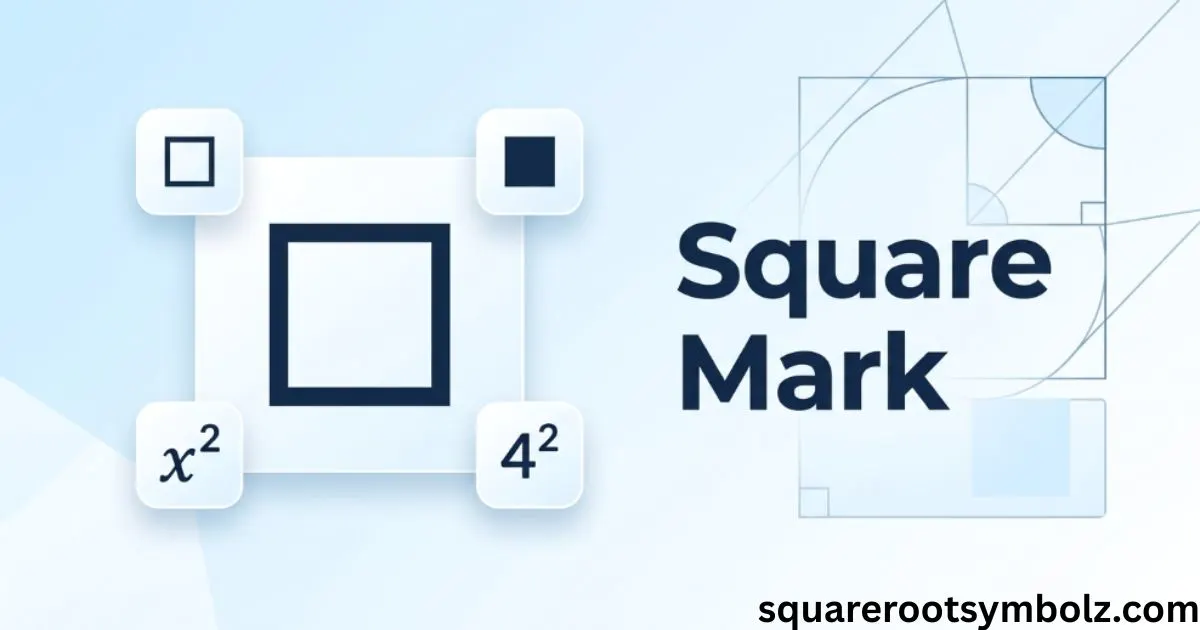
The square mark can refer to several square-shaped symbols, including □, ■, and the Japanese Masu Mark 〼. If you need a square character for text, documents, typography, or Unicode work, the right choice depends on what you want the mark to represent. After working with mathematical and Unicode symbols, I have found that the biggest frustration is not finding a square shape but identifying the correct character and code. This guide separates the common square symbol from specialized marks, explains their meanings, and gives you practical copy, Unicode, HTML, CSS, and typing information.
A simple square can act as a geometric shape, text symbol, bullet, checkbox, or punctuation mark, while specialized characters belong to particular writing systems. The Masu Mark, CJK Symbols and Punctuation, Zanabazar Square, Unicode code point, and character encoding all describe different parts of this larger symbol family. The goal here is simple: help you choose the correct square mark without guessing, copying the wrong character, or confusing a decorative square with a genuine Unicode punctuation mark.
Square Mark: Masu Mark Symbol
The Masu Mark is written as 〼 and has Unicode code point U+303C. It belongs to the CJK Symbols and Punctuation block and was added in Unicode 3.2. The character is associated with Japanese typography and can appear as a distinctive square-shaped text character rather than an ordinary geometric square.
If you searched for a square mark because you saw 〼 somewhere online, this is likely the character you need. It is different from □, ■, ☐, and other square symbols. That distinction matters when you need an exact Unicode character for text, websites, documents, or social posts rather than simply a square-looking shape.
Copy and paste the square mark
〼
Copy the character above when you specifically need the Masu Mark. For an ordinary outlined square, use □; for a filled square, use ■. These characters may look related, but Unicode treats them as separate characters with different names, code points, and uses. Choosing the exact character prevents unexpected results when text is searched, processed, encoded, or displayed.
Square Mark: Unicode Character
The phrase square mark does not identify just one universal character. Unicode contains many square-shaped symbols, including BLACK SQUARE U+25A0, WHITE SQUARE U+25A1, small square characters, ballot-box symbols, and specialized script punctuation. Unicode’s Geometric Shapes block therefore provides several visually related choices rather than one all-purpose square mark.
This distinction is useful when you are copying symbols for mathematics, lists, design, forms, or ordinary text. A filled square can work as a bullet, while an outlined square can represent an empty box. A character from the Zanabazar Square script has a completely different linguistic role. The visual shape alone does not determine its meaning.
Bidirectional Data
Unicode also records properties that are invisible when you simply look at a glyph. These include bidirectional behavior, script classification, general category, and line-breaking behavior. For example, the Zanabazar Square punctuation characters are classified as punctuation and belong to the Zanabazar Square script, while the Masu Mark has different Unicode properties.
Other Unicode Data
A square mark can therefore belong to different semantic groups. Geometric Shapes contains ordinary square characters, CJK Symbols and Punctuation contains the Masu Mark, and the Zanabazar Square block contains specialized punctuation used by that script. Understanding the block helps you identify what a character actually is instead of relying only on its appearance.
Square Mark: Main Unicode Properties
For everyday copying, the most useful properties are the character name, code point, Unicode block, and encoding. For example, the Masu Mark is 〼 U+303C, while the common black and white squares are ■ U+25A0 and □ U+25A1. These identifiers let developers and researchers distinguish similar-looking characters precisely.
The Zanabazar Square script adds another interesting group. Unicode defines four punctuation marks: Zanabazar Square Mark Tsheg U+11A41, Zanabazar Square Mark Shad U+11A42, Zanabazar Square Mark Double Shad U+11A43, and Zanabazar Square Mark Long Tsheg U+11A44. They are not interchangeable with ordinary square symbols.
| Character | Unicode name | Code point | General role |
| ■ | Black Square | U+25A0 | Filled geometric square |
| □ | White Square | U+25A1 | Outlined geometric square |
| 〼 | Masu Mark | U+303C | Japanese/CJK character |
| 𑩁 | Zanabazar Square Mark Tsheg | U+11A41 | Zanabazar Square punctuation |
| 𑩂 | Zanabazar Square Mark Shad | U+11A42 | Zanabazar Square punctuation |
| 𑩃 | Zanabazar Square Mark Double Shad | U+11A43 | Section-ending punctuation |
| 𑩄 | Zanabazar Square Mark Long Tsheg | U+11A44 | Punctuation mark |
Preview
A character’s appearance can change between fonts, operating systems, browsers, and applications. This is especially important for less common Unicode characters. If a square mark appears as an empty box, missing glyph, or unexpected shape, the problem may be font support rather than the Unicode code point itself.
UTF Encodings
Unicode characters can be represented through several encoding systems. For the Masu Mark, U+303C corresponds to UTF-8 bytes E3 80 BC. Zanabazar Square characters use code points in the supplementary multilingual plane and therefore have different UTF-8 and UTF-16 representations. Developers normally work with these encodings rather than typing the visual character manually.
Square Mark: How to Type and Convert It
The easiest way to use a common square mark is simply to copy it. For web development, however, a Unicode code point or HTML entity can be more reliable. For example, the Masu Mark can be represented in HTML as 〼, while the black square is ■ and the white square is □. CSS and JavaScript provide their own escape formats.
For specialized Zanabazar Square punctuation, direct keyboard entry may be less convenient because these characters are uncommon. Unicode reference pages provide HTML, CSS, JavaScript, and other programming representations. If a character does not display correctly, check the selected font and confirm that the application supports the relevant Unicode range.
Representations
Different representations are useful in different situations. A writer may prefer the visible character, a webpage may use an HTML entity, and a programmer may use a Unicode escape. For example, 〼 can be written directly in text or represented using its Unicode value U+303C. The correct representation depends on where the character will be used.
How to type the square mark
For ordinary square symbols, copying is usually faster than using a keyboard shortcut. On Windows, applications such as Microsoft Word can also support Unicode input methods for many characters. For uncommon Zanabazar Square characters, a Unicode character reference is often more practical than searching through a keyboard’s symbol menu.
Complete Record
A complete Unicode record can include the character’s official name, code point, block, script, category, directionality, decomposition data, encoding values, and related characters. This information becomes valuable when a symbol must behave consistently across websites, databases, programming languages, or multilingual documents.
Square Mark Related Characters and Practical Uses
The most useful square mark depends on context. Use ■ when you need a solid black square, □ for an outlined square, and 〼 when you specifically need the Masu Mark. A checkbox such as ☐ has a different purpose again. Similar appearance does not mean identical meaning.
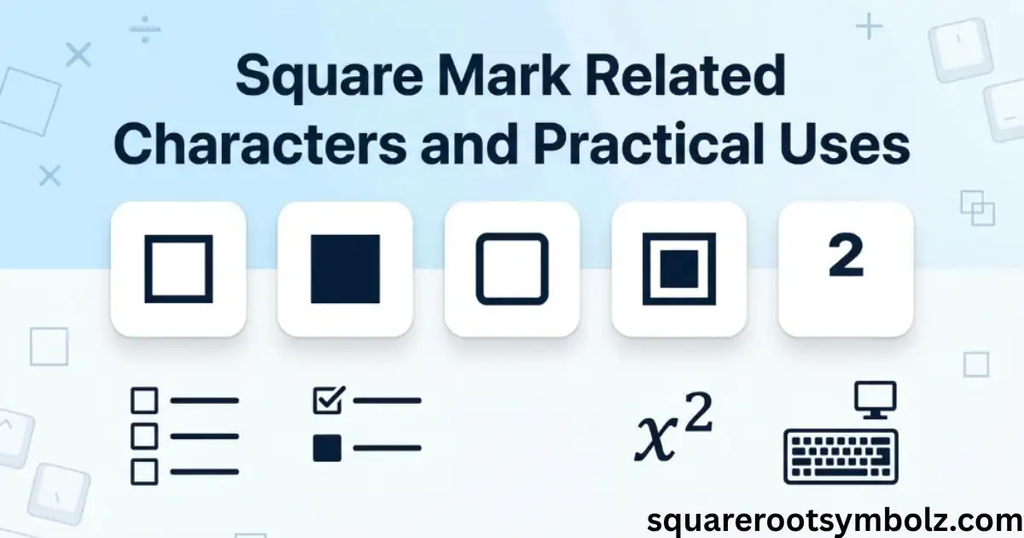
In mathematics and technical writing, square-shaped symbols may appear as operators, placeholders, bullets, diagram elements, or notation. In typography, they can separate information or mark items. In forms, an empty square can represent a selectable option. Choosing a character by its Unicode identity rather than appearance makes the result more predictable.
References
For authoritative character information, the Unicode Standard is the strongest reference because it defines character names, code points, blocks, scripts, and properties. Unicode’s current character charts list BLACK SQUARE and WHITE SQUARE in Geometric Shapes, while its Zanabazar documentation identifies the four Zanabazar Square punctuation marks and their linguistic roles.
Conclusion
The square mark is not one single Unicode character. Depending on your purpose, you may need ■, □, 〼, or one of the specialized Zanabazar Square punctuation characters. For ordinary text, identify the visual form you need first, then verify its Unicode name and code point. That small step prevents many copy-and-paste and encoding mistakes.
For quick use, copy ■ for a black square, □ for a white square, or 〼 for the Masu Mark. If you are working with code, HTML, CSS, or multilingual text, use the appropriate Unicode representation rather than assuming that similar-looking characters are interchangeable.
FAQ Section
What is the square mark symbol?
A square mark can refer to several Unicode characters. Common examples include ■ BLACK SQUARE, □ WHITE SQUARE, and 〼 MASU MARK. The correct character depends on whether you need a geometric square, an outlined square, or a specialized text character.
What is the Unicode for a square mark?
There is no single Unicode code point named simply “square mark” for every use. Common square characters include U+25A0 BLACK SQUARE, U+25A1 WHITE SQUARE, and U+303C MASU MARK.
What is the symbol 〼?
〼 is the Unicode MASU MARK, code point U+303C. It belongs to the CJK Symbols and Punctuation block and is a distinct Unicode character from ordinary black and white square symbols.
How do I copy a square mark?
You can copy ■, □, or 〼 directly from this page. Choose the character based on its intended meaning rather than simply selecting the one that looks closest to what you saw.
What is the black square Unicode?
The black square is ■, with Unicode code point U+25A0. Unicode places it in the Geometric Shapes block.
What is the white square Unicode?
The white square is □, with Unicode code point U+25A1. It is the standard outlined square character in the Geometric Shapes block.
What are Zanabazar Square marks?
The Zanabazar Square script contains four punctuation characters: Zanabazar Square Mark Tsheg U+11A41, Shad U+11A42, Double Shad U+11A43, and Long Tsheg U+11A44. Unicode documents these as punctuation used with the script.

I’m the creator of SquareRootSymbolz.com, where I publish easy-to-understand guides on symbols, Unicode characters, Alt codes, keyboard shortcuts, and copy-and-paste text symbols. My goal is to provide accurate, well-researched, and user-friendly content that helps readers quickly find the information they need.