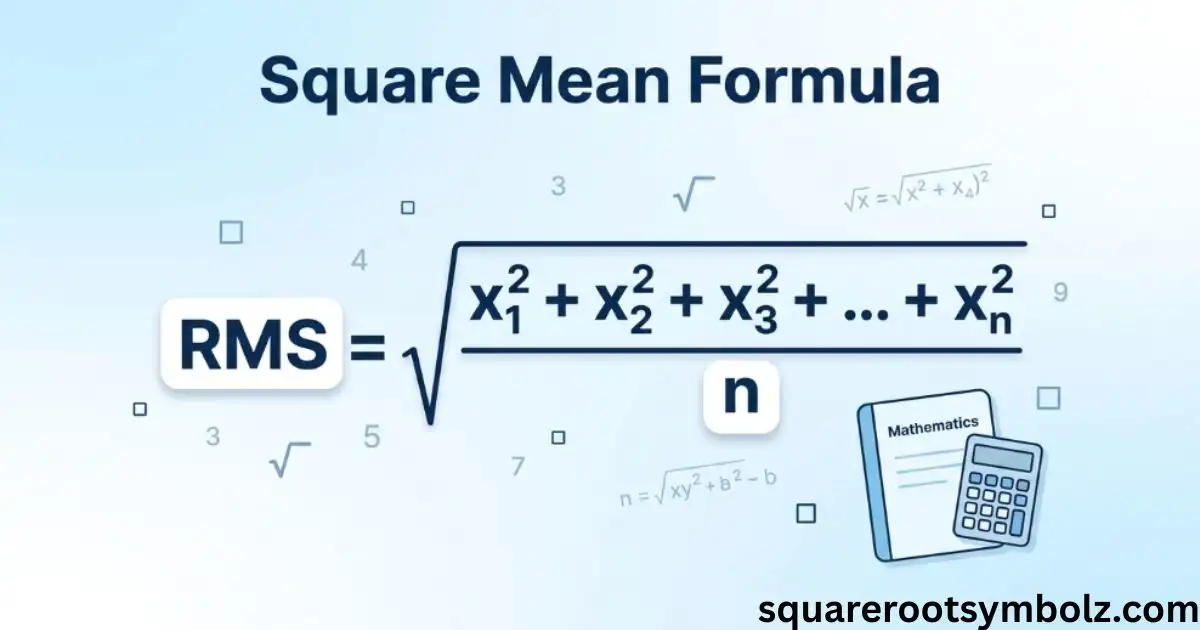
Square mean usually refers to the quadratic mean, also called the root mean square (RMS): square each value, find the mean of those squares, and take the square root. However, the phrase can also appear in discussions of the mean of squares and the square of the mean, so understanding the wording matters.
If these terms have felt confusing, you are not alone. A quick calculation can make them look almost identical while producing different results. This guide separates square mean, quadratic mean, RMS, mean of squares, and square of the mean with simple examples, mathematical reasoning, and practical context. The goal is a definition you can trust and a method you can actually use.
Square Mean
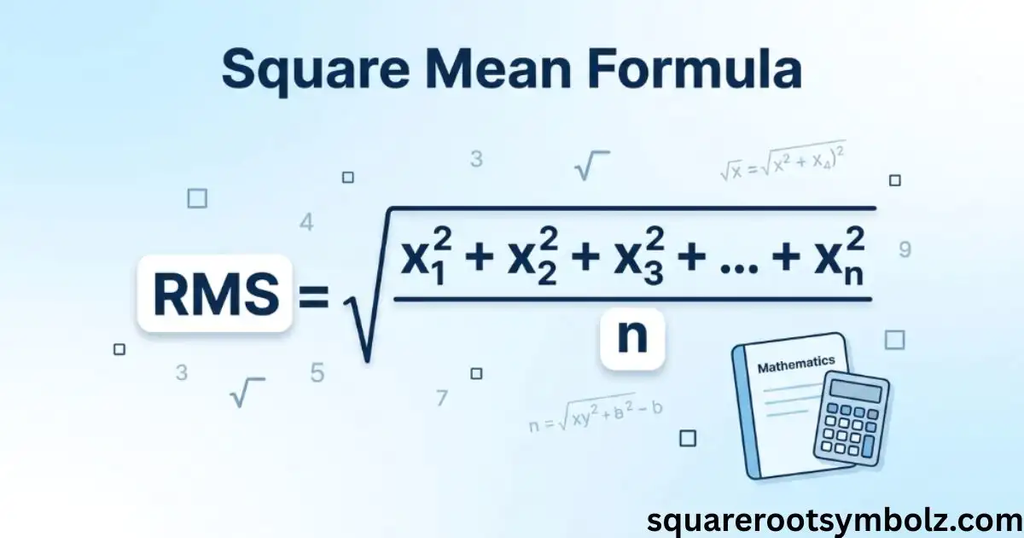
In statistics, a square mean is commonly understood as the quadratic mean, whose familiar name is root mean square. For numbers x₁ through xₙ, square each observation, calculate the arithmetic mean of those squared values, and then take the square root. This returns the result to the original measurement units.
For example, take 3 and 4. Their squares are 9 and 16. The mean of those squares is 12.5, and the square root of 12.5 is about 3.54. Therefore, the square mean, or RMS, is approximately 3.54. Unlike an ordinary arithmetic average, this calculation gives greater influence to larger magnitudes.
| Term | What happens |
| Arithmetic mean | Add values, then divide by the count |
| Mean of squares | Square values, then average them |
| Square of mean | Find the mean, then square it |
| Square mean / quadratic mean | Square values, average them, then take the square root |
| Root mean square | Another name for the quadratic mean |
For a data set of n values, the square mean is:
Square mean = √[(x₁² + x₂² + … + xₙ²) / n]
The three-word memory trick is simple:
Square → Mean → Root
That order is important. If you calculate the ordinary mean first and square it, you are finding the square of the mean, not the square mean. Wolfram MathWorld defines RMS as the square root of the mean of squared values, and OpenStax describes the same three-step process.
Square Mean: Thinking mathematically
A useful way to understand square mean is to ask what happens when positive and negative numbers appear together. With an arithmetic mean, opposite signs can cancel. Squaring removes those signs before averaging, so the calculation measures magnitude rather than allowing positive and negative values to offset one another.
Suppose the values are −4, −2, 0, 2, and 4. Their ordinary arithmetic mean is 0, which may hide the fact that every nonzero observation has a meaningful size. The square mean instead works with 16, 4, 0, 4, and 16, giving an RMS of about 2.83.
Square Mean: Mathematical mindsets
There is another important mathematical idea behind the term. The mean of squares and the square of the mean are not generally equal. NRICH demonstrates that for two numbers, their difference can be written as (p − q)² / 4, which is never negative. They are equal when the two numbers are equal and otherwise the mean of squares is larger.
This distinction is worth remembering because similar-looking expressions can answer different questions. If you calculate (a + b) / 2 and then square it, you have the square of the mean. If you calculate (a² + b²) / 2, you have the mean of squares. If you take the square root of that last quantity, you have the square mean or RMS.
Square Mean: Problem
A common problem asks whether the mean of two squared values is greater than, less than, or equal to the square of their mean. Let the numbers be p and q. The mean of their squares is (p² + q²) / 2, while the square of their mean is (p + q)² / 4. Comparing them reveals the relationship directly.
Subtracting the square of the mean from the mean of squares produces (p − q)² / 4. Because a squared quantity cannot be negative, the difference is always zero or positive. It is zero only when p and q are equal. Otherwise, the mean of squares is greater than the square of the mean.
Example: 3 and 4
Mean:
(3 + 4) / 2 = 3.5
Square of the mean:
3.5² = 12.25
Mean of squares:
(3² + 4²) / 2 = 25 / 2 = 12.5
So:
12.5 > 12.25
The difference is:
12.5 − 12.25 = 0.25
That agrees with:
(4 − 3)² / 4 = 1 / 4 = 0.25
This is a beautiful example because the result is not based on a calculator accident. The algebra explains why the inequality must hold.
Example: Equal values
Now take 5 and 5.
Mean:
(5 + 5) / 2 = 5
Square of mean:
5² = 25
Mean of squares:
(5² + 5²) / 2 = 25
Both results are exactly the same.
That happens because:
(5 − 5)² / 4 = 0
So equality occurs when the values are equal. This is precisely the relationship demonstrated in the NRICH problem.
Square Mean vs. Mean of Squares vs. Square of Mean
| Concept | Operation | Example using 3 and 4 | Result |
| Arithmetic mean | Add, divide | (3 + 4) / 2 | 3.5 |
| Square of mean | Mean, then square | 3.5² | 12.25 |
| Mean of squares | Square, then mean | (9 + 16) / 2 | 12.5 |
| Square mean / RMS | Square, mean, then root | √12.5 | 3.54 |
The distinction is especially important when reading statistics, physics, or engineering material. “Mean square” usually refers to the average of squared values, while “root mean square” adds the final square-root step. In technical applications, RMS is also called the quadratic mean.
Square mean and RMS
Square mean is closely associated with root mean square, or RMS. In a technical context, RMS is used to summarize the magnitude of varying quantities. NIST documentation includes RMS-related statistical computation, while OpenStax uses RMS for changing electrical quantities and explains why ordinary averaging can be misleading when positive and negative values cancel.
For an AC waveform, for example, the average voltage over a complete symmetric cycle can be zero even though the circuit is delivering energy. RMS solves this problem by squaring the instantaneous values, averaging them, and taking the square root. For a sinusoidal waveform, the RMS value equals the peak value divided by √2.
Square mean in statistics
In statistics, square mean belongs to the broader family of mathematical means. Statistics Poland lists square mean alongside arithmetic, geometric, and harmonic means as statistical terminology. The quadratic mean is also associated with the power-mean family, where the exponent determines the type of mean being calculated.
The relationship with variance is also useful. For a population, RMS² can be expressed as mean² + variance. When the mean is zero, RMS becomes equal to the population standard deviation. This helps explain why RMS appears in signal analysis, error measurement, physics, and statistical data analysis.
Square mean in physics
Physics provides an intuitive reason for using the quadratic mean. Quantities such as molecular speed and alternating electrical signals can vary continuously, and their ordinary average does not always represent their physical magnitude. OpenStax defines RMS molecular speed as the square root of the average squared speed and notes that it relates to kinetic energy.
Electrical engineering provides another familiar example. AC current and voltage reverse direction, so simply averaging their instantaneous values can produce zero. RMS provides an effective value that can be used in power calculations, which is why household electrical specifications commonly use RMS values rather than peak values.
Square mean and larger values
Squaring makes large magnitudes contribute disproportionately to the calculation. For example, 10² is 100, while 2² is only 4. That difference means RMS responds more strongly to large observations than the arithmetic mean does. This behavior is useful when magnitude or energy-related effects matter, but it also means RMS is sensitive to unusually large values.
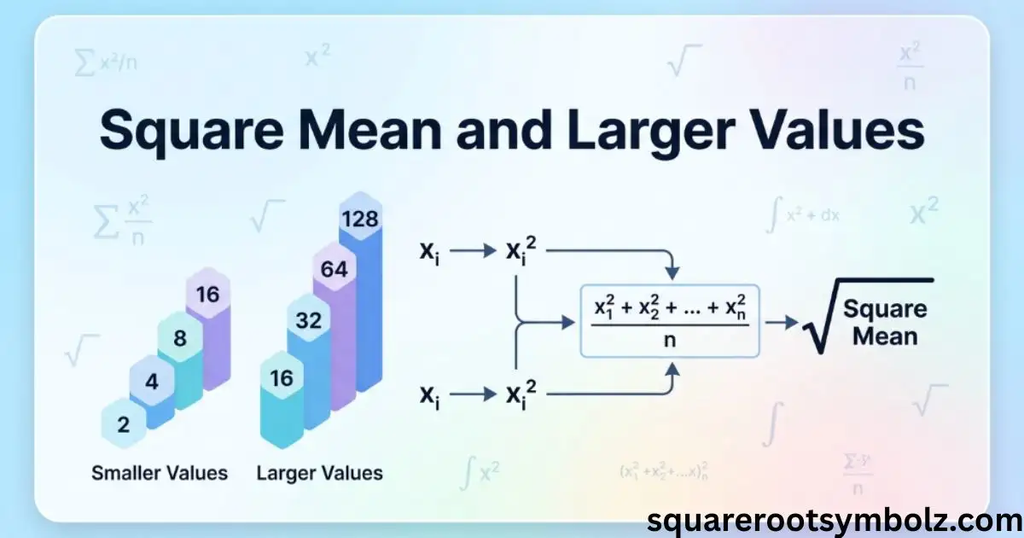
This is why choosing an average should depend on the question being asked. If you want the ordinary central value, arithmetic mean may be appropriate. If you need a measure of magnitude where positive and negative values should not cancel, square mean or RMS may be more meaningful.
A quick calculation
For the values 2, 4, and 6:
- Square the values: 4, 16, and 36.
- Add them: 56.
- Divide by 3: 18.67.
- Take the square root: about 4.32.
So the square mean is approximately 4.32.
Notice that the arithmetic mean is 4. The square mean is larger because the squaring step gives additional influence to the larger value, 6.
Why the terminology causes confusion
The phrase square mean can be confusing because several related expressions contain the same words. “Mean of squares” means average the squared observations. “Square of the mean” means calculate the ordinary average first and then square it. “Root mean square” means square the observations, average them, and finally take the square root. These operations are related but not interchangeable.
If you remember only one rule, remember the order:
Square → Mean → Root = RMS or quadratic mean
That simple sequence prevents one of the most common mistakes when working with this family of mathematical averages.
Conclusion
Square mean is commonly used for the quadratic mean or root mean square, calculated by squaring values, finding the mean of those squares, and taking the square root. The term should not be confused with the mean of squares or the square of the mean.
The distinction becomes especially important with positive and negative data, statistical measurements, physical quantities, and AC signals. When the goal is to measure magnitude rather than allow opposite signs to cancel, RMS provides a useful and mathematically consistent measure.
FAQ Section
What is square mean in math?
Square mean commonly refers to the quadratic mean, also known as root mean square. It is calculated by squaring each value, finding the arithmetic mean of the squares, and then taking the square root.
What is the formula for square mean?
For n values, the square mean is:
√[(x₁² + x₂² + … + xₙ²) / n]
This is the standard root mean square or quadratic mean formula.
Is square mean the same as RMS?
Yes, in the common statistical and mathematical usage, square mean refers to the quadratic mean, while RMS means root mean square. Both describe the square root of the mean of squared values.
What is the difference between square mean and arithmetic mean?
The arithmetic mean averages the original values. Square mean squares the values first, averages those squares, and then takes a square root. Because of the squaring step, larger magnitudes have more influence on the square mean.
What is the difference between mean of squares and square of mean?
The mean of squares squares each value before averaging. The square of the mean calculates the ordinary mean first and then squares that result. For unequal values, the mean of squares is greater than the square of the mean.
Is square mean always greater than the arithmetic mean?
For real-valued data, the RMS is greater than or equal to the arithmetic mean. Equality occurs when all values are equal. For data containing negative values, it is more precise to compare RMS with the mean of the absolute values because RMS measures magnitude.
Why is square mean used for AC current and voltage?
AC quantities change direction, so their ordinary average over a complete symmetric cycle can be zero even though they transfer energy. RMS gives an effective magnitude that is useful for electrical power calculations.
What is another name for square mean?
The most important alternate terms are quadratic mean and root mean square (RMS). The term “quadratic mean” is particularly useful when distinguishing this mean from arithmetic, geometric, and harmonic means.
What happens when all values are equal?
When every value is the same, the arithmetic mean, square mean, and other standard power means coincide at that common value. This is also why the difference between the mean of squares and square of the mean becomes zero when the compared values are equal.

I’m the creator of SquareRootSymbolz.com, where I publish easy-to-understand guides on symbols, Unicode characters, Alt codes, keyboard shortcuts, and copy-and-paste text symbols. My goal is to provide accurate, well-researched, and user-friendly content that helps readers quickly find the information they need.