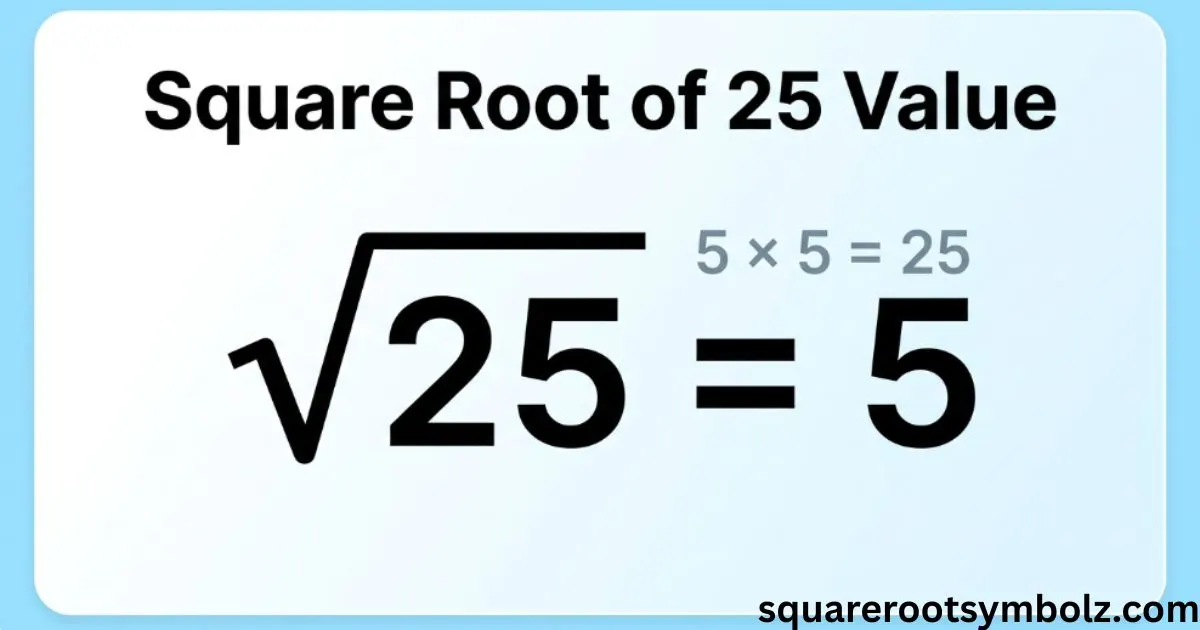
The square root of 25 is 5 because 5 × 5 = 25. Since 25 is a perfect square, its principal square root is an exact whole number, not a decimal approximation. The same result can be written as √25 = 5 or 25^(1/2) = 5.
If square roots sometimes feel confusing, especially when you see ±5 in an equation, you are not alone. The key is separating the radical symbol from solving an equation. This guide explains the square root of 25 using simple methods, perfect squares, prime factorization, repeated subtraction, long division, geometry, and algebra so you can recognize the answer confidently.
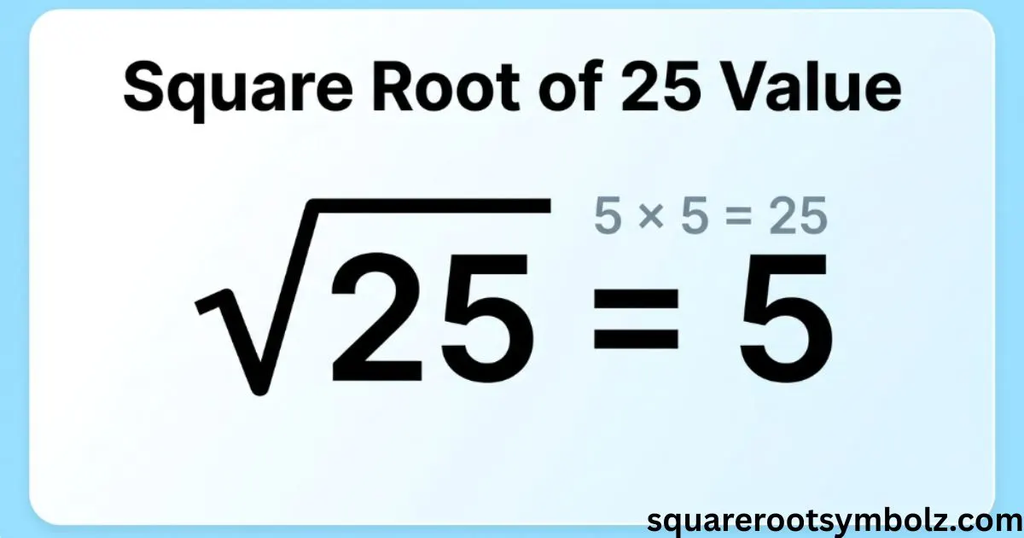
The Square Root of 25 Is 5
The square root of 25 is 5 because multiplying 5 by itself gives 25. In other words, 5² = 25. Therefore, the principal square root is √25 = 5. Because 25 is a perfect square, the answer is exact and requires no rounding.
Here is the basic relationship:
5 × 5 = 25
So:
√25 = 5
This is one of the easiest perfect-square roots to recognize because 25 belongs to the familiar sequence of square numbers:
| Number | Square |
| 1 | 1 |
| 2 | 4 |
| 3 | 9 |
| 4 | 16 |
| 5 | 25 |
| 6 | 36 |
| 7 | 49 |
| 8 | 64 |
| 9 | 81 |
| 10 | 100 |
Learning these common squares makes mental calculation much faster.
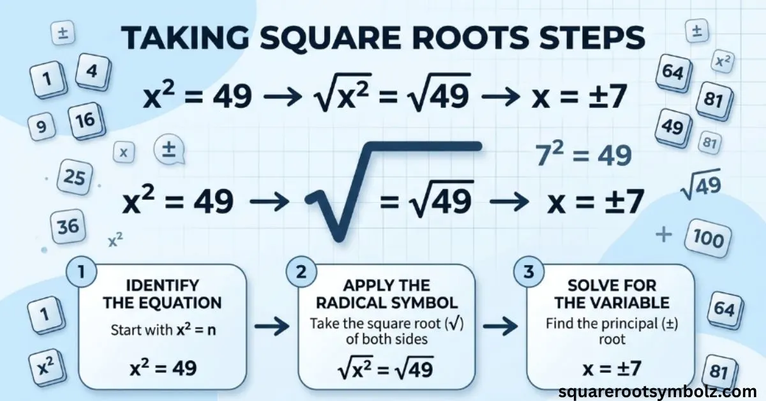
There is also an important distinction between √25 and the equation x² = 25. The radical √25 represents the principal, nonnegative square root, so it equals 5. The equation x² = 25 has two solutions: x = 5 and x = −5. OpenStax confirms that the radical symbol denotes the principal square root rather than ±5.
Where the square root of 25 appears
The square root of 25 appears naturally in geometry, especially in the famous 3–4–5 right triangle. Using the Pythagorean theorem, the hypotenuse is √(3² + 4²) = √25 = 5. This makes the value useful for geometry, construction, measurement, and distance calculations.
For example, imagine a right triangle with legs of 3 inches and 4 inches. The missing side is:
c = √(3² + 4²)
c = √(9 + 16)
c = √25
c = 5
The same number can appear in coordinate geometry. The distance between (0,0) and (3,4) is:
√[(3 − 0)² + (4 − 0)²]
= √(9 + 16)
= √25
= 5
This illustrates an important idea: square roots are not just classroom calculations. They reverse squared quantities and therefore appear whenever a formula gives you a squared measurement but asks you to recover the original length.
The number 25 can also appear in algebra. If a quadratic equation has a discriminant of 25, its square root is simply 5. Because √25 is rational, calculations involving it can often produce rational solutions.
What “square root of 25” Means
A square root is a number that produces the original value when multiplied by itself. For 25, the number is 5 because 5 × 5 = 25. Therefore, 25 is called a perfect square, and 5 is its principal square root.
The radical symbol √ tells us to take the principal square root:
√25 = 5
However, both 5 and −5 square to 25:
5² = 25
(−5)² = 25
That is why the equation:
x² = 25
has two solutions:
x = ±5
But writing:
√25 = ±5
is not correct when evaluating the radical itself. The radical symbol gives the nonnegative principal root. The ± sign becomes relevant when you are solving an equation such as x² = 25.
| Expression | Correct result |
| √25 | 5 |
| −√25 | −5 |
| x² = 25 | x = ±5 |
| 25^(1/2) | 5 |
| 5² | 25 |
| (−5)² | 25 |
This distinction is small but important. Many students understand the calculation but lose a solution when solving equations because they treat the radical symbol and the equation as if they mean exactly the same thing.
How To Find The Square Root of 25
Because 25 is a perfect square, you can find its square root mentally by remembering that 5 × 5 = 25. You can also verify it through prime factorization, repeated subtraction of odd numbers, or long division. All three methods lead to the exact answer 5.
For a quick calculation, simply ask:
What number multiplied by itself equals 25?
The answer is 5.
5 × 5 = 25
Therefore:
√25 = 5
The following methods are useful when you want to understand the process rather than simply recall the answer.
Method 1 Prime factorisation
Prime factorization breaks 25 into its prime factors:
25 = 5 × 5
The two 5s form a matching pair. Taking one number from the pair gives:
√25 = 5
This method is especially useful for larger numbers because pairing identical prime factors helps reveal which values can move outside a radical. BYJU’S and Bhanzu both use prime factorization as a method for finding √25.
Method 2 Repeated subtraction of odd numbers
Start with 25 and subtract consecutive odd numbers:
25 − 1 = 24
24 − 3 = 21
21 − 5 = 16
16 − 7 = 9
9 − 9 = 0
It takes five subtractions to reach zero, so:
√25 = 5
This works because the sum of the first n odd numbers is n². Five consecutive odd numbers, 1 + 3 + 5 + 7 + 9, add to 25. Both BYJU’S and Cuemath demonstrate this method.
Method 3 — Long division
The long-division method is a traditional way to calculate square roots, particularly useful when a number is not an obvious perfect square. For 25, the process ends immediately because 5 × 5 equals 25 and leaves a remainder of zero.
For √25, the largest whole number whose square does not exceed 25 is 5:
5 × 5 = 25
Subtracting 25 from 25 leaves:
25 − 25 = 0
Because the remainder is zero, there is no additional decimal part.
So the exact answer remains:
√25 = 5
Examples of Square Root of 25
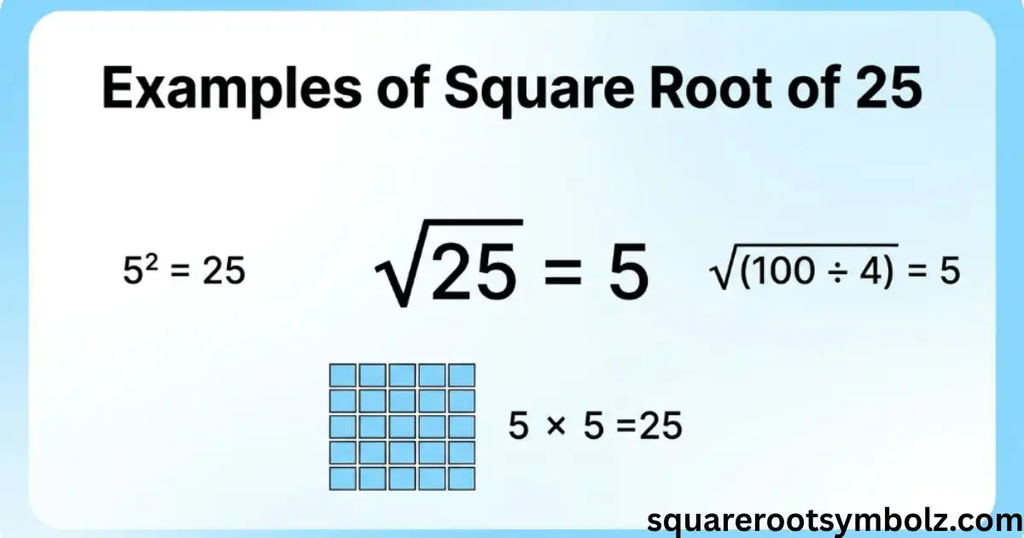
The value √25 becomes even easier to understand when it appears in different mathematical expressions. The important skill is recognizing when you are simply evaluating a radical, simplifying a larger expression, solving an equation, or applying the root to a geometric measurement.
Example 1
Evaluate √25 directly.
Since:
5² = 25
the answer is:
√25 = 5
There is no need for a calculator because 25 is a perfect square.
Example 2
Does x² = 25 mean x = 5 only?
No. Both 5 and −5 produce 25 when squared:
5² = 25
(−5)² = 25
Therefore:
x = ±5
The key difference is that √25 itself equals 5, while the equation x² = 25 has two solutions.
Example 3
Simplify:
3√25
First find the square root:
√25 = 5
Then multiply:
3 × 5 = 15
Therefore:
3√25 = 15
This type of problem is straightforward once you recognize that the radical can be evaluated exactly.
Example 4
Find the hypotenuse of a right triangle with legs 3 and 4.
Use the Pythagorean theorem:
c = √(3² + 4²)
c = √(9 + 16)
c = √25
c = 5
So the hypotenuse is 5 units. This is the classic 3–4–5 right triangle.
Example 5
Simplify √(25x²) for x > 0.
Separate the perfect-square factors:
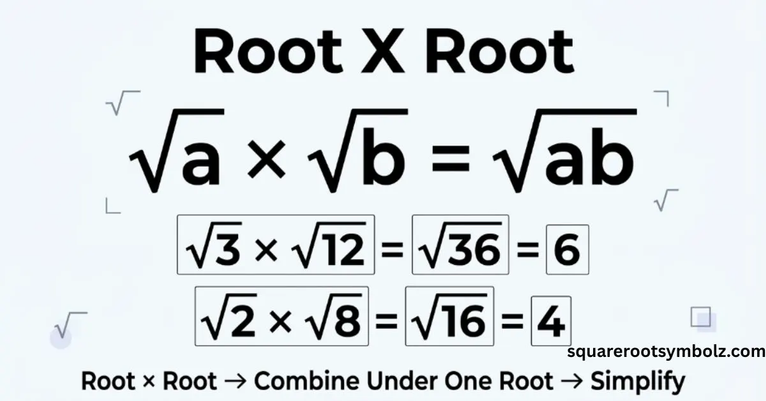
√(25x²) = √25 × √x²
Since √25 = 5 and x is positive:
√(25x²) = 5x
This example shows how a familiar numerical square root can work together with an algebraic variable.
Conclusion
The square root of 25 is 5 because 5 × 5 = 25, making 25 a perfect square. The principal square root is therefore √25 = 5, while the equation x² = 25 has the two solutions x = ±5.
You can find √25 mentally or verify it through prime factorization, repeated subtraction, or long division. The result also appears naturally in the Pythagorean theorem, coordinate geometry, algebraic equations, and everyday measurements. Once you understand the difference between a radical and an equation, square roots become much easier to handle.
FAQ Section
What is the square root of 25?
The principal square root of 25 is 5, because 5 × 5 = 25.
Is 25 a perfect square?
Yes. 25 is a perfect square because 5 × 5 = 25.
Is the square root of 25 rational or irrational?
The square root of 25 is rational because √25 = 5, and 5 can be written as 5/1.
What is the prime factorization of 25?
The prime factorization of 25 is:
25 = 5 × 5 = 5²
Is √25 equal to ±5?
No. √25 = 5. The radical symbol represents the principal nonnegative square root. However, the equation x² = 25 has two solutions: x = 5 and x = −5.
What is the square root of −25?
There is no real square root of −25. In the complex-number system:
√−25 = 5i
where i is the imaginary unit and i² = −1.
What is 16√25?
Because √25 = 5:
16√25 = 16 × 5 = 80.
What is 13 + 15√25?
Since √25 = 5:
13 + 15√25 = 13 + 15(5) = 13 + 75 = 88.
What is the cube root of 25?
The cube root of 25 is approximately 2.924, which is different from its square root. The square root asks for a number multiplied by itself to make 25, while the cube root asks for a number multiplied by itself three times.

I’m the creator of SquareRootSymbolz.com, where I publish easy-to-understand guides on symbols, Unicode characters, Alt codes, keyboard shortcuts, and copy-and-paste text symbols. My goal is to provide accurate, well-researched, and user-friendly content that helps readers quickly find the information they need.