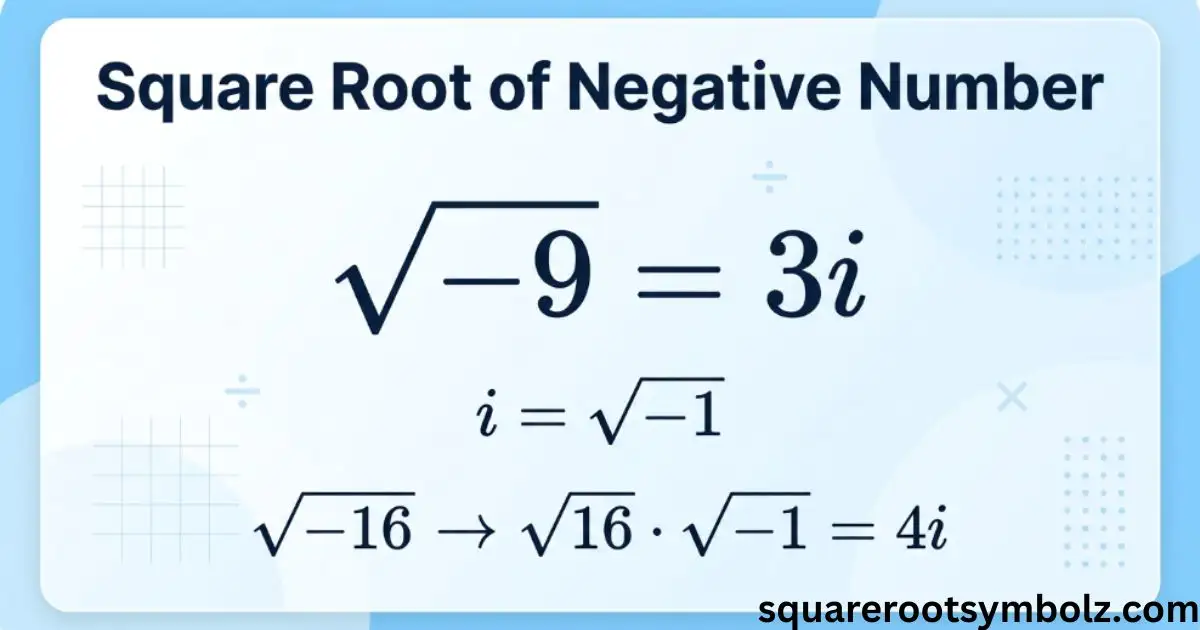
The square root of negative number is not a real number, but it can be written using the imaginary unit i, where i = √−1. This is why √−4 becomes 2i instead of a real-number answer. The idea can feel strange at first, especially when you have learned that square roots should produce ordinary numbers.
The good news is that the rule is simple once the reason becomes clear. In this guide, we will connect negative radicals, imaginary numbers, complex numbers, real solutions, and algebraic equations. We will also work through examples such as √−4, √−9, √−25, and √−32 so you can see exactly what happens.
Evaluate the Square Root of a Negative Number
Within the real number system, the square root of negative number does not exist. The reason is that squaring any real number gives a positive result or zero. A positive number times itself is positive, and a negative number times itself is also positive.
For example, 3 × 3 = 9 and −3 × −3 = 9. Neither produces −9. Therefore, no real number squared can equal −9. This is why √−9 has no real-number value. Mathematics solves this limitation by extending the number system with the imaginary unit i.
Example 8.76
Consider three expressions: √−25, √−7, and √−12. Each can be rewritten by separating the negative factor from the positive radicand. √−25 becomes 5i, √−7 becomes i√7, and √−12 becomes 2i√3 after simplifying the positive radical.
The important pattern is that square root of negative number sign produces i, while the positive number underneath the radical is simplified normally. This gives a consistent method rather than treating every negative square root as an impossible calculation.
How do you simplify the square root of a negative number using the imaginary unit?
Start with √−b, where b is positive. Rewrite the negative value as −1 × b, then use √−1 = i. The result becomes i√b. Finally, simplify √b if it contains a perfect-square factor, just as you would simplify an ordinary positive radical.
For example, √−32 becomes i√32. Since 32 = 16 × 2, √32 = 4√2. Therefore, √−32 = 4i√2. The i stays outside the radical, and the remaining positive radical is simplified normally.
Square Root of a Negative Number
A square root of negative number becomes an imaginary number when we work beyond the real-number system. The basic definition is i = √−1, which means i² = −1. This single definition makes negative square roots usable in algebra.
The general rule is simple: for a positive number b, √−b = i√b. So √−4 = 2i, √−9 = 3i, and √−25 = 5i. If the positive part is not a perfect square, leave the remaining radical in simplified form.
| Expression | Simplified form |
| √−1 | i |
| √−4 | 2i |
| √−9 | 3i |
| √−16 | 4i |
| √−25 | 5i |
| √−7 | i√7 |
| √−12 | 2i√3 |
| √−32 | 4i√2 |
| √−50 | 5i√2 |
Notice that the result does not contain a real-number value such as 2.236. Instead, the imaginary unit identifies the expression as belonging outside the real-number system.
Square Roots of Negative Numbers Video Summary
The central idea is that negative square roots can be handled consistently by introducing i. First separate −1 from the positive part, replace √−1 with i, and then simplify the positive radical. This procedure works for perfect squares and non-perfect squares alike.
For instance, √−75 becomes i√75. Because 75 = 25 × 3, √75 = 5√3. Therefore, the simplified result is 5i√3. The coefficient comes first, followed by i, followed by any remaining radical.
What is the standard form for writing expressions involving the imaginary unit?
When a result contains a coefficient, i, and a radical, the conventional order is the whole-number coefficient first, then i, then the radical. Thus, √−32 is written as 4i√2, not √2 × 4i. This format makes the mathematical structure easier to read.
The same idea applies to expressions such as 3i√5 or 7i√2. The imaginary unit is not placed under the radical. Keeping i outside the radical also makes it easier to recognize that the expression represents an imaginary quantity.
Can you give an example of simplifying the square root of a negative number step-by-step?
Take √−50. First separate −1 from 50: √−50 = √−1 × √50. Replace √−1 with i, giving i√50. Since 50 = 25 × 2, simplify √50 to 5√2. The final answer is 5i√2.
You can verify the result by squaring it: (5i√2)² = 25 × i² × 2. Because i² = −1, the result becomes 25 × −1 × 2 = −50. The original radicand is recovered, confirming the calculation.
Square Roots of Negative Numbers
Square roots of negative numbers are closely connected to imaginary numbers and complex numbers. An expression containing i is not a real number, but it is still part of the larger complex-number system. Complex numbers combine real and imaginary components in forms such as a + bi.
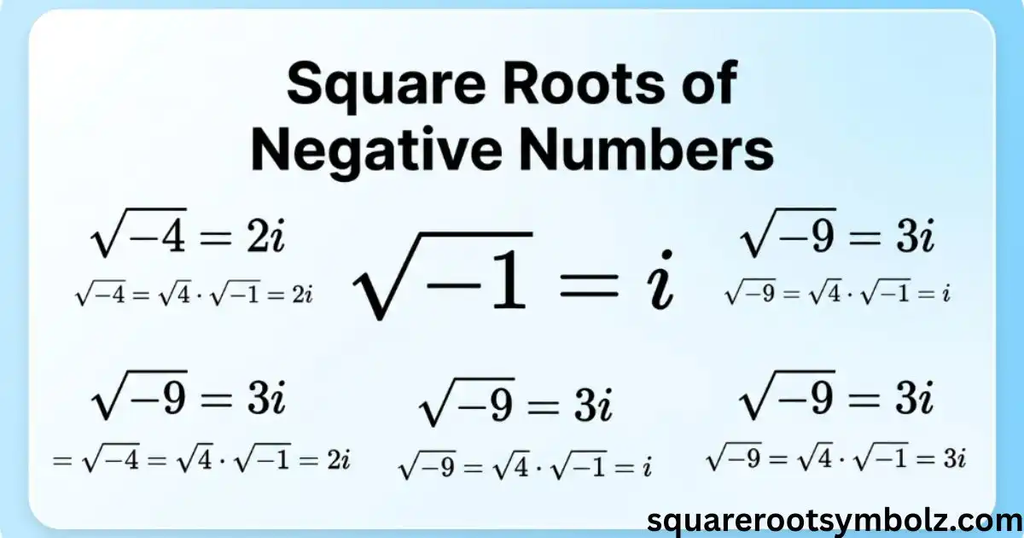
This extension becomes especially useful when solving equations. For example, x² + 9 = 0 leads to x² = −9. There is no real solution, but using i gives x = ±3i. Imaginary numbers therefore allow algebra to describe solutions that real numbers alone cannot provide.
What are imaginary numbers and how do they relate to the imaginary unit?
Imaginary numbers contain the imaginary unit i, defined by i² = −1. Examples include i, 3i, and 4i√2. They are not real numbers, but they form part of the complex-number system, which combines real and imaginary quantities and expands the possible solutions of algebraic equations.
The distinction is important: saying “√−9 is not real” does not mean the expression is meaningless. It means that the answer lies outside the real numbers. In the complex system, √−9 has the principal value 3i, giving mathematics a precise way to work with it.
Conclusion
The square root of negative number is not real, but it can be represented using the imaginary unit i = √−1. The key rule is:
√−b = i√b, for b > 0.
So √−4 = 2i, √−9 = 3i, √−25 = 5i, and √−32 = 4i√2. Once you understand that the negative sign contributes i, the remaining positive radical can be simplified using the same techniques you already know.
The concept also provides the bridge from real numbers to imaginary numbers and complex numbers, making it possible to solve algebraic equations that have no real solutions. OpenStax and Pearson both emphasize this extension of the number system.
FAQ Section
Is the square root of a negative number real?
No.square root of negative number does not have a real square root because squaring any real number produces a nonnegative result.
What is the square root of −1?
The square root of −1 is i, the imaginary unit. By definition, i² = −1.
What is the square root of −4?
√−4 = 2i.
Because 2i × 2i = 4i² = −4.
What is the square root of −9?
√−9 = 3i.
The positive part √9 becomes 3, while √−1 becomes i.
What is the square root of −25?
√−25 = 5i.
What is the square root of −7?
√−7 = i√7.
Because 7 is not a perfect square, √7 remains under the radical.
What is the square root of −32?
√−32 = 4i√2.
The calculation is √−32 = i√32 = i√(16 × 2) = 4i√2.
Why can’t a negative number have a real square root?
square root of negative number. Because the product of two positive real numbers is positive, and the product of two negative real numbers is also positive. Therefore, no real number multiplied by itself can produce a negative result.
Are imaginary numbers real numbers?
No. Imaginary numbers are outside the real-number system, although they are part of the broader complex-number system.
What is i in math?
The symbol i represents the imaginary unit and is defined by i = √−1, so i² = −1.
Can a negative number have a square root in complex numbers?
Yes. Complex numbers extend the real-number system so that square roots of negative numbers can be represented using i.

I’m the creator of SquareRootSymbolz.com, where I publish easy-to-understand guides on symbols, Unicode characters, Alt codes, keyboard shortcuts, and copy-and-paste text symbols. My goal is to provide accurate, well-researched, and user-friendly content that helps readers quickly find the information they need.