The square root of 5 is √5, with an exact value that cannot be written as a terminating decimal and an approximate value of 2.23606797749979. If you have ever wondered why the answer does not become a neat whole number, the reason is simple: 5 is a prime number and is not a perfect square.
In this guide, we will work through the square root, radical form, decimal approximation, irrational number classification, prime factorization, and long division. As a math teacher, I find that the biggest confusion comes from treating an approximation such as 2.236 as if it were the exact answer. Here, you will see the difference clearly and learn when each form is useful.
What Is the Square Root of 5?
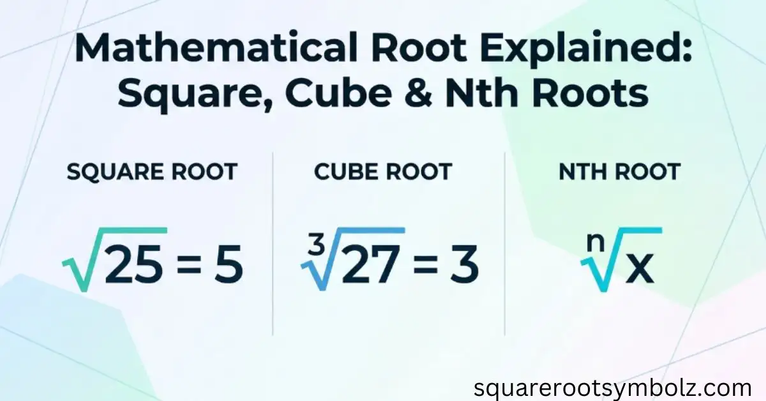
The square root of 5 is the positive number that produces 5 when multiplied by itself. In radical notation, it is written as √5. Its decimal value begins 2.23606797749979…, so √5 is greater than 2 but less than 3.
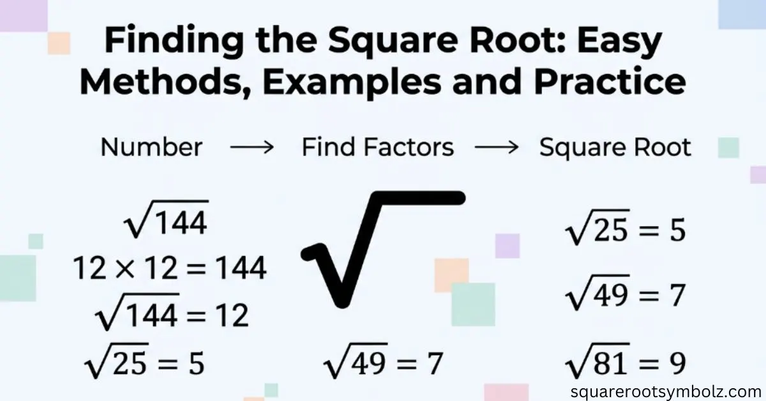
A quick check makes this easier to see. Because 2² = 4 and 3² = 9, the number 5 lies between two consecutive perfect squares. Therefore, its principal square root must lie between 2 and 3. This simple comparison is one of the fastest ways to estimate √5 before using a calculator.
Square Root of 5
The exact form of the square root of 5 is √5. The decimal form is approximately 2.23606797749979, although you may see 2.236, 2.2361, or another rounded version depending on the required precision.
| Form | Value |
| Radical form | √5 |
| Decimal form | 2.23606797749979… |
| Rounded to 3 decimal places | 2.236 |
| Rounded to 4 decimal places | 2.2361 |
| Exponent form | 5^(1/2) |
| Approximate range | 2 < √5 < 3 |
The key point is that √5 is exact, while 2.236 is an approximation. Keeping that distinction in mind prevents many common errors in algebra and geometry.
Is the Square Root of 5 Rational or Irrational?
The square root of 5 is irrational. An irrational number cannot be expressed exactly as a ratio of two integers. Its decimal expansion continues without terminating and does not repeat in a fixed pattern. Since 5 is not a perfect square, √5 does not simplify to an integer or terminating fraction.
There is also a useful perfect-square test. Numbers such as 1, 4, 9, 16, and 25 have whole-number square roots. The number 5 does not belong to that group. That is why √5 remains an irrational radical even after simplification.
Why the Decimal Does Not End
If √5 had a terminating decimal, it could be represented as a fraction with a denominator based on a power of 10. But squaring such a rational number would produce a rational result, whereas 5 would require √5 itself to be rational. Therefore, the decimal expansion of √5 continues indefinitely.
How to Find the Square Root of 5?
There are several ways to find the square root of 5, but two traditional approaches are especially useful: estimation and long division. Estimation quickly tells you where the answer lies, while long division lets you calculate additional decimal places without relying on a calculator.
Start with the nearby perfect squares. Since 4 < 5 < 9, we know that 2 < √5 < 3. Testing values around 2.2 and 2.3 narrows the answer further. A calculator gives √5 ≈ 2.23606797749979, which confirms the estimate.
Estimating Between Perfect Squares
Try 2.2² = 4.84 and 2.3² = 5.29. Therefore, √5 must fall between 2.2 and 2.3. Testing 2.23 gives 4.9729, while 2.24² gives 5.0176. So √5 lies between 2.23 and 2.24, giving a quick practical estimate before more precise calculation.
Square Root of 5 Using Prime Factorization
Prime factorization shows immediately why √5 cannot be simplified. The only positive factors of the prime number 5 are 1 and 5. There is no repeated pair of equal prime factors that can be taken outside the radical, so √5 is already in simplest radical form.
For comparison, √20 can be simplified because 20 contains a perfect-square factor: √20 = √(4 × 5) = 2√5. But √5 itself has no such factor. This distinction becomes important when simplifying larger radical expressions in algebra.
Prime Factorization Check
For 5, the prime factorization is simply 5 = 5. Because there is no pair such as 2 × 2 or 3 × 3, nothing can leave the radical. Therefore:
√5 = √5
That is not an unfinished calculation. It is the correct simplest radical form.
Square Root of 5 Using Long Division
The long division method gives increasingly accurate decimal digits. Begin with 5.000000 and group the digits into pairs. The first digit of the answer is 2 because 2² = 4, leaving a remainder of 1. Bringing down pairs of zeros allows the process to continue beyond the decimal point.
The next calculations produce digits that begin 2.23, then 2.236, and continue toward 2.236067977…. Because √5 is irrational, the process does not reach a final terminating decimal. In practice, you stop when you have enough decimal places for the problem.
Long Division Result
The first few digits are:
√5 ≈ 2.23606797749979
For most school calculations, 2.236 or 2.2361 is enough. For higher precision, keep more digits. Always use the approximation symbol when rounding because the decimal value is not exactly equal to the radical.
Square Root of 5 Solved Examples
Suppose a geometry problem gives a diagonal or side length involving √5. The exact radical form is often preferable because it preserves the mathematical value without rounding. If a numerical answer is requested, convert √5 to approximately 2.23606797749979 and calculate from there.
For example, consider 3√5. Multiply the coefficient 3 by the radical value: 3 × √5 ≈ 3 × 2.23606797749979 = 6.70820393249937. The exact answer remains 3√5, while the decimal answer is an approximation.
Example: Squaring √5
Consider:
(√5) × (√5) = 5
This is one of the most important facts about the expression. The square root operation reverses squaring for a nonnegative number. Therefore, when √5 is multiplied by itself, the radical disappears and the result returns to 5.
Example: Compare √5 With 2.2 and 2.3
We know:
2.2² = 4.84
and
2.3² = 5.29
Because 5 lies between these two results:
2.2 < √5 < 2.3
This gives a useful mental estimate without a calculator.
Example: √20 and √5
Consider √20. Since 20 = 4 × 5:
√20 = √4 × √5 = 2√5
This means √20 is approximately 4.4721. The example shows why recognizing perfect-square factors is important when simplifying radical expressions.
Properties of the Square Root of 5
The square root of 5 has several useful mathematical properties. It is an irrational, real, non-terminating, non-repeating decimal and its principal value is positive. It also satisfies the fundamental identity √5 × √5 = 5.
Because √5 lies between 2 and 3, it can be placed naturally on the real number line. It is not a whole number, rational fraction, or terminating decimal. These properties make it a useful example when learning the difference between rational and irrational numbers.
| Property | √5 |
| Exact form | √5 |
| Decimal | 2.23606797749979… |
| Rational or irrational | Irrational |
| Real or imaginary | Real |
| Perfect-square result | No |
| Between | 2 and 3 |
| Simplest radical form | √5 |
| Square of √5 | 5 |
| Principal value | Positive |
Applications of the Square Root of 5
The square root of 5 appears naturally in algebra, geometry, number theory, and formulas involving the golden ratio. One famous relationship is φ = (1 + √5) / 2, where φ represents the golden ratio. This connection gives √5 significance beyond a simple square-root exercise.
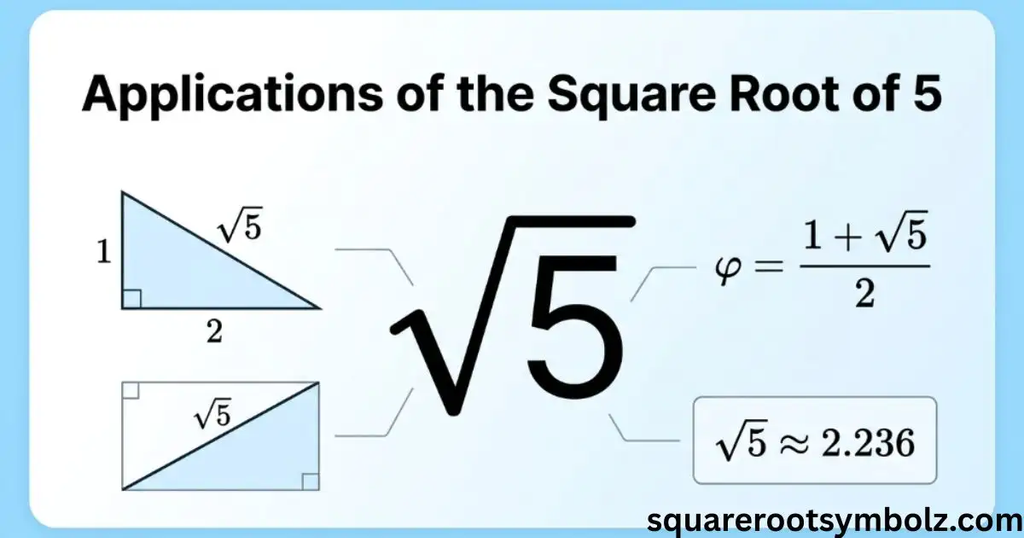
In geometry, irrational square roots often appear when calculating distances, diagonals, and lengths that do not correspond to perfect-square measurements. In algebra, √5 can appear when solving quadratic equations. Keeping the radical exact is often better than replacing it with a rounded decimal too early.
Golden Ratio Connection
The golden ratio is approximately 1.618 and can be written using √5 as φ = (1 + √5) / 2. This is one reason √5 appears in discussions of mathematical patterns, geometry, proportions, and the golden ratio.
Geometry Connection
Suppose a geometric calculation produces a length of √5 units. The exact measurement is √5 units, while the decimal approximation is about 2.236 units. Keeping the radical form can preserve accuracy throughout several calculations and avoids accumulating rounding errors.
Conclusion
The square root of 5 is √5, and its decimal value is approximately 2.23606797749979. Because 5 is prime and not a perfect square, √5 cannot be simplified into a whole number or rational fraction. It is an irrational real number that lies between 2 and 3.
When you need an exact answer, keep √5. When a decimal is required, use the appropriate rounded value. Understanding that difference makes square-root problems much easier and gives you a reliable foundation for algebra, geometry, radicals, and more advanced mathematics.
FAQ Section
These questions reflect the FAQ/PAA-style query patterns visible across the current competing pages, including questions about value, irrationality, simplification, negative 5, and expressions involving √5.
What is the square root of 5?
The square root of 5 is √5, which is approximately 2.23606797749979. Its exact radical form is √5.
Is the square root of 5 rational or irrational?
√5 is irrational because 5 is not a perfect square. Its decimal expansion continues indefinitely without repeating.
What is the square root of 5 to 3 decimal places?
Rounded to three decimal places, √5 ≈ 2.236.
Can the square root of 5 be simplified?
No. √5 is already in simplest radical form because 5 is prime and has no perfect-square factor greater than 1.
Is 5 a perfect square?
No. The perfect squares around 5 are 4 and 9. Since 5 is between them, its square root is between 2 and 3 rather than being a whole number.
What is the square root of negative 5?
The square root of −5 is not a real number. In complex-number form, it is i√5, which is approximately 2.236i.
What is √5 squared?
(√5)² = 5.
Squaring a square root of a nonnegative number returns the original number.
Is √5 a real number?
Yes. Although √5 is irrational, it is still a real number. It lies between 2 and 3 on the real number line.
What is √5 in decimal form?
√5 = 2.23606797749979…
The dots indicate that the decimal continues indefinitely.
What is the simplest radical form of √5?
The simplest radical form is simply √5. There is no perfect-square factor available to extract from the radical.

I’m the creator of SquareRootSymbolz.com, where I publish easy-to-understand guides on symbols, Unicode characters, Alt codes, keyboard shortcuts, and copy-and-paste text symbols. My goal is to provide accurate, well-researched, and user-friendly content that helps readers quickly find the information they need.