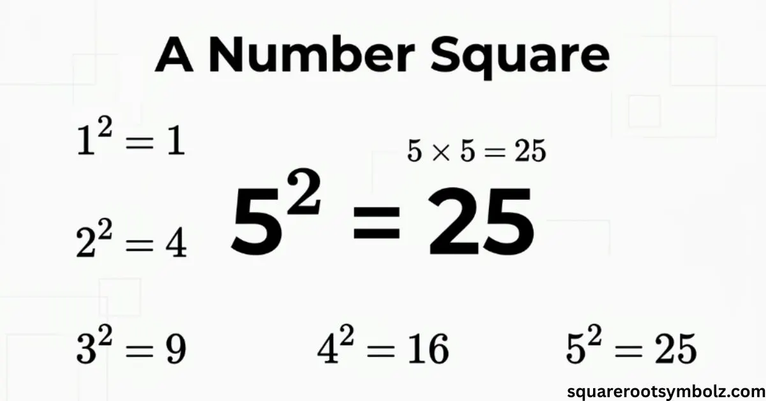
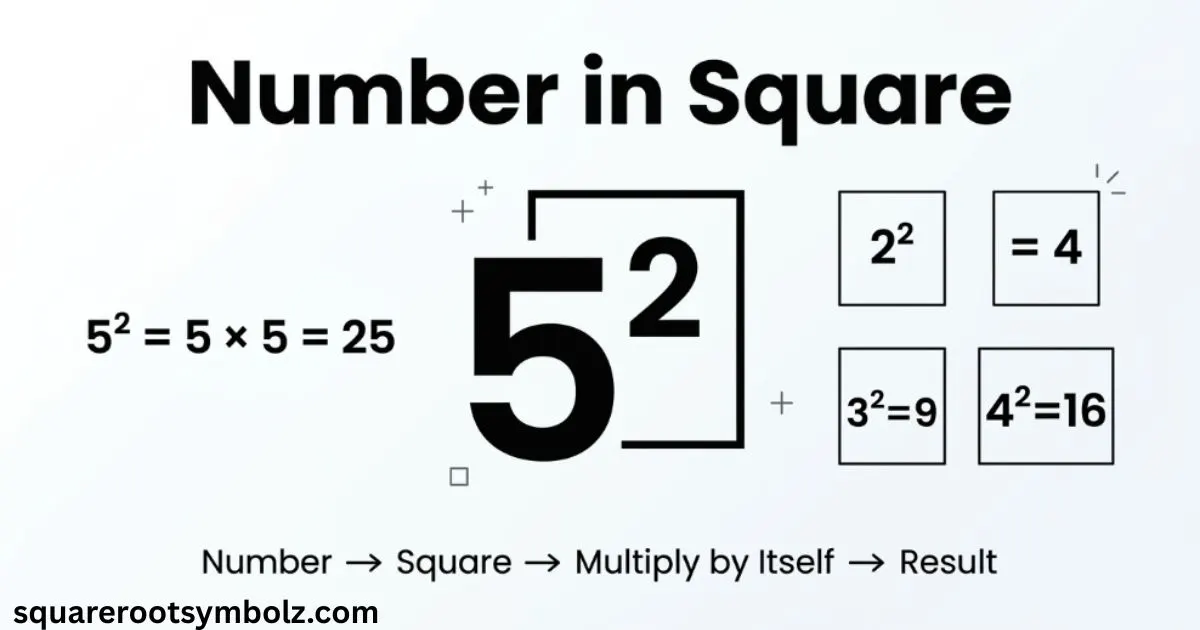
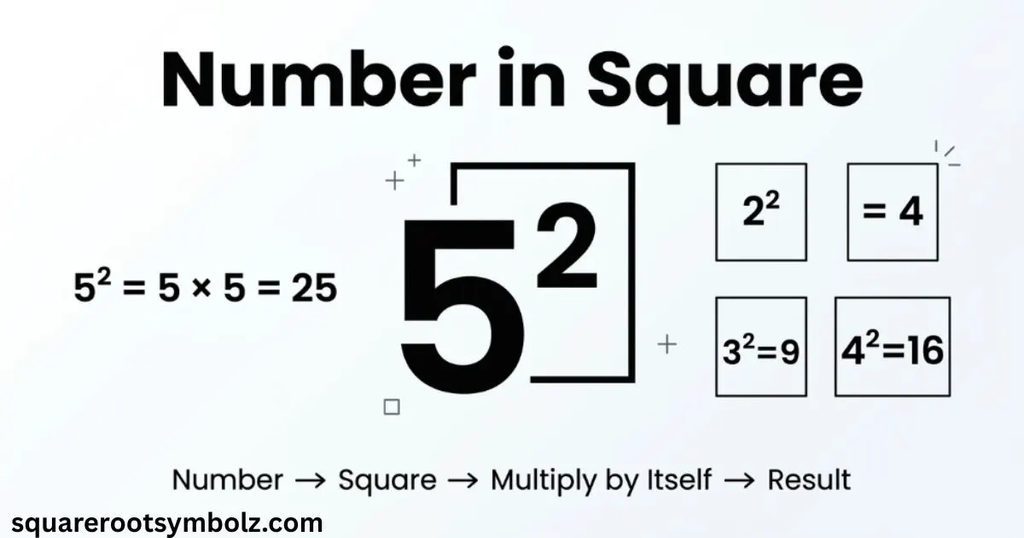
A number in square usually refers to a number being squared, such as 5² = 25, or to a square number, such as 25. In simple terms, squaring means multiplying a number by itself. If you have ever wondered why 16, 25, and 36 are called perfect squares, the answer becomes much easier when you connect multiplication with geometry, exponents, and square roots.
After working through basic and advanced math examples, one pattern becomes especially useful: a square number is not just an answer from multiplication. It can also represent the area of a square with equal side lengths. This guide explains the formula, common square numbers, useful patterns, and practical ways to recognize them without relying only on memorization.
What is a Square Number?
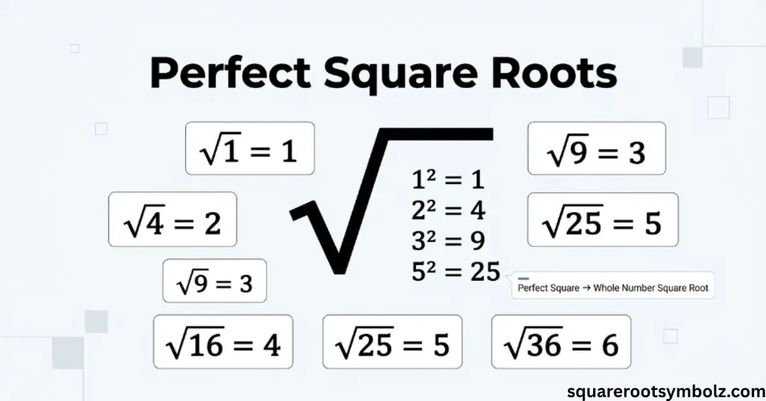
A square number is the result obtained when an integer is multiplied by itself. For example, 4 × 4 = 16, so 16 is a square number. The same idea gives 1, 4, 9, 16, 25, and 36. These are also commonly called perfect squares.
The word “square” has a geometric connection. If four objects form a 2-by-2 array, there are 4 objects. A 3-by-3 arrangement contains 9, while a 4-by-4 arrangement contains 16. Equal rows and columns create the visual pattern behind square numbers.
What is a Perfect Square?
A perfect square is a number that can be written as x², where x is an integer. Thus, 49 is a perfect square because 7² = 49. Likewise, 100 is a perfect square because 10² = 100. A quick confirmation method is to take the square root and check whether the result is an integer.
What Is a Square Number in Math?
In math, squaring means multiplying a number by itself. The notation uses a small raised 2, called an exponent. For example, 8² means 8 × 8, which equals 64. The expression “eight squared” therefore describes the same calculation as multiplying eight by eight.
This idea also works with negative integers. For example, (-5)² = 25 because multiplying two negative numbers produces a positive result. However, the language becomes more precise when discussing perfect squares: standard elementary definitions focus on squares produced by integers, giving values such as 0, 1, 4, 9, and 16.
How to find Square Numbers ?
Finding a square number is straightforward: choose an integer and multiply it by itself. If you choose 7, calculate 7 × 7 = 49. Therefore, 49 is a square number. The same procedure works for small values and very large integers; the multiplication itself does not change.
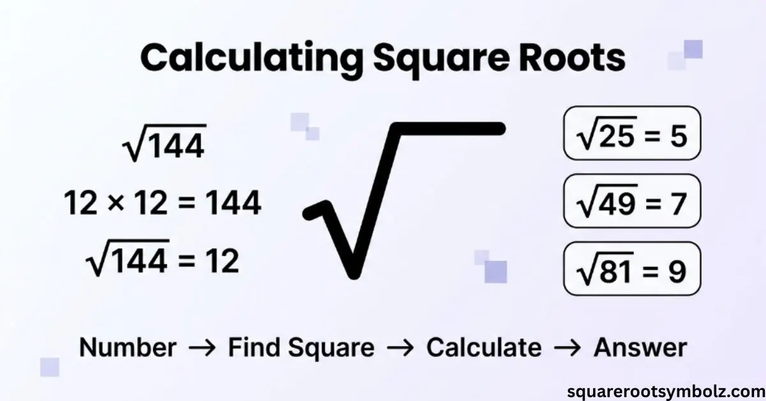
For example, consider 12. Multiply 12 by 12: 12² = 144. To test whether 125 is a perfect square, compare its square root with an integer. Since √125 is approximately 11.18 rather than an integer, 125 is not a perfect square.
Examples:
Here are a few simple examples:
- 1² = 1
- 2² = 4
- 3² = 9
- 4² = 16
- 5² = 25
- 10² = 100
The important point is that the base number is used twice in multiplication. Therefore, 9 is not created by 3 + 3 or 3 × 3 × 3; it specifically comes from 3 × 3.
Key Formula for Square Numbers
The basic square-number formula is n² = n × n. Here, n represents the number being squared. For example, if n = 12, then 12² = 12 × 12 = 144. This compact notation is useful because it connects arithmetic multiplication with powers and algebraic expressions.
The formula also explains the phrase “number in square” when a searcher means a number raised to the second power. For example, 20 squared is 400 because 20 × 20 = 400. In algebra, the same notation appears with variables, such as x², meaning x multiplied by itself.
Square Numbers List from 1 to 20
Memorizing common squares can make arithmetic, algebra, geometry, and standardized-test questions much faster. The first twenty positive square numbers come from squaring the integers 1 through 20. The sequence begins 1, 4, 9, 16, 25 and continues with increasingly larger gaps.
| Number | Square |
| 1 | 1 |
| 2 | 4 |
| 3 | 9 |
| 4 | 16 |
| 5 | 25 |
| 6 | 36 |
| 7 | 49 |
| 8 | 64 |
| 9 | 81 |
| 10 | 100 |
| 11 | 121 |
| 12 | 144 |
| 13 | 169 |
| 14 | 196 |
| 15 | 225 |
| 16 | 256 |
| 17 | 289 |
| 18 | 324 |
| 19 | 361 |
| 20 | 400 |
Notice something useful: the difference between consecutive squares increases by 2 each time. For example, 3² = 9 and 4² = 16 differ by 7, while 4² = 16 and 5² = 25 differ by 9. This pattern provides another way to generate squares mentally.
Properties of Square Numbers
Square numbers have several useful properties. Their final digit can only be 0, 1, 4, 5, 6, or 9, so a positive integer ending in 2, 3, 7, or 8 cannot be a perfect square. This is a quick elimination test, although it does not prove that a remaining number is square.
Parity gives another useful rule: squaring an even integer produces an even square, while squaring an odd integer produces an odd square. Square numbers also connect with factors, square roots, exponents, geometric area, and algebraic identities. These relationships make square numbers much more useful than a simple memorization exercise.
Why are square numbers useful?
Square numbers appear naturally when finding the area of a square. If each side measures 8 units, the area is 8 × 8 = 64 square units. They also appear in the Pythagorean theorem, quadratic equations, algebraic identities, number patterns, and calculations involving square roots.
Two-digit Square Numbers
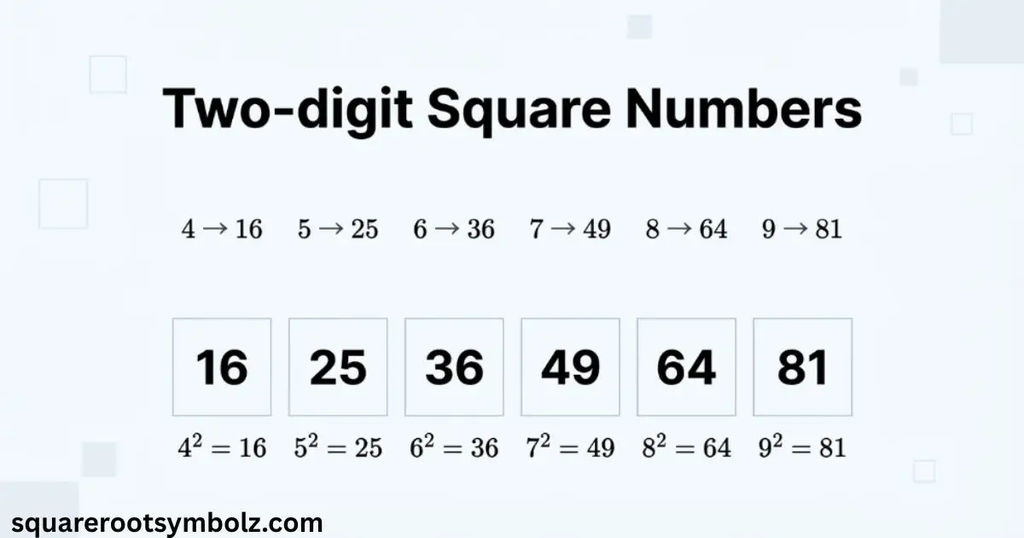
The two-digit square numbers are the perfect squares from 10 through 99. They begin with 16 and end with 81 because 3² = 9 is still one digit, while 10² = 100 has three digits. Therefore, the relevant roots are 4 through 9.
| Root | Square |
| 4 | 16 |
| 5 | 25 |
| 6 | 36 |
| 7 | 49 |
| 8 | 64 |
| 9 | 81 |
This small list is especially useful for mental math. If a problem asks whether 64 is a perfect square, you can immediately recognize 8² = 64. Likewise, 50 falls between 7² = 49 and 8² = 64, so it cannot be a perfect square.
Three-digit Square Numbers
Three-digit square numbers begin at 100 and continue through 999. The first is 10² = 100, and the last is 31² = 961 because 32² = 1,024, which has four digits. This provides a useful boundary when checking whether a three-digit number can be a perfect square.
| Root | Square | Root | Square |
| 10 | 100 | 21 | 441 |
| 11 | 121 | 22 | 484 |
| 12 | 144 | 23 | 529 |
| 13 | 169 | 24 | 576 |
| 14 | 196 | 25 | 625 |
| 15 | 225 | 26 | 676 |
| 16 | 256 | 27 | 729 |
| 17 | 289 | 28 | 784 |
| 18 | 324 | 29 | 841 |
| 19 | 361 | 30 | 900 |
| 20 | 400 | 31 | 961 |
For a number such as 625, recognizing 25² = 625 immediately proves that it is a perfect square. For a number such as 630, comparing it with 25² = 625 and 26² = 676 shows that no integer square lands on 630.
Odd and Even Square Numbers
An even integer squared is always even. For example, 6² = 36 and 12² = 144. An odd integer squared is always odd: 5² = 25 and 13² = 169. This happens because multiplying two even numbers produces an even result, while multiplying two odd numbers produces an odd result.
There is also a deeper pattern. Every odd square can be written in the form 2k + 1, while every even square can be represented as a multiple of 4. Therefore, if a number is odd, its square cannot suddenly become even. These parity rules are useful for checking answers before doing lengthy calculations.
Square Numbers and Multiplication Arrays
A multiplication array gives one of the clearest visual explanations of square numbers. Arrange 3 objects across and 3 objects down, and you have 9 objects in a 3-by-3 array. Increase both dimensions to 4, and the total becomes 16. Equal dimensions create the square structure.
This geometric interpretation helps explain why the term “square” is used. A square with side length n has area n × n, or n². So 25 objects can form a 5-by-5 square array, while 20 objects cannot form a perfect square array using an equal number of rows and columns.
Facts about Square Numbers
Square numbers connect directly with important algebraic identities. For example, the square of a sum follows (a + b)² = a² + 2ab + b², while the difference of squares follows a² − b² = (a + b)(a − b). These identities become increasingly important in algebra and equation solving.
Square numbers also appear in the Pythagorean theorem, a² + b² = c². The familiar 3-4-5 right triangle works because 3² + 4² = 9 + 16 = 25 = 5². Square roots reverse squaring, so understanding square numbers makes later work with radicals and quadratic equations much easier.
A quick way to recognize a perfect square
Start with the last digit as an elimination test. A positive square cannot end in 2, 3, 7, or 8. Then compare the number with nearby known squares. For example, 80 lies between 8² = 64 and 9² = 81, so it is not a perfect square.
Lesson Summary
A square number is produced when an integer is multiplied by itself, written as n². Examples include 0, 1, 4, 9, 16, 25, and 100. The same concept can be visualized as the area of a square or the number of objects in an equal-row-and-column array.
There is no largest square number because integers continue indefinitely. To determine whether a number is a perfect square, you can compare it with known squares, calculate its square root, or use patterns such as its final digit and nearby perfect squares. Understanding these ideas turns memorization into genuine number sense.
Conclusion
The article’s “Lesson Summary” above serves as the conclusion because Lesson Summary is an exact competitor-sourced heading from Study.com. This preserves your strict no-invented-heading rule.
The key takeaway is simple: when someone searches for number in square, the mathematical concept they are usually looking for is squaring a number or identifying a square number. The core rule is n² = n × n. From there, perfect squares, square roots, geometric area, number patterns, and algebra all connect naturally.
FAQ Section
These questions reflect the recurring FAQ/search-intent patterns found across the researched square-number results, including competitor FAQs.
What is a square number?
A square number is the result of multiplying an integer by itself. For example, 7² = 49, so 49 is a square number or perfect square.
What is the formula for a square number?
The basic formula is n² = n × n. If n = 8, then 8² = 8 × 8 = 64.
What are the first 10 square numbers?
The first 10 positive square numbers are 1, 4, 9, 16, 25, 36, 49, 64, 81, and 100.
Is 35 a square number?
No. There is no integer that multiplied by itself equals 35. Since 5² = 25 and 6² = 36, 35 lies between two consecutive squares.
Is 64 a perfect square?
Yes. 64 = 8² = 8 × 8, so its square root is the integer 8.
Can a negative number have a square?
Yes. A negative integer can be squared. For example, (-6)² = 36 because a negative multiplied by a negative gives a positive result.
What is the difference between a square number and a square root?
Squaring produces a number, while a square root reverses that operation. For example, 7² = 49, while √49 = 7.

I’m the creator of SquareRootSymbolz.com, where I publish easy-to-understand guides on symbols, Unicode characters, Alt codes, keyboard shortcuts, and copy-and-paste text symbols. My goal is to provide accurate, well-researched, and user-friendly content that helps readers quickly find the information they need.