
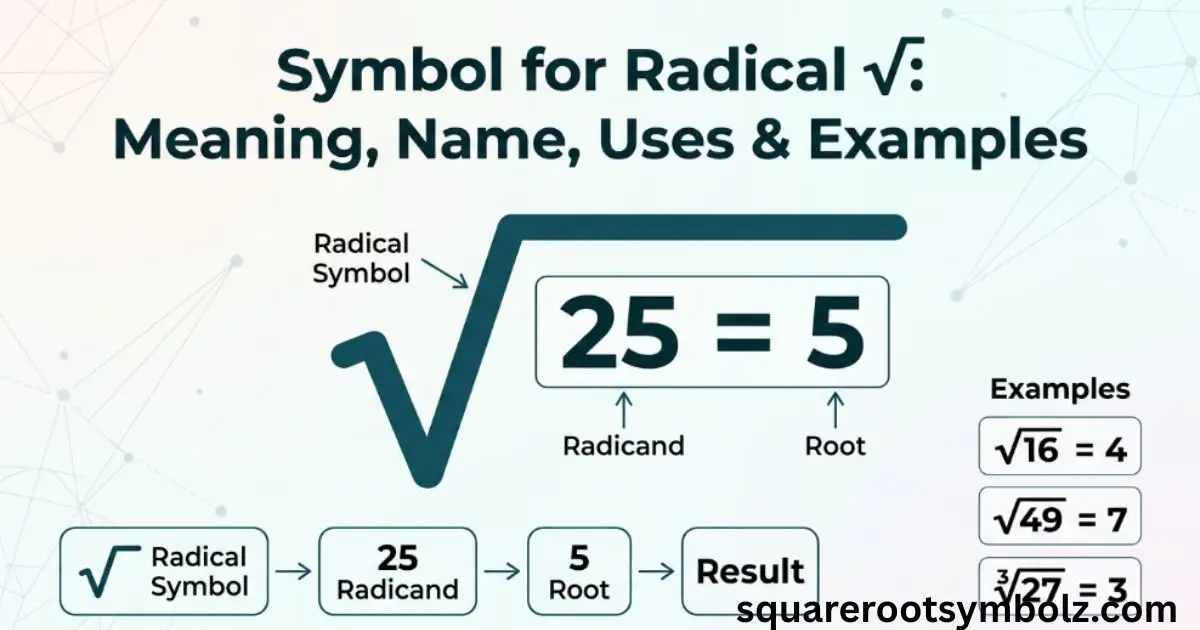
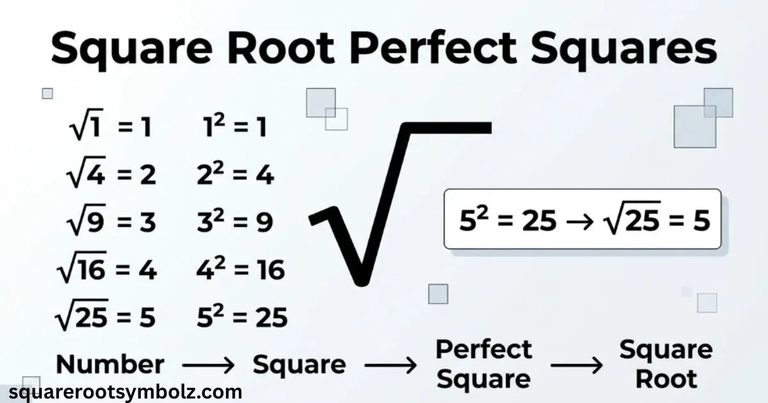
The symbol for radical is √, commonly called the radical symbol or radical sign. It tells you that a root is being taken; without an index, √ normally means the square root. For example, √25 = 5. In higher roots, an index is added, as in ∛27 = 3 or ⁿ√x.
If you’ve ever wondered why √ looks different from an ordinary check mark, or what the number underneath and the small number beside it mean, you’re dealing with the parts of a radical expression. Understanding the radical symbol, radicand, index, vinculum, and principal root makes mathematical notation much easier to read and use.
The bar length matters
The horizontal bar attached to √ is called the vinculum. Its length matters because it shows exactly which numbers or terms belong under the radical. For example, √(x − y) means the entire expression x − y is inside the square root.
Compare √(x − y) with √x − y. In the first expression, the subtraction occurs inside the square root; in the second, only x is rooted and y is subtracted afterward. The bar therefore acts somewhat like grouping symbols, helping communicate the intended order of operations clearly.
| Expression | Meaning |
| √25 | Square root of 25 |
| √(x + 4) | Square root of the entire x + 4 |
| √x + 4 | Square root of x, then add 4 |
| ∛27 | Cube root of 27 |
| ⁿ√x | Nth root of x |
This distinction becomes especially important in algebra. A missing or shortened vinculum can change the meaning of an expression completely, so when reading handwritten mathematics, always check how far the radical bar extends.
Used in a radical expression
A radical expression contains a root and the quantity associated with that root. The familiar √25 is a simple example: √ is the radical symbol, while 25 is the quantity whose square root is being taken. More complicated expressions can contain variables, fractions, coefficients, and operations.
The symbol for radical does not by itself always mean only square root. A small index changes the root being requested. With no index, the conventional interpretation is a square root; with 3, it becomes a cube root; with 4, a fourth root; and so on.
Radicand
The radicand is the number, variable, or expression underneath the radical symbol. In √36, the radicand is 36. In √(x + 5), the radicand is x + 5. It is the quantity whose root you are finding.
This small vocabulary point can prevent confusion when solving algebra problems. The radical symbol tells you to take a root, while the radicand tells you what to take the root of. In √49 = 7, √ is the radical symbol, 49 is the radicand, and 7 is the principal square root.
Radical symbol
The radical symbol is √. It is also called the radical sign, root symbol, or square root symbol when it is being used for a square root. The symbol represents root extraction, while an index placed beside it identifies a higher-order root such as a cube or fourth root.
For example, √64 = 8 because 8² = 64. Add a 3 as the index and the notation becomes ∛27 = 3 because 3³ = 27. The same basic radical structure therefore works across different roots, making √ a central piece of mathematical notation.
Degree
The degree or index tells you which root is being taken. An index of 2 means square root, 3 means cube root, and 4 means fourth root. When the index is 2, it is normally omitted, which is why √x is understood as the square root of x.
Consider these examples: √16 = 4, ∛8 = 2, and ⁴√16 = 2. Each expression asks a slightly different question. The index tells you how many times the answer must be multiplied by itself to reproduce the radicand.
Principal square root
For a positive real number, there are two numbers whose squares produce that number. For example, both 5² and (−5)² equal 25. However, the radical symbol √ represents the principal square root, which is the non-negative root. Therefore, √25 = 5, not −5.
This distinction matters when solving equations. The equation x² = 25 has two solutions, x = 5 and x = −5. But √25 is simply 5. If a problem asks for both solutions, the notation ±√25 gives ±5. Keeping the radical function separate from the equation prevents one of the most common square-root mistakes.
| Notation | Result |
| √25 | 5 |
| −√25 | −5 |
| ±√25 | ±5 |
| x² = 25 | x = 5 or −5 |
For negative real numbers, the situation changes if you stay within the real-number system. A negative number has no real square root. In the complex-number system, however, √(−1) is represented by the imaginary unit i, and roots of negative numbers can be expressed using complex numbers.
Origin
The exact historical origin of √ is not completely certain. Wikipedia notes theories connecting its development either with the Arabic letter ج associated with the word for “root” or with the Latin letter r from radix, meaning root. The symbol developed into the notation familiar today.
The printed history of the notation is particularly interesting. Wikipedia records that the radical sign appeared in print without the modern horizontal vinculum in 1525 in Christoff Rudolff’s Die Coss. René Descartes later combined the radical sign with the vinculum in 1637, producing the familiar form used today.
That history explains why the symbol is more than a decorative check mark. Its shape is the result of centuries of mathematical notation evolving toward a compact way to communicate root extraction.
Encoding
For digital text, the standard Unicode character for the square root symbol is √, U+221A, SQUARE ROOT. Unicode also defines U+221B for ∛, the cube root symbol, and U+221C for ∜, the fourth root symbol.
The plain Unicode character √ is useful when you simply need a copyable symbol. Mathematical typesetting can display a longer radical bar over an expression, however, because the complete visual form of a radical expression is more than a single standalone character.
| Item | Value |
| Square root symbol | √ |
| Unicode | U+221A |
| Unicode name | SQUARE ROOT |
| Cube root | ∛ |
| Cube root Unicode | U+221B |
| Fourth root | ∜ |
| Fourth root Unicode | U+221C |
For web pages, the square root can also be represented with the HTML entity √. In LaTeX, the standard command for a square root is \sqrt{}. Wikipedia documents \sqrt for the square-root notation and \surd for the radical symbol without the overline.
Multiplying Radicals
Radicals can be multiplied using a useful property. For suitable non-negative real quantities, √a × √b = √(ab). For example, √3 × √2 = √6. This property lets you combine compatible radical expressions and is an important part of simplifying radicals.
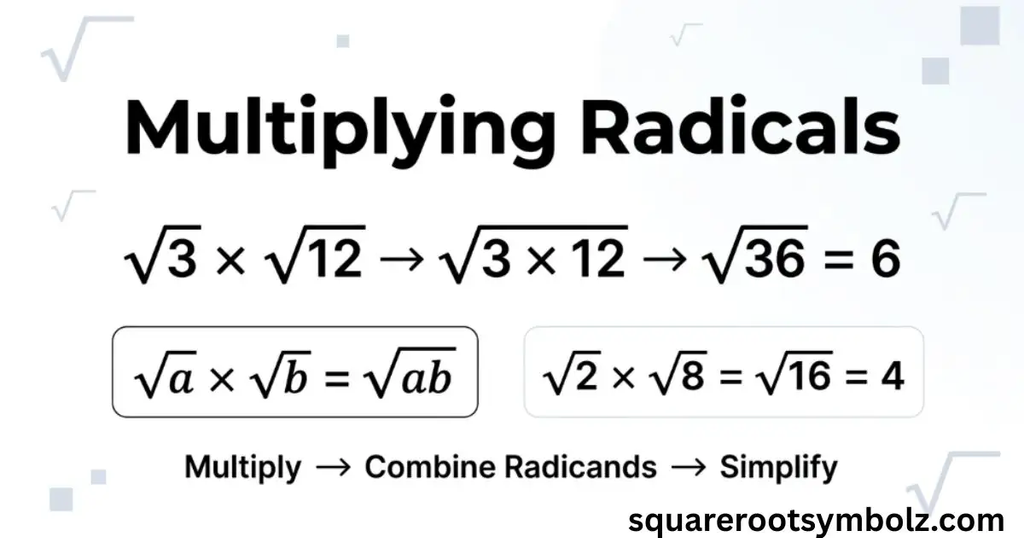
Suppose you have 2√3 × 4√5. Multiply the coefficients first and the radical parts separately: 2 × 4 = 8 and √3 × √5 = √15. The result is 8√15. Breaking the calculation into outside and inside parts keeps the process organized.
| Expression | Simplified result |
| √2 × √8 | √16 = 4 |
| √3 × √5 | √15 |
| 2√3 × 4√5 | 8√15 |
| √7 × √7 | 7 |
One useful check is to square or otherwise reverse the operation when appropriate. Mathematics becomes much less intimidating when each symbol is treated as a precise instruction rather than something to memorize blindly.
Conclusion
The symbol for radical is √, and it is commonly called the radical symbol or radical sign. When no index appears, √ normally represents a square root. Add an index such as 3 or 4, and the notation represents a cube root or fourth root.
The most important parts to remember are simple:
- √ = radical symbol
- Radicand = number or expression under the radical
- Index/degree = identifies the root
- Vinculum = horizontal bar over the radicand
- √x = principal square root of x
For digital use, √ is Unicode U+221A. For higher roots, use ∛ for cube root or an indexed radical such as ⁿ√x.
FAQ Section
What is the symbol for radical?
The symbol for radical is √. It is called the radical symbol or radical sign and is used to indicate root extraction.
What is √ called?
√ is called the radical symbol, radical sign, or root symbol. When it specifically represents a square root, it is also called the square root symbol.
What does the radical symbol mean?
The radical symbol means that a root is being taken. For example, √25 means the principal square root of 25, which is 5.
What is the Unicode for the radical symbol?
The Unicode code point for the square root character √ is U+221A, named SQUARE ROOT.
What is the number under a radical called?
The number or expression underneath the radical is called the radicand. In √81, the radicand is 81.
What is the line over a radical called?
The horizontal line over the radicand is called the vinculum. Its length helps show which part of an expression belongs under the root.
What is the difference between √ and ∛?
√ represents a square root when no index is shown, while ∛ represents a cube root. For example, √25 = 5 and ∛27 = 3.
Does √ mean positive or negative?
The radical symbol √ represents the principal, non-negative square root. For example, √36 = 6. The equation x² = 36 has two solutions: 6 and −6.
What is the symbol for cube root?
The cube root symbol is ∛. Its Unicode code point is U+221B.
What is the symbol for fourth root?
The fourth-root symbol is ∜, with Unicode code point U+221C.
Is the radical symbol the same as the square root symbol?
For ordinary school mathematics, √ is both the radical symbol and the square root symbol when no index is displayed. More generally, a radical can represent other roots when an index is included.

I’m the creator of SquareRootSymbolz.com, where I publish easy-to-understand guides on symbols, Unicode characters, Alt codes, keyboard shortcuts, and copy-and-paste text symbols. My goal is to provide accurate, well-researched, and user-friendly content that helps readers quickly find the information they need.
One Comment