A mathematical symbol and meaning are best understood together: the character tells you what relationship, operation, quantity, or condition is being expressed. Whether you are reading an equation, checking an inequality, studying algebra, or working through geometry, knowing the symbol name, notation, mathematical operation, equation, and example removes much of the confusion.
After years of working through mathematical notation, one lesson stands out: students rarely struggle because a symbol is difficult to draw. They struggle because they do not know how to interpret it in context. This guide connects math symbols, mathematical signs, arithmetic, algebra, geometry, calculus, sets, logic, statistics, and probability so you can recognize what a symbol is saying rather than simply memorize a list.
How to read mathematical symbols correctly
A symbol should be read as part of the complete mathematical statement, not as an isolated character. The same vertical bar, for example, can represent absolute value, set size, conditional probability, divisibility, or another relationship depending on the surrounding notation. Context determines the correct interpretation.
When reading an equation, first identify the mathematical branch, then examine what appears immediately before and after the symbol. In arithmetic, + normally means addition. In algebra, a letter such as x usually represents a variable. In geometry, ∠ identifies an angle, while in calculus ∫ represents integration.
Read the whole statement, not a symbol in isolation
Consider x ≤ 5. The symbol ≤ does not simply mean “less.” It means less than or equal to, so 5 itself is included. Compare that with x < 5, where 5 is excluded. Small visual differences can therefore change the mathematical condition being expressed.
Common Math Symbols and Their Meanings
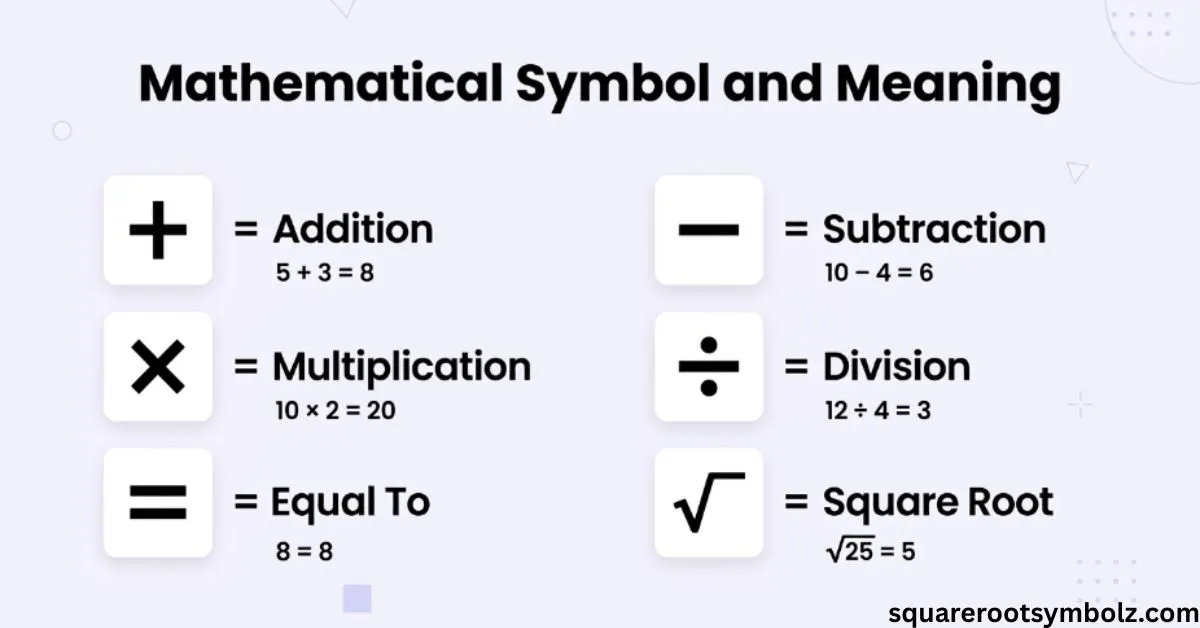
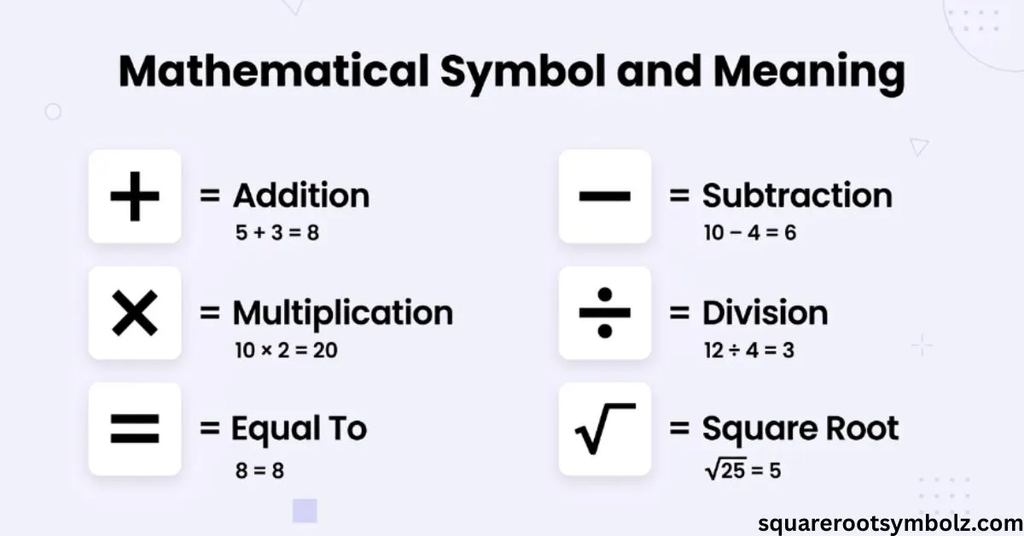
The most familiar mathematical symbols represent addition, subtraction, multiplication, division, equality, inequality, roots, constants, summation, sets, and percentages. A quick reference is useful, but examples are what make the notation memorable.
| Symbol | Name | Meaning | Example |
| + | Plus | Addition | 4 + 3 = 7 |
| − | Minus | Subtraction | 8 − 3 = 5 |
| × | Multiplication | Multiply | 5 × 4 = 20 |
| ÷ | Division | Divide | 12 ÷ 3 = 4 |
| = | Equals | Same value | 3 + 2 = 5 |
| ≠ | Not equal | Different values | 5 ≠ 7 |
| < | Less than | Smaller value | 3 < 8 |
| > | Greater than | Larger value | 9 > 4 |
| ≤ | Less than or equal | At most | x ≤ 10 |
| ≥ | Greater than or equal | At least | x ≥ 2 |
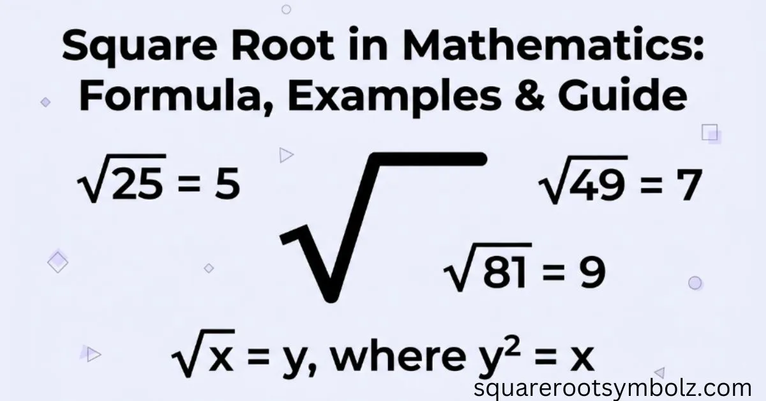
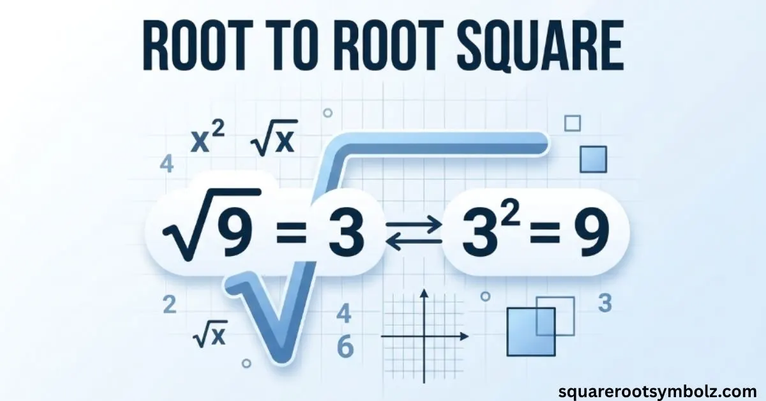
| √ | Square root | Principal square root | √25 = 5 |
| π | Pi | Circle constant | C = 2πr |
| ∞ | Infinity | Unbounded concept | x → ∞ |
| % | Percent | Per hundred | 25% |
| ∑ | Sigma | Summation | ∑x |
These are only a small portion of mathematical notation. More specialized symbols appear in logic, set theory, calculus, probability, statistics, matrices, and advanced algebra.
Arithmetic and comparison symbols
Arithmetic notation provides the basic language for calculating with numbers. The familiar +, −, ×, and ÷ symbols represent addition, subtraction, multiplication, and division. Parentheses and brackets can also change the order in which operations are performed.
For example:
8 − 3 × 2 = 2
but:
(8 − 3) × 2 = 10
The grouping symbols force the subtraction to happen first. Comparison notation works similarly: 3 < 5 says that 3 is smaller than 5, while 5 ≥ 5 is true because the greater-than-or-equal relationship includes equality.
| Symbol | Meaning | Example |
| + | Add | 7 + 2 = 9 |
| − | Subtract | 7 − 2 = 5 |
| × | Multiply | 7 × 2 = 14 |
| ÷ | Divide | 14 ÷ 2 = 7 |
| < | Less than | 2 < 6 |
| > | Greater than | 8 > 3 |
| ≤ | Less than or equal | x ≤ 6 |
| ≥ | Greater than or equal | x ≥ 6 |
Algebra, functions, and equation symbols
Algebra uses symbols to represent unknown values, known quantities, relationships, functions, identities, and mathematical operations. A variable such as x can represent a number, while an equation uses = to state that two expressions have the same value.
For example:
2x + 3 = 11
Solving the equation gives:
2x = 8
x = 4
Other notation communicates relationships more specifically. The symbol ≡ can represent an identity in algebra, while ∝ means proportional to. Function notation such as f(x) describes a rule that assigns an output to an input.
A useful distinction is that equals (=) usually describes equality in a particular statement, while an identity can express that two expressions remain equivalent for every permitted value of the variable.
Set theory and logic symbols
Set theory uses mathematical symbols to describe collections, membership, unions, intersections, subsets, and relationships between sets. For example, 2 ∈ A means that 2 is an element of set A, while 4 ∉ A means that 4 is not an element of that set.
Logic notation goes further by expressing conditions and reasoning. The symbol ∀ means for every, while ∃ means there exists. Similarly, ⇒ commonly expresses implication and ⇔ expresses “if and only if.” These symbols make long logical statements compact.
| Symbol | Meaning | Example |
| ∈ | Is an element of | 3 ∈ A |
| ∉ | Is not an element of | 5 ∉ A |
| ∪ | Union | A ∪ B |
| ∩ | Intersection | A ∩ B |
| ⊂ | Proper subset | A ⊂ B |
| ∀ | For all | ∀x |
| ∃ | There exists | ∃x |
| ⇒ | Implies | P ⇒ Q |
| ⇔ | If and only if | P ⇔ Q |
Geometry and trigonometry symbols
Geometry uses notation to describe angles, lines, triangles, parallel relationships, perpendicular relationships, vectors, measurements, and shapes. For example, ∠ABC identifies an angle, while AB ∥ CD states that two lines are parallel.
Trigonometry adds symbols such as θ, φ, and α for angles. The familiar functions sine, cosine, and tangent connect angles with side ratios in right triangles:
sin θ = opposite / hypotenuse
cos θ = adjacent / hypotenuse
tan θ = opposite / adjacent
Geometry also relies heavily on symbols such as ° for degrees and π for the circle constant. The Pythagorean theorem combines several types of notation:
a² + b² = c²
That single expression uses variables, exponents, equality, and geometric relationships together.
Calculus and analysis symbols
Calculus introduces notation for change, accumulation, limits, derivatives, integrals, and infinite processes. The derivative can appear as dy/dx, f′(x), or d/dx, while the integral symbol ∫ represents accumulation.
For example:
d/dx(x²) = 2x
This tells us that the derivative of x² with respect to x is 2x. An integral provides a different operation:
∫₀¹ x² dx = 1/3
Other calculus notation includes lim for a limit, ∞ for infinity, and ∂ for partial derivatives. The symbol ∇, called nabla, is used in vector calculus for concepts such as gradient, divergence, and curl.
Probability and statistics symbols
Probability and statistics use notation to describe events, averages, samples, populations, variation, and conditional relationships. Symbols such as P(A) represent the probability of event A, while P(A | B) represents the probability of A given B.
Statistics also distinguishes population quantities from sample quantities. μ commonly represents a population mean, while x̄ represents a sample mean. Similarly, σ is commonly used for population standard deviation and s for sample standard deviation.
A common sample-mean expression is:
x̄ = (1/n) ∑xᵢ
Here, n represents the number of observations, Σ indicates summation, and the subscript i identifies individual observations.
Symbols with Examples
A mathematical symbol becomes much easier to remember when it appears in a complete expression. For example, seeing √25 = 5 immediately connects the square-root symbol with its operation, while 9 ≠ 6 shows how the not-equal sign compares two values.
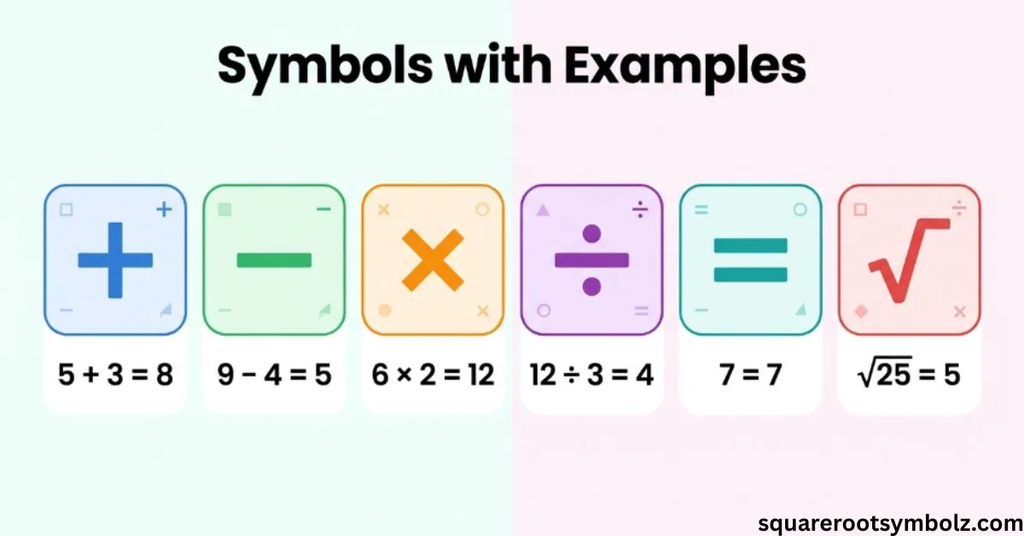
Try reading these examples aloud:
- 6 + 4 = 10 — six plus four equals ten.
- 9 > 2 — nine is greater than two.
- 3 ≤ 8 — three is less than or equal to eight.
- √16 = 4 — the square root of sixteen is four.
- A ∩ B — the intersection of A and B.
- P(A | B) — the probability of A given B.
- ∑xᵢ — the sum of the listed terms.
This approach teaches both symbol recognition and mathematical meaning, which is more useful than memorizing characters separately.
How to type mathematical symbols in LaTeX, documents, and online forms
There are several ways to enter mathematical notation digitally. You can copy a Unicode symbol, use a LaTeX command, or insert the character through an equation editor. The appropriate method depends on whether you are writing ordinary text, a formal equation, a worksheet, or an online document.
For example, LaTeX commands include:
- \sqrt{x} → √x
- \frac{a}{b} → a fraction
- \pi → π
- \sum → ∑
- \infty → ∞
Unicode is convenient when you need a symbol such as ≤, ≥, ≠, π, or ∞ in ordinary text. Equation editors are especially useful for complicated expressions containing fractions, exponents, matrices, subscripts, and integrals.
Copying Unicode symbols
Unicode mathematical characters can be useful in messages, worksheets, headings, documents, and simple online content. However, not every mathematical structure has a single Unicode character, so complex equations are usually better represented with LaTeX or an equation editor.
Using LaTeX commands
LaTeX is particularly useful when mathematical structure matters. Commands can create fractions, roots, sums, integrals, exponents, subscripts, and other notation while preserving the relationship between different parts of an expression.
Using equation editors
Equation editors are useful in word processors, educational platforms, presentations, and online documents. They reduce the risk of losing fraction bars, superscripts, subscripts, or mathematical symbols during formatting and copying.
Do not rely on font shape alone
Some characters are visually similar even though their mathematical meanings differ. Examples include O and 0, l and 1, × and x, and − and -. Always check the surrounding expression instead of identifying a symbol purely by its appearance.
Frequent Errors and Misunderstandings
Many students make mistakes not because they cannot recognize a symbol, but because they confuse symbols that look similar or use them in the wrong context. Common problems include reversing < and >, confusing ∈ with ∉, and using = where an approximation symbol is needed.
Another common mistake is treating x as multiplication simply because it looks like the letter used for the multiplication symbol. In algebra, x frequently represents a variable, whereas × represents multiplication.
A simple habit helps: before calculating, ask, “What does this symbol tell me to do or what relationship does it describe?”
Relation to Other Concepts
Mathematical notation connects different areas of mathematics. A learner who understands basic operations, equality, variables, sets, and comparison symbols has a stronger foundation for algebra, geometry, calculus, probability, and statistics.
For example, the symbol = appears in arithmetic equations, algebraic formulas, geometry relationships, and statistical calculations. Likewise, √ can appear in algebra, geometry, quadratic equations, distance formulas, and other mathematical settings.
This interconnectedness is why learning symbols by category works better than memorizing a random list. Once you understand the underlying concept, the notation becomes easier to recognize.
Conclusion
Use symbols to make mathematics clearer
The real value of a mathematical symbol and meaning guide is not memorizing hundreds of characters. It is learning to recognize the relationship each symbol communicates. From + and = to ∑, ∫, ∈, and ∞, mathematical notation turns complicated ideas into compact statements.
When you encounter an unfamiliar symbol, look at the mathematical topic, surrounding expression, operation, variables, and context before deciding what it means. That habit prevents many common errors and makes arithmetic, algebra, geometry, calculus, probability, and statistics much easier to read.
FAQ Section
What is a mathematical symbol?
A mathematical symbol is a character or notation used to represent a mathematical object, operation, relationship, quantity, condition, or concept. Its exact meaning can depend on the mathematical context.
What are the most common mathematical symbols?
Common symbols include +, −, ×, ÷, =, ≠, <, >, ≤, ≥, √, π, ∞, and ∑. These represent operations, relationships, quantities, or mathematical concepts.
What does the equal sign mean?
The = symbol means that the expressions on both sides have the same value. For example, 5 + 3 = 8 states that both sides equal 8.
What is the difference between < and >?
< means less than, while > means greater than. For example, 3 < 7 and 9 > 4. The open side faces the larger value.
What does the square root symbol mean?
The √ symbol represents a square root. For example, √25 = 5 because 5 multiplied by itself equals 25.
What does π mean in mathematics?
π represents the ratio of a circle’s circumference to its diameter. Its commonly used decimal approximation is 3.14159.
What does ∑ mean?
The ∑ symbol represents summation. It provides a compact way to indicate that a sequence of terms should be added together.
What does ∞ mean?
∞ represents infinity, an idea of something without an upper or finite limit. It is a concept rather than an ordinary real number.
How can I type mathematical symbols?
You can use Unicode characters, keyboard shortcuts, symbol menus, LaTeX commands, or equation editors. The best method depends on the application and the complexity of the expression.

I’m the creator of SquareRootSymbolz.com, where I publish easy-to-understand guides on symbols, Unicode characters, Alt codes, keyboard shortcuts, and copy-and-paste text symbols. My goal is to provide accurate, well-researched, and user-friendly content that helps readers quickly find the information they need.