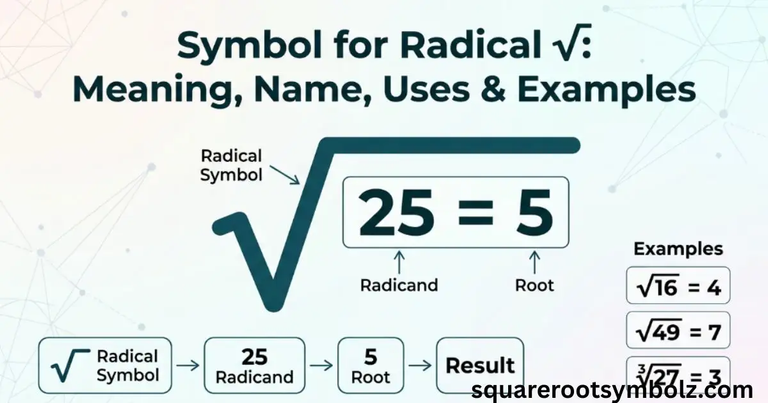
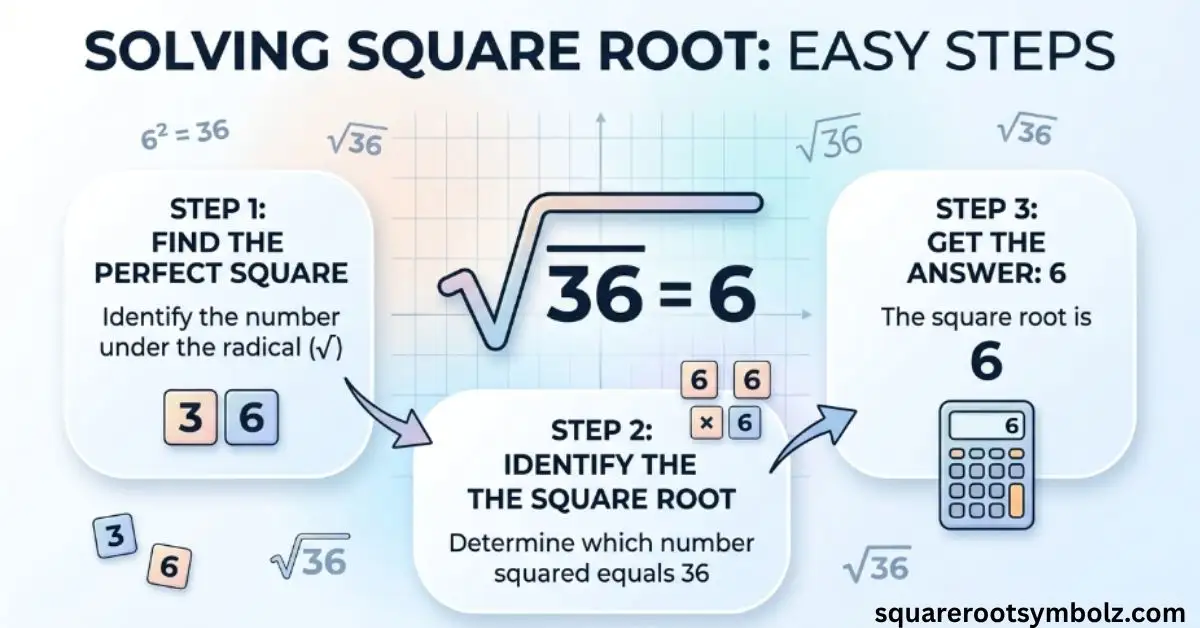
Solving square root problems means finding the value that makes a square-root expression or radical equation true. The process usually involves understanding the square root, identifying the radical equation, isolating the radical term, using opposite operations, and checking the final answer. From experience teaching root problems, the hardest part is rarely the arithmetic; it is knowing which solving method fits the equation.
A square-root problem may ask you to find a simple value such as √49, simplify a radical expression, or solve for x when a variable appears inside the radicand. This guide explains solving square root problems step by step, including perfect squares, squaring both sides, the principal square root, and the important final check that prevents extraneous answers.
Finding Square Roots
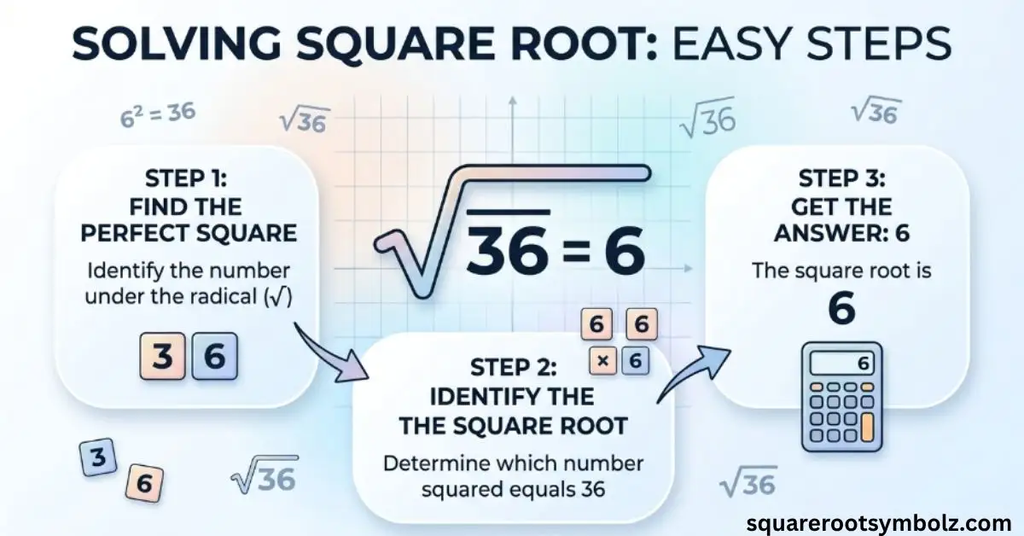
Solving square root problems begins with understanding what a square root asks. The square root of a number is a value that can be multiplied by itself to produce the original number. For example, because 7 × 7 = 49, we know that √49 = 7.
The quickest method is to recognize perfect squares. Numbers such as 1, 4, 9, 16, 25, 36, 49, 64, 81, and 100 have whole-number square roots. Learning these common values makes solving square root questions faster and more accurate.
| Number | Square Root |
| 1 | 1 |
| 4 | 2 |
| 9 | 3 |
| 16 | 4 |
| 25 | 5 |
| 36 | 6 |
| 49 | 7 |
| 64 | 8 |
| 81 | 9 |
| 100 | 10 |
When a number is not a perfect square, you may need to simplify it, estimate the answer, or use a calculator. Factorization can also help by separating the number into perfect-square factors and remaining factors.
Square Roots
A square root is the opposite of squaring. Squaring 6 gives 36, while taking √36 moves backward and gives 6. This inverse relationship is the foundation behind solving square root expressions and equations.
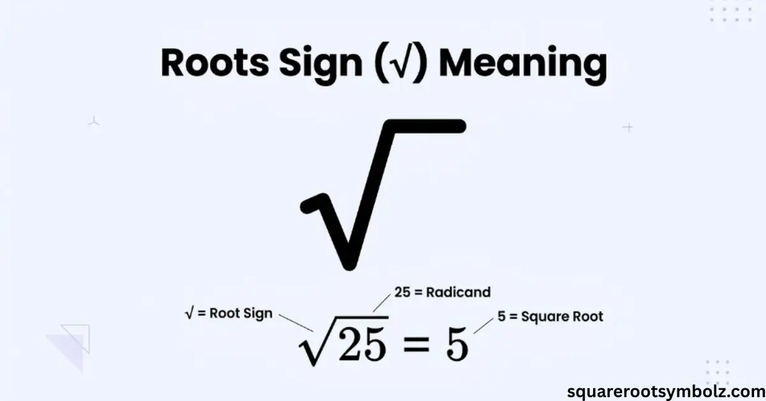
The radical symbol √ normally represents the principal square root, meaning the non-negative answer. Therefore:
√25 = 5
But when solving:
x² = 25
the solutions are:
x = 5 and x = −5
This difference is important. A square-root symbol gives the principal value, while an equation may require all values that satisfy the mathematical relationship.
Solve Radical Equations
A radical equation contains a radical expression with a variable involved. An example is:
√(x + 9) = 7
The goal is to remove the radical and solve for the unknown variable. The most common strategy is to isolate the square-root expression and then apply the opposite operation by squaring both sides.
The general process is simple:
- Isolate the radical.
- Square both sides.
- Simplify the new equation.
- Solve for the variable.
- Check the answer in the original equation.
The final step matters because squaring can sometimes create an answer that works after algebraic manipulation but does not work in the original radical equation. Such an invalid answer is called an extraneous solution.
Radical Equation
A radical equation is an equation in which a variable appears inside a radical, usually a square root. For example:
√(2x − 3) = 5
contains the variable x inside the radicand 2x − 3.
To solve this equation, square both sides:
(√(2x − 3))² = 5²
This gives:
2x − 3 = 25
Then solve:
2x = 28
x = 14
Finally, substitute 14 into the original equation:
√(2(14) − 3) = √25 = 5
The answer works, so x = 14 is a valid solution.
Isolating the Radical Term
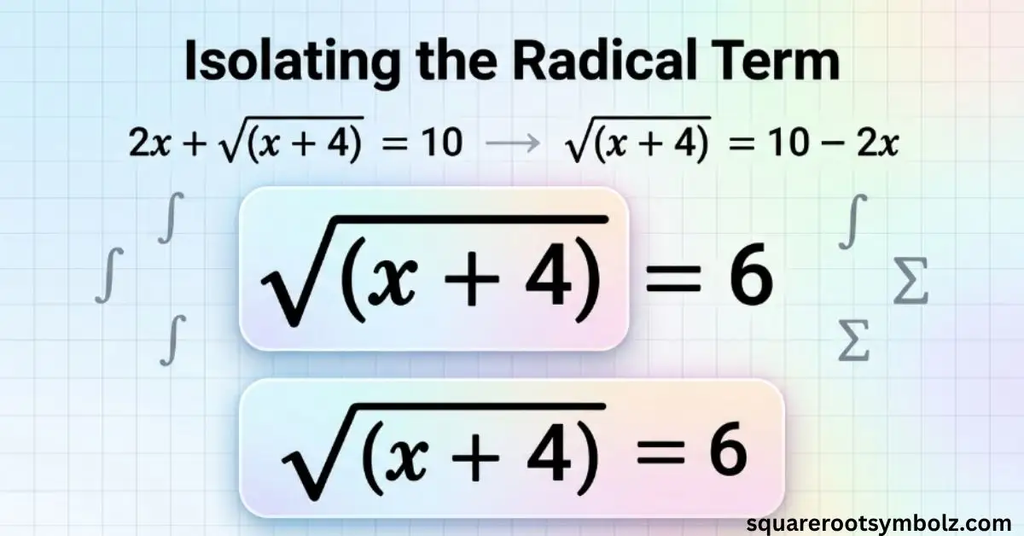
Before squaring both sides, isolate the radical whenever possible. This means moving every other term away from the square-root expression so the radical stands alone on one side of the equation.
Consider:
√(3x + 4) − 2 = 7
The radical is not yet isolated because −2 appears on the same side. Add 2 to both sides:
√(3x + 4) = 9
Now the radical term is isolated and the equation is ready for the next solving step.
This step reduces mistakes because squaring an entire side containing additional terms would require more algebra. Isolating the radical first keeps the process clear and makes it easier to see what should be squared.
Step 1: Isolate the Radical Term
When solving square root equations, first identify the radical expression. Move constants or other algebraic terms to the opposite side using inverse operations. Keep the equation balanced by performing the same operation on both sides.
Example:
√(5x + 6) + 3 = 12
Subtract 3 from both sides:
√(5x + 6) = 9
The square-root expression is now alone. This prepares the equation for squaring and prevents unnecessary expansion or complicated algebra.
If the radical is already isolated, such as:
√(2x − 5) = 7
you can move directly to the next step. The main purpose is always the same: place the radical expression by itself before applying the square operation.
Step 2: Take the Square of Both Sides
Once the radical is isolated, square both sides. Squaring reverses the square root because:
(√a)² = a
Using the previous example:
√(5x + 6) = 9
Square both sides:
(√(5x + 6))² = 9²
This becomes:
5x + 6 = 81
Then solve:
5x = 75
x = 15
The radical has disappeared, leaving an ordinary algebra equation. This is why squaring both sides is the central operation in solving many square-root equations.
Step 3: Check for Extraneous Solutions
After finding a possible answer, substitute it back into the original equation. This step is essential because squaring both sides can produce an extraneous solution—a value that solves the transformed equation but fails the original one.
For example, consider:
√(x + 2) = x
Squaring both sides can produce more than one algebraic result. But every potential answer must be checked in the original equation. If a value makes the right side negative while the principal square root remains non-negative, it cannot be valid.
A square root expression using the principal root cannot produce a negative result. Therefore, checking the original equation is not optional; it is part of the solving process. The valid answer must satisfy the equation exactly as it was originally written.
Conclusion
Solving square root problems becomes much easier when you follow the same logical order every time: understand the square root, isolate the radical, square both sides, solve the new equation, and check the result. This method works because squaring and taking a square root are opposite operations.
The biggest mistake is stopping after the algebra gives you a value. Always test your possible answer in the original equation because radical equations can create extraneous solutions. Once you learn the difference between finding a simple square root and solving a radical equation, even more complicated root problems become easier to manage.
FAQs
How do you solve a square root?
To solve a square-root equation, isolate the radical expression, square both sides, solve the resulting equation, and check the answer in the original equation.
What is the first step in solving a square-root equation?
The first step is usually to isolate the radical term so that the square-root expression is alone on one side of the equation.
Why do you square both sides?
Squaring both sides removes the square root because squaring and taking a square root are opposite operations.
Can solving a square-root equation give two answers?
Yes, a transformed equation can produce more than one possible answer. However, each value must be checked because some may be extraneous and fail the original equation.
What is an extraneous solution?
An extraneous solution is an answer created during algebraic manipulation that does not satisfy the original equation. Squaring both sides can produce extraneous solutions.
What is a radical equation?
A radical equation contains a radical expression, often with a variable inside the square root. For example, √(x + 4) = 6 is a radical equation.
Why must you check your answer?
You must check the answer because a potential solution may work after squaring but fail when substituted into the original square-root equation.
What is the easiest way to find a square root?
For perfect squares, identify the number that multiplies by itself to produce the original number. For example, √64 = 8 because 8 × 8 = 64.

I’m the creator of SquareRootSymbolz.com, where I publish easy-to-understand guides on symbols, Unicode characters, Alt codes, keyboard shortcuts, and copy-and-paste text symbols. My goal is to provide accurate, well-researched, and user-friendly content that helps readers quickly find the information they need.