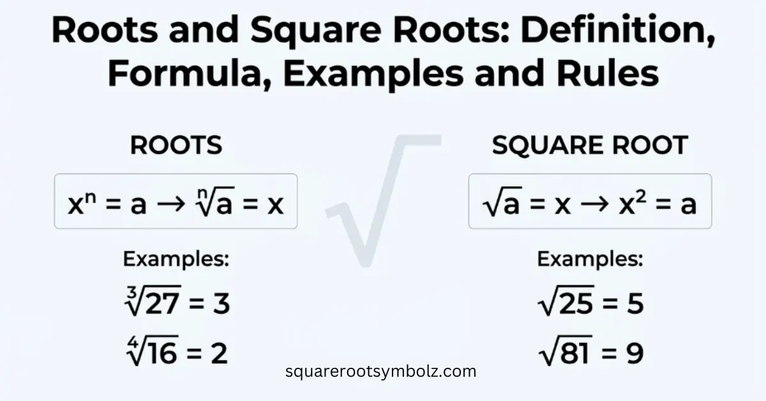
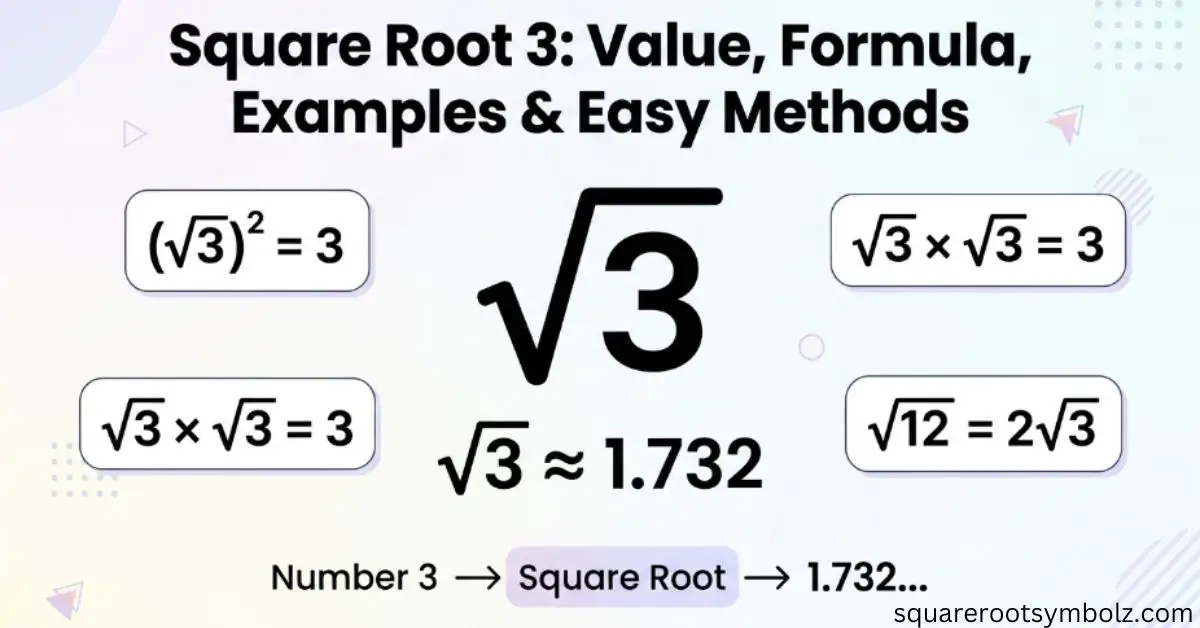
The square root 3 is √3 ≈ 1.73205080757, the positive number whose square equals 3. It is an irrational number, so its decimal expansion never ends or repeats. If you are trying to remember the value, simplify the radical, or understand where √3 comes from, the key is connecting square roots, perfect squares, radical form, decimal approximation, and algebra. The methods below make the calculation much easier to follow.
In classroom problems, √3 often appears unexpectedly in geometry, trigonometry, right triangles, equilateral triangles, and coordinate geometry. I find that students usually struggle not with the number itself, but with knowing whether it can be simplified and how to estimate it accurately. This guide walks through the reasoning step by step.
What is the Square Root of 3?
The square root of 3 is the number that produces 3 when multiplied by itself. In mathematical notation, it is written as √3. In exponential form, the same value is written as 3¹ᐟ² or 3⁰·⁵. Its decimal value begins 1.73205080757….
A quick way to understand its size is to compare nearby perfect squares. Since 1² = 1 and 2² = 4, √3 must fall between 1 and 2. More precisely, 1.7² = 2.89, while 1.8² = 3.24, placing √3 comfortably between those values.
Quick Reference
| Form | Value |
| Radical form | √3 |
| Exponential form | 3¹ᐟ² |
| Decimal form | 1.73205080757… |
| Rounded to 2 decimals | 1.73 |
| Rounded to 3 decimals | 1.732 |
| Rounded to 4 decimals | 1.7321 |
The exact form √3 is normally preferable in algebra because it does not introduce rounding. The decimal 1.732… is an approximation used when a numerical answer is required.
Is the Square Root of 3 Rational or Irrational?
√3 is irrational. That means it cannot be expressed exactly as a fraction of two integers, and its decimal expansion is non-terminating and non-repeating. Because 3 is prime and has no paired square factors, √3 cannot be reduced to a simpler whole-number radical.
This distinction matters when solving algebra problems. For example, √4 simplifies to 2 because 4 is a perfect square. √3 does not simplify because there is no integer that multiplies by itself to produce 3. Therefore, √3 is already in simplest radical form.
Why does being prime matter?
Prime factorization gives a quick explanation. The number 3 has only one prime factor: 3¹. To simplify a square root, factors normally need to appear in pairs. Because the exponent is odd, nothing can be pulled outside the radical.
How to Find the Square Root of 3?
There are several ways to approximate √3, but two particularly useful approaches are long division and estimation between perfect squares. The long-division approach can produce many decimal places, while estimation is faster when you only need a few digits.
For everyday mathematics, you can begin with the simple fact that 1² < 3 < 2². Then test decimal values until their squares get closer to 3. This gives a practical understanding of why the answer is approximately 1.732 instead of simply memorizing a calculator result.
Long Division Method
To calculate √3 manually, write the number as 3.000000 and work through pairs of decimal digits. The first digit is 1 because 1² = 1. After subtracting, bring down two zeros, giving 200. Doubling the current result produces the trial divisor used to determine the next digit.
The next digit is 7 because 27 × 7 = 189, which is the largest suitable product below 200. Continuing the same process produces more decimal places: √3 ≈ 1.732050…. This method is slower than using a calculator, but it shows exactly where the decimal digits come from.
Estimation between Perfect Squares
Estimation is quicker when extreme precision is unnecessary. Start with 1.7² = 2.89, which is below 3. Try 1.73² = 2.9929, which is still slightly low. Then 1.732² = 2.999824, extremely close to 3. Therefore, √3 rounds to 1.732 to three decimal places.
This approach is especially useful during tests because it lets you check whether an answer makes sense without depending entirely on a calculator. If someone gives 2.4 as √3, squaring 2.4 immediately exposes the mistake because 2.4² = 5.76.
Important Notes
The exact value of √3 is different from its decimal approximation. Writing √3 keeps the answer exact, while writing 1.732 replaces the infinite decimal with a rounded value. This difference becomes important in algebra, geometry, trigonometry, and calculations where rounding errors can accumulate.
Another useful point is that −√3 and √−3 are not the same expression. The first is a negative real number, while the second involves the square root of a negative number and leads into imaginary numbers. Cuemath specifically highlights this distinction in its solved examples.
| Expression | Meaning | Approximate value |
| √3 | Principal square root of 3 | 1.732 |
| −√3 | Negative of √3 | −1.732 |
| (√3)² | Square of √3 | 3 |
| √−3 | Square root of negative 3 | i√3 |
Also remember that √3 cannot be simplified further. There is no hidden factor such as 4, 9, or 16 inside 3 that can produce a number outside the radical.
Real-World Examples
The value √3 is more than an algebra exercise. It appears naturally in equilateral triangles, trigonometry, coordinate geometry, cubes, and electrical engineering. For example, an equilateral triangle with side length 2 has a height of √3, obtained by applying the Pythagorean theorem after splitting the triangle into two right triangles.
In electrical engineering, √3 appears in formulas involving three-phase power systems. It also appears in coordinate geometry: the distance from (0, 0) to (1, √3) is 2 because the distance formula gives √(1² + (√3)²) = √4.
Example: Equilateral Triangle
Suppose an equilateral triangle has sides of length 2. Draw an altitude from the top vertex to the midpoint of the base. The base is divided into two pieces of length 1, leaving a right triangle with hypotenuse 2.
Using the Pythagorean theorem:
h² + 1² = 2²
h² = 4 − 1
h² = 3
h = √3
Therefore:
h ≈ 1.732
This is one of the most recognizable geometric appearances of √3.
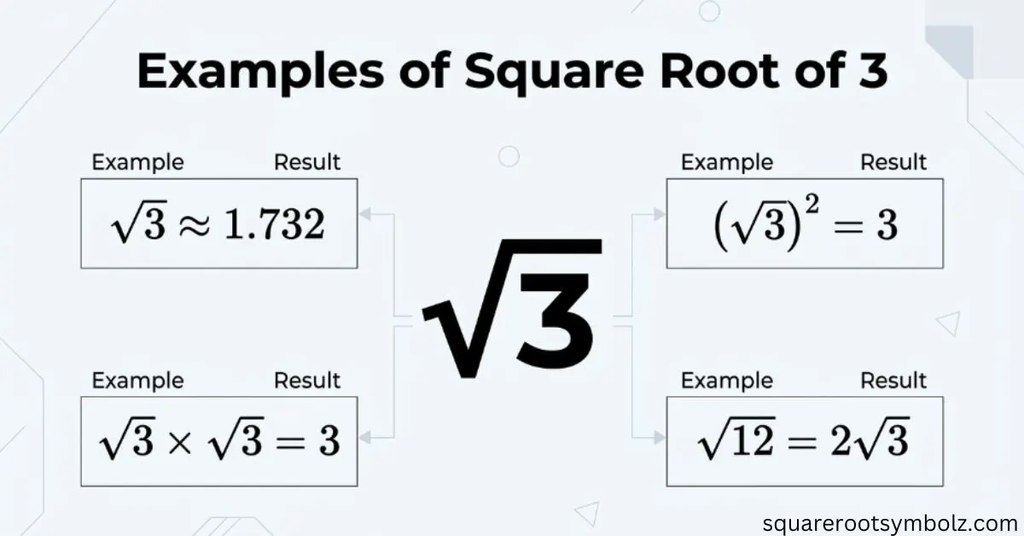
Examples of Square Root of 3
Example 1: Simplify √12
Factor 12 into a perfect square and 3:
√12 = √(4 × 3)
Take √4 outside:
√12 = 2√3
Using the decimal approximation:
2√3 ≈ 3.4641
The important idea is that 12 contains a square factor, while 3 itself does not.
Example 2: Find the Height of an Equilateral Triangle
For a triangle with side length 2:
h = √(2² − 1²)
h = √(4 − 1)
h = √3
So:
h ≈ 1.732
This example demonstrates why simply dividing the side by 2 does not give the height. The altitude creates a right triangle, so the Pythagorean theorem must be used.
Example 3: Evaluate tan 60°
A 30-60-90 triangle has side ratios:
1 : √3 : 2
Therefore:
tan 60° = opposite / adjacent
tan 60° = √3 / 1
tan 60° = √3
So:
tan 60° ≈ 1.732
This is one reason √3 appears frequently in trigonometric calculations.
Example 4: Rationalize 1/√3
If a denominator contains √3, multiply the numerator and denominator by √3:
1/√3 × √3/√3
= √3/3
Therefore:
1/√3 = √3/3 ≈ 0.5774
The expression remains mathematically equivalent, but the denominator no longer contains a radical.
Example 5: Find the Space Diagonal of a Unit Cube
For a cube with side length 1, the space diagonal can be found using the three-dimensional version of the Pythagorean theorem:
d = √(1² + 1² + 1²)
d = √3
Therefore:
d ≈ 1.732
This shows how the same mathematical constant appears naturally in three-dimensional geometry.
Conclusion
The square root 3 is √3, with a decimal approximation of 1.73205080757…. Because 3 is prime rather than a perfect square, √3 is irrational and cannot be simplified into a smaller radical. You can estimate it by comparing nearby squares or calculate it more precisely with long division.
The most useful thing to remember is not just 1.732, but why that number works: 1.732² is very close to 3. Once that idea is clear, √3 becomes much easier to recognize in algebra, geometry, trigonometry, and real-world mathematical problems.
FAQs
Why is √3 irrational?
√3 is irrational because 3 is prime and cannot be represented as a perfect square of an integer. Its decimal expansion is non-terminating and non-repeating.
Can √3 be simplified?
No. √3 is already in simplest radical form because 3 has no perfect-square factor greater than 1.
What’s the difference between √3 and 3²?
√3 means the square root of 3, which is approximately 1.732. In contrast, 3² means 3 squared, which equals 9. They are opposite operations.
What is √3 to two decimal places?
√3 ≈ 1.73 when rounded to two decimal places.
What is √3 to three decimal places?
√3 ≈ 1.732 when rounded to three decimal places.
Is 3 a perfect square?
No. A perfect square is produced by multiplying an integer by itself. Since no integer squared equals 3, it is not a perfect square.
What is the exact value of √3?
The exact value is √3. The decimal 1.73205080757… is only an approximation.
Where is √3 used in real life?
√3 appears in geometry, trigonometry, electrical engineering, coordinate geometry, architecture, and physics.

I’m the creator of SquareRootSymbolz.com, where I publish easy-to-understand guides on symbols, Unicode characters, Alt codes, keyboard shortcuts, and copy-and-paste text symbols. My goal is to provide accurate, well-researched, and user-friendly content that helps readers quickly find the information they need.