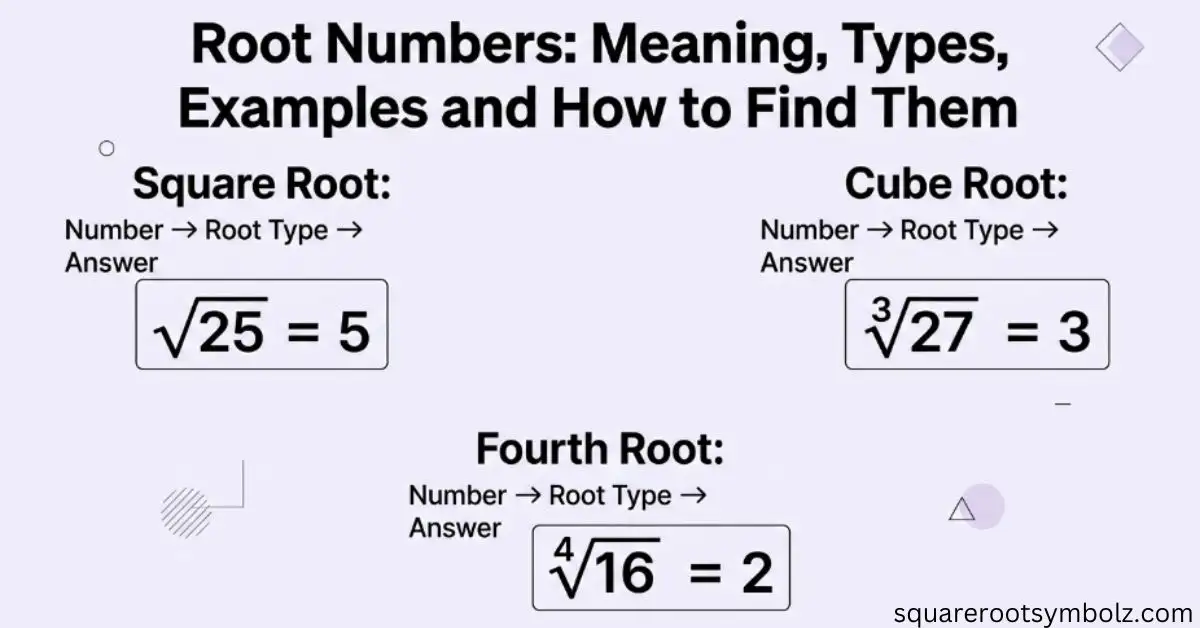
Root numbers are values that produce another number when raised to a specific power, with square roots being the most common example. In simple terms, if a number multiplied by itself creates a perfect square, that original value is its root. Understanding square roots, perfect squares, radical signs, positive numbers, and exponents makes this topic much easier.
Many students get confused when they see symbols like √25 or equations involving roots because the language can sound more difficult than the math itself. After years of explaining number concepts through simple patterns, I have found that the easiest approach is to connect root numbers, factors, radicals, principal roots, and squared values to one simple question: What number creates this result?
Roots and Radicals
Root numbers describe the reverse relationship between powers and their original values. For example, because 5² equals 25, the number 5 is a root connected to 25. This relationship introduces exponents, radicals, square roots, cube roots, and perfect powers in a natural way.
A radical is the mathematical expression used to show a root. The familiar symbol √ is called the radical sign, while the value beneath it is the radicand. Root numbers therefore connect powers, multiplication, notation, factors, and numerical relationships into one mathematical idea.
Square roots
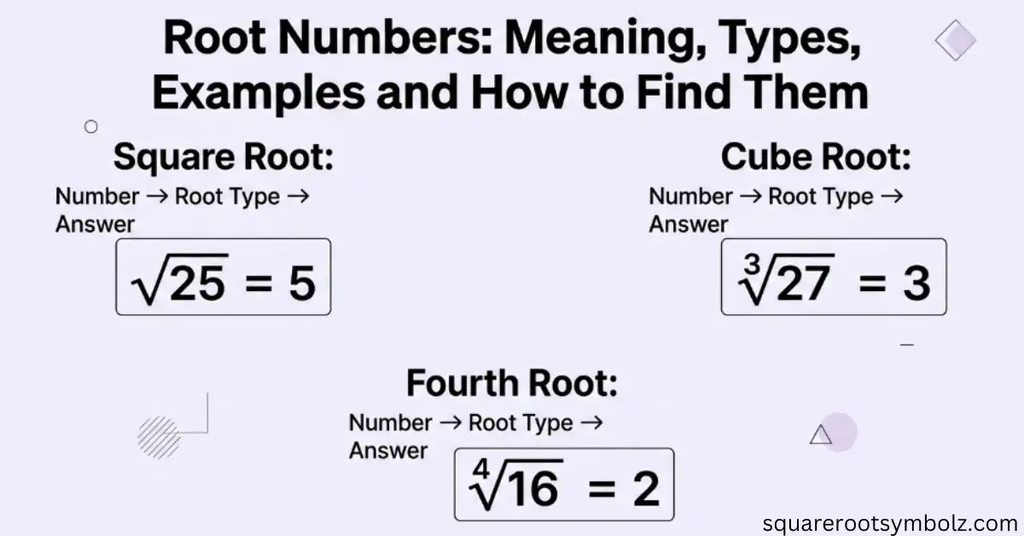
Square roots are the most familiar type of root numbers. A square root asks which value can be multiplied by itself to produce a given number. For instance, 6 × 6 equals 36, so 6 is the positive square root of 36.
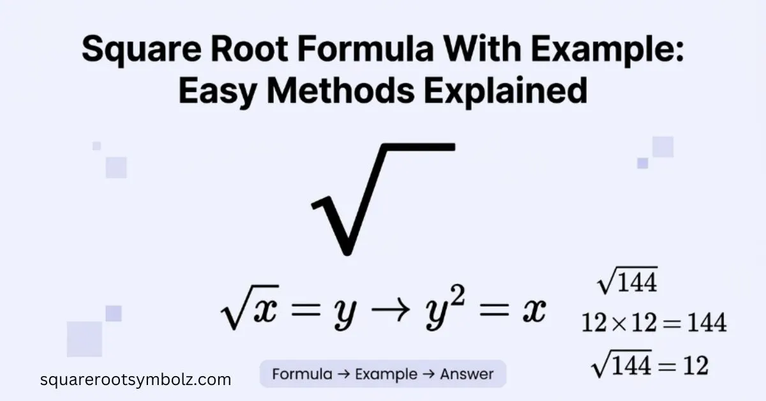
The reverse relationship matters because squaring moves forward while finding a root moves backward. If 9² equals 81, then √81 equals 9. Learning this connection helps students recognize perfect squares, factors, multiplication patterns, radical expressions, and principal roots more quickly.
Square Root of a Number
A square root of a number is a value whose square equals the original number. For example, both 7 and −7 are connected to 49 because 7² and (−7)² both equal 49. This creates an important distinction between roots, principal roots, positive values, and negative values.
Every positive real number has two square roots in an equation: one positive and one negative. However, the radical expression √49 represents the principal square root, which is 7. The symbol itself does not automatically show both answers.
| Number | Positive Root | Negative Root |
| 4 | 2 | −2 |
| 9 | 3 | −3 |
| 16 | 4 | −4 |
| 25 | 5 | −5 |
| 100 | 10 | −10 |
This table helps explain a common confusion: √25 = 5, but the equation x² = 25 has two solutions, 5 and −5.
Square Root Notation
The expression √m is read as “the square root of m.” The symbol contains the radical sign and the radicand, which is the number or expression underneath it. Understanding this notation helps students read root numbers instead of simply memorizing answers.
For example, in √64, the radical sign tells us to find the principal square root, while 64 is the radicand. Because 8 × 8 equals 64, the expression becomes √64 = 8. The notation represents an exact mathematical operation.
Perfect Squares
Perfect squares are especially important when learning root numbers because they have whole-number square roots. Numbers such as 1, 4, 9, 16, and 25 are perfect squares because they result from multiplying a whole number by itself.
For example, 8² equals 64, making 64 a perfect square and 8 its principal square root. Recognizing these patterns saves time when solving equations involving square numbers, multiplication, whole numbers, factors, and radicals.
Modeling Squares
The word “square” comes from geometry as well as arithmetic. A square with equal side lengths can be represented using tiles. A square that is 3 units by 3 units contains 9 units, showing visually why 3² equals 9.
This visual pattern makes root numbers easier to understand. If 25 tiles form a 5-by-5 square, then 5 is the square root of 25. The area, side length, perfect square, multiplication, and square root all describe the same relationship.
Finding Square Roots
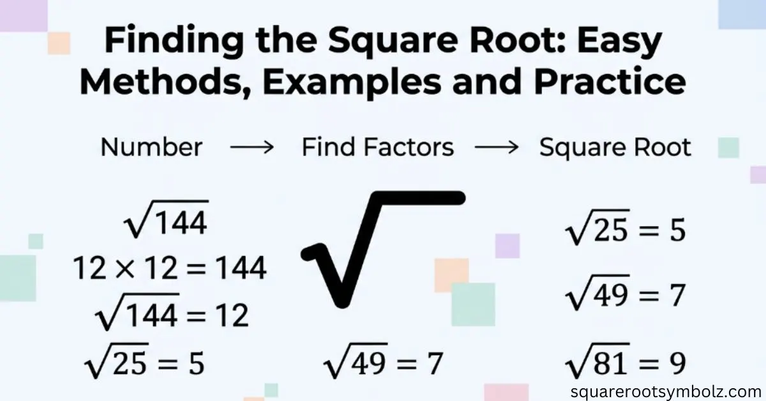
Finding root numbers often begins with asking a simple question: What number multiplied by itself gives the original value? For √36, the answer is 6 because 6 × 6 equals 36.
When the answer is not immediately obvious, use multiplication facts, perfect square patterns, or prime factorization. For example, factor trees can help identify repeated factors and reveal the square root of a number through its prime factors, multiplication pairs, perfect squares, radicals, and numerical structure.
Here are a few quick examples:
√1 = 1
√4 = 2
√9 = 3
√16 = 4
√25 = 5
√36 = 6
√49 = 7
√64 = 8
√81 = 9
√100 = 10
The fastest method is usually pattern recognition. The more perfect squares you remember, the easier it becomes to identify common root numbers.
Estimate Square Roots
Not every root number is a whole number. When a value falls between two perfect squares, its square root also falls between the corresponding whole numbers. For example, 49 is less than 60 and 64 is greater than 60.
Because √49 equals 7 and √64 equals 8, we know that √60 is between 7 and 8. This method uses perfect squares, consecutive whole numbers, inequalities, estimation, and numerical comparison before calculating a decimal answer.
For example:
49 < 60 < 64
Therefore:
7 < √60 < 8
This is useful when you need a quick estimate without a calculator.
Approximate Square Roots with a Calculator
A calculator can provide decimal approximations for root numbers that are not perfect squares. For example, √5 does not equal a terminating whole number, so its decimal form continues beyond a few digits.
A calculator gives approximately 2.236 for √5, which can be rounded according to the problem. When writing a rounded value, use ≈, the approximation symbol, rather than pretending the rounded decimal is the exact value.
Examples:
√5 ≈ 2.24
√17 ≈ 4.12
√60 ≈ 7.75
The important difference is simple: a perfect square can have an exact whole-number root, while many other values produce irrational numbers, decimal approximations, rounded answers, and estimated values.
Square Root of a Negative Number
Within the real number system, a negative number does not have a real square root. This is because both a positive number squared and a negative number squared produce a positive result.
For example, no real number multiplied by itself equals −25. Therefore, √−25 is not a real number. Later in mathematics, the imaginary unit i extends the number system and allows expressions involving negative radicands.
This distinction is important:
√25 = 5
but
√−25 is not a real number.
Students often confuse −√25 with √−25. They are not the same. The first equals −5, while the second has no real-number value.
Square Roots and the Order of Operations
When root numbers appear inside larger expressions, the radical sign acts as a grouping symbol. This means the expression inside the radical must be handled as one unit before completing other operations.
For example, √25 + √144 equals 5 + 12, which equals 17. However, √(25 + 144) equals √169, which equals 13. Parentheses and radical placement completely change the calculation.
Compare these:
√25 + √144 = 17
√(25 + 144) = 13
This is why radicals, grouping symbols, operations, expressions, and order of operations must be read carefully before solving.
Simplify Variable Expressions with Square Roots
Root numbers also appear in algebraic expressions containing variables. For example, √(9x²) can simplify to 3x when x is nonnegative, because squaring 3x produces 9x².
These expressions combine variables, exponents, radicals, perfect squares, and algebraic factors. The goal is usually to identify a factor inside the radical that has an exact square root and move it outside the radical sign.
For example:
√(16x²) = 4x
because:
(4x)² = 16x²
This connection becomes especially useful in algebra, geometry, equations, and more advanced radical expressions.
Use Square Roots in Applications
Root numbers are not limited to textbook exercises. Square roots appear whenever a squared relationship must be reversed, especially in geometry, measurement, physics, engineering, and algebra.
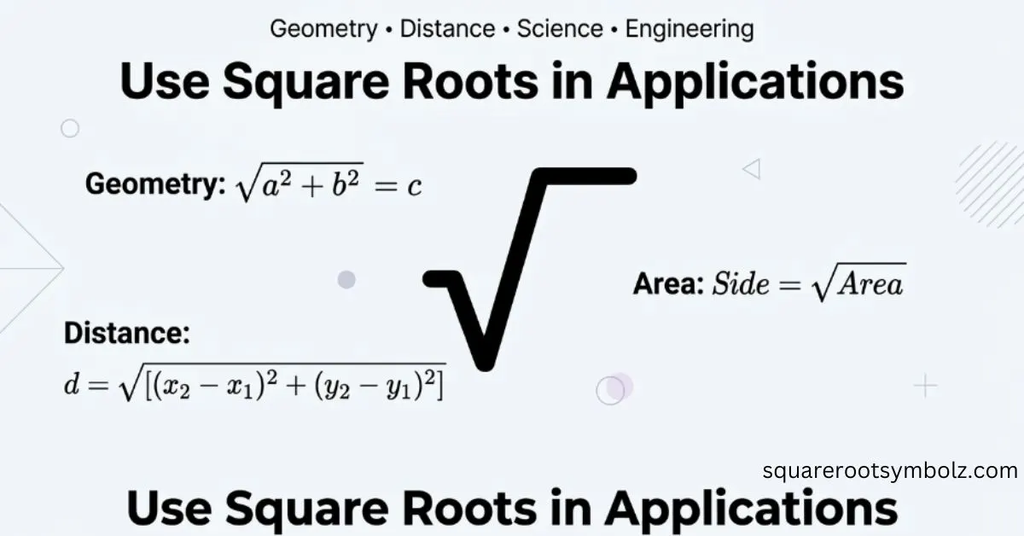
One of the clearest examples involves the area of a square. If you know the area but need the side length, you find the square root. This connects area, dimensions, square units, side length, geometry, and root numbers directly.
Square Roots and Area
If a square has an area of 144 square units, each side measures √144, or 12 units. The square root reverses the multiplication used to calculate area.
This idea works with both exact and approximate values. A square with an area of 200 square units has a side length of √200, approximately 14.1 units. Root numbers therefore help convert area, square units, dimensions, estimates, and side measurements.
Square Roots and Gravity
Square-root relationships also appear in simplified mathematical models involving motion. In some educational applications, the time associated with a falling object can be represented using an expression containing the square root of its height.
The key lesson is not memorizing every formula but recognizing why root numbers appear: a quantity may be squared in the original relationship, so reversing that relationship requires a square root, radical expression, measurement, approximation, and mathematical model.
Root Numbers: The Main Idea
Root numbers help reverse powers. If you know the result of repeated multiplication but need the original value, a root can take you backward through that relationship.
The most important examples are square roots, perfect squares, radical signs, principal roots, and cube roots. Once you understand that √81 asks, “What number multiplied by itself equals 81?” the topic becomes much less intimidating.
For everyday learning, remember these three rules:
- A square root reverses squaring.
- A positive number can have positive and negative square roots in an equation.
- The √ symbol represents the principal, or nonnegative, square root.
FAQ Section
What are root numbers in math?
Root numbers are values connected to powers in reverse. A square root, for example, is a number that produces a given value when multiplied by itself.
What are the root numbers of 16?
The two square roots of 16 are 4 and −4 because 4² = 16 and (−4)² = 16. However, √16 means the principal square root, which is 4.
Is a square root always positive?
The radical symbol √ represents the nonnegative principal square root. But an equation such as x² = 25 has two solutions: 5 and −5.
What is the difference between a root and a square root?
A root is a broad mathematical concept that can include square roots, cube roots, and higher roots. A square root specifically reverses the operation of squaring.
Is zero a square root?
Yes. Since 0 × 0 = 0, the square root of zero is zero. Zero has only one square root.
Why do some square roots have decimals?
Numbers that are not perfect squares often have irrational square roots. Their decimal values continue without repeating, so they are usually written as approximations.
Can negative numbers have square roots?
A negative number does not have a real square root. Expressions such as √−9 require the complex number system, where i is used.
How do you estimate a square root?
Find the two perfect squares surrounding the number. For example, 60 lies between 49 and 64, so √60 lies between 7 and 8.

I’m the creator of SquareRootSymbolz.com, where I publish easy-to-understand guides on symbols, Unicode characters, Alt codes, keyboard shortcuts, and copy-and-paste text symbols. My goal is to provide accurate, well-researched, and user-friendly content that helps readers quickly find the information they need.