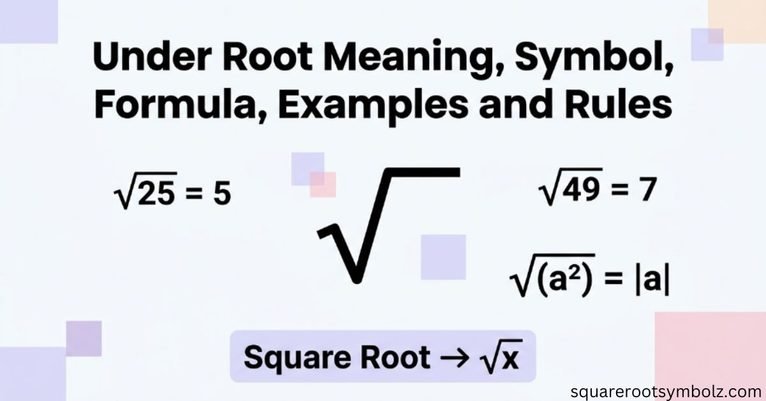
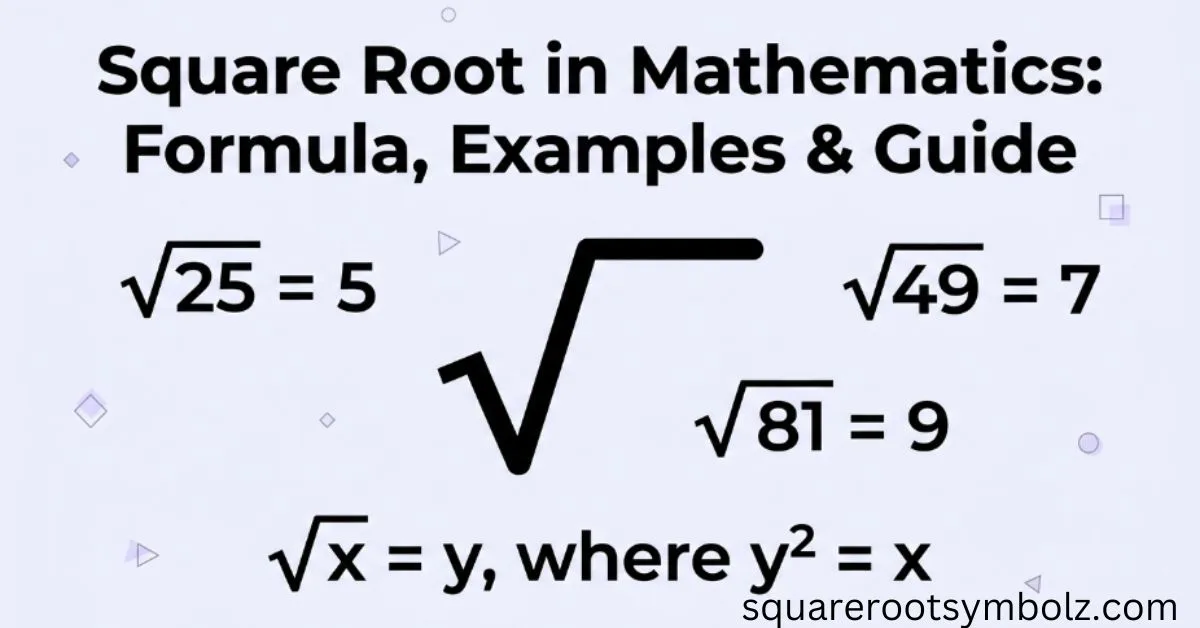
A square root in mathematics is a number that produces a given value when multiplied by itself. For example, 6 is the square root of 36 because 6 × 6 = 36. The concept connects squaring, perfect squares, radicals, integers, and equations and appears throughout algebra and geometry.
If the radical symbol √ has ever felt confusing, the trick is to think backward: instead of asking what a number becomes when squared, ask what number was squared to create the value. From the principal square root to irrational numbers, decimal roots, factorization, and equations, this guide makes the whole idea easier to use.
Square Root Definition in Mathematics
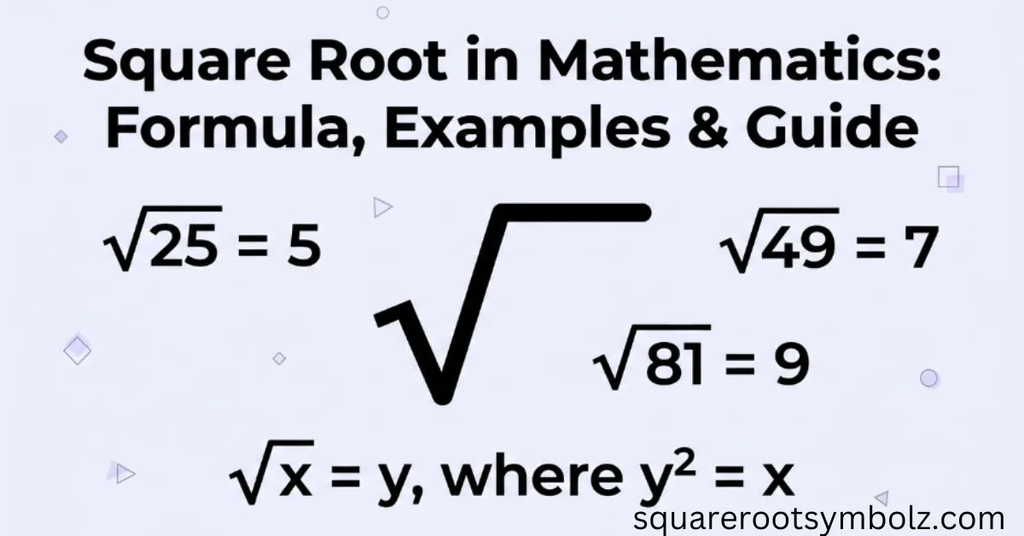
A square root in mathematics is a number that, when multiplied by itself, gives the original number. If r2=x, then r is a square root of x. For example, 7² = 49, so 7 is a square root of 49.
The important detail is that positive numbers generally have two square roots. For 25, they are +5 and −5 because both 5 × 5 and −5 × −5 equal 25. However, the symbol √25 means the principal, non-negative square root, so √25 = 5.
Example: Square Root of 36
Since 6 × 6 = 36, the principal square root is √36 = 6. The complete set of square roots is +6 and −6. This distinction matters when solving equations because an equation such as x² = 36 has two solutions: x = ±6.
Square Root Symbol in Mathematics
The square root in mathematics is represented by the radical symbol √. The number or expression placed underneath the radical is called the radicand. For example, in √49, the radical sign is √ and 49 is the radicand.
The radical symbol normally represents the principal square root. Thus √9 = 3 rather than −3. When both values are required, mathematicians commonly write ±√9, which means +3 or −3. Understanding this small notation difference prevents many algebra mistakes.
Example: Reading √64
Read √64 as “the square root of 64.” Ask yourself, “What number multiplied by itself equals 64?” Because 8 × 8 = 64, the answer is √64 = 8.
Square Root Formula in Mathematics
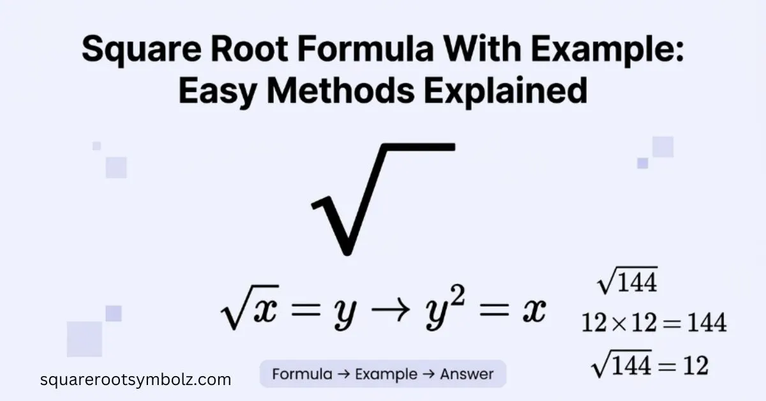
The basic square root in mathematics can be written as:
x=x1/2
This means taking a square root is equivalent to raising a non-negative number to the one-half power. Another useful relationship is y=x, which means y2=x. These forms connect radicals with exponents, algebraic expressions, and equations.
For example:
81=811/2=9
because:
92=81
For positive real numbers, square-root rules can also simplify products and quotients, such as ab=ab when the relevant values are non-negative.
Properties of Square Root in Mathematics
Several square root in mathematics properties help you recognize and simplify expressions. A perfect square has an integer square root, while non-perfect squares often produce irrational values. The principal square root is always non-negative for a non-negative real input.
Another useful property is that squaring and square-rooting work as inverse operations on non-negative values. For instance, (49)2=49. But remember that x2=∣x∣, not always x, because the principal square root cannot be negative.
| Expression | Result | Reason |
| √0 | 0 | 0 × 0 = 0 |
| √1 | 1 | 1 × 1 = 1 |
| √4 | 2 | 2 × 2 = 4 |
| √9 | 3 | 3 × 3 = 9 |
| √25 | 5 | 5 × 5 = 25 |
| √36 | 6 | 6 × 6 = 36 |
How to Find Square Root in Mathematics
To find a square root in mathematics, first determine whether the number is a perfect square. If it is, you can usually identify the answer from known square numbers. For example, because 12² = 144, √144 = 12.
For larger or non-perfect numbers, methods such as prime factorization, long division, and estimation become useful. A calculator is convenient for quick results, but understanding at least one manual method helps you check whether an answer makes sense.
Square Root by Prime Factorization in Mathematics
Prime factorization breaks a number into its prime factors and pairs identical factors. For example:
144=2×2×2×2×3×3
Pairing the factors gives:
144=2×2×3=12
This method is especially useful for perfect squares and for simplifying radical expressions.
Square Root by Long Division in Mathematics
The long-division method is useful when the number is not a perfect square and you need a decimal approximation. The digits are grouped in pairs, and successive digits of the root are determined through a structured division process. BYJU’S and Vedantu both present long division as a standard manual technique.
For example:
50≈7.071
because 7² = 49 and 8² = 64, placing the answer between 7 and 8.
Square Root by Estimation in Mathematics
Estimation is often the fastest approach when exact precision is unnecessary. To estimate √20, notice that 4² = 16 and 5² = 25. Therefore, √20 must fall between 4 and 5. A calculator or further testing can then refine the approximation.
Perfect Squares in Mathematics
Perfect squares are numbers produced by multiplying an integer by itself. Examples include 1, 4, 9, 16, 25, 36, 49, 64, 81, and 100. Their square roots are exact integers, making them especially important for mental math and algebra.
A useful pattern is:
| Number | Square | Square Root |
| 1 | 1 | 1 |
| 2 | 4 | 2 |
| 3 | 9 | 3 |
| 4 | 16 | 4 |
| 5 | 25 | 5 |
| 6 | 36 | 6 |
| 7 | 49 | 7 |
| 8 | 64 | 8 |
| 9 | 81 | 9 |
| 10 | 100 | 10 |
Knowing common perfect squares makes estimating unfamiliar roots much easier.
Square Root of Decimal in Mathematics
A square root in mathematics can also involve decimal numbers. For example:
0.09=0.3
because:
0.3×0.3=0.09
The same inverse-operation idea still applies. You simply look for the number that produces the decimal when multiplied by itself.
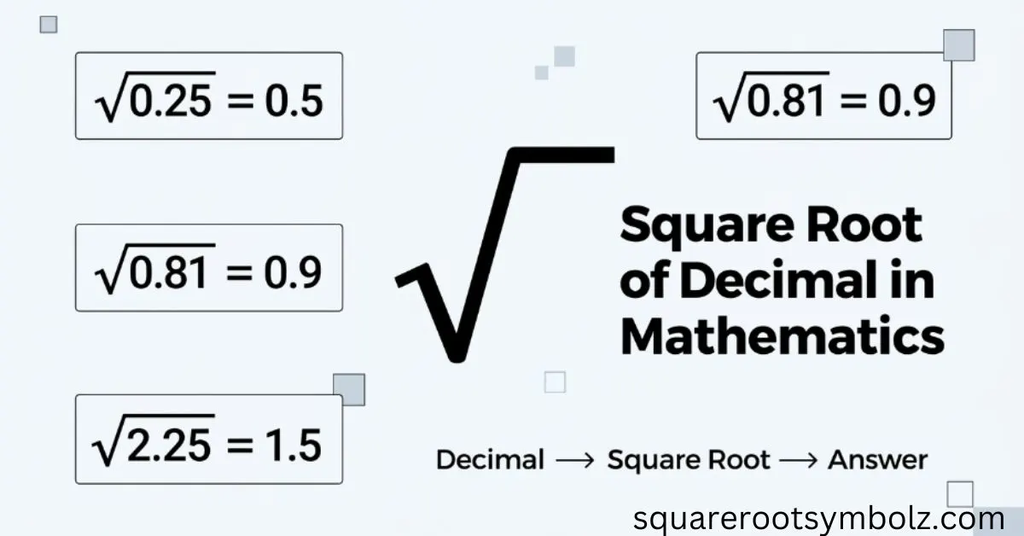
For non-perfect decimal values, the answer may be irrational or may require approximation. Keeping track of decimal places is important because squaring a decimal changes its scale as well as its numerical value.
Square Root of Negative Number in Mathematics
Within the real number system, a negative number has no square root because the square of every real number is non-negative. For example, neither 3² nor −3² can equal −9.
Complex numbers extend the system. The imaginary unit is defined by:
i=−1
Therefore:
−9=3i
This is where square roots move beyond elementary arithmetic into complex numbers, algebra, engineering, and higher mathematics.
Applications of Square Roots in Mathematics
The square root in mathematics is not simply a classroom operation. It appears whenever a problem requires reversing a squared quantity. In geometry, for example, the Pythagorean theorem uses a square root to calculate an unknown side of a right triangle.
If:
a2+b2=c2
then:
c=a2+b2
Square roots also appear in algebra, quadratic equations, distance calculations, statistics, physics, engineering, and computer science. The underlying reason is simple: many real-world formulas produce squared quantities, so the square root reverses that operation.
Solved Example: Finding a Square Root
Suppose a square has an area of 81 square inches. Because the area of a square is s2, its side length is:
s=81=9
So each side measures 9 inches. This is a simple example of how square roots turn an area measurement back into a length.
Conclusion
The square root in mathematics is the inverse operation of squaring: it identifies the number that produces a given value when multiplied by itself. Once you understand the √ symbol, radicand, principal root, perfect squares, negative roots, formulas, and calculation methods, the topic becomes much less intimidating.
The most useful habit is to connect every root back to multiplication. When you see √49, think “What number times itself equals 49?” The answer is 7. That simple question is the foundation behind more advanced work with radicals, algebraic equations, geometry, and irrational or complex numbers.
FAQ Section
What is a square root in mathematics?
A square root is a number that, when multiplied by itself, produces the original number. For example, √25 = 5 because 5 × 5 = 25.
What is the formula for a square root?
The basic form is √x = x¹ᐟ². Equivalently, if y=x, then y2=x.
What is the square root of 25?
The principal square root of 25 is 5. The two square roots of 25 are +5 and −5.
Can a square root be negative?
The principal square root represented by √ is non-negative. However, a positive number has both a positive and negative square root; for 25, they are +5 and −5.
What is a perfect square?
A perfect square is a number that can be written as an integer multiplied by itself, such as 1, 4, 9, 16, or 25.
What is the square root symbol called?
The symbol √ is called the radical sign or radical symbol. The number underneath it is called the radicand.
How do you find the square root of a non-perfect square?
You can estimate it between two neighboring perfect squares, use long division, prime-factor methods where applicable, or use a calculator.
What is the square root of a negative number?
A negative number does not have a real square root. In the complex number system, √−1 is represented by i, so √−9 = 3i.

I’m the creator of SquareRootSymbolz.com, where I publish easy-to-understand guides on symbols, Unicode characters, Alt codes, keyboard shortcuts, and copy-and-paste text symbols. My goal is to provide accurate, well-researched, and user-friendly content that helps readers quickly find the information they need.