
The symbol for at most is ≤, which means less than or equal to. If a value is at most 10, it can be 10 or any number below 10, but it cannot be greater than 10. This simple inequality symbol represents a maximum allowed value or upper limit.
Students often hesitate because “at most,” “less than,” and “at least” sound similar in a word problem. The easiest way to remember the difference is to focus on the boundary: at most includes the boundary, while less than does not. Once that idea is clear, inequalities, number lines, algebra problems, probability, and everyday limits become much easier to translate correctly.
What Does the “At Most” Symbol Mean?
The symbol for at most is ≤. It is called the less-than-or-equal-to symbol because the value on the left can be smaller than or exactly equal to the value on the right. In an inequality such as x ≤ 8, x cannot be greater than 8.
Think of “at most” as a ceiling or maximum limit. If a classroom allows at most 30 students, then 30 is acceptable, as are smaller numbers. The inequality is n ≤ 30. The important detail is that the boundary value, 30, is included in the solution set.
| Phrase | Symbol | Meaning |
| At most | ≤ | Less than or equal to |
| No more than | ≤ | Less than or equal to |
| At least | ≥ | Greater than or equal to |
| Less than | < | Strictly below |
| Greater than | > | Strictly above |
Understanding the “At Most” Symbol in Mathematics: Definitions and Examples
In mathematics, “at most” describes an upper bound. The expression x ≤ 5 says that x may equal 5 or any value below 5. The symbol therefore communicates both possibilities at once: the value may be less than the boundary, or it may exactly reach it.
This notation appears throughout algebra, probability, statistics, and other areas where limits matter. For example, P(X) ≤ 0.5 means the probability is no greater than 0.5. In every case, the defining idea remains the same: the stated value is the greatest permitted value.
| Expression | Plain-English meaning |
| x ≤ 5 | x is at most 5 |
| y ≤ 20 | y is no more than 20 |
| n ≤ 100 | n cannot exceed 100 |
| P(X) ≤ 0.5 | Probability is at most 0.5 |
| a ≤ 12 | a is 12 or less |
Symbols Representing “At Most”
The main symbol representing “at most” is ≤. It combines the less-than symbol with an equality line, signaling that the boundary is included. This makes it different from <, which excludes the boundary. Understanding that small horizontal line can prevent many inequality mistakes.
Related comparison symbols help put the notation into context. The symbol ≥ represents “at least,” while < means “less than” and > means “greater than.” When translating a word problem, identify whether the stated limit can be reached before selecting the inequality symbol.
| Symbol | Name | Meaning | Boundary included? |
| ≤ | Less than or equal to | At most | Yes |
| < | Less than | Below | No |
| ≥ | Greater than or equal to | At least | Yes |
| > | Greater than | Above | No |
| = | Equal to | Exactly equal | Yes |
How to Show “At Most” on a Number Line
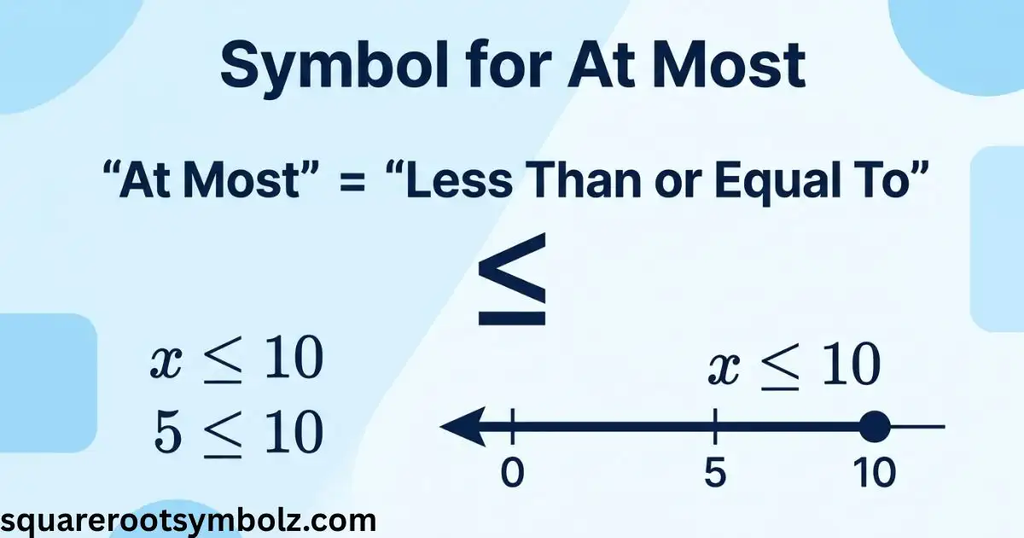
To graph an at-most inequality such as x ≤ 4, place a closed circle at 4 because the boundary is included. Then shade to the left because every number smaller than 4 also satisfies the inequality. The shaded region represents the complete solution set.
For example, x ≤ 4 includes 4, 3, 2, 1, 0, and negative numbers. The direction matters: numbers become smaller as you move left on a standard number line. A filled circle says “include 4,” while the leftward shading says “include values below 4.”
Number-line rule:
≤ → closed circle → shade left
That quick visual pattern is useful when solving inequalities in middle-school algebra.
How Is the “At Most” Sign Different From a “Less Than” Sign?
“At most” and “less than” both point toward smaller values, but they differ at the boundary. The inequality x ≤ 8 allows 8, whereas x < 8 does not. The equality line underneath the less-than sign is what tells you the boundary number counts.
Imagine a backpack limit of 15 pounds. If it weighs exactly 15 pounds, an “at most 15 pounds” rule allows it. A “less than 15 pounds” rule does not. This real-world distinction makes the mathematical difference easier to remember.
| Statement | Does the boundary count? |
| x ≤ 8 | Yes |
| x < 8 | No |
| x ≥ 8 | Yes |
| x > 8 | No |
At Most Vs. at Least: Key Differences
“At most” establishes a maximum, while “at least” establishes a minimum. The symbol ≤ belongs to the first phrase, and ≥ belongs to the second. Both include the boundary because both contain the equality component in their inequality symbols.
A simple memory check is to ask whether the problem is setting a ceiling or a floor. “At most 10” means 10 or lower. “At least 10” means 10 or higher. Once you identify the direction of the limit, the correct comparison symbol becomes much easier to choose.
| Phrase | Symbol | Direction | Boundary |
| At most 10 | ≤ | Lower values | Included |
| At least 10 | ≥ | Higher values | Included |
| Less than 10 | < | Lower values | Excluded |
| Greater than 10 | > | Higher values | Excluded |
Examples of At Most in Equations
Suppose a teacher says that a student may earn at most 85 points. Let x represent the score. The mathematical statement is x ≤ 85. The student can score 85 or anything lower, but a score above 85 would not satisfy the stated condition.
The same pattern works with algebraic expressions. If 3x ≤ 15, divide both sides by 3 to obtain x ≤ 5. If 2y + 4 ≤ 10, subtract 4 and divide by 2 to obtain y ≤ 3. The phrase “at most” always establishes the upper boundary.
| Word statement | Inequality | Result |
| At most 85 points | x ≤ 85 | x can be 85 or lower |
| At most 30 students | n ≤ 30 | n can be 30 or lower |
| At most $200 | c ≤ 200 | c can be $200 or lower |
| 3x is at most 15 | 3x ≤ 15 | x ≤ 5 |
Using the “At Most” Sign in Word Problems
Word problems often hide the inequality inside ordinary language. Phrases such as “at most,” “no more than,” “cannot exceed,” and “up to” commonly indicate an upper limit. Before writing an inequality, identify the quantity being limited and the exact boundary that cannot be exceeded.
For example, a theater can hold at most 500 people. If n represents attendance, write n ≤ 500. The number 500 is allowed because “at most” includes the boundary. The same reasoning works for age limits, budgets, weights, temperatures, quantities, and capacity restrictions.
Problem 1
A school club can have at most 40 members. Let m represent the number of members. The correct inequality is m ≤ 40. The club can have 40 members, 39 members, 38 members, or any smaller nonnegative whole number.
Problem 2
A package may weigh at most 50 pounds. Let w represent its weight. The inequality is w ≤ 50. A package weighing exactly 50 pounds meets the condition, while one weighing 50.1 pounds does not.
Solving Problems Using At Most Notation
When solving an inequality, first translate the phrase into mathematical notation. For “at most,” use ≤. Then solve the inequality using ordinary algebra while paying attention to operations that can change the inequality direction, particularly multiplication or division by a negative number.
For example, consider 4x ≤ 20. Divide both sides by 4 to obtain x ≤ 5. The solution contains 5 and every smaller value. You can verify the result by substituting an allowed value, such as x = 3, which produces 12 ≤ 20.
A useful solving pattern is:
Translate → simplify → solve → check the boundary
That final boundary check is especially helpful when a word problem determines a maximum or capacity.
Common Misconceptions
One of the most common mistakes is using < instead of ≤. Students sometimes remember that “at most” points toward smaller numbers but forget that the boundary itself is allowed. The equality line matters: ≤ means the limit counts, while < means the limit is excluded.

Another mistake is reversing the symbol. In x ≤ 7, the smaller-value side is represented by x, while 7 is the upper boundary. A reliable method is to read the complete statement aloud: “x is less than or equal to 7.” This prevents many direction errors.
Remember:
- At most 7 → 7 is included.
- Less than 7 → 7 is excluded.
- At least 7 → 7 is included.
- Greater than 7 → 7 is excluded.
Conclusion
The symbol for at most is ≤, meaning less than or equal to. It represents a maximum or upper boundary, and importantly, the boundary itself is included. Thus, “at most 12” means 12 or any value below 12.
The fastest way to remember it is:
At most → ≤ → less than or equal to → boundary included → shade left on a number line.
This same relationship works in algebra, statistics, probability, set theory, and everyday limits such as capacity, weight, age, temperature, and budget constraints. Current educational guidance also emphasizes the same boundary-value distinction between ≤ and <.
FAQs
What is the symbol for at most?
The symbol for at most is ≤, called the less-than-or-equal-to symbol. It means a value can be smaller than or equal to a stated number. For example, x ≤ 10 means x can be 10 or any number below 10.
Does at most include the number?
Yes. At most includes the boundary number. If a problem says “at most 8,” the value 8 is allowed, along with every value less than 8. This is why the symbol is ≤ rather than <.
What does ≤ mean in math?
The symbol ≤ means less than or equal to. It establishes an upper limit. For example, x ≤ 5 means x cannot exceed 5, and 5 itself is part of the solution set.
Is “at most” the same as “less than”?
No. “At most” means less than or equal to, while “less than” means strictly below. Therefore, x ≤ 5 includes 5, but x < 5 excludes 5.
What is the difference between at most and at least?
“At most” describes a maximum and uses ≤. “At least” describes a minimum and uses ≥. Both include their boundary value.
How do you graph at most on a number line?
Use a closed circle at the boundary and shade to the left. For example, x ≤ 6 is graphed with a filled circle at 6 and shading toward smaller numbers.

I’m the creator of SquareRootSymbolz.com, where I publish easy-to-understand guides on symbols, Unicode characters, Alt codes, keyboard shortcuts, and copy-and-paste text symbols. My goal is to provide accurate, well-researched, and user-friendly content that helps readers quickly find the information they need.