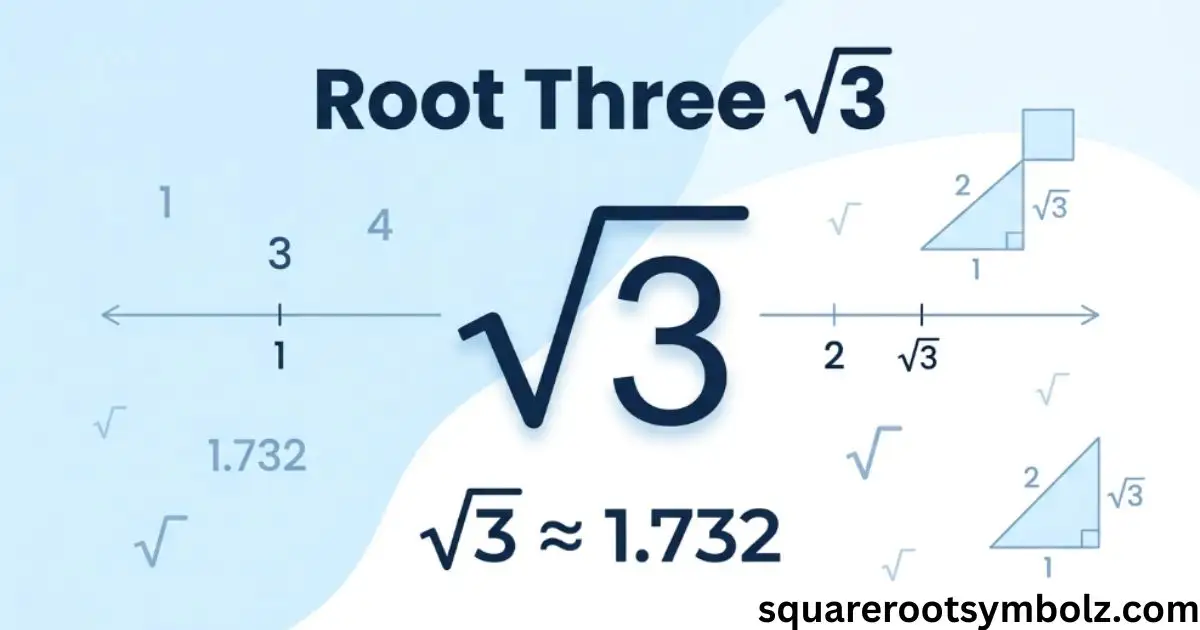
Root three, written as √3, equals approximately 1.7320508075. Its exact form is √3, and it cannot be simplified because 3 is a prime number. In this guide, we will connect the square root, radical form, decimal value, irrational number, perfect square, and exact value so the answer is clear from the start.
Students often know that 3 is not a perfect square but still wonder where 1.732 comes from or how to calculate it without a calculator. As a math educator, I find that the confusion usually disappears when the long division, estimation, prime factorization, 30-60-90 triangle, and Pythagorean theorem are connected instead of taught as separate facts.
What Is Root Three?
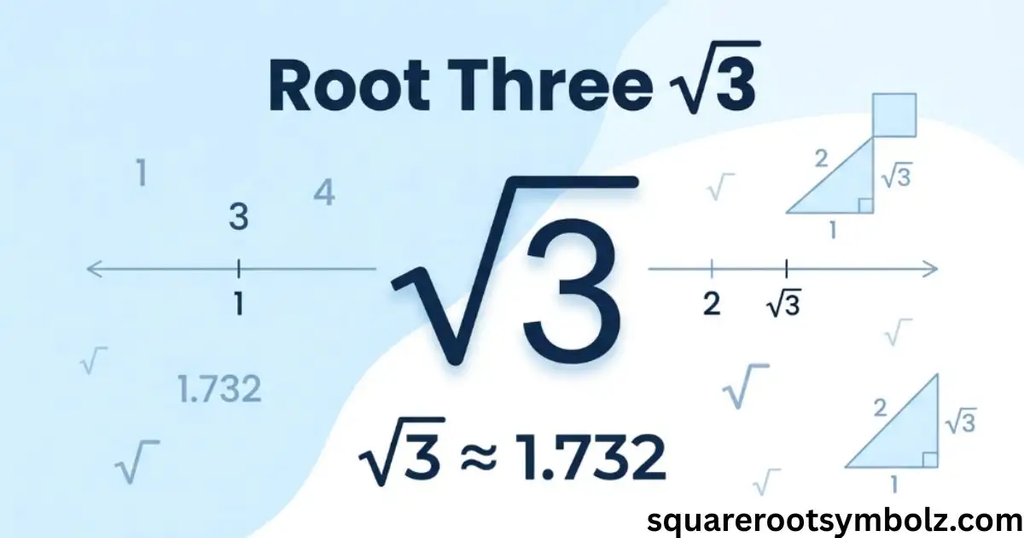
Root three is the positive square root of 3. In other words, it is the number that produces 3 when multiplied by itself. The exact notation is √3, while the decimal approximation is 1.7320508075. Because its digits continue without repeating, it is an irrational number.
You can also write root three in exponential form as 3^(1/2). The equation x² = 3 has two real solutions, +√3 and −√3, but the principal square root symbol √3 refers to the positive value. This distinction becomes important when solving equations involving square roots.
The Answer at a Glance
The most useful values to remember are √3 = 1.7320508075…, √3 ≈ 1.73 to two decimal places, and √3 ≈ 1.732 to three decimal places. The exact radical form remains √3 because no perfect-square factor can be removed from 3.
| Form | Root Three |
| Exact radical form | √3 |
| Decimal | 1.7320508075… |
| 2 decimal places | 1.73 |
| 3 decimal places | 1.732 |
| 4 decimal places | 1.7321 |
| Exponential form | 3^(1/2) |
| Number type | Irrational |
Where Root Three Appears
Root three is not just a number found on a calculator. It appears naturally in geometry and trigonometry. The height of an equilateral triangle with side length 2 is √3, and the side ratios of a 30-60-90 triangle include 1, √3, and 2.
The same value also appears in three-dimensional geometry. A cube with side length 1 has a space diagonal of √3. In trigonometry, tan 60° equals √3. These connections show why root three keeps appearing whenever right triangles, symmetry, and spatial distance meet.
30-60-90 Triangle
A 30-60-90 triangle has side ratios 1 : √3 : 2. If the shortest side is 1, the longer leg is √3 and the hypotenuse is 2. This special triangle provides one of the cleanest exact examples of root three in geometry and trigonometry.
Equilateral Triangle
Drop an altitude from an equilateral triangle with side length 2. The altitude divides the base into two segments of length 1. Applying the Pythagorean theorem gives height² = 2² − 1² = 3, so the height is √3.
Is Root Three Rational or Irrational?
Root three is irrational because 3 is prime and is not a perfect square. An irrational number cannot be expressed exactly as a ratio of two integers. Its decimal representation continues forever without settling into a repeating pattern, so 1.7320508075 is only an approximation.
A useful way to see this is through perfect squares. Since 1² = 1 and 2² = 4, √3 must lie between 1 and 2. But no whole number between them squares exactly to 3. The exact value therefore remains √3 rather than becoming a terminating decimal.
What Is the Square Root of 3 in Simplest Radical Form?
The simplest radical form of root three is √3. The number 3 has no square factor greater than 1, so there is nothing to pull outside the radical. Unlike √12, which becomes 2√3, √3 itself cannot be reduced.
Is the Number 3 a Perfect Square?
No. A perfect square is produced by multiplying an integer by itself, such as 1, 4, 9, 16, or 25. There is no integer whose square equals 3. Therefore, 3 is not a perfect square and √3 is irrational rather than a whole number.
How to Find Root Three
There are several ways to calculate root three. The most useful by hand are prime factorization, long division, and approximation. Each method serves a different purpose: factorization tells you whether the radical can simplify, long division gives decimal precision, and estimation gives a quick answer.
For a quick estimate, start with the nearest perfect squares. Because 3 lies between 1 and 4, its square root lies between 1 and 2. Testing 1.7, 1.73, and 1.732 gives increasingly accurate values. This is often faster than performing a complete long-division calculation.
Square Root of 3 By Prime Factorization Method
Prime factorization shows immediately why √3 stays unchanged. The number 3 is already prime, so its factorization contains only one factor of 3. There is no pair of identical factors to extract from the radical. Therefore, √3 remains in simplest radical form.
Method 1 — Long Division (Digit by Digit)
Write 3 as 3.000000 and begin with 1 because 1² is the largest perfect square below 3. Subtract 1, bring down two zeros, and continue the square-root division process. The successive digits produce 1.7, then 1.73, then 1.732, approaching the exact irrational value.
Method 2 — Estimation Between Perfect Squares
Because 1² = 1 and 2² = 4, begin with a number between 1 and 2. Try 1.7: its square is 2.89, which is low. Try 1.73: its square is 2.9929, much closer. Then 1.732² = 2.999824, giving an excellent three-decimal approximation.
Square Root of 3 by Approximation Method
Approximation is useful when you need a practical decimal rather than a long calculation. Start with nearby perfect squares, choose a value between their roots, square your estimate, and adjust it. Repeating the process moves the estimate closer to 3 and produces 1.7320508…
Important Notes About Root Three
Keep the distinction between exact and approximate values clear. √3 is exact, while 1.732, 1.73, and 1.7320508 are approximations. The number of decimal places you use depends on the problem. In exact algebra, it is usually better to keep √3 until the final calculation.
Another important distinction is between −√3 and √−3. The first is a negative real number, while the second is not a real number and is written using the imaginary unit i as i√3. Confusing these expressions can lead to an entirely different answer.
Real Roots of √3
For the equation x² = 3, the two real solutions are x = √3 and x = −√3. However, √3 itself denotes the principal, positive square root. This convention is important when interpreting equations, geometry formulas, and calculator results.
Root Three to Decimal Places
For two decimal places, use 1.73. For three decimal places, use 1.732. For four decimal places, use 1.7321. If a problem requires an exact answer, do not replace √3 with a rounded decimal unless the question specifically requests an approximation.
Common Mistakes With Root Three
The most common errors involve simplifying a radical that is already simple, treating a square root like an ordinary operation over addition, and rounding too early. These mistakes can look reasonable at first, especially when students are moving quickly through algebra problems.
A reliable check is to square your decimal approximation. For example, 1.73² = 2.9929, which is close to 3 but not exactly 3. That immediately reminds you that 1.73 is an approximation and √3 is the exact value.
Mistake 1: Treating √3 as if It Can Be Simplified
Because 3 is prime, it has no square factor that can be removed from the radical. Therefore, √3 is already in simplest radical form. Trying to simplify it into an integer or another smaller radical changes the mathematical value and creates an incorrect result.
Mistake 2: Splitting the Root Over Addition
A common error is assuming √(1 + 2) equals √1 + √2. It does not. The correct value is √3, approximately 1.732. Square roots do not distribute across addition in this way, so always simplify the expression using valid radical rules.
Mistake 3: Rounding Too Early
Replacing √3 with 1.73 at the beginning of a long calculation can introduce unnecessary error. If the expression can remain in exact radical form, keep √3 until the final step. Then round once, according to the number of decimal places the problem requires.
Examples of Root Three
Root three becomes easier to recognize when it appears inside different mathematical expressions. It can be used in radical simplification, fractions, powers, geometry, and trigonometry. The important skill is to recognize what √3 represents before deciding whether an exact or decimal answer is appropriate.
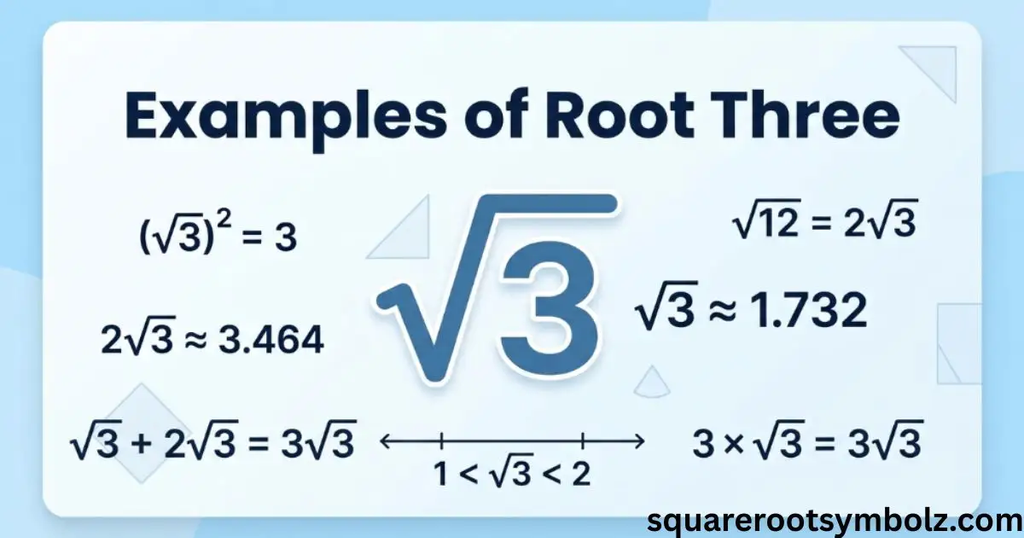
For example, √12 contains a perfect-square factor: √12 = √(4 × 3) = 2√3. Here, the 4 can leave the radical as 2, while the 3 remains underneath. This is different from √3 itself, which has no factor that can be simplified.
Example 1
Simplify √12 using root three.
√12 = √(4 × 3)
√12 = 2√3
So the exact answer is 2√3. Using the decimal value of √3, this is approximately 3.4641. The example demonstrates why identifying perfect-square factors is essential when simplifying radical expressions.
Example 2 (Wrong Path First)
Find the height of an equilateral triangle with side length 2. A tempting answer is 1 because the base is divided in half. But the height is not the same as half the base. Using the Pythagorean theorem gives height = √(4 − 1) = √3.
Example 3
Evaluate tan 60°. In a 30-60-90 triangle, the side opposite 60° has length √3 when the adjacent side has length 1. Therefore, tan 60° = opposite ÷ adjacent = √3. In decimal form, tan 60° is approximately 1.732.
Example 4
Rationalize 1/√3. Multiply the numerator and denominator by √3. The result is √3/3. In decimal form, this is approximately 0.5774. This example shows how the exact radical can remain useful even when the expression contains a denominator.
Example 5
Find the space diagonal of a cube with side length 1. Moving through all three perpendicular dimensions gives d² = 1² + 1² + 1² = 3. Therefore, d = √3, or approximately 1.732 units.
Conclusion
Root three, written as √3, has the exact value √3 and the approximate decimal value 1.7320508075. It is irrational, cannot be simplified further, and lies between 1 and 2 because 3 lies between the perfect squares 1 and 4.
The most useful ideas to remember are simple: keep √3 when an exact answer is required, use 1.73 or 1.732 when a rounded answer is requested, and recognize √3 in 30-60-90 triangles, equilateral-triangle heights, trigonometry, and three-dimensional geometry. Once these connections are clear, root three becomes much easier to recognize and use.
FAQs
What Is the Value of Root Three?
The exact value is √3. Its decimal expansion begins 1.7320508075688772… and continues forever without repeating. Common rounded forms are 1.73 to two decimal places and 1.732 to three decimal places.
Why Is Root Three Irrational?
Root three is irrational because 3 is prime and is not a perfect square. Therefore, √3 cannot be written exactly as a fraction of two integers. Its decimal representation is non-terminating and non-repeating.
Is 3 a Perfect Square or Non-Perfect Square?
3 is a non-perfect square. The perfect squares around it are 1 and 4. Since no integer multiplied by itself equals 3, √3 cannot simplify to a whole number.
Can Root Three Be Simplified?
No. √3 is already in simplest radical form. Simplification requires a perfect-square factor inside the radicand. Since the prime number 3 has no such factor, nothing can be removed from the radical.
What Is √3 to Two Decimal Places?
√3 rounded to two decimal places is 1.73. The next digit is 2, so the hundredths digit remains 3. The exact value is still √3; 1.73 is simply its two-decimal approximation.
What Is √3 to Three Decimal Places?
√3 rounded to three decimal places is 1.732. The next digit is 0, so the thousandths digit does not increase. For more precision, use 1.7320508075 or retain the exact radical √3.
Is −√3 the Same as √−3?
No. −√3 is a negative real number, while √−3 = i√3 in the complex-number system. The minus sign outside the radical and the negative sign inside the radicand have different mathematical meanings.

I’m the creator of SquareRootSymbolz.com, where I publish easy-to-understand guides on symbols, Unicode characters, Alt codes, keyboard shortcuts, and copy-and-paste text symbols. My goal is to provide accurate, well-researched, and user-friendly content that helps readers quickly find the information they need.