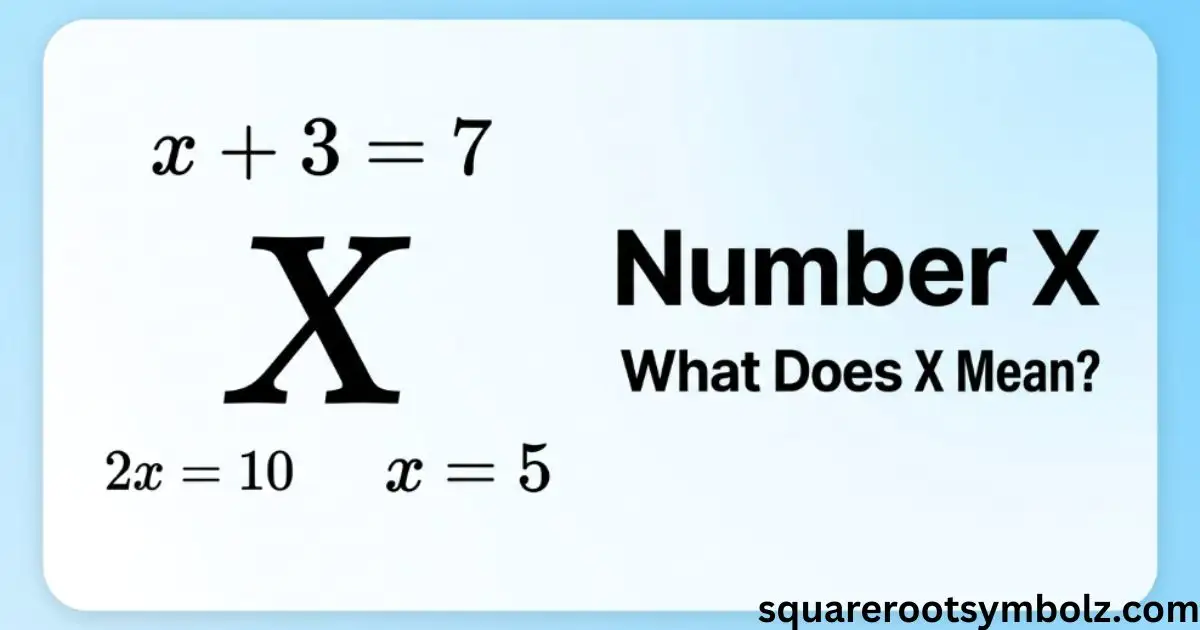
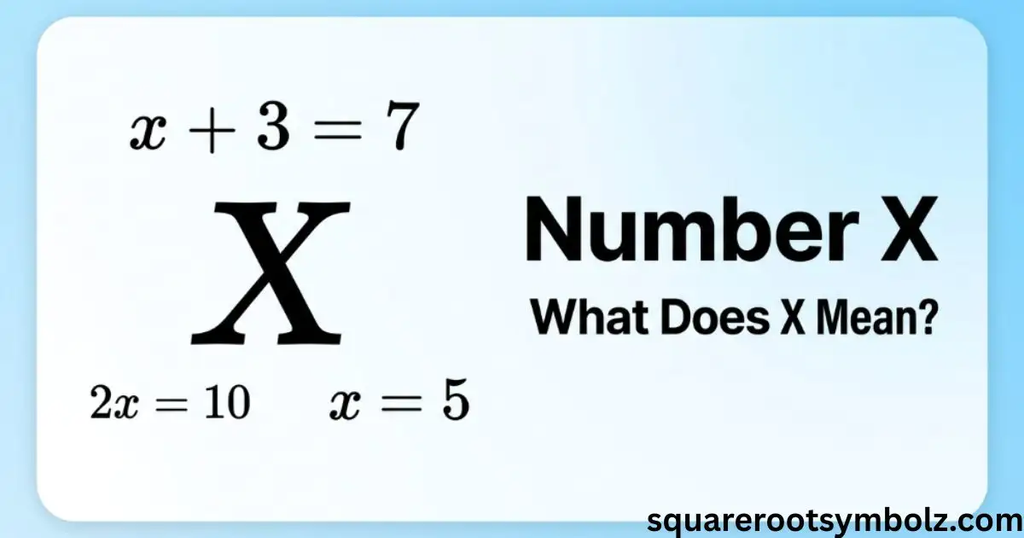
Number x usually means a number represented by the variable x, especially when its value is unknown. In algebra, x can represent an unknown number, a changing quantity, or a value that satisfies an equation. If you see x in an expression such as x + 5 = 12, your task may be to determine which number makes the statement true. This connects variables, unknown numbers, equations, expressions, and algebra in one simple idea. Mathnasium similarly explains that letters such as x, y, and n can represent unknown values.
The confusing part is that x does not always mean “the answer.” It can represent a variable, quantity, value, coefficient relationship, or coordinate depending on context. In my experience explaining algebra, students often become stuck because they memorize “find x” without understanding what x actually represents. Once you see x as a placeholder for a number, equations become much easier to read, solve, and check.
Basic Algebra
The idea behind number x becomes much clearer when you view algebra as a language for representing quantities. A variable is commonly represented by a letter, while a constant has a fixed value. An equation connects expressions using an equals sign, allowing us to determine an unknown value.
For example, consider x + 4 = 10. Here, x is the unknown number. We need the value that makes both sides equal. Since 6 + 4 = 10, the number x is 6. This is the central relationship between x, unknown, equation, value, and solution.
Basic Algebra Rules
Algebra follows the same arithmetic principles you already know. Addition, subtraction, multiplication, and division can be used with variables, provided the equation remains balanced. When solving for x, the goal is normally to use inverse operations to isolate the variable on one side of the equals sign.
For example, if x + 7 = 15, subtract 7 from both sides. You get x = 8. The operation is not a trick; it simply reverses the addition. Checking the result gives 8 + 7 = 15, confirming that the value works.
Basic Algebra Equations
An algebra equation contains an equals sign and states that two expressions have the same value. When x represents an unknown number, solving the equation means finding the value that makes the statement true. This is why students often hear the instruction “solve for x.”
Take 2x + 3 = 11. First subtract 3 from both sides, giving 2x = 8. Then divide by 2, producing x = 4. Substitution provides a quick check: 2(4) + 3 = 11, so 4 is the correct value represented by x.
How to do Algebra
When someone asks what number is x, the equation itself supplies the clues. Start by identifying the operation attached to x, then use its inverse to undo that operation. The basic sequence is identify the variable, isolate x, calculate the value, and check the equation.
For instance, x – 4 = 2 asks which number becomes 2 after subtracting 4. Adding 4 to both sides gives x = 6. This is exactly the kind of simple algebra puzzle used by Study.com to introduce solving for a variable.
Algebra equations using addition and subtraction.
Addition and subtraction equations are often the easiest way to understand number x. In x + 9 = 14, subtract 9 from both sides to get x = 5. In x – 3 = 12, add 3 to both sides and get x = 15. Each step uses an inverse operation.
A useful habit is to read the equation aloud. x + 9 = 14 means “a number plus 9 equals 14.” Asking which number makes that sentence true can make the algebra feel much more natural.
Algebra equations using multiplication and division.
Multiplication and division require the same basic idea. If 4x = 20, divide both sides by 4 and obtain x = 5. If x ÷ 5 = 3, multiply both sides by 5 and obtain x = 15. The number next to x is called its coefficient.
Remember that 4x means 4 multiplied by x. Algebra commonly writes multiplication by placing a number directly beside a variable instead of using the multiplication symbol. This avoids confusion between the letter x and the multiplication sign.
Writing Equations for Everyday Life
Number x becomes especially useful when a real situation contains something unknown. Suppose you have some money, spend $8, and have $12 left. If x represents the starting amount, the situation becomes x – 8 = 12. Solving gives x = 20.
This translation skill is one reason algebra matters beyond worksheets. A missing price, unknown distance, number of objects, time, or quantity can be represented by a variable. Study.com uses everyday examples such as shopping and collections to demonstrate how unknown quantities become algebraic equations.
A simple translation table can help:
| Words | Algebra |
| A number | x |
| A number plus 5 | x + 5 |
| A number minus 3 | x – 3 |
| Twice a number | 2x |
| Three times a number | 3x |
| A number divided by 4 | x ÷ 4 |
| Five more than a number | x + 5 |
| Seven less than a number | x – 7 |
The important point is that x does not have a permanent value. Its value comes from the problem. If one equation gives x = 4 and another gives x = 20, there is no contradiction. The same symbol can represent different numbers in different mathematical situations.
When Do Students Start Using Unknowns in Math?
Students first encounter the idea of an unknown through missing numbers and simple number sentences. Mathnasium explains that learners progress from early missing-number problems toward using letters as symbols and eventually solving multi-step algebraic equations.
That progression explains why number x can initially seem strange. A blank such as □ + 3 = 7 feels familiar because you can imagine the missing number. Replacing the box with x gives x + 3 = 7, but the mathematical idea remains the same: find the number that makes the statement true.
Grades 1–2 – Beginning to Solve for the Unknown
At an early level, students may solve missing-number problems using boxes, blanks, pictures, or number sentences. The goal is to recognize that something is unknown and determine its value. This prepares students for later algebra without requiring formal variable notation immediately.
For example, □ + 2 = 5 has the missing value 3. Later, the same reasoning becomes x + 2 = 5, so x = 3. The notation changes, but the underlying thinking stays remarkably similar.
Grades 3–5 – Using Letters as Symbols
As students progress, letters begin representing unknown quantities. Mathnasium notes that learners start using letters as symbols in equations and basic algebraic expressions. At this stage, understanding that x is a number placeholder is more important than memorizing complicated terminology.
For example, x + 6 = 10 simply asks which number plus 6 equals 10. The answer is 4. Once this becomes familiar, students can move toward multiplication, division, multi-step equations, and word problems.
Grades 6+ – Working with Unknowns in Algebra
In higher grades, x can appear in multi-step equations, inequalities, geometry, functions, graphs, and other algebraic relationships. Mathnasium describes this progression as students begin solving more complex equations and applying unknowns to geometry and real-world situations.
At this stage, x should no longer be thought of only as “the missing number.” In an equation it may be an unknown value, while in a function it can represent an input or changing quantity. Context determines what x means.
What Number Is X in Algebraic Equations?
To find what number x represents, look at the entire equation rather than the letter alone. For 3x + 2 = 14, x is the value that makes both sides equal. Subtract 2 to get 3x = 12, then divide by 3. Therefore, x = 4.
Here are several quick examples:
| Equation | Value of x |
| x + 3 = 9 | 6 |
| x – 5 = 7 | 12 |
| 2x = 18 | 9 |
| 4x = 28 | 7 |
| x ÷ 3 = 5 | 15 |
| 3x + 2 = 14 | 4 |
| 5x – 10 = 20 | 6 |
The best way to check an answer is substitution. If you calculate x = 4 for 3x + 2 = 14, replace x with 4: 3(4) + 2 = 14. Since 12 + 2 = 14, the equation is true.
Number X Does Not Always Mean the Same Thing
One of the most important ideas for beginners is that x does not always mean “the unknown.” In an equation such as x + 5 = 12, x is an unknown value to find. In a formula or function, however, x may represent an input that can take many different values.
For example, in y = 2x, x could be 1, 2, 3, or another allowed value. If x = 3, then y = 6. If x = 10, then y = 20. Here, x is acting as a variable whose value changes.
This distinction prevents a common misconception: x is not automatically the answer. It is a mathematical symbol whose meaning depends on the context.
Number X and the Multiplication Sign
The letter x and the multiplication sign × can look similar, but they are different mathematical symbols. In algebra, 3x means 3 multiplied by x. The multiplication sign can also be written as a centered dot, such as 3 · x.
This distinction becomes especially important in handwritten work. A student may read 2x as though x were the multiplication symbol, but algebra reads it as “two times x.” In typed mathematics, multiplication may also be represented with an asterisk, such as 2*x, depending on the software.
Number X Examples
Consider a simple example: x + 8 = 13. Subtract 8 from both sides, giving x = 5. The number x represents is therefore 5. Now consider 2x = 18. Divide both sides by 2, and x = 9.
A word problem works the same way. Suppose a movie ticket costs $12 and you have x dollars. If you spend $12 and have $8 remaining, the equation is x – 12 = 8. Solving gives x = 20.
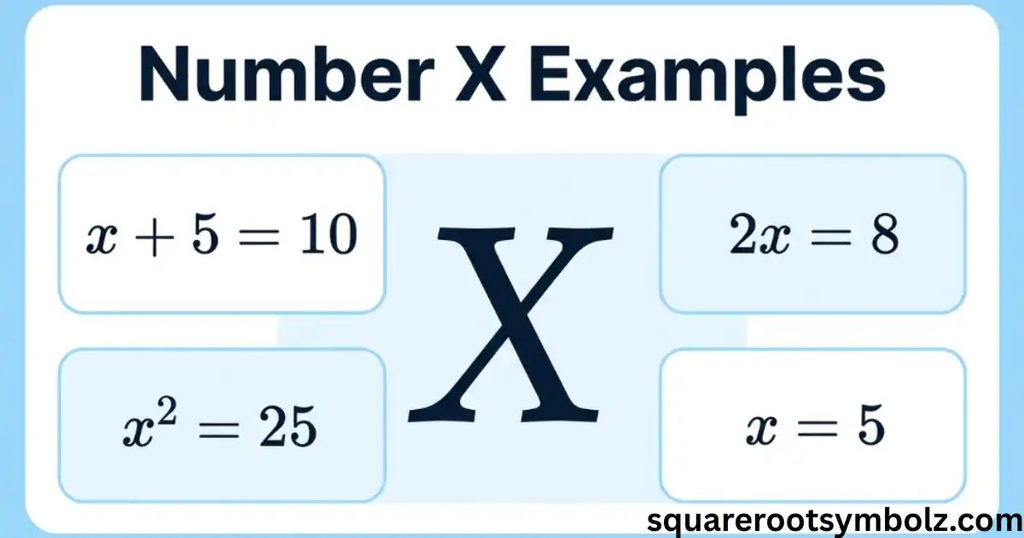
For a more advanced example, consider 3x + 6 = 21. Subtract 6 to get 3x = 15. Divide by 3, giving x = 5. Checking gives 3(5) + 6 = 21, so the solution is confirmed.
The pattern is consistent:
Read → identify x → undo operations → isolate x → check the result.
Conclusion
The phrase number x usually refers to the number represented by the variable x. In a simple equation, x may be an unknown number that you need to find. In a formula, function, graph, or real-world model, x can instead represent a changing quantity or input.
The most useful habit is to stop thinking of x as a mysterious letter. Think of it as a placeholder for a number whose meaning comes from the mathematical context. Once you understand that relationship, equations such as x + 5 = 12, 3x = 18, and 2x + 4 = 14 become much easier to read and solve.
FAQ Section
What number is x?
The value of x depends on the equation. For example, in x + 5 = 12, x = 7 because 7 + 5 = 12.
What does x mean in math?
x is commonly used as a variable or unknown number. Its exact meaning depends on the equation, formula, function, graph, or mathematical context.
Is x always an unknown number?
No. x can represent an unknown in an equation, but it can also represent a changing quantity or input in a function.
How do you find the number x?
Use the operations in the equation to isolate x. For example, x + 4 = 10 becomes x = 6 after subtracting 4 from both sides.
What does 2x mean?
2x means 2 multiplied by x. If x = 5, then 2x = 10.
What is x in x + 3 = 7?
x = 4 because 4 + 3 = 7.
What is x in 3x = 15?
x = 5. Divide both sides by 3.
Can x represent a negative number?
Yes. A variable can represent a negative number when the equation permits it. For example, x + 5 = 2 gives x = -3.
Is x a number or a variable?
In algebra, x is a variable symbol. It can represent a number, and in a particular equation it may represent one specific unknown value.
What is the difference between x and ×?
x is a letter commonly used as a variable. × is the multiplication symbol. For example, 3x means 3 multiplied by x.

I’m the creator of SquareRootSymbolz.com, where I publish easy-to-understand guides on symbols, Unicode characters, Alt codes, keyboard shortcuts, and copy-and-paste text symbols. My goal is to provide accurate, well-researched, and user-friendly content that helps readers quickly find the information they need.