Square roots are the reverse of squaring: they tell you which number multiplied by itself produces a given value. If you have struggled with radicals, perfect squares, irrational numbers, or square root equations, this guide brings the ideas together in one clear path.
After teaching and working through these problems, I have found that most confusion comes from a few small details: the radical symbol, positive and negative solutions, simplifying factors, and knowing when an answer is exact or approximate. This all about square roots guide walks through those ideas with simple examples, algebra connections, and practical uses.
What Is a Square Root?
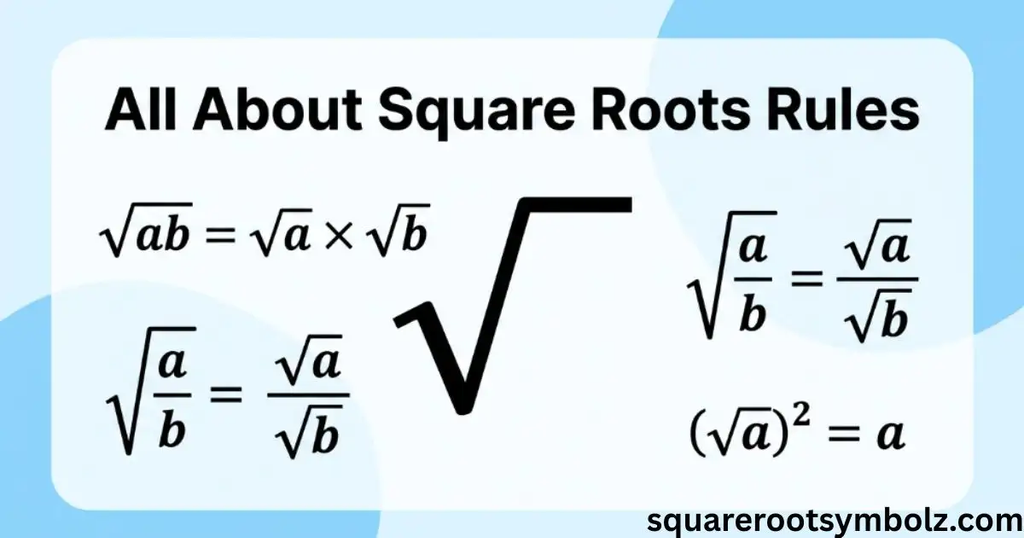
A square root is a number that produces another number when multiplied by itself. For example, 6 is a square root of 36 because 6 × 6 = 36. In the expression √36, the symbol √ is the radical sign, while 36 is the radicand.
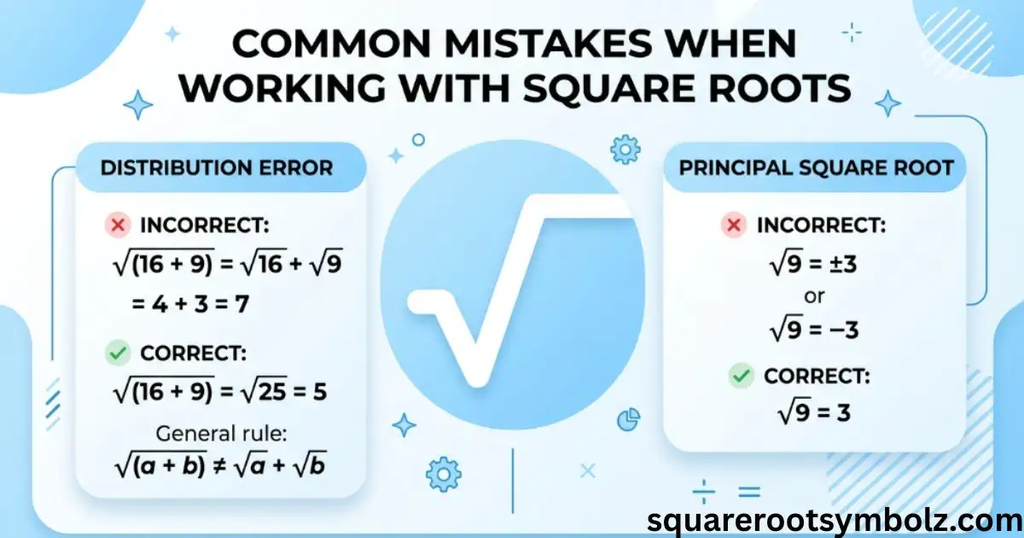
There is an important distinction between a square root and the principal square root. The equation x² = 36 has two solutions all about square roots , 6 and −6. However, √36 means the principal square root, which is 6. This small distinction prevents many algebra mistakes later.
For example:
| Expression | Answer |
| √4 | 2 |
| √9 | 3 |
| √16 | 4 |
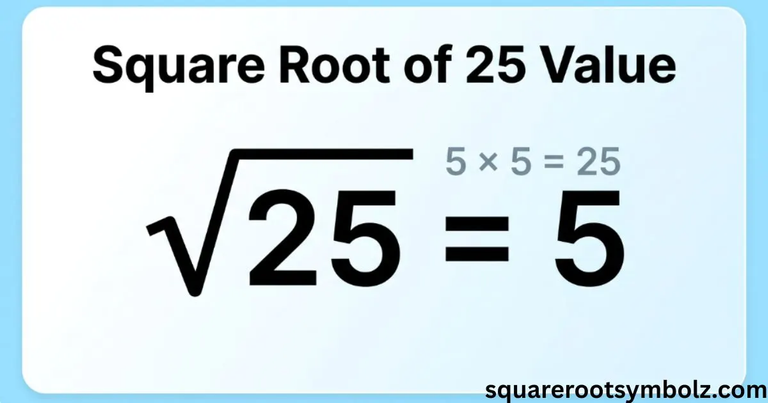
| √25 | 5 |
| √36 | 6 |
| √49 | 7 |
| √64 | 8 |
| √81 | 9 |
| √100 | 10 |
Think of square roots as working backward. Squaring asks, “What does this number produce?” A square root asks, “Which number produced this result?” That inverse relationship is why square roots appear throughout algebra, geometry, measurement, and equations.
Perfect Squares
A perfect square is a number that results from multiplying a whole number by itself. The sequence begins 1, 4, 9, 16, 25, 36, 49, 64, 81, and 100. For example, 8² = 64, so 64 is a perfect square and √64 = 8.
Perfect squares are useful because they make square root calculations exact and usually quick. Learning the common squares through at least 15² can make mental math much easier, especially when estimating a non-perfect square or simplifying a radical.
| Number | Square |
| 1 | 1 |
| 2 | 4 |
| 3 | 9 |
| 4 | 16 |
| 5 | 25 |
| 6 | 36 |
| 7 | 49 |
| 8 | 64 |
| 9 | 81 |
| 10 | 100 |
| 11 | 121 |
| 12 | 144 |
| 13 | 169 |
| 14 | 196 |
| 15 | 225 |
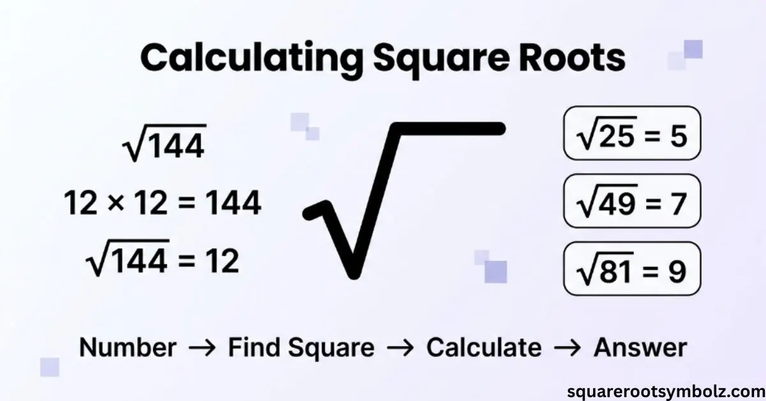
A useful memory trick is to connect each square with multiplication rather than memorizing a disconnected list. If you know that 12 × 12 = 144, then you immediately know √144 = 12. This becomes especially helpful when simplifying larger radicals.
Types of Square Roots
Square roots do not all produce the same kind of answer. Some are whole numbers, some are irrational decimals, some contain fractions or decimals, and negative radicands require a different number system.
Knowing the type first helps you decide whether to give an exact radical, a decimal approximation, or a complex-number answer. This is one of the most useful habits when working through square root problems.
1. Perfect Square Roots
A perfect square root is a whole-number result such as √36 = 6 or √225 = 15. These are the easiest roots because the number under the radical has a whole-number square root.
Perfect squares appear frequently in geometry, algebra, measurement, and standardized math questions. If you recognize them quickly, you can solve many problems without a calculator and use them as reference points for estimating harder roots.
2. Irrational Square Roots
An irrational square root cannot be written exactly as a simple fraction. Examples include √2, √3, √5, and √7. Their decimal forms continue without ending or repeating, so keeping the radical form is often more accurate.
For example, √5 is approximately 2.23607, but √5 is the exact form. In algebra, the exact radical is normally preferred until a problem specifically asks for a decimal approximation or a particular number of decimal places.all about square roots
3. Square Roots of Fractions
Fractions can also have square roots. When the numerator and denominator are perfect squares, the process is especially simple. For example, √(1/4) = 1/2 because 1 and 4 both have exact square roots.
For a fraction such as 2/3, the square root does not simplify to a whole number. You can leave it as √(2/3), rewrite it using separate radicals when appropriate, or calculate a decimal approximation depending on the problem.all about square roots
4. Square Roots of Decimals
Decimals work the same basic way. If a decimal is a perfect square, its square root may be exact. For example, √0.25 = 0.5 because 0.5 × 0.5 = 0.25.
Other decimals may produce irrational values. In that situation, a calculator gives an approximation rather than an exact answer. Keep the radical form when exactness matters, and round only when the question tells you how much precision to use.
5. Square Roots of Negative Numbers
A negative number has no real square root because squaring a real number cannot produce a negative result. For example, there is no real number whose square equals −25.
In complex-number mathematics, negative square roots can be represented using i, where i² = −1. Thus √−25 = 5i. This distinction becomes important in algebra, quadratic equations, engineering, physics, and other advanced mathematical settings.
How to Simplify Square Roots (Manually)
Simplifying a square root means looking for perfect-square factors inside the radicand and moving their square roots outside the radical. For example, √72 can be simplified because 72 contains the perfect-square factor 36.all about square roots
The basic strategy is simple: factor the radicand, identify the largest useful perfect square, separate the factors, and simplify the perfect-square portion. The goal is a clean exact expression such as 6√2 rather than an unnecessarily complicated radical.
Step 1: Find a perfect square factor
Start with the number under the radical. For √72, look for the largest perfect square that divides 72. That square is 36 because 36 × 2 = 72.
This gives us:
√72 = √(36 × 2)
The reason this helps is that √36 is an exact whole number. Recognizing perfect-square factors is the key skill behind simplifying many radical expressions.
Step 2: Break it up
Next, separate the factors under the radical:
√(36 × 2) = √36 × √2
Now the problem is easier because one radical contains a perfect square and the other contains the remaining factor.
This method can also work with expressions such as √50, √75, or √180. The important step is choosing a factorization that exposes a perfect square instead of stopping at the first factor pair you notice.all about square roots
Step 3: Simplify the perfect square
Since √36 = 6, the expression becomes:
√72 = 6√2
That is the simplified radical form. Notice that √2 stays under the radical because 2 has no perfect-square factor greater than 1.
Try the same idea with √50:
50 = 25 × 2
√50 = √25 × √2
√50 = 5√2
This approach is faster with practice because your eyes begin to recognize familiar square factors immediately.all about square roots
How to find square roots
For a perfect square, finding the root can be as simple as asking which whole number multiplied by itself produces the given value. For √81, you know that 9 × 9 = 81, so the principal square root is 9.
For a non-perfect square, first locate nearby perfect squares. Suppose you need √50. Since 49 < 50 < 64, its square root must be between 7 and 8. A calculator gives approximately 7.071.all about square roots
A useful three-step process is:
- Write the radical expression.
- Find or estimate the square root.
- Simplify or round the answer as required.
For algebraic expressions, look for perfect-square factors in both the numerical and variable parts. For example:
√(16x²) = 4x
assuming x is non-negative.
When solving an equation such as x² = 49, remember that the equation has two solutions:
x = 7 or x = −7
The radical √49 itself represents the principal square root, 7. The ± appears when solving the equation because both 7 and −7 square to 49.all about square roots
Simplify Expressions with Square Roots
Square roots become more interesting when they appear inside longer expressions. Order of operations still matters. For example, √25 + √144 is 5 + 12 = 17, while √(25 + 144) is √169 = 13.
The location of the radical symbol changes the calculation. Treat the radical as a grouping symbol and simplify what belongs inside it before performing operations outside it.all about square roots
Square roots can also appear with variables. Consider:
√(9x²)
If x is non-negative, the expression simplifies to 3x because 3x × 3x = 9x².
Another important rule is that you cannot distribute a square root across addition:
√(a + b) ≠ √a + √b
For example:
√(9 + 16) = √25 = 5
but:
√9 + √16 = 3 + 4 = 7
The expressions are different, so the answers are different.all about square roots
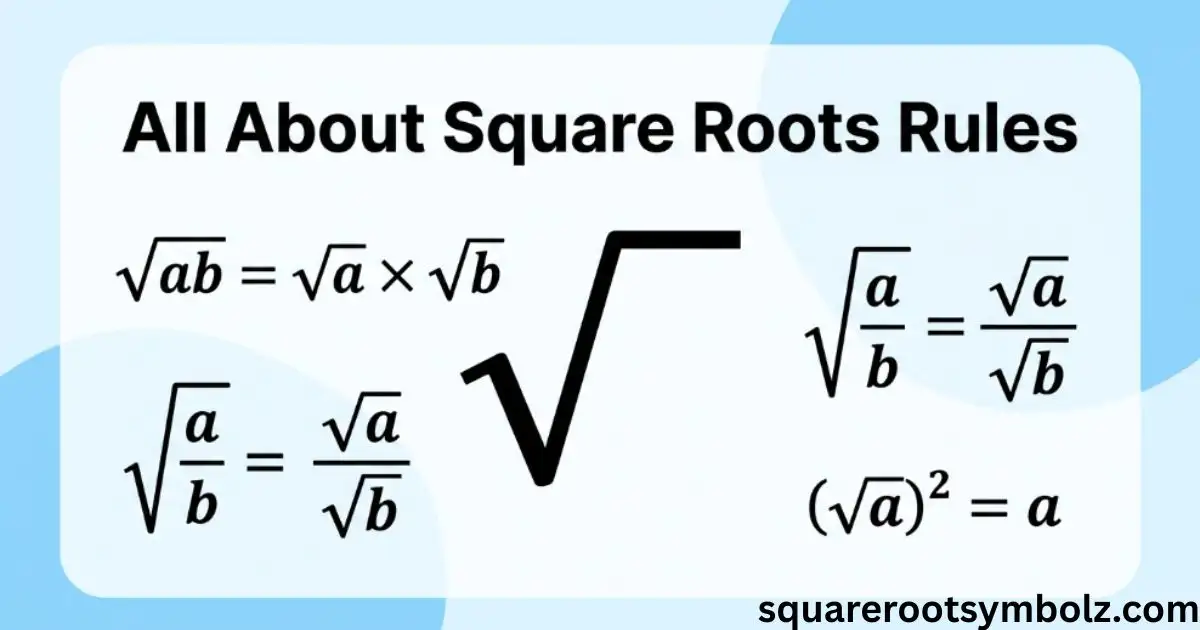
For multiplication, however, square roots can often be separated when the values are in the appropriate real-number domain:
√(ab) = √a × √b
This property is what makes radical simplification possible.
How to solve problems involving square numbers and square roots
Many word problems hide a square root inside a familiar formula. The trick is to identify what the problem gives you and what it asks you to find.
Suppose a square has an area of 144 square feet. The area formula is A = s². To find the side length, reverse the squaring operation:
s = √144 = 12
Therefore, each side is 12 feet.
The same reasoning works in equations. Suppose:
2x² = 32
First divide by 2:
x² = 16
Then take the square root:
x = ±4
Always check whether the question asks for a measurement, because a physical length cannot normally be negative, while an algebraic variable may have both positive and negative solutions.
Checking the original equation is also a powerful habit. Substitute each proposed answer back into the starting equation. If both values work, both belong in the solution set.
Applications of Square Roots in Real Life
Square roots are not limited to classroom exercises. In geometry, they help calculate unknown side lengths and diagonals. The Pythagorean Theorem is a familiar example because the hypotenuse of a right triangle can require a square root.
They also appear in physics, engineering, statistics, finance, computer graphics, and technology. Whenever a formula involves a squared quantity and you need to recover the original measurement, a square root may appear.
| Area | Example use |
| Geometry | Finding a missing side or diagonal |
| Construction | Finding dimensions from area |
| Physics | Relationships involving distance, motion, or energy |
| Engineering | Calculations involving measurements and forces |
| Statistics | Standard deviation and variability |
| Computer graphics | Distance and geometric calculations |
| Finance | Certain risk and statistical formulas |
Consider a square patio with an area of 200 square feet. The side length is √200, which is approximately 14.1 feet. The square root turns an area measurement back into a linear measurement.
This is the bigger idea behind square roots: they reverse a squared relationship. Once you see that connection, many formulas that initially look unrelated become easier to understand.
Common Mistakes When Working with Square Roots
One of the most common mistakes is confusing √25 with the solutions to x² = 25. The radical means the principal square root, so √25 = 5. The equation x² = 25 has two solutions: x = 5 and x = −5.
Another mistake is incorrectly distributing radicals across addition. Remember that √(a + b) is generally not equal to √a + √b. Students also sometimes stop simplifying too early, such as leaving √50 instead of recognizing that 50 = 25 × 2.
Rounding too early can create another problem. If you are working with √2, keep √2 in exact form as long as possible. Convert to a decimal only when necessary, then round at the final step.
Negative signs also deserve attention. There is a major difference between:
√−9
and:
−√9
The first involves the square root of a negative number and is not real. The second simply means the negative of √9, which equals −3.
Finally, always look at the wording of the question. A calculator can provide a decimal, but a math problem may expect an exact radical. Likewise, a geometry problem asking for a length normally requires a positive measurement even if the corresponding algebraic equation has two numerical solutions.
Conclusion
All about square roots becomes much easier once the subject is organized around a few core ideas: squaring and square roots are inverse operations, perfect squares have exact whole-number roots, non-perfect squares often produce irrational values, and radicals can be simplified by extracting perfect-square factors.
The most important habit is to understand what the radical means before calculating. Remember the difference between √25 and the solutions of x² = 25, keep exact radicals when appropriate, estimate using nearby perfect squares, and check algebraic answers in the original equation. With those habits, square roots become a useful mathematical tool rather than a confusing symbol.
FAQ Section
What is a square root?
A square root is a number that, when multiplied by itself, gives the original number. For example, √49 = 7 because 7 × 7 = 49.
What is a perfect square?
A perfect square is a number produced by multiplying a whole number by itself. Examples include 1, 4, 9, 16, 25, 36, and 100.
Why does a positive number have two square roots?
A positive number has two square roots because a positive and its negative produce the same square. For example, 8² = 64 and (−8)² = 64. The radical symbol √64, however, represents the principal root, 8.
How do you simplify square roots?
Factor the number under the radical and identify its largest perfect-square factor. For example, 72 = 36 × 2, so √72 = √36 × √2 = 6√2.
What is the square root of 2?
√2 is an irrational number. Its decimal value begins approximately 1.41421356 and continues without ending or repeating.
Can a negative number have a square root?
A negative number has no real square root. In the complex-number system, negative square roots can be written using i, where i² = −1. For example, √−16 = 4i.
What is the difference between a square and a square root?
Squaring multiplies a number by itself. Taking a square root reverses that process. For example, 6² = 36, while √36 = 6.
Can square roots be used in geometry?
Yes. Square roots are frequently used to find unknown lengths, diagonals, and distances. The Pythagorean Theorem is one of the best-known examples.
How do you estimate a square root without a calculator?
Find two nearby perfect squares. For √50, use 49 and 64. Because 49 < 50 < 64, √50 lies between 7 and 8.
Why should you not round a square root too early?
Early rounding can introduce errors into later calculations. Keep an exact radical such as √5 until the final step whenever the problem allows it, then round the final answer.

I’m the creator of SquareRootSymbolz.com, where I publish easy-to-understand guides on symbols, Unicode characters, Alt codes, keyboard shortcuts, and copy-and-paste text symbols. My goal is to provide accurate, well-researched, and user-friendly content that helps readers quickly find the information they need.