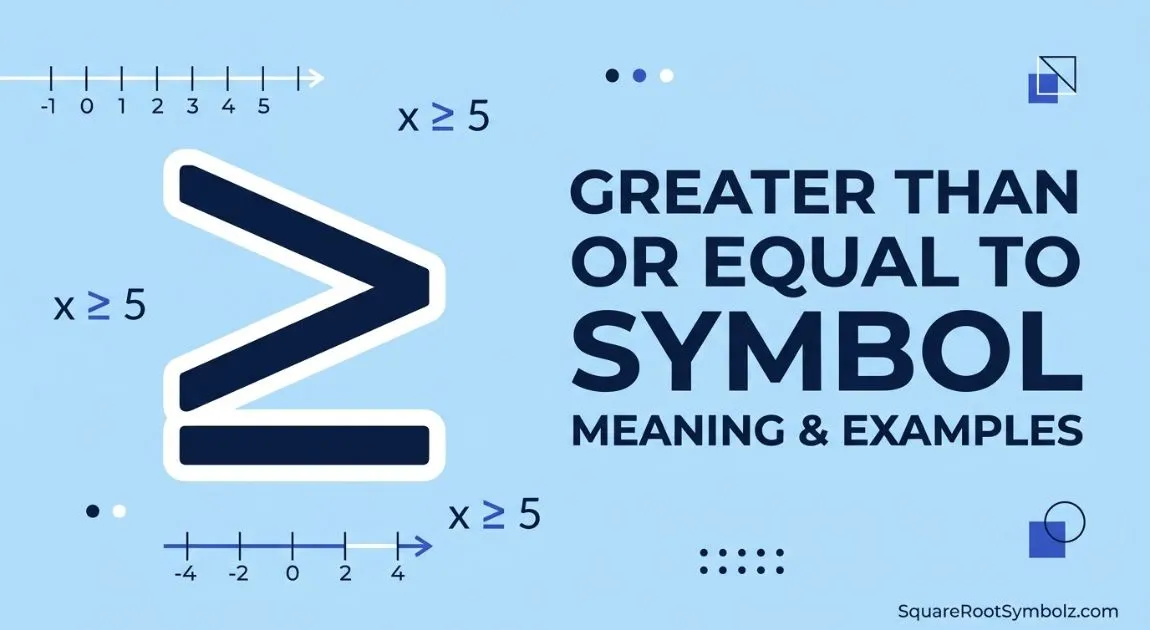
The greater than or equal to symbol (≥) is one of the most commonly used mathematical symbols for comparing two values. It indicates that the value on the left is either larger than or exactly equal to the value on the right. This symbol plays an essential role in algebra, inequalities, arithmetic, and real-world calculations where minimum or maximum limits are involved.
You’ll also find it in statistics, computer programming, and spreadsheet tools like Excel and Google Sheets for creating logical conditions and formulas. Learning how to read, write, and apply the greater than or equal to symbol makes solving equations, comparing numbers, and interpreting mathematical expressions easier and more accurate in both academic and practical situations.
What Is the Greater Than or Equal to Symbol?
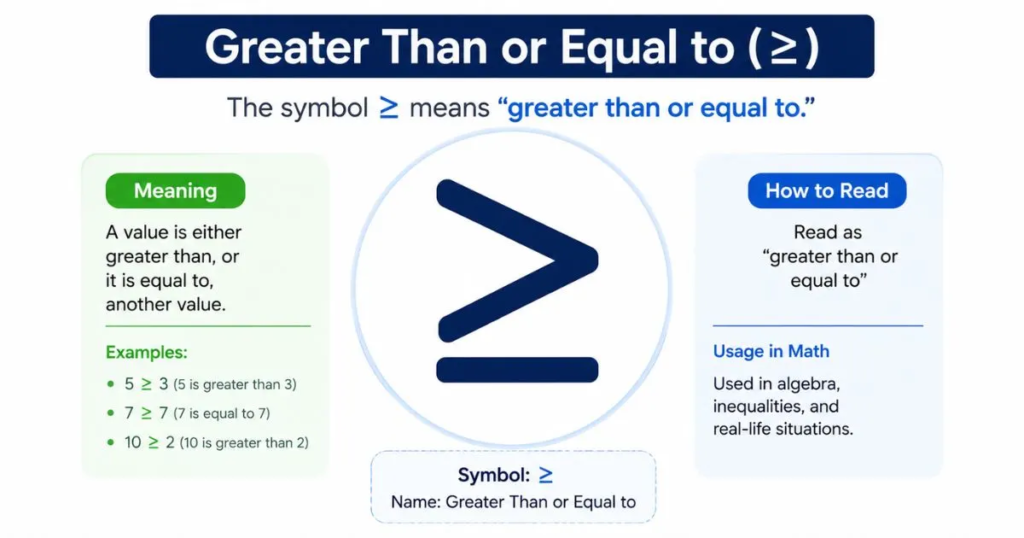
The greater than or equal to symbol combines the greater than sign (>) with the equal sign (=). It shows that the value on the left side of the symbol is either larger than or exactly equal to the value on the right side. This makes it especially useful whenever a strict “greater than” comparison is too limiting for example, when a rule allows a value to match a threshold exactly rather than only exceed it.
Symbol: ≥ Meaning: Greater than or equal to Unicode: U+2265 HTML Entity: ≥ or ≥
Examples:
- 8 ≥ 5 ✓ (8 is greater than 5)
- 6 ≥ 6 ✓ (6 is equal to 6)
- 3 ≥ 7 ✗ (3 is not greater than or equal to 7)
Notice that ≥ is satisfied in two different ways in the examples above: once because the left value is strictly larger, and once because the two values are identical. Both cases make the statement true.
Related Symbols
| Symbol | Meaning |
| > | Greater than |
| < | Less than |
| ≥ | Greater than or equal to |
| ≤ | Less than or equal to |
| = | Equal to |
| ≠ | Not equal to |
What Does Greater Than or Equal to Mean?
“Greater than or equal to” means a value satisfies either condition:
- It is larger than another value, or
- It is exactly the same as another value.
For example, x ≥ 10 means x can be 10 or any number greater than 10, such as 11, 20, or 100. It does not include values below 10, such as 9.9 or 5, since those fail both conditions.
Where the Symbol Is Used
The greater than or equal to symbol shows up across math, science, and technology wherever a value needs to be compared against a threshold. Unlike a strict inequality, it’s the natural choice any time a rule, condition, or requirement is meant to include the boundary value itself, not just values beyond it.
In Mathematics used to solve linear inequalities, plot number-line and graph regions, and define the boundaries of equations.
2x ≥ 12 → Divide both sides by 2 → Solution: x ≥ 6
In Algebra and Geometry inequalities involving ≥ describe an entire range of acceptable values rather than a single fixed answer, which is especially useful for word problems involving minimums, limits, capacities, or thresholds that a solution must satisfy.
In Statistics ≥ is used to define cutoffs and ranges within data sets, such as “scores ≥ the 90th percentile” or “response times ≥ a set benchmark,” helping analysts separate data into meaningful groups.
In Engineering and Science ≥ is used to express minimum safety tolerances, thresholds, and specification limits that a measurement or material property must meet or exceed.
In Computer Programming nearly every programming language supports the operator >= as a direct equivalent of ≥.
if(score >= 50)
The condition becomes true when the score is exactly 50 or any value higher.
In Excel
=A1>=10
Returns TRUE if the value in cell A1 is 10 or more, and FALSE otherwise.
In Google Sheets
=B2>=25
Works the same way as in Excel, returning TRUE or FALSE based on the comparison.
In SQL
WHERE Salary >= 50000
Filters database records to only those meeting or exceeding the given value.
In Python
if marks >= 60:
In JavaScript
if(age >= 18)
In each case, the underlying logic matches the mathematical symbol ≥: the condition is satisfied whenever the left-hand value is equal to or larger than the right-hand value.
Examples and Word Problems
| Statement | Meaning | True or False |
| 9 ≥ 5 | 9 is greater than 5 | True |
| 7 ≥ 7 | Equal values | True |
| 4 ≥ 9 | 4 is smaller than 9 | False |
| 20 ≥ 15 | Larger number | True |
| 12 ≥ 13 | Smaller number | False |
Example 1: A movie ticket is available for people aged 18 years or older. This can be written as Age ≥ 18. Someone who is exactly 18, or any age above that such as 25 or 40, qualifies for the ticket, while someone aged 17 does not.
Example 2: A school requires students to score 75 marks or above to pass an exam. This is written as Marks ≥ 75. Scores of 75, 80, and 95 all satisfy the condition, while a score of 74 falls short.
Example 3: A parking garage charges a flat fee for stays of 2 hours or more. Written as Time parked ≥ 2 hours, this means anyone parking for exactly 2 hours, or longer, pays the flat rate, while shorter stays are charged differently.
More Real-Life Applications
The greater than or equal to symbol appears constantly outside of textbooks, wherever a rule sets a minimum that can also be met exactly.
Speed limits: A road sign reading “Minimum speed 45 mph” can be written as Speed ≥ 45, meaning drivers must travel at 45 mph or faster.
Weight limits: An elevator rated for “up to 1000 kg” allows loads described as Weight ≤ 1000, since exceeding that limit is unsafe but reaching it exactly is fine.
Eligibility rules: A discount for customers who have spent “$100 or more” this year can be written as Spending ≥ 100, so a customer who has spent exactly $100 still qualifies.
Grading thresholds: A pass mark of “60% or higher” is written as Score ≥ 60, meaning a student scoring exactly 60% passes along with anyone scoring higher.
These situations all share the same structure as the math and programming examples above: a boundary value is included in the set of acceptable outcomes rather than excluded from it. Recognizing this pattern makes it easier to translate everyday rules and requirements into a mathematical inequality, and vice versa.
Comparing ≥ With Other Symbols
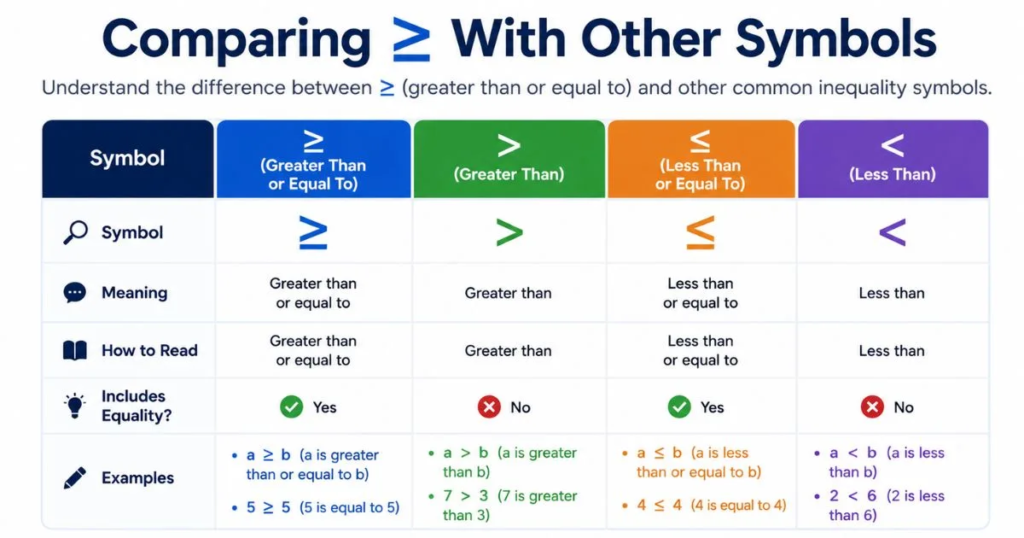
Comparison symbols make mathematical statements shorter and easier to understand than writing them out in words. Sometimes two numbers may also be equal, so instead of using only “greater than” (>) or “less than” (<), we write ≥ or ≤ to allow for that possibility.
| Symbol | Description |
| > | Greater than, strictly excludes equal values |
| < | Less than, strictly excludes equal values |
| ≥ | Greater than or equal to, includes equal values |
| ≤ | Less than or equal to, includes equal values |
Example: A jug can hold up to 4 cups of water → Water ≤ 4 cups. The jug can hold exactly 4 cups but not more.
Example: John had 10 marbles but lost some → Marbles ≤ 10. He could still have exactly 10, or any smaller number.
Combining Inequalities
You can combine two conditions into a single statement to describe a range of values:
5 ≤ x ≤ 20
This means x is between 5 and 20, including both endpoints so 5, 12, and 20 all satisfy the statement, while 4 and 21 do not. Registered Trademark Symbol is very important for trading.
Example: Becky starts with $10 and gets change back after a purchase → Money spent ≤ $10, meaning she could not have spent more than the $10 she started with.
Changing Sides
When multiplying or dividing both sides of an inequality by a negative number, the inequality sign reverses direction. This is one of the most common mistakes students make when solving inequalities, so it’s worth remembering carefully.
-2x ≥ 8 → Divide both sides by -2 and flip the sign → x ≤ -4
Worked Examples
Cutting Rope: Sam cuts a 10-meter rope into two pieces. If the longer piece is x, then the longer piece must be x ≥ 5 meters (at least half the rope), while the shorter piece is ≤ 5 meters.
Algebra: Given x > 11, find the range of x + 3. Since x is greater than 11, adding 3 to both sides of the inequality gives x + 3 > 14. The relationship between the two values stays the same because the same number was added to both sides.
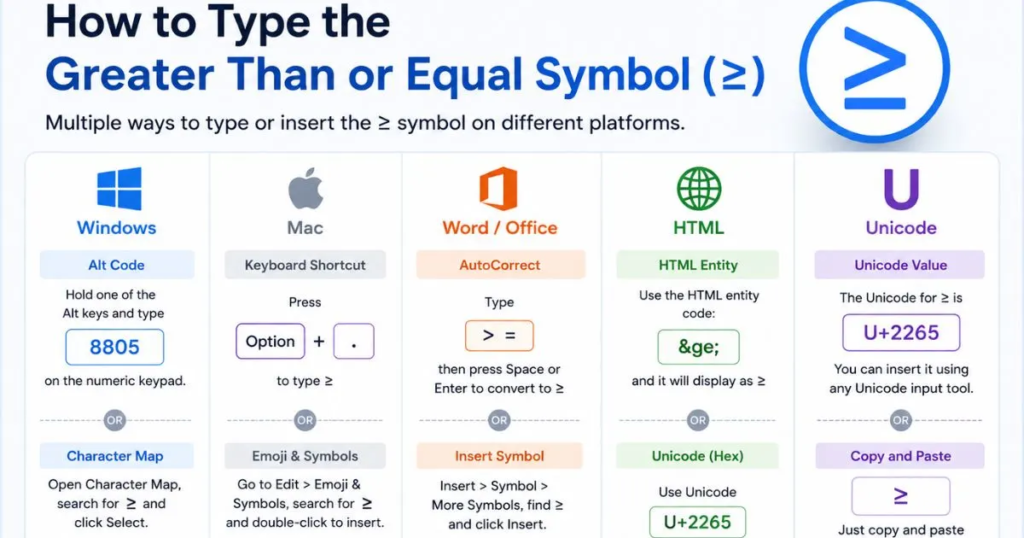
How to Type the Greater Than or Equal Symbol
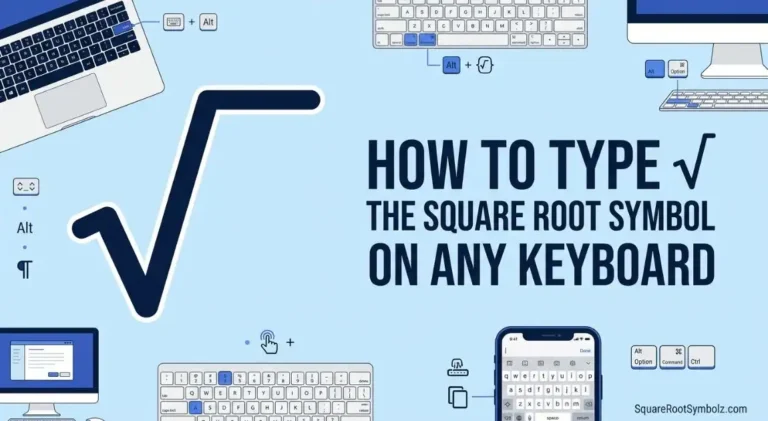
If you just need the symbol itself, you can copy and paste it directly: ≥
Different devices and platforms offer their own methods for typing it:
| Platform | Method |
| Windows | Hold Alt and type 242 on the numeric keypad, or open Character Map and search for “greater than or equal to” |
| Mac | Press Option + > , or open the Character Viewer and search for the symbol |
| HTML | Use the entity ≥ or the numeric code ≥ in your markup |
| LaTeX | Use the command \geq inside math mode |
| Microsoft Word | Go to Insert → Symbol, then locate ≥ in the symbol list, or use the AutoCorrect shortcut if enabled |
| Excel / Google Sheets | Use the plain-text operator >= directly inside formulas rather than the ≥ character |
For everyday writing and documents, copying and pasting the symbol is usually the fastest option, while the >= operator is what’s actually used in spreadsheets and code.
Practice Questions
Test your understanding with these short questions before checking the answers below.
- Is 15 ≥ 10?
- Is 8 ≥ 8?
- Is 5 ≥ 12?
- Solve for x: x + 7 ≥ 20
- Solve for x: 4x ≥ 16
Answers
- Yes — 15 is greater than 10, so the statement is true.
- Yes — 8 is equal to 8, which satisfies the “or equal to” part of the symbol.
- No — 5 is smaller than 12, so neither condition is met.
- Subtract 7 from both sides: x ≥ 13.
- Divide both sides by 4: x ≥ 4.
Conclusion
The greater than or equal to symbol (≥) is one of the most important comparison symbols in mathematics. It shows that a value is either greater than or equal to another, making it useful for solving inequalities, comparing numbers, writing algebraic expressions, and building formulas in Excel, Google Sheets, and programming languages.
Because it captures two possibilities “larger than” and “exactly equal to” in a single symbol, ≥ shows up anywhere a rule or condition needs to include a boundary value rather than exclude it, from age and score requirements in everyday word problems to filtering conditions in spreadsheets, databases, and code. Learning to read, write, type, and apply it correctly makes it much easier to work confidently with inequalities in both academic and professional settings.
FAQs
What is greater than or equal to in math?
It is an inequality symbol that shows one number is either larger than or exactly equal to another number, rather than restricting the comparison to strictly larger values.
What is the symbol for greater than or equal to?
The symbol is ≥, formed by combining the greater than sign with a line representing equality.
How do you explain greater than or equal to?
It means a value can be equal to, or greater than, another value both possibilities satisfy the statement.
What is the difference between greater than and greater than or equal to?
Greater than (>) excludes equal values and only allows strictly larger numbers, while greater than or equal to (≥) includes numbers that match exactly as well as those that are larger.
What is the difference between greater than or equal to and less than or equal to?
≥ means a value is larger than or equal to another, whereas ≤ means a value is smaller than or equal to another. They point in opposite directions but both include the equal case.
What is the difference between greater than or equal to and equal to?
The equal to (=) symbol shows that two values are identical, while ≥ allows for values that are larger as well as those that are identical.
Is 4 greater than or equal to 3?
Yes. Since 4 is larger than 3, the statement 4 ≥ 3 is true.
What is the use of greater than or equal to?
It is used to compare values in mathematics, algebra, statistics, computer programming, and spreadsheet formulas whenever a threshold allows an exact match as well as larger values.
What is the solution to 3x + 2.4 ≥ 3.0?
Subtract 2.4 from both sides to get 3x ≥ 0.6, then divide both sides by 3. The solution is x ≥ 0.2.

I’m the creator of SquareRootSymbolz.com, where I publish easy-to-understand guides on symbols, Unicode characters, Alt codes, keyboard shortcuts, and copy-and-paste text symbols. My goal is to provide accurate, well-researched, and user-friendly content that helps readers quickly find the information they need.