The fastest way to understand square root perfect squares is to remember one relationship: squaring multiplies a number by itself, while a square root works backward to find that number. For example, (6^2=36), so (\sqrt{36}=6). If you know common perfect squares, integer roots, square numbers, factors, and the radical symbol, many problems become much easier.
After teaching and working through basic radical problems, I have found that students usually struggle because they memorize answers without seeing the connection between a square, its area, and its square root. This guide builds that connection step by step, then moves into simplifying square roots, non-perfect squares, principal roots, and practical examples. The goal is simple: make the relationship feel logical rather than something you have to memorize.
Terminology
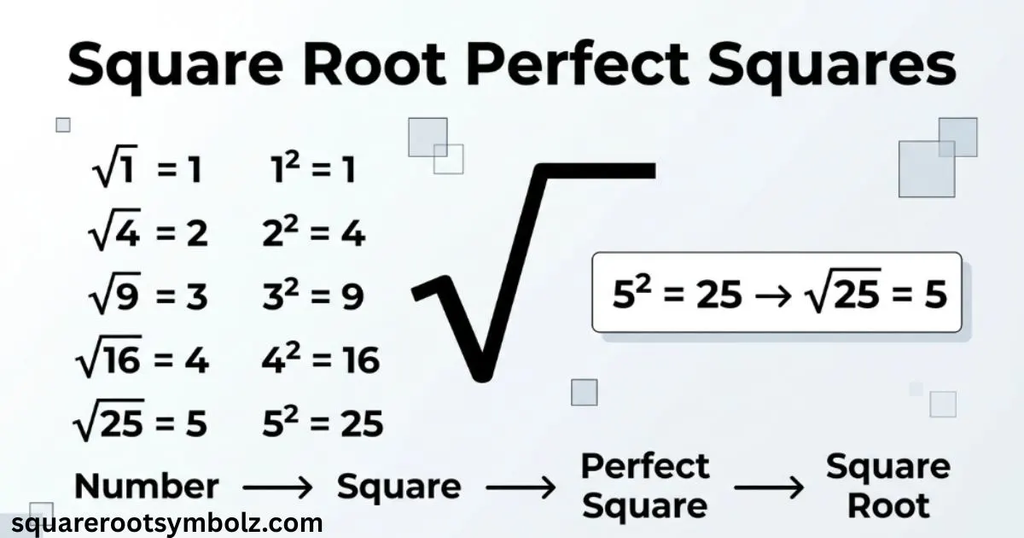
A square root is a number that produces the original number when multiplied by itself. In (\sqrt{25}), the number 25 is called the radicand, while the radical symbol (\sqrt{}) tells us to find a square root. For a square root, the index is normally understood to be 2.
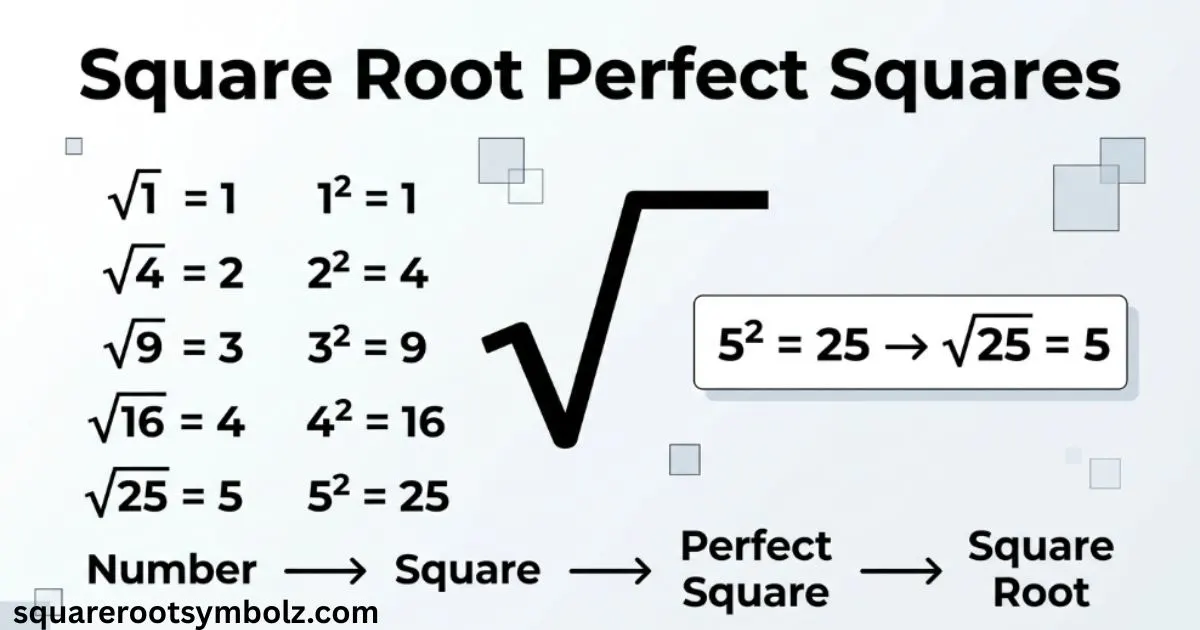
A perfect square is a number produced by squaring an integer. For example, (4=2^2), (9=3^2), (16=4^2), and (25=5^2). Therefore, their principal square roots are 2, 3, 4, and 5. A useful test is simple: if a nonnegative integer has an integer square root, it is a perfect square.
How to Square A Number
To square a number, multiply it by itself. The notation (7^2) means (7\times7), giving 49. This is the operation that creates a square number. The exponent 2 does not mean multiply by 2; it means use the base as a factor twice.
For example:
[
3^2=3\times3=9
]
[
8^2=8\times8=64
]
[
12^2=12\times12=144
]
This direction is important because finding a square root reverses it. If you know that (12^2=144), you immediately know that (\sqrt{144}=12).
Squares From 0² to 5²
The smallest square numbers provide an excellent starting reference:
| Number | Square | Square Root |
| 0 | 0 | 0 |
| 1 | 1 | 1 |
| 2 | 4 | 2 |
| 3 | 9 | 3 |
| 4 | 16 | 4 |
| 5 | 25 | 5 |
These values form the foundation for recognizing perfect squares. Once you know them, larger examples become easier to identify because many can be recognized from familiar multiplication facts. Math Is Fun similarly introduces squaring through small numbers before moving into square roots.
A useful study habit is to learn squares at least through 12:
[
1,4,9,16,25,36,49,64,81,100,121,144
]
You do not need to memorize hundreds of values. A small collection of common square numbers gives you enough reference points to solve many classroom and test questions quickly.
Finding the Square Root
To find a square root, ask: What number multiplied by itself gives the number inside the radical? For example, to solve (\sqrt{49}), look for a number whose square is 49. Since (7\times7=49), the answer is 7.
Try these:
[
\sqrt{36}=6
]
because
[
6\times6=36
]
Similarly,
[
\sqrt{81}=9
]
and
[
\sqrt{144}=12
]
These are exact answers because 36, 81, and 144 are perfect squares.
Square Roots
A square root reverses the process of squaring. If (5^2=25), then the principal square root of 25 is 5. In other words, the square tells you the result, while the root asks you to find the original number that produced it.
There is one detail that often causes confusion. Both 5 and −5 produce 25 when squared:
[
5^2=25
]
[
(-5)^2=25
]
Therefore, the equation (x^2=25) has two solutions:
[
x=\pm5
]
But the radical expression
[
\sqrt{25}=5
]
represents the principal square root, which is the nonnegative root. This distinction is essential when solving equations involving square roots.
Connection to a square
There is a beautiful geometric way to understand a square root. Imagine a square with an area of 36 square units. If you know the area but not the side length, finding the side means asking for (\sqrt{36}). The answer is 6 because (6\times6=36).
The relationship can be written as:
[
\text{Area}=s^2
]
so
[
s=\sqrt{\text{Area}}
]
For example, a square patio has an area of 225 square feet. Its side length is:
[
\sqrt{225}=15
]
So each side measures 15 feet. This is one reason square roots matter beyond classroom exercises: they can recover a length from a known square area.
Perfect Squares
The perfect squares are numbers created by squaring integers. The sequence begins:
[
0,1,4,9,16,25,36,49,64,81,100,121,144,169,196,225
]
For example:
| Integer | Perfect Square | Square Root |
| 1 | 1 | 1 |
| 2 | 4 | 2 |
| 3 | 9 | 3 |
| 4 | 16 | 4 |
| 5 | 25 | 5 |
| 6 | 36 | 6 |
| 7 | 49 | 7 |
| 8 | 64 | 8 |
| 9 | 81 | 9 |
| 10 | 100 | 10 |
| 11 | 121 | 11 |
| 12 | 144 | 12 |
| 13 | 169 | 13 |
| 14 | 196 | 14 |
| 15 | 225 | 15 |
The pattern continues indefinitely. A particularly useful shortcut is this: if the square root of a nonnegative integer is a whole number, the original number is a perfect square.
How to recognize a perfect square
Suppose you are given 196. Instead of testing many numbers randomly, recall that:
[
14^2=196
]
Therefore:
[
\sqrt{196}=14
]
and 196 is a perfect square.
Now consider 50. There is no integer whose square equals 50, so 50 is not a perfect square. Its square root is irrational and is approximately 7.071.
Simplifying Square Roots
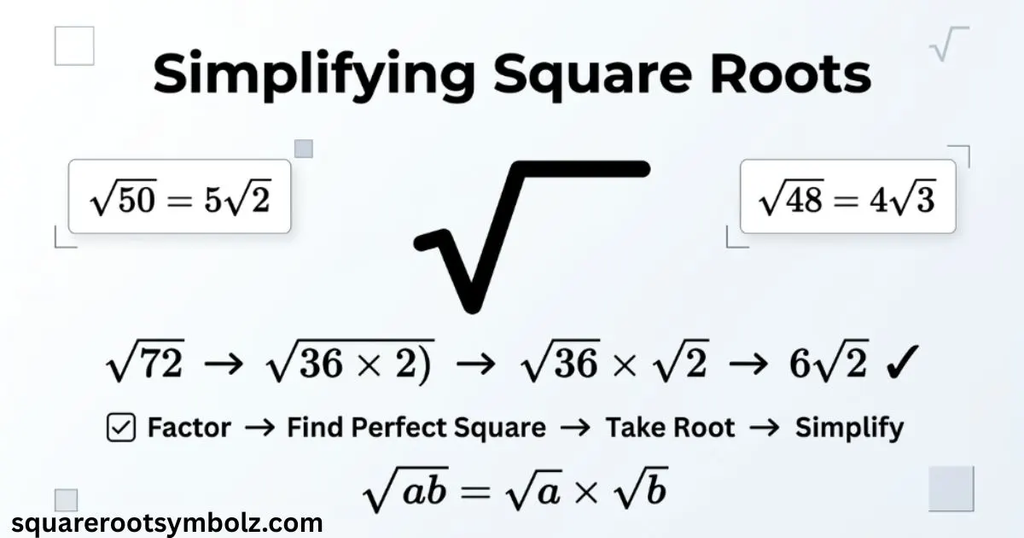
Not every radical contains a perfect square. When that happens, you can sometimes simplify the expression by separating a perfect-square factor. For example:
[
\sqrt{40}
]
Since
[
40=4\times10
]
we can write:
[
\sqrt{40}=\sqrt4\sqrt{10}=2\sqrt{10}
]
The perfect-square factor 4 leaves the radical because (\sqrt4=2). Mometrix uses the same factor-based approach when explaining how to simplify non-perfect square roots.
Consider another example:
[
\sqrt{72}
]
The largest convenient perfect-square factor is 36:
[
72=36\times2
]
Therefore:
[
\sqrt{72}=\sqrt{36}\sqrt2
]
[
\sqrt{72}=6\sqrt2
]
The key idea is to look for a perfect square factor inside the radicand. Once you find one, its square root can be moved outside the radical.
Calculating Square Roots
For a perfect square, calculating the root is straightforward. Find the integer that squares to the given number. For example, because (11^2=121),
[
\sqrt{121}=11
]
The process becomes different when the number is not a perfect square. Consider (\sqrt{10}). Since (3^2=9) and (4^2=16), the answer must lie between 3 and 4.
A calculator gives:
[
\sqrt{10}\approx3.1623
]
This is an approximation rather than an exact terminating decimal. Numbers such as (\sqrt{10}) are irrational because their decimal expansions continue without repeating in a fixed pattern.
This gives you a powerful estimation strategy:
[
3^2<10<4^2
]
Therefore:
[
3<\sqrt{10}<4
]
You can use neighboring perfect squares in the same way for much larger numbers.
The Square Root Symbol
The symbol (\sqrt{}) is called the radical symbol and is used to represent a square root. In an expression such as (\sqrt{81}), the 81 is the radicand. The radical symbol tells you to find the principal square root.
For example:
[
\sqrt{64}=8
]
because:
[
8\times8=64
]
When a different root is required, the index can be shown. For example:
[
\sqrt[3]{27}=3
]
Here the small 3 identifies a cube root. In an ordinary square root, the index 2 is normally omitted.
Conclusion
Understanding square root perfect squares becomes much easier when you see squares and roots as opposite operations. If (12^2=144), then (\sqrt{144}=12). The key is recognizing perfect squares, remembering common square numbers, and checking whether a square root is an integer.
For non-perfect squares, use nearby perfect squares to estimate the answer or factor out a perfect-square factor to simplify the radical. Once these relationships become familiar, square-root problems stop feeling like memorization and start becoming a logical process.
FAQs
What is a perfect square?
A perfect square is a number that can be written as the square of an integer. Examples include 1, 4, 9, 16, 25, 36, and 49.
How do you find the square root of a perfect square?
Find the integer that multiplied by itself produces the given number. For example, (7\times7=49), so (\sqrt{49}=7).
What are the whole number square roots from 1 to 20?
Among the numbers 1 through 20, the perfect squares are 1, 4, 9, and 16, with principal square roots 1, 2, 3, and 4.
What are numbers with integer square roots?
Numbers with integer square roots are perfect squares. For example, 64 has the integer square root 8 because (8\times8=64).
What are the first 20 perfect squares?
The first 20 positive perfect squares are:
[
1,4,9,16,25,36,49,64,81,100,
]
[
121,144,169,196,225,256,289,324,361,400
]
These correspond to (1^2) through (20^2).
What are the perfect squares from 1 to 100?
There are ten:
[
1,4,9,16,25,36,49,64,81,100
]
Each is the square of an integer from 1 through 10.
How do you determine perfect squares?
Check whether the number can be written as an integer multiplied by itself. Alternatively, find its square root. If the result is an integer, the original number is a perfect square.
Why are there no perfect squares between 144 and 169?
Because (144=12^2) and (169=13^2), and there is no whole number between 12 and 13 whose square could produce another perfect square.
Perfect Squares and Square Root Practice Questions
Question 1
Is 64 a perfect square?
Answer: Yes.
[
8^2=64
]
Therefore:
[
\sqrt{64}=8
]
Question 2
Is 75 a perfect square?
Answer: No. There is no integer whose square equals 75.
The nearest perfect squares are:
[
8^2=64
]
and
[
9^2=81
]
Therefore:
[
8<\sqrt{75}<9
]
Question 3
Find:
[
\sqrt{225}
]
Answer:
[
15^2=225
]
Therefore:
[
\sqrt{225}=15
]
Question 4
Simplify:
[
\sqrt{48}
]
Find a perfect-square factor:
[
48=16\times3
]
Therefore:
[
\sqrt{48}=\sqrt{16}\sqrt3
]
[
\boxed{4\sqrt3}
]
Question 5
A square garden has an area of 400 square feet. What is the length of each side?
Use the square-root relationship:
[
s=\sqrt{400}
]
[
s=20
]
So each side of the garden is 20 feet.

I’m the creator of SquareRootSymbolz.com, where I publish easy-to-understand guides on symbols, Unicode characters, Alt codes, keyboard shortcuts, and copy-and-paste text symbols. My goal is to provide accurate, well-researched, and user-friendly content that helps readers quickly find the information they need.