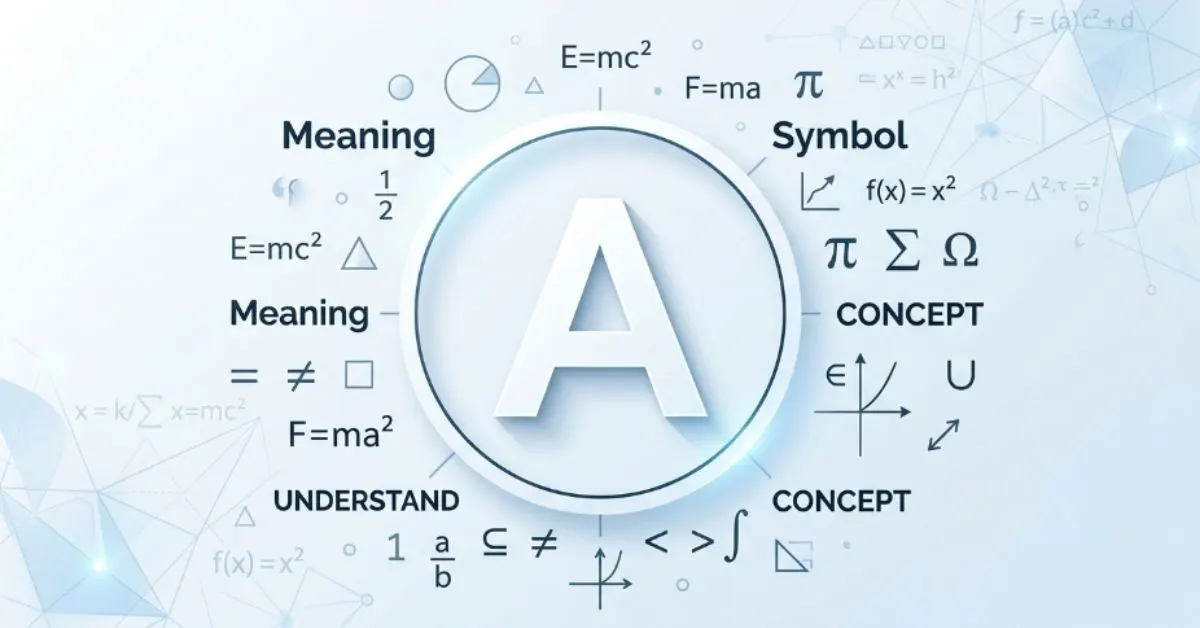
A mathematical symbol is a character, sign, or notation used to represent a number, operation, relationship, quantity, or mathematical idea. After years of studying and explaining math notation, one thing remains clear: symbols become much less intimidating once you understand the idea behind them. From an equals sign and plus sign to a square root, inequality, or mathematical expression, every mark communicates something specific.
If you have ever looked at an equation and wondered what one unfamiliar sign means, you are not alone. Mathematical notation, math symbols, variables, operations, and equations can make even a simple problem feel confusing. This guide explains how symbols work, where common signs are used, and how their meaning changes across arithmetic, algebra, geometry, set theory, and calculus.
How It Works
A mathematical symbol works by replacing a word, instruction, or relationship with a compact visual mark. Instead of writing “add five and three,” we write 5 + 3. This use of mathematical notation, operators, mathematical expressions, and equations makes information faster to read and easier to compare.
The meaning of a symbol depends on its mathematical context. A plus sign, equality symbol, or variable may appear in arithmetic and algebra, while the same visual mark can sometimes carry another meaning in computer science or advanced notation. Understanding context is therefore as important as recognizing the symbol itself.
| Symbol | Common Name | Main Meaning | Example |
| + | Plus sign | Addition | 4 + 3 = 7 |
| − | Minus sign | Subtraction | 9 − 2 = 7 |
| × | Multiplication sign | Multiply | 5 × 2 = 10 |
| ÷ | Division sign | Divide | 12 ÷ 3 = 4 |
| = | Equals sign | Exact equality | 2 + 2 = 4 |
| ≠ | Not equal to | Inequality | 5 ≠ 3 |
| < | Less than | Smaller value | 4 < 9 |
| > | Greater than | Larger value | 9 > 4 |
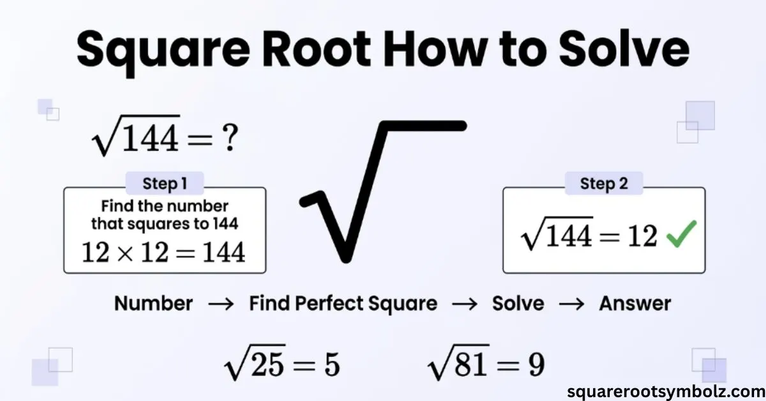
| √ | Square root | Principal root | √25 = 5 |
| ∞ | Infinity | No finite end | x → ∞ |
The Unicode Standard supports a large repertoire of mathematical characters and also emphasizes that symbols may carry different meanings in different contexts.
Basic Symbols of Maths
The most familiar mathematical symbols belong to everyday arithmetic. The plus sign, minus sign, multiplication sign, and division sign tell you what operation to perform. Other common marks show equality, comparison, percentage, powers, or the order in which parts of an expression should be evaluated.
These basic signs form the language used in elementary calculations. A mathematical symbol can shorten an entire instruction into one character, helping students read a problem quickly. Learning the difference between an operator, relation symbol, and grouping symbol creates a stronger foundation for algebra and more advanced mathematics.
| Type | Common Symbols | What They Do |
| Operations | +, −, ×, ÷ | Perform arithmetic actions |
| Equality | =, ≠ | Compare whether values are the same |
| Comparison | <, >, ≤, ≥ | Show relative size |
| Grouping | (), [], {} | Control how expressions are organized |
| Roots and powers | √, x², xⁿ | Represent roots and repeated multiplication |
| Percentage | % | Express a value per hundred |
A useful way to remember basic notation is to ask, “What is this symbol asking me to do?” The plus sign asks you to combine quantities, while an equals sign shows that two expressions have the same value. That simple habit helps turn unfamiliar math signs into understandable mathematical instructions.
Algebraic Symbols
Algebraic symbols extend basic arithmetic by representing unknown values, relationships, patterns, and general rules. Letters such as x and y often act as variables, while symbols like ≠, ≈, ≤, and ≥ describe equality, approximation, or inequality between mathematical quantities.
For example, in x + 5 = 12, the letter x represents an unknown number. The mathematical symbols surrounding it explain what must happen to solve the equation. Algebra becomes easier when you read an expression as a sentence: a variable represents something, while each operator or relation sign explains its role.
Other important algebraic notation includes exponents, absolute value, functions, factorials, and proportionality. These symbols help mathematicians describe general relationships without repeatedly writing long sentences. A small mark can therefore carry a surprisingly large amount of mathematical meaning.
Geometry Symbols
Geometry uses mathematical symbols to describe shapes, measurements, angles, lines, and spatial relationships. Common examples include the angle symbol ∠, the degree sign °, the parallel symbol ∥, and the perpendicular symbol ⟂. These signs make geometric statements shorter and visually precise.
Imagine describing a diagram entirely with words: “line AB is perpendicular to line CD and angle ABC measures ninety degrees.” Symbols simplify this into a compact mathematical statement. Geometry notation therefore connects points, lines, angles, triangles, and measurements through a shared visual language.
Symbols such as π are also important in geometry because they represent mathematical constants used in formulas involving circles. The same mathematical symbol can connect a geometric object to an equation, showing why notation is more than decoration—it is part of the reasoning process.
Set Theory Symbols
Set theory introduces symbols used to describe collections of objects and relationships between them. Common examples include ∈ for “is an element of,” ∉ for “is not an element of,” ∪ for union, ∩ for intersection, and ∅ for the empty set.
These mathematical symbols are especially useful because they describe relationships compactly. If 7 ∈ A, the statement means that 7 belongs to set A. Instead of writing several words, one set theory symbol expresses the entire relationship between an element and a collection.
Set notation also appears in algebra, probability, statistics, and advanced mathematics. Understanding symbols such as subset, superset, complement, and intersection helps readers move from individual numbers toward broader mathematical structures and relationships.
Calculus & Analysis Symbols
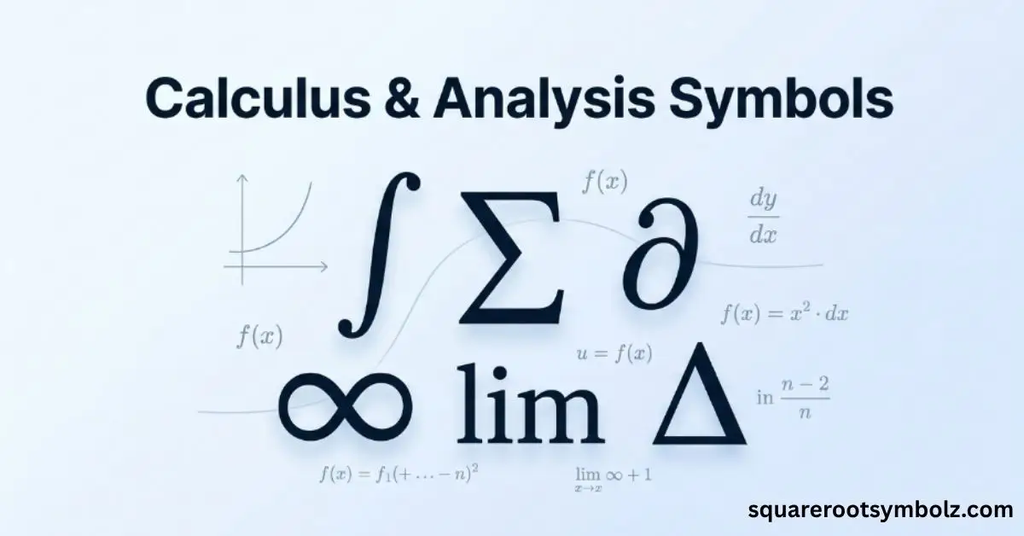
Calculus introduces mathematical symbols that describe change, accumulation, limits, and behavior. The integral sign ∫, limit notation lim, derivative notation, partial derivative ∂, and infinity symbol ∞ allow mathematicians to express ideas that would otherwise require long explanations.
For example, a derivative describes how a quantity changes, while an integral represents accumulation. The symbols themselves may look advanced, but each belongs to a clear mathematical purpose. Learning the surrounding concept first makes complex calculus notation much easier to read.
Calculus also shows why context matters. A symbol such as ∞ does not represent an ordinary number in the same way that 5 does. Instead, it describes an unbounded idea. This distinction helps prevent one of the most common mistakes in mathematical notation: assuming every symbol behaves like a simple number.
Worked Example
Consider the sentence: “Five plus three is less than ten.” To convert it into mathematical notation, replace “five” with 5, “plus” with +, “three” with 3, “is less than” with <, and “ten” with 10.
The result is 5 + 3 < 10. Now evaluate the left side: 5 + 3 = 8, so the statement becomes 8 < 10. This is true. The example shows how a mathematical symbol can translate ordinary language into a compact mathematical statement.
Try another sentence: “The product of 4 and 6 is not equal to 30.” The multiplication operation becomes 4 × 6, while “is not equal to” becomes ≠. The complete statement is 4 × 6 ≠ 30, which simplifies to 24 ≠ 30.
This process is useful far beyond school exercises. Reading mathematical language means recognizing relationships, operations, variables, and quantities. Once you learn to translate between words and mathematical notation, unfamiliar equations become much easier to understand.
Common Mistakes
One common mistake is confusing the less-than symbol < with the greater-than symbol >. A practical method is to remember that the pointed end faces the smaller value. In 3 < 7, the pointed end faces 3, while the wider opening faces 7.
Another frequent error is treating = and ≈ as identical. The equals sign expresses exact equality, while approximately equal means the values are close but not necessarily identical. For example, writing π = 3.14 is inaccurate, while π ≈ 3.14 correctly shows approximation.
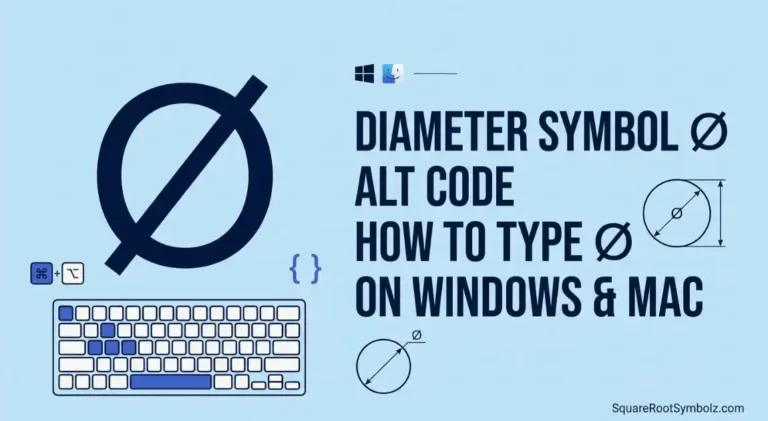
Students also confuse visually similar characters. The multiplication sign ×, the letter x, the empty-set symbol ∅, and the slashed Latin letter Ø may look related in some fonts but are different characters. The Unicode Standard specifically distinguishes similar-looking mathematical characters because their meanings can differ by context.
Another mistake is memorizing symbols without understanding their relationships. A stronger approach is to group symbols by purpose: operations, comparison, equality, grouping, sets, geometry, calculus, and logic. This creates a mental map instead of forcing you to memorize isolated marks.
A mathematical symbol is ultimately a shortcut for mathematical thought. The more you understand the concept behind the notation, the less intimidating the character becomes. Start with the common signs, learn their relationships, and then move into specialized notation as your mathematical knowledge grows.
Conclusion
A mathematical symbol is much more than a simple sign on a page. From basic operations such as addition and subtraction to advanced notation used in algebra, geometry, set theory, and calculus, each symbol helps express mathematical ideas in a clear and compact way. Learning the meaning behind common math symbols makes equations easier to read, solve, and understand.
The best way to master mathematical notation is to learn symbols by their purpose instead of memorizing them randomly. Start with basic arithmetic signs, then explore comparison symbols, variables, roots, geometric notation, and advanced mathematical operators. Once you understand the relationship between a symbol and the idea it represents, even complex mathematical expressions begin to feel much less confusing.
FAQs
What is a mathematical symbol?
A mathematical symbol is a sign, character, or notation used to represent an operation, value, relationship, quantity, or mathematical concept in a shorter and more precise form.
What are the four basic mathematical symbols?
The four basic arithmetic symbols are + for addition, − for subtraction, × for multiplication, and ÷ for division.
What does the symbol = mean in mathematics?
The equals sign = shows that two mathematical expressions have the same exact value, such as 2 + 3 = 5.
What is the difference between < and >?
The symbol < means “less than,” while > means “greater than.” The pointed end of each symbol faces the smaller value.
Is π a mathematical symbol?
Yes. π, called pi, is a mathematical symbol representing the constant ratio of a circle’s circumference to its diameter.
What does ∑ mean in mathematics?
The symbol ∑, called sigma or the summation symbol, tells you to add a sequence of values together.
Why do mathematical symbols have different meanings?
A symbol can have different meanings because mathematical notation depends on context, subject area, and the surrounding expression. The same character may be used differently in mathematics, computing, or other technical fields.

I’m the creator of SquareRootSymbolz.com, where I publish easy-to-understand guides on symbols, Unicode characters, Alt codes, keyboard shortcuts, and copy-and-paste text symbols. My goal is to provide accurate, well-researched, and user-friendly content that helps readers quickly find the information they need.